US Holds Fire Against Iran as War Spreads to the Caspian

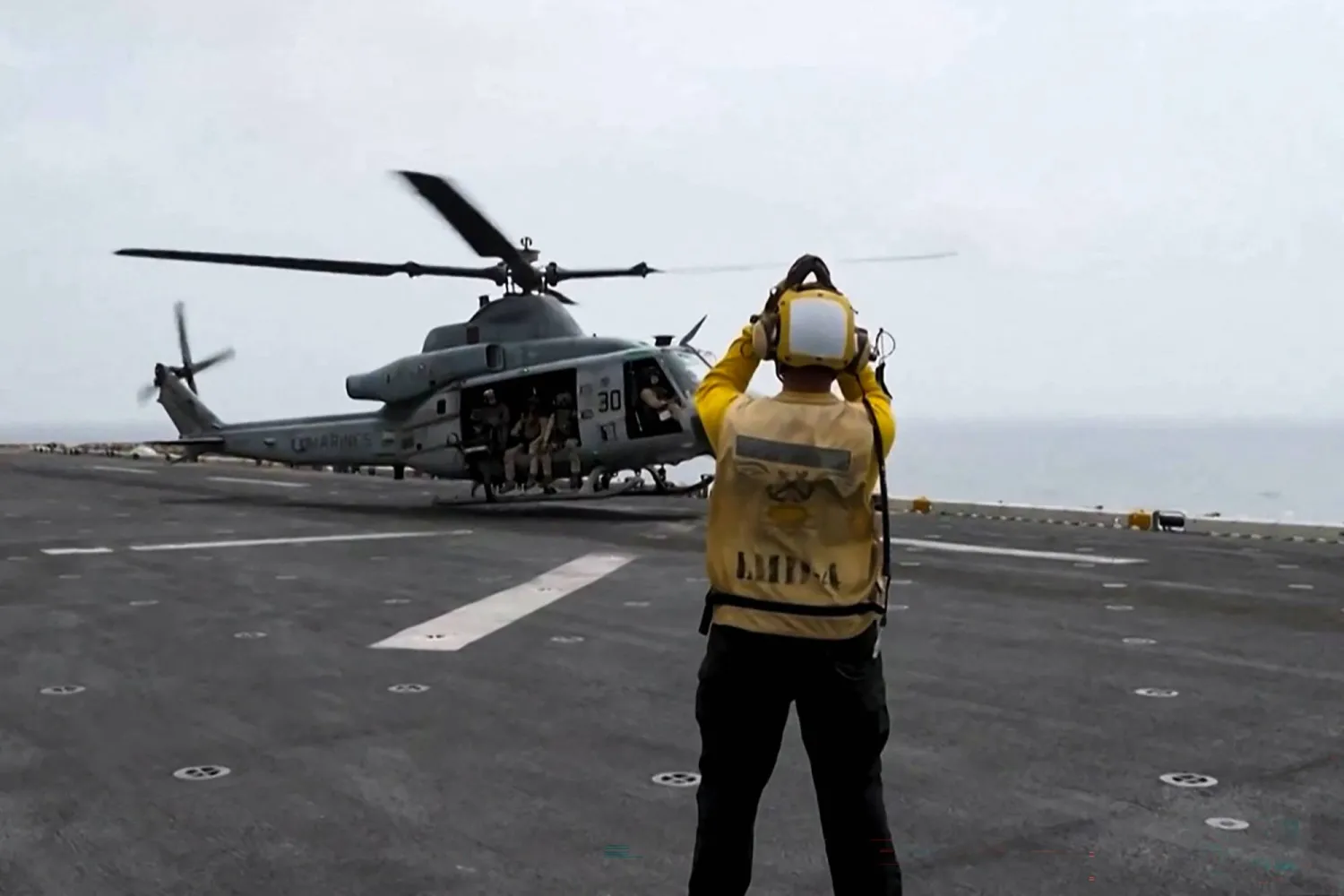
This screen grab made on July 26, 2026 from undated handout video footage released by the US Central Command (CENTCOM) on July 25, 2026 shows what CENTCOM says are operations enforcing its naval blockade against Iran. (Photo by US Central Command (CENTCOM) / AFP)
TT

US Holds Fire Against Iran as War Spreads to the Caspian

This screen grab made on July 26, 2026 from undated handout video footage released by the US Central Command (CENTCOM) on July 25, 2026 shows what CENTCOM says are operations enforcing its naval blockade against Iran. (Photo by US Central Command (CENTCOM) / AFP)

Iran passed another night without US airstrikes on Sunday, as Washington paused a war nearing its fifth month and reports emerged that concerns over dwindling munitions were restraining plans for further escalation.

The lull has revived hopes of a return to negotiations after nearly two weeks of consecutive nightly US bombardments, although US media reported the pause could also reflect pressure on stockpiles of Patriot interceptors and other defensive weapons.

Fighting over the strategic Strait of Hormuz derailed diplomatic efforts between Washington and Tehran, but the conflict then expanded beyond the vital energy corridor to include attacks on US bases, regional shipping and the Gulf.

However, US operations against Iran were "on a hold,” CNN reported, quoting an unidentified Pentagon source, even as US President Donald Trump threatened a "much higher level" of strikes on Friday.

Plans to escalate the campaign have been shelved in part because of those shrinking supplies, The New York Times reported, citing two people briefed on the matter.

Trump said on Friday he had not decided whether to return to an all-out operation.

"We're talking to them right now. I think they're getting more and more serious," he told journalists.

Trump said Iran faced a choice between a deal and strikes at a "much higher level.”

Meanwhile, Iran accused Ukraine on Saturday of attacking one of its merchant vessels in the Caspian Sea, killing a sailor and wounding another, and warned it would not leave the incident unanswered.

The accusation came after Ukrainian President Volodymyr Zelensky said Kyiv had carried out long-range strikes in the Caspian Sea against vessels involved in transporting military cargo involving Iran, underscoring the increasingly international dimensions of Russia's war in Ukraine.

Iran's foreign ministry said the attack on Saturday morning caused the ship "to explode, killing one sailor and injuring another,” according to the official IRNA news agency.

Tehran "has never intervened in the conflict between Russia and Ukraine,” it asserted.

On Saturday, Zelensky said on social media that armed forces had achieved "very strong results with long-range strikes in the Caspian Sea -- including vessels used in military cargo shipments involving Iran, as well as a warship.”

Ukraine's intelligence services (SBU), for their part, reported on Telegram that drone attacks had been carried out against "cargo vessels under international sanctions that were used to transport military cargo between Iran and Russia.”

According to Iranian state television, the foreign ministry summoned the Ukrainian charge d'affaires in Tehran on Saturday to protest this "hostile and criminal act.”

And in a conversation with the European Union's foreign policy chief Kaja Kallas, Iranian Foreign Minister Abbas Araghchi called for a "firm response" by the EU and the United Nations Security Council to this attack, IRNA added.


North Korea's Kim Returns Home after Visit to Chinese Border City

01 October 2026, North Korea, Pyongyang: FILE PHOTO - A photograph released by North Korea's official Korean Central News Agency (KCNA) on September 30, 2026, shows North Korean leader Kim Jong-un addressing a ceremony at Kim Il Sung University in Pyongyang marking the 80th anniversary of the country's top university. Photo: -/YNA/dpa
TT

North Korea's Kim Returns Home after Visit to Chinese Border City

01 October 2026, North Korea, Pyongyang: FILE PHOTO - A photograph released by North Korea's official Korean Central News Agency (KCNA) on September 30, 2026, shows North Korean leader Kim Jong-un addressing a ceremony at Kim Il Sung University in Pyongyang marking the 80th anniversary of the country's top university. Photo: -/YNA/dpa

North Korean leader Kim Jong Un returned home on Saturday after making a day-long trip to the Chinese border city of Dandong, Beijing's state media reported, though the purpose of the unannounced visit was not immediately clear and there was no mention of talks with his counterpart Xi Jinping.

Kim is thought to have crossed into China via a major border bridge that officially opened last week, 12 years after its completion, deepening economic ties between China and diplomatically isolated North Korea.

Neither North Korea nor China disclosed Kim's visit in advance. South Korean lawmaker Youn Kun-young said Kim was "understood" to have met Chinese Premier Li Qiang on Saturday.

A readout from China's Xinhua news agency did not mention talks between Kim and Xi or Li. Instead, it said Wang Huning, Beijing's top political advisor, accompanied Kim in Dandong and "saw him off" at the bridge at the end of the trip.

The aims and outcomes of Kim's visit were murky, but China is North Korea's largest trading partner and a vital source of diplomatic, economic and political support for Pyongyang.

Xinhua quoted Wang as saying the visit was significant for "consolidating public goodwill towards the friendship... (and) deepening political mutual trust and jointly pursuing cooperation and development".

He also said China and North Korea should expand personnel exchanges, economic cooperation and strategic coordination, "to foster a peaceful and stable external environment for safeguarding their respective sovereignty, security and development interests", according to Xinhua.

Wang conveyed Xi's "cordial greetings and best wishes" to the North Korean leader.

The trip fell near the date both countries use to mark the entry of Chinese troops into the Korean War. Kim attended a memorial ceremony to fallen soldiers and visited an automobile factory, Xinhua said.

China's top diplomat, Wang Yi, also took part in the events, it added.

Youn, the South Korean lawmaker, said he had been briefed on Friday that a visit was likely.

The trip could send a "positive signal" about a possible US-North Korea summit, he said in a statement sent to AFP.

World leaders are preparing for November's APEC summit in China's Shenzhen, where it has been speculated that Kim may meet US President Donald Trump.


Iran's Pezeshkian Blames US for Interim Deal Failure, Urges New Try

Iranian President Masoud Pezeshkian attends the leaders' summit of the 17th meeting of the Conference of the Parties (COP 17) to the Convention on Biological Diversity (CBD), in the Armenian capital of Yerevan on October 16, 2026. (Photo by AFP)
TT

Iran's Pezeshkian Blames US for Interim Deal Failure, Urges New Try

Iranian President Masoud Pezeshkian attends the leaders' summit of the 17th meeting of the Conference of the Parties (COP 17) to the Convention on Biological Diversity (CBD), in the Armenian capital of Yerevan on October 16, 2026. (Photo by AFP)

Iranian President Massoud Pezeshkian, in remarks broadcast on state TV on Saturday, blamed the United States for the failure of an interim deal with Iran, but said there should be a new attempt at concluding it.

"We were having negotiations, the (Americans) messed everything up...I still think we should go and conclude it," Pezeshkian said.

Washington is preparing for the possibility of a prolonged confrontation with Tehran, amid growing reports that the United States could launch fresh strikes against Iran before or after the US congressional midterm elections, despite President Donald Trump's insistence that the war could end soon.

US Ambassador to the United Nations Mike Waltz said Washington could maintain its blockade of Iranian ports for the foreseeable future and continue increasing economic pressure on Tehran, while expressing hope that Iran would return to meaningful negotiations over its nuclear program.

Trump, meanwhile, said the United States could take control of Iran and seize its oil. US Ambassador to Türkiye Tom Barrack did not rule out an American strike against Iran as early as this weekend, saying Trump had repeatedly given Tehran opportunities to reach an agreement.


Iran Reportedly in ‘Advanced Stages’ of Planning Attacks Against Americans

US national intelligence chief Jay Clayton (Reuters)
TT

Iran Reportedly in ‘Advanced Stages’ of Planning Attacks Against Americans

US national intelligence chief Jay Clayton (Reuters)

Iran has "substantially increased" its efforts to target Americans in the Middle East and beyond, US national intelligence chief Jay Clayton has warned.

The US government has put employees on heightened alert across the Middle East and moved to reduce personnel levels at embassies and consulates, officials said Friday.

"We have received intelligence that Iran has substantially increased efforts to target US personnel," Clayton said in a memo sent to Secretary of State Marco Rubio, according to a US official.

"The lethal plotting efforts by the Iranians against US citizens have reached advanced stages in both the Middle East and certain other countries," said the memo, which was first reported by Axios.

The US official said: "When it comes to our staffing at embassies, we constantly evaluate new information about the security environment."

Trump suggested on Friday that the US might launch renewed military operations against Iran.

"We may do another little Epic Fury" Trump said, referring to the US name for its attacks on Iran. He did not give any indication on timing.

The conflict began in late February with US-Israeli attacks on Iran, killing the country's supreme leader, along with senior military commanders.

The United States and Israel have drawn up plans for a new wave of strikes on Iran after the US midterm elections, though Trump has not made a final decision to carry them out, The New York Times reported on Wednesday.