


US Supreme Court Refuses to Halt $655 Million Judgment Against Palestinians over Attacks

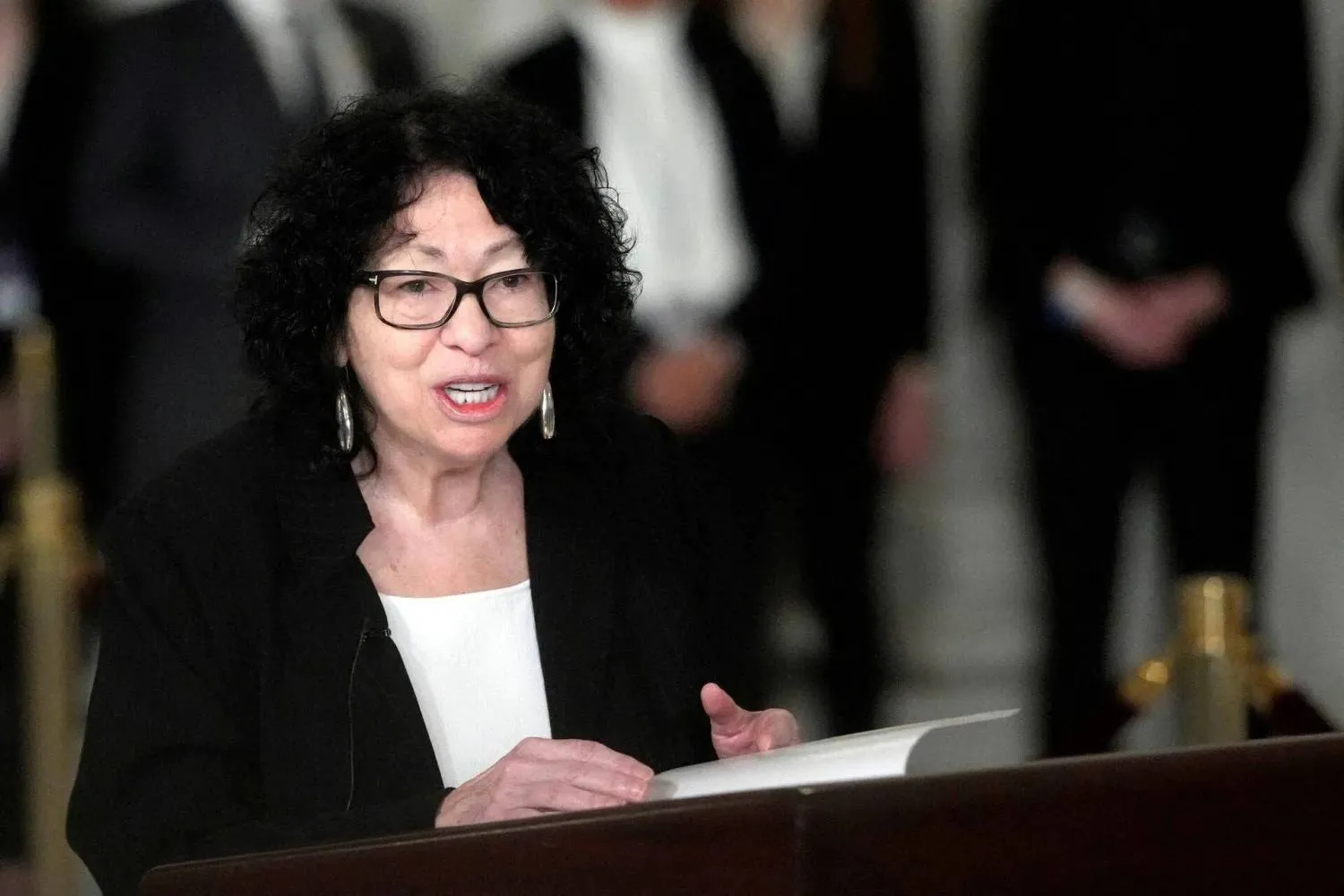
US Supreme Court Justice Sonia Sotomayor (Reuters)
TT

US Supreme Court Refuses to Halt $655 Million Judgment Against Palestinians over Attacks

US Supreme Court Justice Sonia Sotomayor (Reuters)

US Supreme Court Justice Sonia Sotomayor declined on Monday to halt $655.5 million in damages that Palestinian authorities were ordered to pay plaintiffs in a US civil lawsuit concerning attacks that killed and injured ‌Americans in Israel from 2002 to 2004.

Sotomayor denied a request by the Palestinian Authority and the Palestine Liberation Organization to put on hold the judgment while they appeal a lower court's decision to revive the case years after it had been dismissed, according to Reuters.

The lawsuit was brought on behalf of Americans killed or injured in those shootings and bombings in the Jerusalem area.

The Supreme Court last year upheld a federal law that allowed claims like those brought by the plaintiffs in the ⁠case.

Sotomayor did not explain her decision and did not refer the case to the entire court. The judge handles emergency matters for cases arising from New York and certain other states.

The Manhattan-based 2nd US Circuit Court of Appeals reinstated the judgment in March following the Supreme Court's 9-0 decision in June 2025 to uphold the 2019 law, called the Promoting Security and Justice for Victims of Terrorism Act.

The Palestinian organizations said that enforcing the judgment in the case will cause severe financial harm and destabilize government services in the West Bank, harming people who live there and jeopardizing regional security.

They said in a written filing that the plaintiffs intend to seek payment from indirect Palestinian tax revenue collected by Israel, a key source of funding for Palestinian government operations. ‌Security, ⁠sanitation and school services in the West Bank “are hanging by a thread,” they wrote.

The plaintiffs, in winning the judgment in New York federal court in 2015, alleged that the Palestinian entities were responsible for the incidents from 2002 to 2004.

The 2nd Circuit threw out that verdict in 2016 and ordered that the case be dismissed, concluding that the federal judge in the case did not have jurisdiction over the matter.

The Supreme ⁠Court declined to hear an appeal of the case in 2018.

Congress then passed the 2019 law to facilitate lawsuits against Palestinian authorities.

Under the law, the PLO and Palestinian Authority automatically “consent” to jurisdiction if they conduct certain activities in the United States or make payments to people ⁠who attack Americans.

The 2nd Circuit subsequently decided that the 2019 law violated the rights of these Palestinian authorities to due process under the US Constitution. But the Supreme Court overturned that ruling last year.

Following that Supreme Court action, the 2nd Circuit resurrected the judgment ⁠for the plaintiffs.

The Palestinian authorities urged the Supreme Court to halt the payment for now, saying the judgment had long become void and a “nullity.”

“The money judgment at issue became a legal nullity when ... appeals were exhausted in 2018,” they said.



North Korea Fires Multiple Ballistic Missiles, Adding to Streak of Weapons Tests

News coverage showing file footage of a North Korean missile launch is seen on a screen at Seoul Station in Seoul on October 12, 2026. Philip FONG / AFP
TT

North Korea Fires Multiple Ballistic Missiles, Adding to Streak of Weapons Tests

News coverage showing file footage of a North Korean missile launch is seen on a screen at Seoul Station in Seoul on October 12, 2026. Philip FONG / AFP

North Korea on Monday fired multiple ballistic missiles toward its eastern waters, South Korea’s military said, adding to a recent streak of weapons demonstrations that has heightened tensions during a prolonged freeze in diplomacy.

Jang Do-young, spokesperson of South Korea’s Joint Chiefs of Staff, said missiles of various types were fired from an area around the North Korean capital of Pyongyang, where the country’s main airport has been a major launch site in recent years.

Jang said one of the missiles flew more than 900 kilometers (559 miles) before falling into the sea but didn’t comment on the flight details of the other weapons. The joint chiefs didn’t specify how many missiles it detected.

Japan’s Deputy Defense Minister Takashi Koyari said Japan detected at least two missiles launched 17 minutes apart and that the weapons landed in waters outside of its exclusive economic zone. Koyari said the first missile flew about 220 kilometers (137 miles) and the second more than 910 kilometers (565 miles), following an “irregular” flight path that he said suggested it may have been a hypersonic weapon. There were no reports of damage to aircraft or vessels.

While maintaining a hard line toward Seoul, North Korea has been ramping up weapons testing as it seeks to expand its arsenal of nuclear-capable systems, including an Oct. 3 test of what the North described as a hypersonic intermediate-range missile designed to evade missile defenses in South Korea and Japan.

North Korea has also conducted other missile tests and live-fire drills and commissioned a new warship as leader Kim Jong Un continues to flaunt his nuclear weapons program while rejecting US and South Korean offers to resume long-stalled diplomacy.

The latest launch came days after South Korea on Friday flight-tested its own domestically developed hypersonic weapon, designed to fly at least five times the speed of sound and evade missile defense systems, which President Lee Jae Myung described as critical in strengthening the South’s conventional defense capabilities. Without directly addressing the growing threat from North Korea, Lee’s office said the hypersonic weapon, once fully developed, would enhance South Korea’s ability to strike key targets by surprise in the “Korean Peninsula theater of operations.”

Jang, the South Korean military official, said the latest North Korean launches likely were intended to advance the country’s missile technologies while also serving as a possible response to South Korea’s hypersonic test.

The South’s presidential national security office called for North Korea to “immediately cease” its repeated ballistic launches, which violate UN Security Council resolutions against the North and “do not help manage the current situation on the Korean Peninsula.” Koyari said Japan lodged a protest to North Korea through their embassies in Beijing.

Tensions were further worsened after three South Korean soldiers were injured in land mine explosions last month near the heavily armed inter-Korean border. The South’s military and the US-led United Nations Command concluded the blasts were caused by devices planted by North Korea, which has denied responsibility and ridiculed the South’s demands for an apology.

Kim in recent years has halted all diplomacy and cooperation with South Korea and described the neighbor as a permanent enemy during a prolonged stalemate in larger nuclear negotiations with Washington. He has so far rebuffed US President Donald Trump’s calls to revive their diplomacy, which broke down in 2019, with his government demanding that Washington abandon its “hostile” policy toward Pyongyang and drop demands for North Korea’s denuclearization as a precondition for talks.


Opposition, Journalists Allege Police Abuses during India Protests

(FILES) A police personnel fires tear gas shells to disperse activists and supporters of the Cockroach Janta Party (CJP) during a protest demanding the resignation of India's Education Minister Dharmendra Pradhan over alleged NEET examination irregularities in New Delhi on July 20, 2026. (Photo by Sajjad HUSSAIN / AFP)
TT

Opposition, Journalists Allege Police Abuses during India Protests

(FILES) A police personnel fires tear gas shells to disperse activists and supporters of the Cockroach Janta Party (CJP) during a protest demanding the resignation of India's Education Minister Dharmendra Pradhan over alleged NEET examination irregularities in New Delhi on July 20, 2026. (Photo by Sajjad HUSSAIN / AFP)

Opposition leaders and journalists accused police of heavy-handed tactics during weekend demonstrations, as authorities locked down New Delhi on Monday ahead of a fresh rally against the election chief.

Authorities deployed thousands of personnel across central Delhi for a third straight day, erecting heavy metal barricades and closing key metro stations before a march called by opposition leader Rahul Gandhi, reported AFP.

The protests were triggered by allegations of misconduct during a nationwide voter roll revision that critics say could benefit Prime Minister Narendra Modi's ruling Bharatiya Janata Party (BJP).

The Election Commission of India, which oversees the voting process in the world's most populous nation, has denied wrongdoing.

But attention has increasingly shifted to the police response after a chaotic weekend in which thousands of protesters, including members of the youth-led Cockroach Janta Party (CJP) movement, were detained, according to local media reports.

Most of those detained, including three top leaders of the CJP, have since been released.

Opposition figures have accused authorities of trying to suppress dissent through mass detentions.

Parliamentarian John Brittas of the Communist Party of India (Marxist) alleged he was "manhandled, dragged, assaulted" by police during Sunday's demonstrations.

"This is not merely an assault on an MP. It is an assault on democratic freedoms and the rule of law," Brittas said.

Police did not respond to questions on detentions or their actions during a news conference on Sunday.

Several journalists covering the protest said they were detained despite prominently displaying their press cards.

Reporters Without Borders (RSF) said at least 16 journalists were detained during the weekend protests, calling the actions "unacceptable".

- 'Nothing to fear' -

The capital was bracing for a fresh showdown on Monday, with Gandhi, leader of the Congress party, urging supporters to join a march to the Supreme Court.

"There is nothing to fear," he said on social media on Sunday. "These cowards can do absolutely nothing to us."

Hundreds of yellow metal barricades were set up on roads leading to central Delhi, while six major metro stations remained shut.

The leaders of the CJP, which has millions of social media followers, have pledged to continue their protests until Chief Election Commissioner Gyanesh Kumar steps down.

The protests have become one of the most significant political challenges of Modi's third term, drawing together opposition parties, student groups and activists angered by the voter roll revision.

The revision resulted in more than 133 million names being removed from electoral lists, according to media reports.

Critics say the measure has disproportionately affected minorities, particularly Muslims.

Election authorities say the move was intended to eliminate duplicate, deceased and fraudulent entries.


Iran Says Latest US Response Is ‘Insufficient’

 Iranian women hold their country's flags during a protest to condemn France's "violent crackdown on students demonstrations and human rights violations" in front of the French Embassy in Tehran, Iran, Saturday, Oct. 10, 2026. (AP)
Iranian women hold their country's flags during a protest to condemn France's "violent crackdown on students demonstrations and human rights violations" in front of the French Embassy in Tehran, Iran, Saturday, Oct. 10, 2026. (AP)
TT

Iran Says Latest US Response Is ‘Insufficient’

 Iranian women hold their country's flags during a protest to condemn France's "violent crackdown on students demonstrations and human rights violations" in front of the French Embassy in Tehran, Iran, Saturday, Oct. 10, 2026. (AP)
Iranian women hold their country's flags during a protest to condemn France's "violent crackdown on students demonstrations and human rights violations" in front of the French Embassy in Tehran, Iran, Saturday, Oct. 10, 2026. (AP)

The head of Iran’s Supreme National Security Council said on Sunday Tehran found the latest response from the United States “insufficient” as efforts at negotiations to end the war and fully open the Strait of Hormuz limp along.

The comments by Mohsen Rezaei, a former Revolutionary Guard commander, were carried by Iran’s state-run IRNA news agency.

Rezaei added that Iran is no longer responding to the US and said Washington must clarify certain issues, without giving details. He said the US has accepted some of the seven conditions but others remain unclear.

Iran’s delegation to the annual UN gathering of world leaders last month proposed a sped-up agreement that echoed the memorandum of understanding that collapsed days after the US and Iran signed it in June. The new proposal was rejected, but the two sides have remained in contact via mediation.

Rezaei also threatened “cables, data centers, AI facilities and other sites in the region” if intense fighting breaks out again.

Meanwhile, the Guard's navy warned that any ship on the strait that turns off navigation and identification systems would be “identified as hostile," according to an IRNA report.

Attacks on ships transiting the strait have increased since Iran's proposal was rejected. One attack was reported Sunday.