



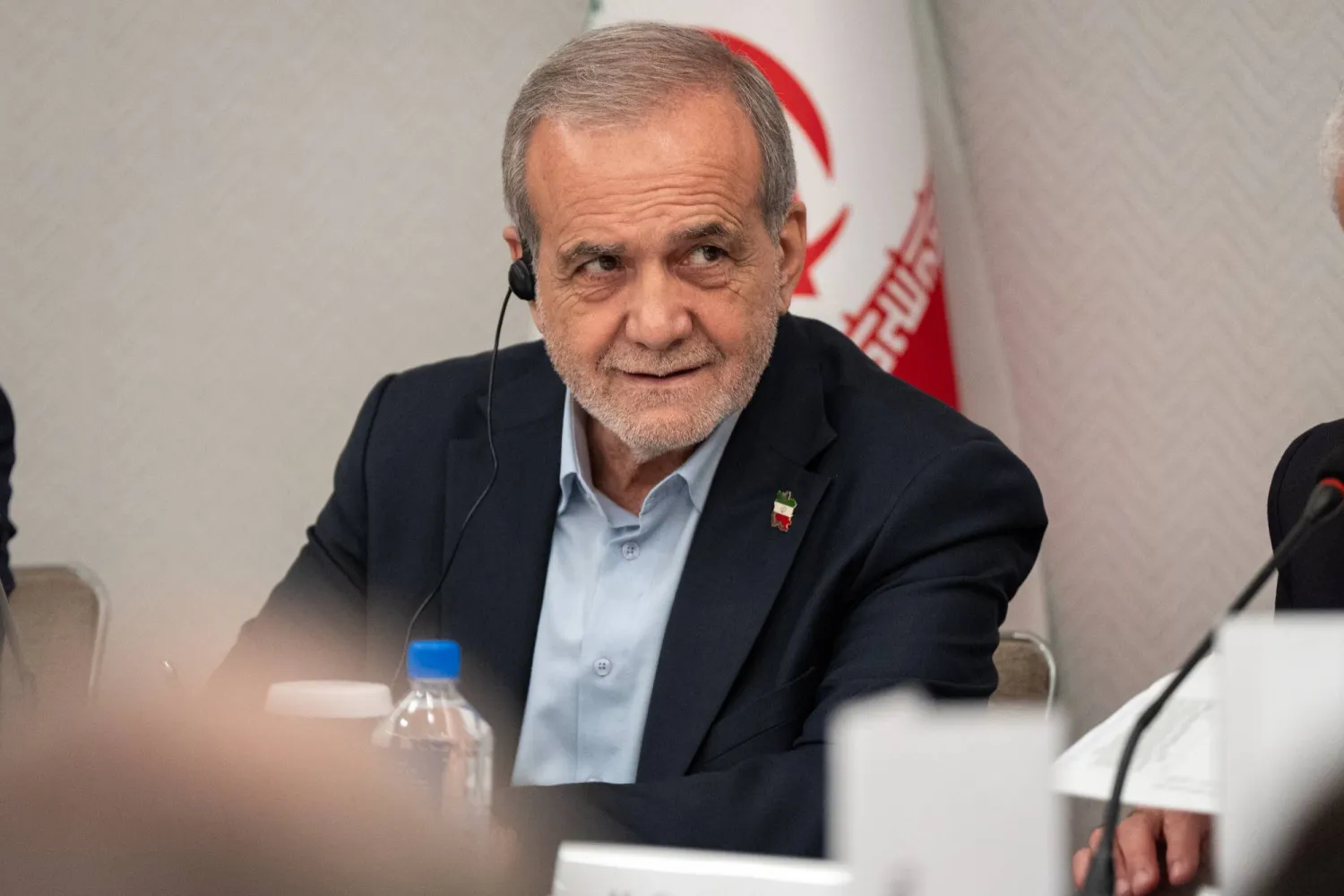

Iranian President Masoud Pezeshkian denied on Tuesday that he was intending to step down amid mounting disputes within the country’s leadership over the negotiations with the US and sharing power between state institutions, and military and security agencies as Supreme Leader Mojtaba Khamenei’s absence continues.
Marking the beginning of his third year in office, Pezeshkian made his remarks in response to a campaign aimed at weakening his government and portraying it as at odds with other state institutions.
“If I wanted to resign, I would say so openly. I will not quit, but I will go on,” he declared.
Certain parties have sought to claim that divisions exist between the president and Khamenei, to which Pezeshkian replied: “They want to create a dispute. The leadership says one thing, and they say another. However, what is in the open does not need an explanation.”
Moreover, he asserted that his government was operating in “complete coordination” with the armed forces, dismissing claims of disputes with them.
Pezeshkian said that a resignation would go against the supreme leader’s wishes and would “wrong” the military personnel who work with him. “If I threatened to step down in spite of the leadership, won’t they turn against me? I would be wronging them.”
The president made his statements in wake of a recording of Mohammad-Baqer Kharrazi, Secretary-General of “Hezbollah of Iran” and an in-law of Khamenei, claiming that the president had threatened to quit his position 28 times since he came to office in 2024.
“If Mr. Pezeshkian wanted to resign one more time, then I would agree to it,” he was quoted as saying by the Fars news agency that is affiliated with the Iranian Revolutionary Guards Corps (IRGC).
Kharrazi said Khamenei has “firmly” become involved in decision-making in Iran. “You don’t know Mojtaba. His father, the martyred leader, used to humor and flatter a bit, but Mojtaba does not at all.”
He also claimed that the supreme leader wanted to introduce changes in the Supreme National Security Council, including the dismissal of its Secretary Mohammad Bagher Zolghadr to appoint Mohsen Rezaee, an adviser to Khamenei, in his place.
Zolghadr and Rezaee are both prominent members of the IRGC whose influence grew during the war with the US and Israel after the killing of several heads of security and military agencies.


