


Iran Says Won't Reopen Hormuz Without US Meeting All Tehran's Conditions

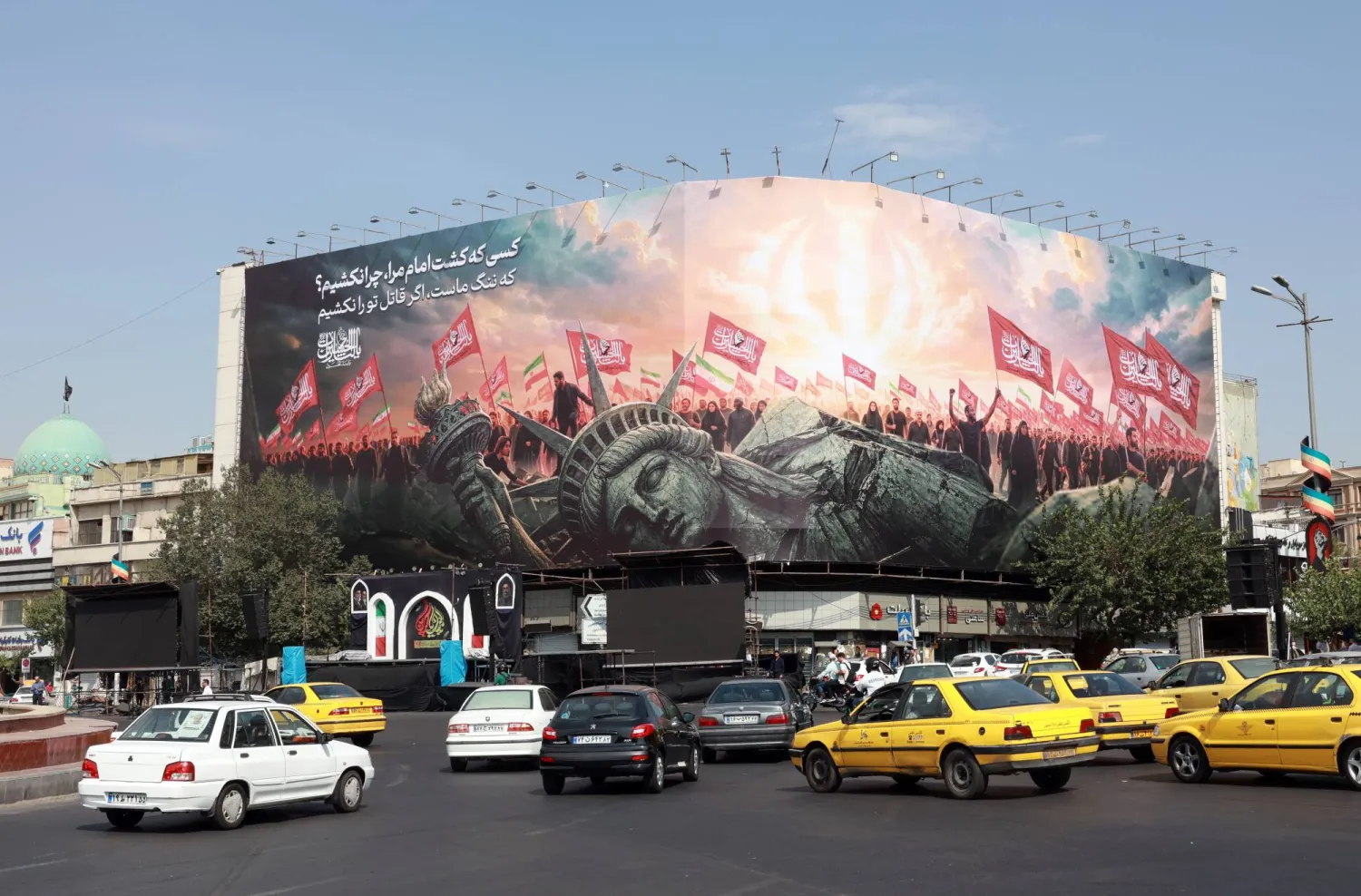
Vehicles drive past an anti-US billboard at Enghelab Square in central Tehran, Iran, 09 August 2026. EPA/ABEDIN TAHERKENAREH
TT

Iran Says Won't Reopen Hormuz Without US Meeting All Tehran's Conditions

Vehicles drive past an anti-US billboard at Enghelab Square in central Tehran, Iran, 09 August 2026. EPA/ABEDIN TAHERKENAREH

Iran's Revolutionary Guards said on Sunday they would not reopen the Strait of Hormuz until the United States met all of Tehran's conditions set out the day before, including compensation for war damages.

Iran has imposed an effective blockade of the strait since the United States and Israel attacked in late February, and wants to charge tolls for passage, striking ships it accuses of attempting to circumvent its preferred route.

Continued attacks in the waterway, which was free to transit before the war, led to the collapse of an April ceasefire. Mediators have urged both sides to return to the terms of a subsequent June memorandum that set out a path for peace talks.

Iranian Foreign Minister Abbas Araghchi said discussions with Oman over transit and management of the strait were "approaching the final stages,” but added that the reopening of Hormuz "is subject to other conditions and compensation for the violation" of the June agreement.

He denied on Sunday that Iran was negotiating with the US, saying they were merely "exchanging messages" via intermediaries.

Iran's security chief Mohammad Bagher Zolghadr on Saturday laid out a list of demands for reopening the strait, including an end to the "war and aggression against Iran and its allies in Lebanon, Palestine, Yemen and Iraq.”

He also demanded the lifting of a US counterblockade of Iranian ports, the end of sanctions, the release of frozen assets and compensation for wartime damage, according to remarks reported by the Tasnim news agency.

Iran's Revolutionary Guards on Sunday said their strategy was to maintain the closure "until the enemy accepts all our conditions... the strait is now actually a theatre of war for us and not just a waterway.”



Venezuela Says Retains ‘Sovereignty’ in US Oil Deal

An oil tanker sails off the coast of Maracaibo, Venezuela, 29 August 2026. (EPA)
TT

Venezuela Says Retains ‘Sovereignty’ in US Oil Deal

An oil tanker sails off the coast of Maracaibo, Venezuela, 29 August 2026. (EPA)

Interim leader Delcy Rodriguez assured the public Saturday that Venezuela retains control of its oil under a new agreement that allows the United States significant access to it.

The United States will have majority control of 65 billion barrels of Venezuela's proven reserves in what President Donald Trump described Friday as "the biggest oil deal in world history."

"One thing must be absolutely clear: Venezuela retains ownership and sovereignty over its resources," Rodriguez said in a speech on state television.

The agreement with the United States aims to turn "cold, inert" resources underground to "a source of social and economic well-being for the people of Venezuela," she said.

Caracas says the deal involves $100 billion in private investment aimed at revitalizing the industry in a country with the world's largest proven oil reserves.

But a lack of transparency is raising concerns among Venezuelans, including supporters of the government. A flood of social media comments decried loss of sovereignty, meager benefits and political costs.

"We don't know who this will benefit -- whether it's Venezuela or (the United States)," said Jesus Salazar, a 68-year-old security guard.

"I have my doubts, but we'll have to wait and see what happens."

Venezuela's government has operated under intense pressure from the Trump administration since American forces ousted and captured long-time ruler Nicolas Maduro in January.

Washington allowed Rodriguez, his vice president, to stay on as interim leader so long as she toes Washington's line.

Venezuela's ruling party said Saturday it supports economic measures that "prioritize national interests and make it possible to overcome the impact of more than a decade of economic sanctions, unilateral coercive measures, and unjust blockades."

The party consistently blames US sanctions for the collapse of Venezuela's economy.

- Petrol and poverty -

Rodriguez has pushed through reforms in Venezuela's mining and petroleum industries, opening once tightly controlled sectors to private capital and foreign investment.

Washington, for its part, has eased sanctions imposed on Venezuela's oil sector under the Maduro government.

Oil production rose by 29.8 percent between January and July, reaching 1.2 million barrels per day -- still well below the three million barrels per day produced a quarter of a century ago.

The US deal aims to restore production to those levels, but analysts agree it would take time.

"The increase in production won't be seen for at least three or four years," said engineer Oswaldo Felizzola, a professor at the Institute of Higher Studies in Administration (IESA) in Caracas.

He welcomed the United States acting as a "guarantor" for investments in Venezuela, which has failed to attract significant capital for more than a decade.

"Without this, these fields would not be developed over the next 10 or 15 years," because state-owned Petroleos de Venezuela (PDVSA) "does not have the financial resources to do so."

An initiative of this magnitude could accelerate long-awaited economic recovery in Venezuela, a country still reeling from the brutal 80 percent contraction between 2014 and 2021 that plunged millions of Venezuelans into poverty.

Many survive on a monthly minimum wage equivalent to $0.16, plus government subsidies that can reach $240 per month -- still far short of the estimated $730 needed to buy basic food necessities for a family of five.

- Doubt and optimism -

Carlos Baco, a 74-year-old government employee, hopes oil revenues will start flowing under the new deal, but said he hasn't felt the effects of the increase in oil production over the past few months.

"Consumer goods and food are more expensive... the dollar is rising and prices are going up," he said. "It's impossible here."

Rodriguez has promised more than $204 billion in tax revenue from the deal, without providing details.

For analyst Elias Ferrer of the Orinoco think tank, the investment is good news, even without specifics.

"It's undoubtedly better than before. Before, this oil wasn't being extracted; if no one extracts it, no one pays royalties, and no one profits from it," he said.

"If everything is done correctly... this will be a great opportunity for Venezuela to see its oil sector revived," said attorney Dolores Dobarro, Venezuela's former deputy minister of energy.


Nepal Warns of Climate Threat After Deadly Floods

A disaster rescue personnel looks on at the site of damaged buildings in the aftermath of flash floods at Trishuli Bazar in Nepal's Nuwakot district on August 29, 2026. (AFP)
TT

Nepal Warns of Climate Threat After Deadly Floods

A disaster rescue personnel looks on at the site of damaged buildings in the aftermath of flash floods at Trishuli Bazar in Nepal's Nuwakot district on August 29, 2026. (AFP)

Nepal's foreign minister warned on Saturday of the growing threat from climate change in the Himalayas, as China offered water and satellite data after devastating floods on their shared border killed hundreds.

The US Geological Survey said the disaster on Wednesday near the high-altitude China-Nepal border was caused by a glacial collapse that sent a torrent of debris downstream, with nearly 3,000 people missing and 682 confirmed dead.

While the exact cause of the collapse is unclear, climate change is causing glaciers to melt worldwide, increasing the risks of such disasters.

Foreign Minister Shisir Khanal said he had spoken by phone with his Chinese counterpart Wang Yi, agreeing to increase the sharing of "real-time hydrological data", according to a statement.

Wang, in a Chinese foreign ministry statement, said Beijing had "shared crucial information with Nepal, including disaster area imagery, satellite and hydrological data, as well as early warnings about upstream barrier lakes".

Wang added that "China and Nepal are bound by mountains and rivers, sharing a common destiny".

Khanal had earlier told reporters on Saturday that Nepal needed greater research to "understand the changing dynamics of the Himalayan ecosystem" and the risks they pose to the landlocked country, encircled by India and China.

That includes not only risks "to Nepal and the downstream community, but also to our northern neighbor, to China, as well," Khanal said.

Himalayan glaciers, which provide critical water to nearly two billion people, are melting faster as the planet heats, exposing communities to unpredictable, costly disasters.

Khanal said climate change required international action.

"We always highlight that Nepal contributes less than or just about 0.01 percent of greenhouse gases but we, the people of Nepal, are one of the major victims of the changing climate and its impact," he added.

"So we request the global community also to come together to preserve the Himalayan ecosystem."

Melting glaciers and thawing permafrost can also destabilize mountain slopes, increasing the risk of landslides and other hazards.


Türkiye Summons Ukraine Ambassador Over Black Sea Attacks

Smoke rises from a civilian vessel on fire, amid Russia's attack on Ukraine, in Odesa, Ukraine July 19, 2026. (Reuters)
TT

Türkiye Summons Ukraine Ambassador Over Black Sea Attacks

Smoke rises from a civilian vessel on fire, amid Russia's attack on Ukraine, in Odesa, Ukraine July 19, 2026. (Reuters)

Türkiye summoned Ukraine's ambassador over attacks this week in the Black Sea against a Turkish vessel, and against a second ship that came to tow the first, the country's foreign ministry said Saturday.

The attacks happened on Wednesday and Thursday, the ministry told AFP.

"During the meeting, Türkiye warned about the absolute need to ensure the safety of people, of assets, of navigation and of the environment in the Black Sea," the ministry said in a statement.

It said the Turkish container ship Lider Bordo Mavi was hit on Wednesday while it was off the Russian coast on the Black Sea. The next day, the ship Lider Kocatepe sent to tow the cargo vessel was also targeted, the ministry said.

The ministry did not say whether there were any casualties in the attacks.

According to local Turkish media, the container ship was towed to the Turkish port of Samsun.

Ankara has been calling for weeks on Ukraine and Russia to suspend their attacks on civilian vessels in the Black Sea. Each of the warring countries has been seeking to damage the other's sources of export revenues as part of their conflict, which Russia started in 2022 with its full-scale invasion of Ukraine.

Turkish commercial ships are active in the Black Sea, sailing under various countries' flags, and several have been hit by drones suspected to be launched by Ukraine.

Türkiye, a NATO member country that maintains relations with both Kyiv and Moscow, has not joined Western sanctions levelled against Russia.

On August 8, Turkish Foreign Minister Hakan Fidan called for a "moratorium" on Black Sea attacks.

"The conflict has spread across the whole Black Sea," he said at the time, complaining that "they are attacking all commercial shipping without distinction".