
Taiwan Building Drones to Repel Any Future Chinese Invasion

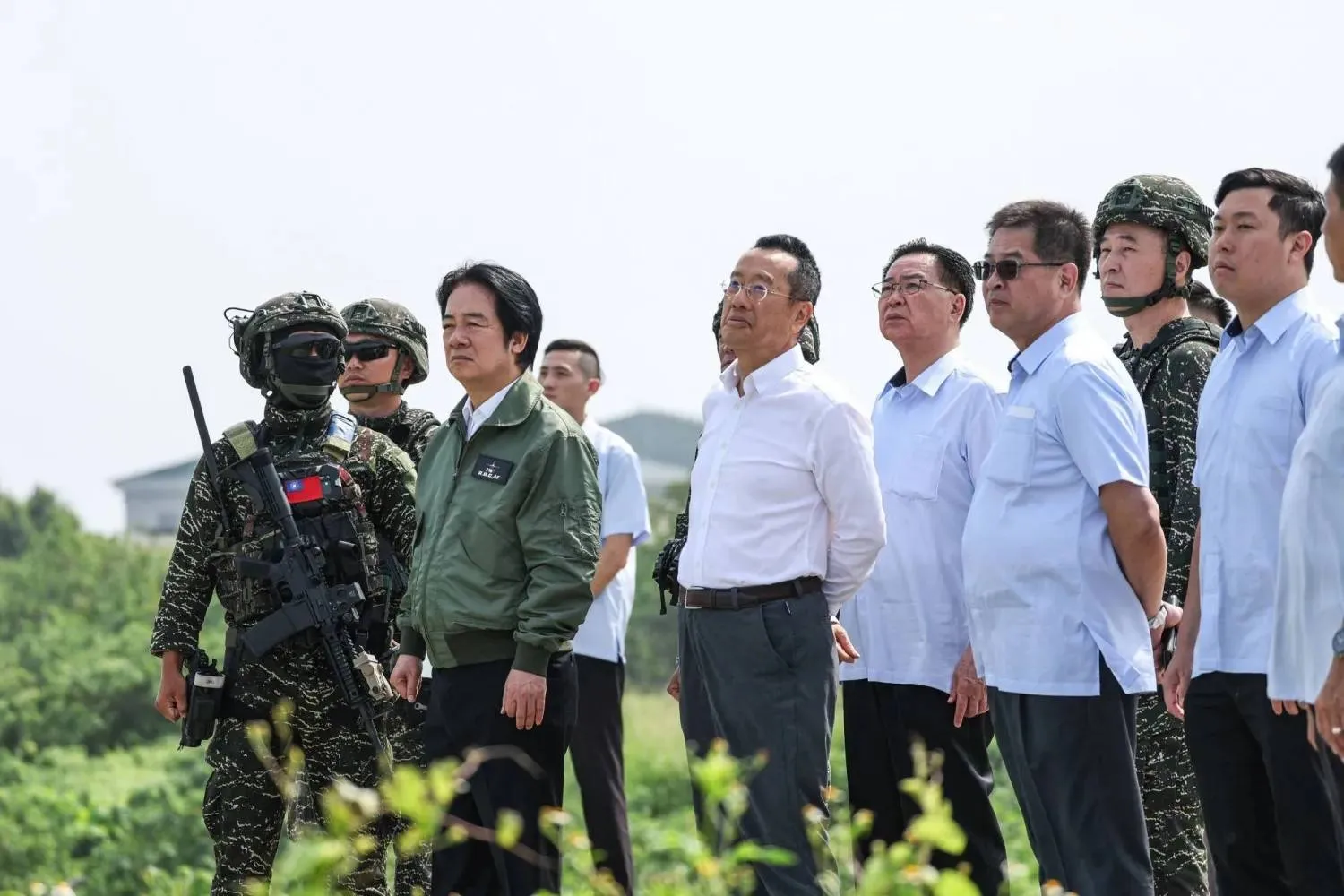
Taiwan's President Lai Ching-te (2nd-L) and Defense Minister Wellington Koo (3rd-L) inspect a drone operation at a navy base during annual Han Kuang military exercise in Kaohsiung, August 8, 2026. (AFP Photo)
TT

Taiwan Building Drones to Repel Any Future Chinese Invasion

Taiwan's President Lai Ching-te (2nd-L) and Defense Minister Wellington Koo (3rd-L) inspect a drone operation at a navy base during annual Han Kuang military exercise in Kaohsiung, August 8, 2026. (AFP Photo)

Taipei: Chris Buckley and Amy Chang Chien

To repel any future Chinese invasion, Taiwan is building fleets of flying drones and unmanned attack boats.

The goal is to use them to help locate and attack Chinese forces approaching the island, relying on Taiwanese soldiers trained to move quickly before China can strike them.

US commanders who developed this strategy call it a “hellscape”: overwhelming an invading force with waves of drones, missiles and artillery, and making an amphibious assault so risky that China’s leaders are deterred from trying.

Inspired by lessons from Ukraine and other recent war zones, Taiwan is now accelerating efforts to put that strategy into practice.

“Our drone and counter-drone efforts started relatively late, and initially we were trying things out as we went along,” Lt General Huang Wen-chi, the director general of strategic planning for the Taiwanese Defense Ministry, told a committee of lawmakers on Wednesday. That has begun to change over the past two years, he added.

On Thursday, Taiwan’s military allowed reporters to watch as troops in central Taiwan practiced using drones for reconnaissance, as part of the island’s annual Han Kuang military exercises, which began on Wednesday and will run for 10 days.

Major General Lu Wen-yuan, who helped plan the exercises, said earlier that they would also train troops to take out enemy drones.

Many militaries across the world are embracing the drone revolution, but Taiwan faces a particularly urgent threat: China, which is roughly 110 miles away, claims the self-governed island as its territory.

Chinese leaders say they want to absorb Taiwan peacefully but will not rule out using force. They are backing that threat with expanding fleets of warships, planes, missiles and drones, as well as more frequent coast guard patrols and landing exercises.

Taiwanese officials have noted Ukraine’s drone-driven gains on the battelfield, and they are trying to emulate Ukraine’s David-versus-Goliath approach: using relatively cheap and nimble drones to level the playing field against a much larger adversary.

“Drones are entering a new chapter,” said Max Lo, the chairman of the Taiwan National Drone Industry Association. “Taiwan, for its own survival and national defense, is in urgent need of these drones. But it’s the same everywhere in the world right now — that’s an opportunity for Taiwan.”

Aiming to make the island a drone industry superpower, the government says it wants Taiwan to make 100,000 drones a month by 2030, with around half exported. It also wants the military to acquire over 210,000 flying and seaborne drones.

Taiwan has “realized that drones will be important in all the domains, in all the phases,” in a potential war with China, said Mick Ryan, a retired Australian major general who has studied Ukraine and Taiwan.

Ukraine’s recent success at longer-range drone strikes suggests that Taiwan could also attack ships leaving Chinese ports if Beijing launched an amphibious assault, said Ryan, now a senior fellow at the Lowy Institute in Sydney.

China’s army is not yet strong enough to easily invade Taiwan, many experts believe, and recent purges in the People’s Liberation Army’s high command have undermined its readiness.

But like Taiwan’s military, it has been building up fleets of crewless planes and boats, and is investing heavily in technology to detect and jam drones.

“Remember, the Chinese are also watching everything the Ukrainians are doing,” Ryan added.

A Long Road to Mastering Drones

For Taiwan, acquiring the drones may be the straightforward part. To master drone warfare, Taiwan must also retool its military organization, training and doctrine.

It must learn to operate swarms of drones, rapidly assess and share the intelligence they provide and prevent an enemy from disabling them, according to experts. This will require troops to be more mobile and self-sustaining.

“The army’s frontline military operations must undergo a total change from the past,” said Shu Hsiao-Huang, an associate research fellow at the Institute for National Defense and Security Research in Taipei, which is supported by Taiwan’s Defense Ministry.

“In the Russia-Ukraine War, if you fire one round, you won’t have a chance to fire a second, if you just stay lined up there without moving on,” he said.

Unlike Ukraine, though, Taiwan lacks the pressure of an actual invasion to mobilize resources and force changes. “It’s very difficult, because they haven’t experienced the crucible of war,” Shu said.

But military units have been working to learn drone tactics, which are a focus of the continuing Han Kuang exercises.

The Taiwanese army also released pictures from a drill last month in which a unit scrambled to defend islands off Taiwan’s east coast by using drones to hunt for enemy forces.

On Saturday, Taiwan’s president, Lai Ching-te, watched an exercise in the island’s south where troops tested two types of prototype drones designed to strike invading forces.

Taiwan also recently created a Littoral Combat Command, integrating drones, mobile missiles and artillery into a coastal shield against potential Chinese invasion.

Still, Taiwan is a long way from meeting the complex demands of 21st-century warfare, many experts said.

It risks becoming “focused on the technology more than the equally essential organizational and doctrinal changes that are needed to implement a hellscape concept,” said Stacie Pettyjohn, a senior fellow at the Center for a New American Security and an author of a recent study of Taiwan’s drone warfare strategy.

Building an Indispensable Drone Industry

In the event of an invasion, China is likely to try to seal off Taiwan from external support. To survive a blockade, Taiwan needs to build stockpiles and expand homegrown drone production, especially “cheaper, shorter-range one-way attack drones,” Pettyjohn said.

Both sides of Taiwan’s polarized political landscape agree on building more drones, even if they disagree on the details.

Taiwan’s government has proposed spending $6.5 billion over five years to buy drones. But two opposition parties that hold the majority in its legislature rejected the plan, arguing that it could attract graft and create waste. The main opposition Nationalist Party has proposed spending $7.4 billion over six years, with requirements for growing levels of domestic production.

As lawmakers debate spending, Taiwanese and US drone makers are competing for potential orders.

Thunder Tiger, a Taiwanese manufacturer, and Shield AI, an American defense technology company, last month staged a trial run for two models of sea drones that could scout for enemy vessels and blow them up. But Chen Kwan-ju, the chairman of Thunder Tiger, said the company is seeking more policy certainty before it expands production partnerships.

At the same time, Taiwan is rapidly increasing its rate of drone exports, seeking to make itself an indispensable supplier of components for other democratic states that want to reduce their reliance on Chinese parts, which raise concerns about supply disruptions, or espionage.

In the first three months of 2026, Taiwan exported drones worth $115 million, exceeding its total drone exports for all of 2025, according to the island’s Ministry of Economic Affairs. The top destination is the Czech Republic, though many of the drones find their way to nearby Ukraine, research shows.

Taiwan’s exports of drone components are probably even higher. Demand for these parts, such as motors and optical equipment, is likely to grow, according to representatives of US drone companies.

“Taiwan sits at the center of one of the most important industrial and strategic competitions of our time,” Michael Robbins, the president of the Association for Uncrewed Vehicle Systems International, wrote in an email. “It is one of the few places positioned to produce trusted drone components at scale.”

The New York Times


North Korea Rejects Call to Halt Nuclear Tests

North Korean leader Kim Jong Un visits the country's nuclear material production base and nuclear weapons institute, at an undisclosed location in North Korea, in this photo released by North Korea's official Korean Central News Agency on January 29, 2025. KCNA via REUTERS/File Photo
TT

North Korea Rejects Call to Halt Nuclear Tests

North Korean leader Kim Jong Un visits the country's nuclear material production base and nuclear weapons institute, at an undisclosed location in North Korea, in this photo released by North Korea's official Korean Central News Agency on January 29, 2025. KCNA via REUTERS/File Photo

North Korea's foreign ministry on Thursday rejected an international statement urging it to halt nuclear tests, with a spokesperson calling it "a grave political provocation against our state" by "hostile forces".

A meeting of ministers from the Friends of the Comprehensive Nuclear-Test-Ban Treaty — a grouping of Australia, Canada, Finland, Germany, Japan and the Netherlands — said any new nuclear test by North Korea would be irresponsible and unacceptable.

The meeting in New York on Tuesday urged Pyongyang to fully comply with all relevant United Nations Security Council resolutions.

The spokesperson for North Korea's foreign ministry described the country as a responsible nuclear-armed state, in a statement carried by state media KCNA, Reuters reported.

In another statement carried by KCNA earlier in the day, North Korea's foreign minister Choe Son Hui said Pyongyang's nuclear weapons status is irreversible.

Choe was responding to a separate meeting on the sidelines of the United Nations General Assembly this week between the United States, South Korea and Japan at which they reaffirmed their commitment to the complete denuclearisation of North Korea.

The Comprehensive Nuclear-Test-Ban Treaty, agreed in 1996, bans "any nuclear weapon test explosion or any other nuclear explosion" anywhere in the world, with the goal of reducing and ultimately eliminating nuclear weapons.


Russian Strikes Kill 8 in Ukraine, Damage Maternity Clinic

A woman walks in front of a house destroyed in a Russian strike on a residential neighbourhood in Kyiv, Ukraine, Thursday, Sept. 24, 2026. (AP Photo/Evgeniy Maloletka)
TT

Russian Strikes Kill 8 in Ukraine, Damage Maternity Clinic

A woman walks in front of a house destroyed in a Russian strike on a residential neighbourhood in Kyiv, Ukraine, Thursday, Sept. 24, 2026. (AP Photo/Evgeniy Maloletka)

Russian drone and missile strikes on Ukraine's capital Kyiv and its northeast killed eight people on Thursday in attacks that included a maternity hospital and a farm, officials said.

Moscow has stepped up its air war in recent months, deploying more of its faster and harder-to-stop drones while Ukraine is short of interceptors to down ballistic missiles.

Two people died in the latest assault on Kyiv, according to President Volodymyr Zelenskiy, who was in New York for the UN General Assembly.

"As people were sleeping, flashes from explosions ⁠lit up the sky," ⁠Zelenskiy said on Telegram.

"Once again, the main targets of their strike were Kyiv and civilian infrastructure, residential buildings, a maternity hospital, energy infrastructure, and logistics."

Police said nine homes, a post office, warehouses and dozens of cars were also damaged in Kyiv.

A separate Russian attack on a vegetable storage facility at a farm in a village of the northeastern Kharkiv region killed six people and injured a further ⁠12, prosecutors said.

The overnight barrage around Ukraine included an unspecified number of hypersonic and ballistic missiles, 282 drones and other weapons, Ukraine's air force said.

In Kyiv, eight people were injured as well as the two fatalities, one of whom was in the parking lot of the maternity hospital, Reuters quoted city mayor Vitali Klitschko as saying.

Part of the hospital's facade, windows and doors were damaged, officials said, adding that no patients or medics were injured.

A handout photo made available by the State Emergency Service (SES) shows Ukrainian rescuers working at the site of an overnight Russian attack on a residential area in Kyiv, Ukraine, 24 September 2026, amid the Russian invasion. EPA/STATE EMERGENCY SERVICE / HANDOUT

Authorities in the northwestern region of Rivne said infrastructure was damaged in overnight strikes that continued into Thursday morning, without providing further details. Volyn region bordering Poland also came under attack.

Insufficient pressure on Moscow ⁠was allowing ⁠it to launch repeated strikes, said Zelenskiy.

"Right now, the United States has the opportunity to respond strongly," he said. "We need ballistic interceptors to protect lives."

Russia's defense ministry said its forces hit Ukrainian defense facilities, logistics and telecoms centers, as well as vessels used by the military.

In the Black Sea port of Odesa, military administration head Serhiy Lysak said overnight Russian strikes damaged a medical facility and shattered windows in nearby houses and a school.

Moldova's President Maia Sandu said four Russian drones crossed into its airspace and at least one exploded, while Romania said a drone also crashed in its territory.

NATO alliance member Poland said it deployed aviation twice on Thursday due to Russian attacks on Ukraine.


Quake Rattles Southeastern Türkiye

Image of earthquake monitoring (Reuters)
TT

Quake Rattles Southeastern Türkiye

Image of earthquake monitoring (Reuters)

An earthquake of 5.4 magnitude rattled cities in southeastern Türkiye on Thursday but there were no immediate reports of damage or injuries, the disaster agency said.

The quake, which occurred at 10:40 am (0740 GMT) was centered just north of the city of Sanliurfa, Türkiye's AFAD disaster agency said, adding "there are currently no reports of adverse effects".

Hasan Silda, governor of Sanliurfa province, said the quake had been felt "intensely", AFP reported.

"According to initial reports, there are no casualties or injuries. There is no destruction. There may be some partial damage to buildings," he told NTV private television.

Türkiye is crisscrossed by several geological fault lines that have previously caused catastrophes in the country.

A massive quake in February 2023 killed at least 53,000 people in southeastern Türkiye and around 7,000 others in Syria, that also caused damage and more than 300 deaths in Sanliurfa.