


Tropical Storm Hits Tokyo Area, Leaving Thousands without Power Before Moving West

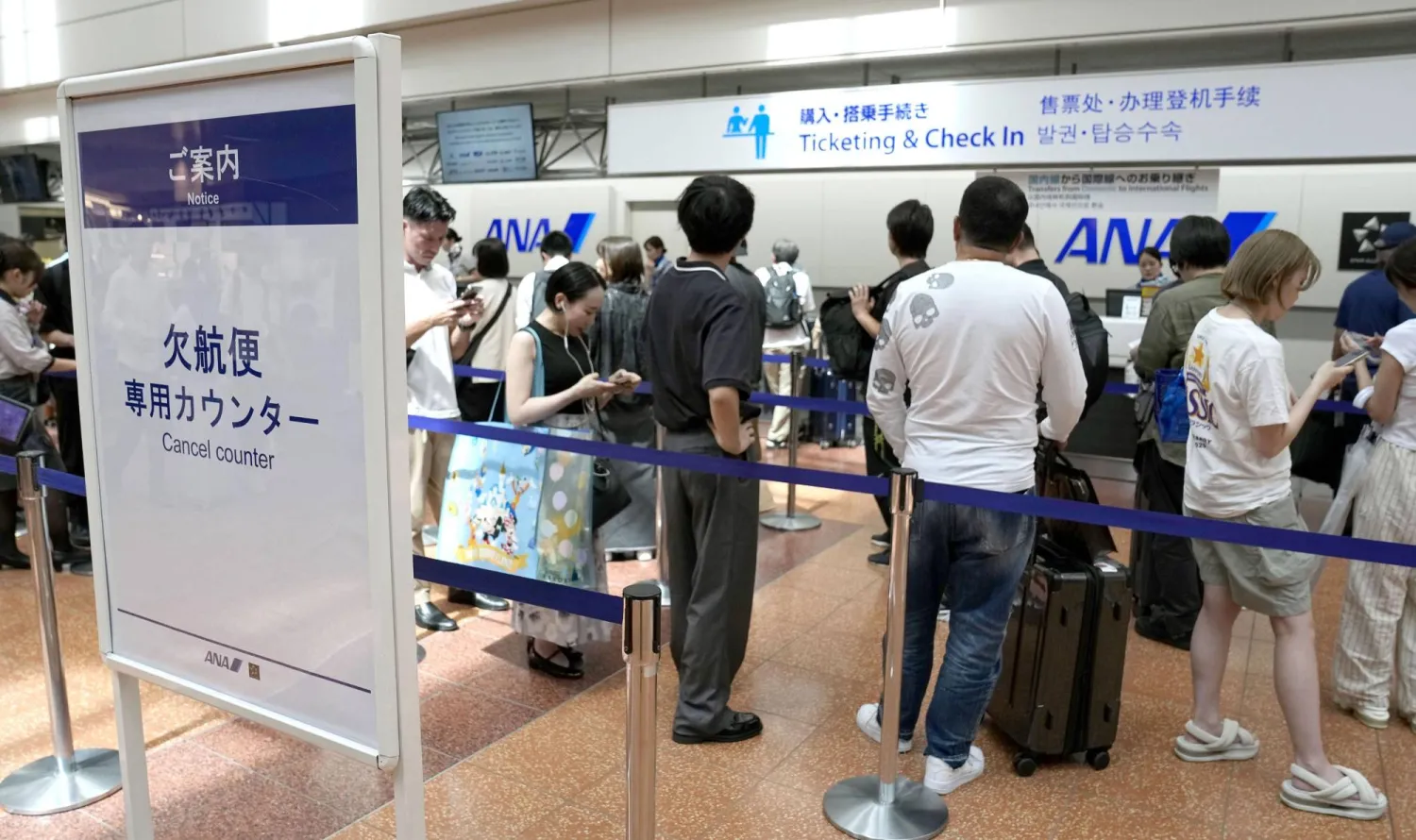
 Passengers line up in front of an All Nippon Airways counter at Haneda airport in Tokyo following flight cancellations due to Tropical Storm Chan-hom Tuesday, Aug. 11, 2026. (Katsuya Miyagawa/Kyodo News via AP)
Passengers line up in front of an All Nippon Airways counter at Haneda airport in Tokyo following flight cancellations due to Tropical Storm Chan-hom Tuesday, Aug. 11, 2026. (Katsuya Miyagawa/Kyodo News via AP)
TT

Tropical Storm Hits Tokyo Area, Leaving Thousands without Power Before Moving West

 Passengers line up in front of an All Nippon Airways counter at Haneda airport in Tokyo following flight cancellations due to Tropical Storm Chan-hom Tuesday, Aug. 11, 2026. (Katsuya Miyagawa/Kyodo News via AP)
Passengers line up in front of an All Nippon Airways counter at Haneda airport in Tokyo following flight cancellations due to Tropical Storm Chan-hom Tuesday, Aug. 11, 2026. (Katsuya Miyagawa/Kyodo News via AP)

Tropical storm Chan-hom moved westward Wednesday after making landfall in the greater Tokyo region the night before, knocking down trees and leaving thousands of homes without power. Five people suffered minor injuries.

Chan-hom was significantly weakened after making landfall in southern Ibaraki prefecture late Tuesday. It was near Gifu, in central Japan, early Wednesday as it headed toward Wakasa Bay on Japan's north-central coast. The storm was packing sustained winds of 64 kph (40 mph), the Japan Meteorological Agency said.

Chan-hom hit Japan days after typhoon Dolphin created havoc in parts of southern Japan, paralyzing traffic and sending hundreds to take shelter. After weakening to a storm, Dolphin killed 10 people in the Philippines and caused flooding in China, forcing hundreds of thousands of people to relocate.

In Tokyo, commuter trains and flights were operating normally and business was almost as usual, but the agency warned residents in northern and western Japan of heavy rain and thunder throughout the day.

Five people were injured slightly — two men in the northern prefecture of Iwate and three women in Ibaraki — according to prefecture officials.

As of Wednesday morning, more than 3,000 homes were without electricity in Ibaraki and its neighboring Tochigi prefecture, according to TEPCO Power Grid.

The storm knocked down trees at several locations in Tokyo, including one in the posh shopping area of Omotesando, though nobody was injured, according to NHK public television.

It affected many holiday travelers during Japan’s “bon” Buddhist holiday week.

About 60 flights departing and arriving at Tokyo’s Haneda airport were canceled Tuesday. In Ibaraki, the popular Oarai beach was empty after closing due to the storm.

Tuesday’s landfall was a first by a tropical storm or typhoon in Ibaraki since the agency started keeping records in 1951.



Russian Nuclear Head Says Ukraine Attacked Fuel Trucks, Endangered Zaporizhzhia Plant

A person inspects the damage at the site of a Russian strike on a building in Zaporizhzhia, Ukraine, 12 September 2026. (EPA)
TT

Russian Nuclear Head Says Ukraine Attacked Fuel Trucks, Endangered Zaporizhzhia Plant

A person inspects the damage at the site of a Russian strike on a building in Zaporizhzhia, Ukraine, 12 September 2026. (EPA)

The head of Russia's ‌state nuclear energy corporation accused Ukraine on Sunday of attacking diesel fuel trucks, killing two Russian servicemen and deliberately jeopardizing safety at the Russian-held Zaporizhzhia nuclear power plant in Ukraine.

Alexei Likhachev said the attack took place on Friday and also resulted in injuries to other Russian soldiers.

The Zaporizhzhia plant, Europe's largest with six reactors, was seized by Russian forces in the early weeks of the Ukraine war that ‌broke out ‌in February 2022. Each side has ‌regularly accused ⁠the other of ⁠actions that endanger safety at the plant and increase the risk of a nuclear accident.

Likhachev issued a statement saying Ukrainian forces had launched "a series of combined strikes" on Friday on fuel trucks which deliver diesel to the station.

"The strikes hit very ⁠close to the perimeter of the station's ‌site," he said.

"Two servicemen ‌were killed, and a large number of Russian soldiers ‌were injured, some seriously. They were all involved ‌in supporting this purely civilian mission."

Fuel is critically important for the plant as diesel generators provide power to keep nuclear fuel in the reactors cool when the plant's ‌two external power links are down. Both were down for nearly three weeks ⁠in August ⁠and September.

Ukraine has demanded that Russia abandon the station and hand its operation back to Kyiv, a demand rejected by Moscow. The fuel currently generates no electricity.

The UN nuclear watchdog, the International Atomic Energy Agency, has stationed an observer team permanently at the station, along with Ukraine's three other working plants.

The agency has repeatedly acted as an intermediary when disputes arise and last month helped arrange a local ceasefire in order to carry out repairs and restore external power links.


Swedish Voters Go to Polls to Choose a New Parliament as Hard Right Bids for Role in Government

 Opposition leader and Sweden's Social Democratic Party leader, Magdalena Andersson, and her husband, Richard Friberg, vote during the general election in Nacka, near Stockholm, Sweden, September 13, 2026. (Reuters)
Opposition leader and Sweden's Social Democratic Party leader, Magdalena Andersson, and her husband, Richard Friberg, vote during the general election in Nacka, near Stockholm, Sweden, September 13, 2026. (Reuters)
TT

Swedish Voters Go to Polls to Choose a New Parliament as Hard Right Bids for Role in Government

 Opposition leader and Sweden's Social Democratic Party leader, Magdalena Andersson, and her husband, Richard Friberg, vote during the general election in Nacka, near Stockholm, Sweden, September 13, 2026. (Reuters)
Opposition leader and Sweden's Social Democratic Party leader, Magdalena Andersson, and her husband, Richard Friberg, vote during the general election in Nacka, near Stockholm, Sweden, September 13, 2026. (Reuters)

Voters in Sweden will head to the polls on Sunday for an election that will determine whether a conservative leader remains in charge and a hard-right party wins ministerial jobs for the first time, or whether the center-left returns to power.

Prime Minister Ulf Kristersson is seeking a second four-year term at the helm of the European Union nation that is also NATO’s newest member. Meanwhile, his predecessor hopes to win the job back.

Experts say the campaign has been fragmented and incoherent, with policy questions such as how healthcare should be organized drowned out by questions about which parties will be able to put together a government.

“Crime has come down, inflation has come down. So these topics are not really what people discuss,” said Zeth Isaksson, a sociologist in electoral behavior at Stockholm University and a political scientist at the European University Institute in Florence, Italy. “People discuss who is going to be in government, and that’s what the election is about.”

Kristersson has led Sweden since 2022 with a three-party center-right coalition. It relies on outside support from the Sweden Democrats, an anti-immigration party that has far-right roots but has moved toward the political mainstream, for a parliamentary majority. If the right is reelected, it can expect Cabinet posts this time.

He’s up against Magdalena Andersson of the center-left Social Democrats, a party that more often than not has led Swedish governments since World War II. Andersson served as prime minister from 2021 until she lost power at the last election.

There are two major political blocs: one with four parties on the right and another with four parties on the left. So the big question is less about which party wins and more about which side can form a majority. Individual parties need a minimum of 4% of the vote to win parliamentary seats.

The Sweden Democrats, who in 2022 took 20.5% of the vote to become the biggest party on the right, can expect Cabinet seats if power doesn’t change hands.

Kristersson announced in April that his conservative Moderates would allow them into government if the right has a majority — though he would remain prime minister even if the Sweden Democrats are the stronger party.

The Sweden Democrats were founded in the 1980s by people who had been active in right-wing extremist groups, including neo-Nazis. They toned down their rhetoric and expelled openly racist members under Jimmie Åkesson, who has led them since 2005 and overseen their growth from what was once a marginal party.

The Sweden Democrats' role is in focus against a background of gains for the populist right in Europe, including the first-place finish by the far-right Alternative for Germany party in a regional election there Sept. 6.

More than 8 million people in the nation of about 10.6 million are eligible to vote in the election for the 349-seat parliament, the Riksdag, which will elect the next prime minister. The Swedish Election Authority says the first preliminary results will be available around 9 p.m. local time (1900 GMT).


DR Congo’s Worst Ebola Epidemic Ever Passes 7,000 Cases

A Congolese medical worker dressed in personal protective equipment (PPE) walks within the emergency unit at the Muthiri Adventist Hospital, as aid agencies intensify efforts to contain a new Ebola outbreak involving the Bundibugyo strain in the Mutiri quarter of Butembo, North Kivu province, Democratic Republic of Congo, September 10, 2026. (Reuters)
TT

DR Congo’s Worst Ebola Epidemic Ever Passes 7,000 Cases

A Congolese medical worker dressed in personal protective equipment (PPE) walks within the emergency unit at the Muthiri Adventist Hospital, as aid agencies intensify efforts to contain a new Ebola outbreak involving the Bundibugyo strain in the Mutiri quarter of Butembo, North Kivu province, Democratic Republic of Congo, September 10, 2026. (Reuters)

More than 7,000 Ebola cases have been recorded in the Democratic Republic of Congo's worst outbreak of the deadly disease ever, according to figures released Saturday by Congolese authorities.

But the government also suggested that the spread of the disease may already have peaked, despite the virus having been confirmed in a seventh province earlier this week.

The DRC officially detected the latest outbreak in mid-May, with nearly 3,400 people killed in its 17th epidemic of the highly infectious virus.

It began in the northeastern Ituri province before spreading to conflict-plagued, remote eastern and northern regions where armed groups have roamed for decades, the presence of the state is weak and health infrastructure is lacking.

The disease was confirmed in South-Ubangi, which borders the Central African Republic and Congo-Brazzaville, earlier this week.

According to the latest figures from the Congolese authorities, 7,022 cases have been recorded since the beginning of the epidemic. Of that number, 3,398 people have died and 1,671 have recovered.

"The peak was reached at the beginning of the third week of August," Congolese government spokesman Patrick Muyaya wrote on X on Saturday.

"All the indicators show a decrease in the number of cases," he added, specifying that "10 of the 61 health zones" affected by the epidemic have not recorded any new cases "for at least 21 days".

Most of the recorded cases are in Ituri, where Ebola has been detected in schools in the days after the post-summer holiday return to classes, causing alarm among parents and health workers.

"We are very worried because we don't know which child comes from which family or what the health status of the members of that family is," Angele Magani, the mother of a student in Bunia, Ituri's provincial capital, told AFP.

"We are so scared, even though the school authorities reassure us about the health measures that have been put in place," she added.

Bunia school official Roger Mungimbo said "there is a mandatory hand-washing system with soap, and we have also done everything possible to have a maximum of 30 pupils per classroom."

"We regularly make the children aware that they must not touch each other" and wash their hands regularly, he added.

Ebola, which has killed more than 15,000 people in Africa over the last 50 years, is transmitted through contact with bodily fluids and can cause severe internal and external bleeding and organ failure.

The current epidemic is caused by the Bundibugyo strain, for which there is no approved vaccine or treatment. Several treatments and vaccines are being tested.