


Iran Goes on Offensive as Diplomacy with US Stalls

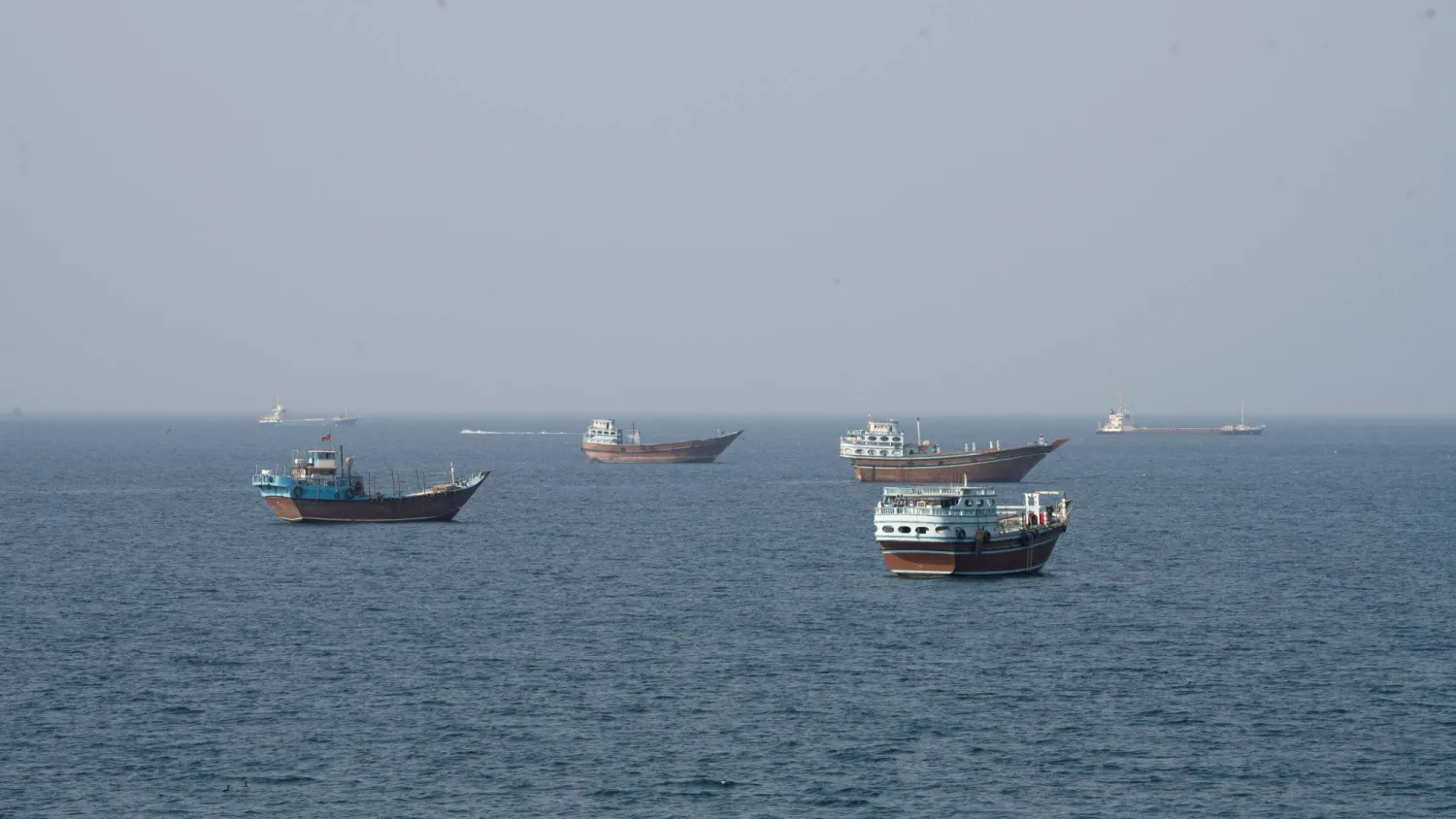
Vessels near the Strait of Hormuz, as seen from Musandam, Oman, August 17, 2026. REUTERS/Stringer
TT

Iran Goes on Offensive as Diplomacy with US Stalls

Vessels near the Strait of Hormuz, as seen from Musandam, Oman, August 17, 2026. REUTERS/Stringer

Six months into its war with the United States, Iran's military has begun signaling a shift from retaliation to offence, which analysts say could reflect Tehran's belief it holds leverage to advance its demands and break the stalemate.

Since US-Israeli strikes launched the war on February 28, Tehran has largely portrayed its strikes against the United States, Israel and Gulf countries as revenge for attacks on the Iranian republic.

Now, Iranian officials are openly talking about giving offensive operations a greater priority while keeping control over the strategic Strait of Hormuz, a key source of leverage against Washington that has disrupted a vital global energy route and driven up energy prices.

Iran's supreme leader Mojtaba Khamenei outlined that approach in a reshuffle of top military commanders earlier this month, calling for "strengthening maximum deterrence and preparing to conduct large-scale offensive operations against the enemy".

Last week, a deputy commander of Iran's Revolutionary Guards indicated that Tehran was revising its military doctrine to give "offensive operations" strategic priority.

Analyst Sina Toossi of the Center for International Policy believes the shift to offensive operations does not mean Tehran was "adopting a doctrine of preventive war".

Rather, he said, Tehran appears to have concluded that "if confrontation becomes unavoidable, Iran should escalate earlier and more forcefully rather than wait for the United States or Israel to define the terms of the conflict".

Ahmad Zeidabadi, a Tehran-based international relations expert, believes the shift reflects Tehran's assessment of Washington's intentions.

"The Islamic Republic believes the United States has likely ruled out war and now seeks to perpetuate the status quo including the US naval blockade and the economic pressure," he told AFP.

- Iran's calculus -

Diplomatic efforts with the US remain stalled, especially since a June 17 truce collapsed and the US reimposed oil sanctions and the blockade on Iranian ports.

"Iranians believe that diplomacy is doomed to fail in the current climate and that the Americans will not accept their terms," said Zeidabadi.

"Consequently, they may feel compelled to resort to offensive action to force the US to accept Iranian conditions ... and to initiate a new round of negotiations."

Iran suffered heavy losses in the initial bombardment campaign, including the killing of supreme leader Ali Khamenei and senior military commanders, as well as extensive material and economic damage.

But the political system has remained intact, and intense bombardment eventually subsided following an April 8 ceasefire, apart from sporadic exchanges of fire, particularly in and around Hormuz.

The war has since spread across the region to include disruption of shipping in the Red Sea's Bab al-Mandab strait.

"Tehran increasingly believes that American military superiority does not give Washington escalation dominance," said Toossi.

The Strait of Hormuz has become central to that calculus, with Tehran requiring vessels to seek permission and to pay service fees to transit -- a move strongly opposed by Washington and regional countries.

Reopening the strait has become a US priority.

US Vice President JD Vance said last week that "goal number one" was keeping energy prices low for Americans, while preventing Tehran from acquiring a nuclear weapon ranked second.

A June 17 memorandum of understanding between Tehran and Washington that outlined terms for a truce was a far cry from US President Donald Trump's initial call for Iran's "unconditional surrender".

That truce later collapsed over disagreements primarily over the management of the Hormuz but Iranian officials still tout it as evidence of "victory".

"I can state with conviction that we have won this war in the true sense of the word, both militarily and politically," top negotiator Mohammad Bagher Ghalibaf said in a speech last week, while describing the deal as a source of "pride and victory".

- Risk of miscalculation -

An Iranian attack in late July on a US air base and a command center in Jordan has been portrayed on Iranian media as an example of that "preemptive" approach.

For Hossein Kanani-Moghadam, an international relations expert and former general in the Revolutionary Guards, the new strategy could take other forms.

"Such operations could encompass a combination of cyber warfare, psychological warfare, intelligence operations, and economic warfare," he said.

But Tehran's calculus comes with serious risks.

"If this threat is serious ... the outcome of this scenario would be catastrophic for Iran and the region," said Zeidabadi.

Toossi also believes that the strategy "means future crises could escalate much faster".

The broader danger, according to Toossi, is what he described as "reciprocal deterrence trap" with each side responding to the other's attempts to strengthen deterrence as evidence it must escalate further.

"That is a much more unstable strategic environment, even if neither side actually wants another major war," he said.



Merz Says Disaster Narrowly Averted in Russia-Prepared Drone Attack at Airport

German Chancellor Friedrich Merz looks on during a debate at the German parliament, the Bundestag, in Berlin, Germany, 09 September 2026. (EPA)
TT

Merz Says Disaster Narrowly Averted in Russia-Prepared Drone Attack at Airport

German Chancellor Friedrich Merz looks on during a debate at the German parliament, the Bundestag, in Berlin, Germany, 09 September 2026. (EPA)

German Chancellor Friedrich Merz said on Wednesday that an attempted drone attack at Leipzig/Halle airport had been prepared in Russia over an extended period and that a disaster was only narrowly ‌averted.

"This attack ‌was planned in ‌Russia ⁠for months and ⁠was specifically targeted at Germany, and only by pure chance was major material damage and harm to people ⁠prevented," Merz told the lower ‌house ‌of parliament.

Merz spoke after ‌the far-right Alternative for ‌Germany scored a major victory in a state election in Saxony-Anhalt on Sunday, running ‌on a platform that includes calls for ⁠closer ties ⁠with Moscow.

Russia has rejected any involvement in the drone incident at Leipzig airport, and its foreign minister has said these accusations were "the start of a real war".


UK Rejects Israel’s ‘Damaging’ Sanctions Retaliation

A view shows the British Consulate General in East Jerusalem, 09 September 2026. (EPA)
TT

UK Rejects Israel’s ‘Damaging’ Sanctions Retaliation

A view shows the British Consulate General in East Jerusalem, 09 September 2026. (EPA)

British foreign minister Ed Miliband on Wednesday condemned as "regrettable and damaging" Israel's decision to order the closure of the UK's consulate in Jerusalem as retaliation for London-led Western sanctions over settler violence. 

"We anticipated this might happen because we saw other countries, the Dutch, for example, who had announced sanctions, who had seen these reprisals from Israel. I think they're regrettable and damaging," Miliband told BBC Radio. 

Israel on Tuesday ordered the closure after 12 countries including Britain, Canada and France announced they would sanction trade with Israeli settlements in the West Bank, following a surge in settler attacks against Palestinians in the occupied West Bank. 

Israel said it would also expel British representatives at a center monitoring the US-brokered ceasefire plan in Gaza, bar British training for Palestinian Authority forces and ban 12 Britons, mostly members of parliament, from visiting the country. 

Miliband rejected suggestions that the sanctions would impact intelligence cooperation with Israel. 

"We have important intelligence and security relationships with Israel, and I'm confident they will continue," he said, declining to go into details. 

"And I was very clear yesterday that we do believe in working with our Israeli partners when it comes to the threats they face from Iran," he added. 

Miliband also dismissed the criticism of the sanctions by Britain's chief rabbi. 

Ephraim Mirvis on Tuesday called the measures "little more than political flag-bearing". 

He said it was a "truly a dark day for British Jews", predicting that the measures "will succeed only in bolstering the very extremism they seek to target". 

Several antisemitic attacks in London this year have targeted synagogues and other Jewish sites. 


Netanyahu Will Make Quick Trip to Speak at UN After Mamdani Urged His Arrest, Diplomat Says

Benjamin Netanyahu, Israeli Prime Minister and leader of the Likud party, speaks during the party's presentation of new team members for the upcoming elections, in Jerusalem, Israel, 08 September 2026. (EPA)
TT

Netanyahu Will Make Quick Trip to Speak at UN After Mamdani Urged His Arrest, Diplomat Says

Benjamin Netanyahu, Israeli Prime Minister and leader of the Likud party, speaks during the party's presentation of new team members for the upcoming elections, in Jerusalem, Israel, 08 September 2026. (EPA)

Israeli Prime Minister Benjamin Netanyahu is making a whirlwind 24-hour trip to speak at the annual UN gathering of world leaders this month because “there is no option” after New York’s mayor urged his arrest over the war in Gaza, Israel’s UN envoy said Tuesday.

Ambassador Danny Danon accused Mayor Zohran Mamdani of “doing politics” when he called the prime minister a “war criminal” and called for his arrest, which he had to withdraw because New York City does not have authority to take Netanyahu into custody.

“You know, it became very trendy to do politics by blaming Israel,” Danon added. He stressed, “For us, it’s important the prime minister will come.”

Netanyahu has become an increasingly polarizing figure over Israel’s war against Hamas in Gaza. Mamdani, whose office did not immediately respond to messages seeking comment Tuesday, has pointed to the arrest warrant issued by the world’s top war crimes tribunal against Netanyahu in November 2024, accusing him and another Israeli official of crimes against humanity.

The International Criminal Court warrant said there was reason to believe Netanyahu used “starvation as a weapon of warfare” by restricting humanitarian aid and intentionally targeting civilians in the campaign against Hamas — charges Israel denies.

While New York City does not have legal authority to execute an ICC arrest warrant, Mamdani has encouraged the federal government to do so. The US and Israel are not members of the court, and the Trump administration has imposed a series of sanctions on ICC staffers in a campaign to dismantle the tribunal.

Netanyahu is scheduled to arrive in New York late on Sept. 23, address the UN General Assembly the afternoon of Sept. 24 and fly back to Israel that night, Danon said.

Danon noted that the meeting of leaders from the 193 UN member nations is taking place during the Jewish holidays and an election campaign as Netanyahu tries to keep his job as prime minister.

Danon said protests against Netanyahu would “create more chaos” on New York streets during the high-level meetings the week of Sept. 22-28.

Last year, there was a mass walkout from the UN General Assembly hall when Netanyahu started to speak from the podium. This year, Danon said, “I expect that there will be something like another show.”

But the ambassador said Netanyahu is experienced, “and I’m sure he will deliver his speech despite those attempts.”