


Trump Warns of 'Economic D-Day' against Iran, but Tehran is Well Acquainted with Sanctions

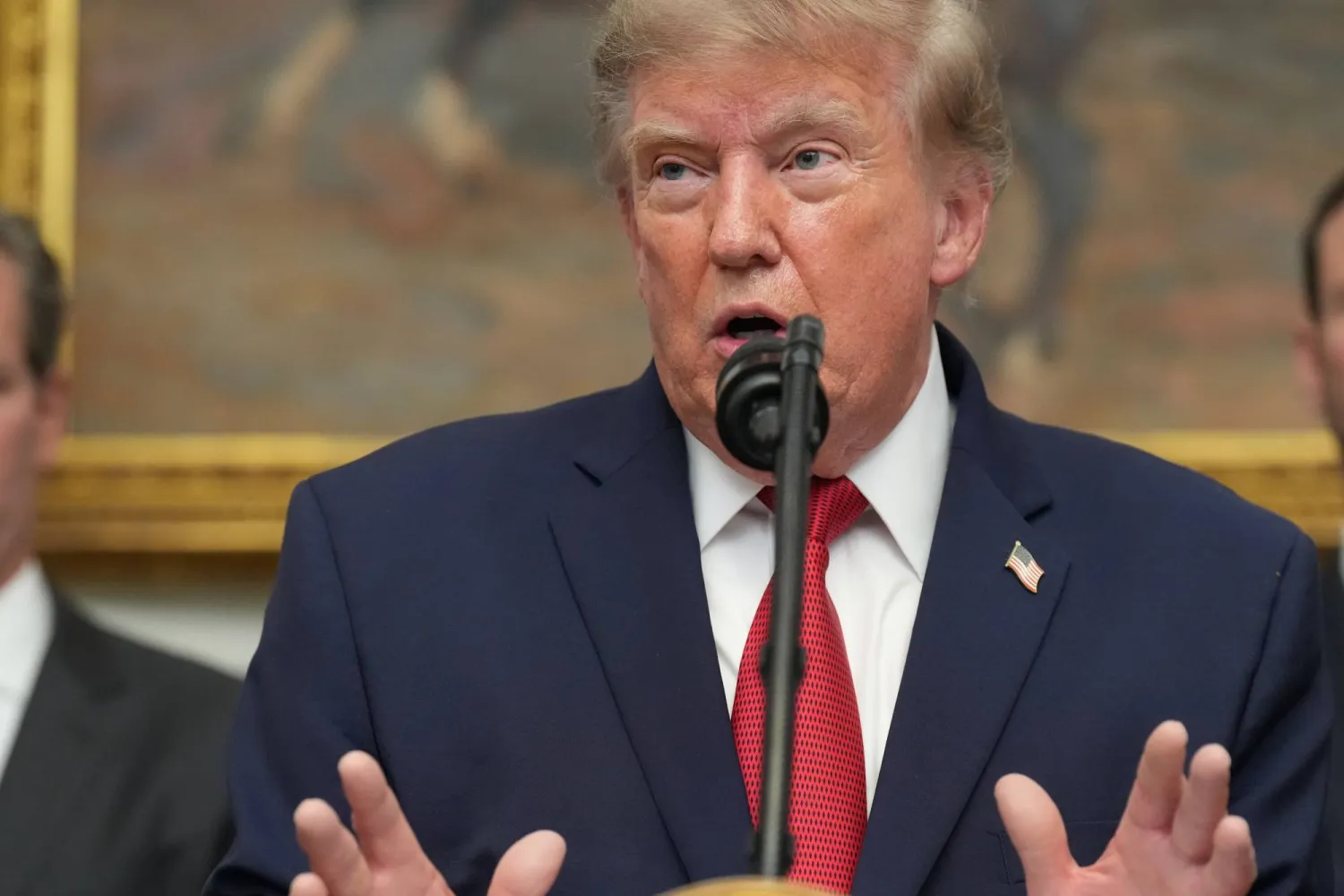
President Donald Trump speaks during a meeting with technology leaders in the Roosevelt Room of the White House, Wednesday, Aug. 19, 2026, in Washington. (AP Photo/Jacquelyn Martin)
TT

Trump Warns of 'Economic D-Day' against Iran, but Tehran is Well Acquainted with Sanctions

President Donald Trump speaks during a meeting with technology leaders in the Roosevelt Room of the White House, Wednesday, Aug. 19, 2026, in Washington. (AP Photo/Jacquelyn Martin)

Nearing the six-month mark of the Iran war and facing diminishing stockpiles of key weapons, the Trump administration is touting a crushing financial campaign against Tehran, promising an “economic D-Day” against a country that has so far withstood nearly five decades of punishing American sanctions.

With sparse details, President Donald Trump announced this week that the US would be imposing an “unprecedented” level of economic warfare and isolation on Iran, aiming to force its leadership to cave to demands to end its nuclear program and fully reopen the crucial Strait of Hormuz to oil and natural gas tankers, The Associated Press said.

It reflects the dire reality Trump faces with an increasingly unpopular war he can't seem to end just months before pivotal midterm elections that will decide whether his Republican Party keeps control of Congress. Whether out of desperation or strategy, the president is refocusing America's might on bringing Iran to its knees through an accelerated sanctions campaign against one of the most economically penalized countries in the world.

The immediate response from Iran hawks has been praise and a call for patience as it plays out, while other analysts warn that Trump is refusing to learn the lessons of his predecessors.

In an interview Thursday on CNBC, Treasury Secretary Scott Bessent offered a small glimpse of what may be ahead, threatening secondary sanctions on nations and companies that conduct business with Iran.

He did not say exactly whom would be targeted as part of this next phase of the administration’s “ Operation Economic Fury, ” which earlier had focused on entities and individuals that buy oil from or bank with Iran. China and India, however, are major buyers of Iranian oil.

“If you insist on doing business with them, then the US Treasury and US government will put its full might and force against you,” Bessent said. “It’s time for our allies and the rest of the world to make a decision."

Some experts see ‘uncharted waters’ that could force Iran's hand

Despite decades of US sanctions against Iran, the Trump administration is arguing that it’s only a matter of time and that striking the right economic target would get Tehran to its breaking point.

Richard Goldberg, who coordinated efforts to put diplomatic pressure on Iran in Trump's first term, said the consequences of US strikes on Iran's nuclear sites last year, the war this year and the American naval blockade on Iranian ports have created the perfect storm for capitulation — one that didn't previously exist.

“I think we’re watching a strategy, whether it takes a short time or a long time, that is very much about fundamentally changing the future of the world by seeing the end of this regime," said Goldberg, who is now at the hawkish Washington think tank Foundation for Defense of Democracies.

“I caution everyone — including myself, who has worked on sanctions, who’s worked on financial warfare — to have the humility to admit that we are in uncharted waters,” he said.

He said the decision this week by the United Arab Emirates — once one of Tehran's most important trading partners — to suspend trade with Iran over a missile attack will only further isolate the government.

Targeting allies and partners comes at a price

With nearly all of Iran's energy, financial and transportation sectors already covered by US sanctions, Trump’s aim appears to be to apply secondary sanctions on countries, including allies and partners, that have not cut all ties with Iran to starve the country of any remaining income it may still be receiving.

In many ways, it is a redux of Trump’s first-term “maximum pressure” campaign, which he has ramped up during his second term to include military action.

But as Trump and his allies discovered during his first administration, it can be difficult to enforce secondary sanctions without harming US interests and provoking reciprocal measures. There were numerous instances of the administration granting sanctions waivers to countries, particularly those that rely on Iranian oil for their energy needs.

“Trump’s strategy now rests on targeting Tehran directly by impeding its touch points and access to the formal financial system and international economy,” said Behnam Ben Taleblu, senior director of FDD’s Iran program. “This will require making the Iran issue more important in US bilateral relations with countries in Europe and Asia.”

Iran doesn't see an ‘open door’ at the end of the sanctions campaign Iranian officials and analysts have accused the Republican president of flip-flopping with his latest pivot to economic pressure against Iran. Trump has long derided past leaders who used sanctions to limit Iran’s ability to pay for its military and nuclear development.

In a post last week on X, Esmail Baghaei, spokesman for Iran’s Foreign Ministry, wrote that Washington's pattern of retreating to sanctions when it doesn't want to pursue diplomacy has proven to be futile.

“Iran has demonstrated over decades that it will not be strangled by these exhausted refrains,” he said. “The real risk is that American politicians, clinging to this bad habit, will instead strangle their own remaining chances of a less humiliating exit from a crisis of their own making.”

Ali Vaez, Iran director at the International Crisis Group, said the Trump administration's decision to take its own “maximum pressure” policy to new heights with military action seems to ignore years of US foreign policy lessons that show Iran does not respond well to pressure.

If anything, he says, the latest economic campaign has only “hardened Iran's position.”

“I think (Trump's) blind spot is the fact that the only thing that the Iranian regime views as more dangerous than suffering from US sanctions is surrendering to US terms," Vaez said.

Plus, the past year of start-stop diplomacy has only worsened the already fragile dynamic between the longtime adversaries, Vaez says, adding that Iranian officials' lack of trust in Trump and his mediators has created an untenable foundation.

“They believe that even if they capitulate to US terms under economic duress, Trump would move the goalposts and ask for more,” he said. “And this is really the fundamental problem: Pressure without an open door is an exercise in futility.”



Zelenskyy Visits Canada to Seek Further Military Support for Ukraine

Ukrainian President Volodymyr Zelenskyy (archive)
TT

Zelenskyy Visits Canada to Seek Further Military Support for Ukraine

Ukrainian President Volodymyr Zelenskyy (archive)

Ukrainian President Volodymyr Zelenskyy was in Canada on Thursday for talks with Prime Minister Mark Carney, his latest international trip aimed at locking in future support for Ukraine’s fight against Russia’s invasion.

Ukraine is under pressure from Russia’s air war, which is using ballistic missiles and jet-powered drones to pierce defenses. Moscow’s attacks have targeted Ukraine’s power grid ahead of the upcoming winter as part of its campaign to demoralize civilians, Ukrainian officials say.

“The main focus will be on supporting Ukraine in protecting our skies and preparing for the winter,” Zelenskyy said of his Canada trip in a social media post. “We will discuss how to strengthen our resilience, support our people, and ensure that Ukraine has the capabilities it needs to defend itself.”

Canada and European countries are sending their own weaponry to Ukraine and are also buying American weapons for Kyiv under the so-called Prioritized Ukraine Requirements List, or PURL. The United States under President Donald Trump has stopped donating weapons to Ukraine, The Associated Press said.

Recent US efforts to stop the more than four years of fighting have delivered no significant breakthrough, although Washington-brokered talks between delegations from Moscow and Kyiv are expected to continue.

Zelenskyy’s arrival on Wednesday night in Calgary, Alberta, came the day after his flight from Moldova to Norway was delayed when authorities closed Moldova’s airspace because of a drone incursion.

The aerial drone battle between Russia and Ukraine has grown in scale since Russia’s all-out invasion in February 2022. Ukraine’s neighbors Romania and Moldova, and other European countries, have reported repeated drone incursions.

Ukraine's drones now reach targets in Siberia, officials say

A Ukrainian sea drone wounded 28 people, including two children, on the waterfront in the Russian city of Sochi, local officials said. They said that beach infrastructure had been damaged but did not provide further details.

Russia’s Ministry of Defense said Thursday that its forces shot down 448 Ukrainian drones overnight. The drones were destroyed over 13 Russian regions, as well as the annexed Ukrainian peninsula of Crimea and the Black and Caspian seas, the ministry said.

Falling debris from a Ukrainian drone set fire to a home in Russia’s southwestern Voronezh region, killing one woman and wounding two other people, local Gov. Alexander Gusev said Thursday.

Ukrainian forces struck eight Russian infrastructure targets supporting the war effort over the past 24 hours, including a refinery in the Yamalo-Nenets region and a port in Dagestan, Zelenskyy said Thursday.

Targets in the Moscow, Voronezh, Astrakhan and Bryansk regions were also hit, he said.

Those targets were hundreds of kilometers (miles) apart, underlining the scope and scale of Ukraine's domestically developed long-range drone technology that has unsettled Russia.

The previous day, Ukrainian forces struck an oil refinery more than 3,000 kilometers (1,800 miles) from Ukraine in Siberia, Ukraine’s General Staff said, confirming earlier reports.

Meantime, Russian forces launched 149 drones, many of them jet-propelled, at Ukraine overnight, Ukraine’s air force said Thursday.

One person was killed and two others wounded in a Russian drone attack on the Kyiv region on Thursday morning, regional head Tymur Tkachenko said.

At least 16 other civilians were wounded in other Ukrainian regions, according to local authorities.


'Heavy Casualties' in Fire on Foreign-flagged Ship at China Port

Representation photo: China Fire and Rescue personnel arrive at Trishuli camp after inspecting the tunnel site in Rasuwa, in the aftermath of flash floods in Nepal's Nuwakot district on August 31, 2026. (Photo by Arun SANKAR / AFP)
TT

'Heavy Casualties' in Fire on Foreign-flagged Ship at China Port

Representation photo: China Fire and Rescue personnel arrive at Trishuli camp after inspecting the tunnel site in Rasuwa, in the aftermath of flash floods in Nepal's Nuwakot district on August 31, 2026. (Photo by Arun SANKAR / AFP)

A fire on a foreign-flagged cargo ship docked in an eastern Chinese port caused "heavy casualties" on Thursday, state media said, with President Xi Jinping calling for urgent search and rescue operations.

"A foreign cargo ship of Beihai Shipbuilding Co., Ltd. in Qingdao, Shandong Province, caught fire during its port call for maintenance, causing heavy casualties," state news agency Xinhua said.

Xinhua did not specify the number of casualties or the cause of the fire, said AFP.

Xi "stressed the need to urgently search for missing persons... and strictly hold those responsible to account", it added.

State media said that the fire broke out at around 11:15 am (0315 GMT). It was not clear whether it had already been extinguished.

Premier Li Qiang also urged the search and rescue of "trapped" people, and for those injured to receive medical treatment, "and strictly prevent secondary disasters".

Qingdao Beihai Shipbuilding is a major shipyard that operates as a subsidiary of the China State Shipbuilding Corporation.

Xi warned that "all regions and relevant departments must draw profound lessons from this incident, thoroughly investigate and rectify all types of fire hazards".


US Military Says It Struck Vessel in Caribbean, Killing Three

This screen grab from a video posted by US Defense Secretary Pete Hegseth on his X account on October 24, 2025, shows what Hegseth says is US military forces conducting a strike on a vessel being operated by Tren de Aragua trafficking narcotics in the Caribbean Sea in on October 23, 2025. (Photo by HANDOUT / US Secretary of Defense Pete Hegseth's X Account / AFP)
TT

US Military Says It Struck Vessel in Caribbean, Killing Three

This screen grab from a video posted by US Defense Secretary Pete Hegseth on his X account on October 24, 2025, shows what Hegseth says is US military forces conducting a strike on a vessel being operated by Tren de Aragua trafficking narcotics in the Caribbean Sea in on October 23, 2025. (Photo by HANDOUT / US Secretary of Defense Pete Hegseth's X Account / AFP)

The US military said on Wednesday three people were killed in a strike on a vessel in the Caribbean Sea, the latest in a series of attacks that Washington says target "narco-terrorists" but human rights groups condemn as extrajudicial ‌killings, Reuters said.

DETAILS:

* US Southern ‌Command said on ‌X ⁠it "executed a lethal kinetic strike ⁠on a go-fast vessel operating along established narco-trafficking routes in the Caribbean."

* It cited "confirmed intelligence" to allege the vessel's active involvement in narco-trafficking, without providing more details.

* The US military said three people, ‌whom it ‌called "narco-terrorists," were killed.

* President Donald Trump's ‌administration has said the vessels it ‌has struck since September 2025 were transporting narcotics.

* The US military's strikes on such vessels in the Caribbean and Eastern ‌Pacific have killed more than 220 people.

* Experts and rights ⁠advocates, ⁠both in the US and globally, have questioned the legality of the strikes.

* Human Rights Watch, Amnesty International and independent UN experts have called the strikes unlawful extrajudicial killings.

* The American Civil Liberties Union has cast the assertions by the Trump administration against those it targets as "unsubstantiated, fear-mongering claims."