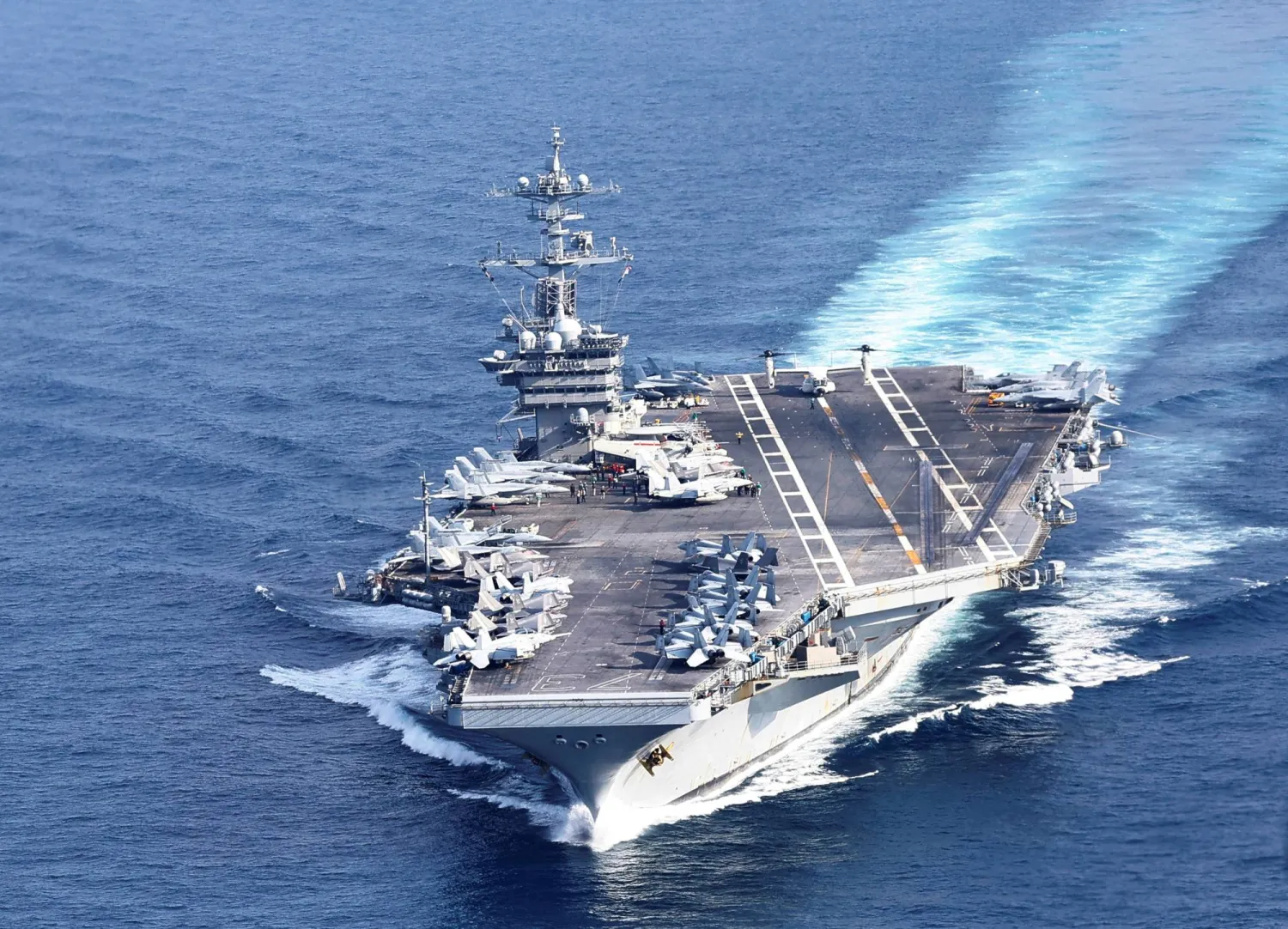
USS Theodore Roosevelt to be Deployed to Middle East for at Least Seven Months

US Navy aircraft carrier USS George Washington is pictured during Freedom Edge trilateral exercise among United States, Japan and South Korea in the East China Sea, south of the Korean peninsula and west of Japan's main islands, November 14, 2024. (Reuters)
TT

USS Theodore Roosevelt to be Deployed to Middle East for at Least Seven Months

US Navy aircraft carrier USS George Washington is pictured during Freedom Edge trilateral exercise among United States, Japan and South Korea in the East China Sea, south of the Korean peninsula and west of Japan's main islands, November 14, 2024. (Reuters)

The aircraft carrier USS Theodore Roosevelt and its company of 5,000 will embark in the coming weeks on what is expected to be at least a seven-month deployment to the Middle East, top Navy officials said on Wednesday.

“They know they’re going to be there longer than seven months. Their [commanding officer] is giving them eight months to plan on,” John Perryman, the master chief petty officer of the Navy, said, CNN reported citing USNI News.

Perryman, the Navy’s top enlisted sailor, spoke to reporters alongside Chief of Naval Operations Adm. Daryl Caudle at Naval Support Activity Hampton Roads in Virginia.

According to CNN, the move will come as the Navy deals with the fallout from the recent deployment of the USS Abraham Lincoln to the region that saw it spend more than 250 days at sea without a port call.

That lengthy deployment raised concerns about the mental health of sailors, including reports of at least one going overboard, as well as reports of low supplies aboard the 100,000-ton warship.

The Lincoln was relieved by the USS George Washington last week, and it is expected to make a port call in Thailand in the coming days, according to several news reports.

The Roosevelt is expected to relieve the George Washington, USNI reported. The carrier USS George HW Bush is also operating in the Middle East region.

On Tuesday, a Thai official told Reuters that US aircraft carrier the USS Abraham Lincoln will dock in Thailand next week, following a prolonged deployment in ‌the Middle East and reports of mental health concerns and deteriorating conditions on board.

The Lincoln, which left the Middle East on Saturday, has not made a port call in more than 200 days, setting a modern-day record for consecutive days at sea, according to Democratic lawmakers.

Two military-focused outlets, Navy Times and Stars and Stripes, this month reported suicide ⁠attempts and declining morale on the ship. US Defense Secretary Pete Hegseth has said the reports “completely misrepresented” the conditions on board.

Thailand is the United States' only treaty ⁠partner in mainland Southeast Asia, having been a treaty ally since 1954 and a major non-NATO ally since 2003. Both countries' militaries maintain strong relations.

Caudle acknowledged the stress the Iran war has put on the US fleet and said the service would try to put more certainty into deployment times, but combat demands can make that difficult.

“I would prefer, you know, seven-month deployments. I typically am not a big fan of extensions, and I push back hard on that. But the enemy gets a vote,” USNI quoted Caudle as saying.


South Korea Backs Trump Bid to Revive North Korea Talks, Seeks Nuclear Progress

US President Donald Trump meets with North Korean leader Kim Jong Un at the demilitarized zone separating the two Koreas, in Panmunjom, South Korea, June 30, 2019. (Reuters)
TT

South Korea Backs Trump Bid to Revive North Korea Talks, Seeks Nuclear Progress

US President Donald Trump meets with North Korean leader Kim Jong Un at the demilitarized zone separating the two Koreas, in Panmunjom, South Korea, June 30, 2019. (Reuters)

South Korea supports US President Donald Trump's efforts to resume dialogue with North Korea, but aims to ensure its security posture is not weakened and that Seoul is not sidelined, South Korea's national security adviser said on Friday.

Seoul believes the resumption of talks between the US ‌and North Korea ‌should focus on progress on the North Korean ‌nuclear weapons ⁠issue and must ⁠not undermine the country's security readiness, Wi Sung-lac told reporters.

"One point to keep in mind is the need to coordinate with the United States to ensure that any resumption of US-North Korea dialogue leads to substantive progress on the North Korean nuclear issue, alongside efforts to establish a peace regime on the Korean Peninsula," Wi said.

To achieve these ⁠aims, policy coordination and communication between South Korea and ‌the United States were more important than ‌ever, he said.

Wi cited Trump's order earlier this month to substantially scale ‌back major joint military drills between the two allies, saying the ‌US president was signaling a willingness to engage with North Korea.

At the same time, Seoul should ensure it was not "sidelined" in Washington's efforts to restart talks with Pyongyang, Wi said.

Trump cited in part Seoul's refusal to offer help ‌in the Iran war for cutting short the Ulchi Freedom Shield drills this month and said they sent ⁠a wrong ⁠message to North Korea. Trump has been seeking a new summit with North Korean leader Kim Jong Un.

The two met three times in 2018 and 2019.

South Korea, Japan and the United States will conduct joint military drills from September 9 to 11 to test readiness against North Korea's missile and nuclear weapons threats, South Korea said on Friday.

Wi said South Korea is seeking to deepen cooperation with Washington on a range of issues that have sometimes caused friction between the allies.

These include South Korean investment in the US agreed under a trade deal, the treatment of US-listed e-commerce firm Coupang, security cooperation, intelligence sharing and the transfer of wartime operational control, he said.


Grossi: Nuclear Talks with Iran Currently 'Stalled'

Rafael Grossi, Director General of the International Atomic Energy Agency (IAEA), and US Energy Secretary Chris Wright, in Washington. (Grossi on X)
TT

Grossi: Nuclear Talks with Iran Currently 'Stalled'

Rafael Grossi, Director General of the International Atomic Energy Agency (IAEA), and US Energy Secretary Chris Wright, in Washington. (Grossi on X)

Rafael Grossi, Director General of the International Atomic Energy Agency (IAEA), said on Thursday that talks on Tehran’s nuclear program remain stalled, adding that the nuclear file has reached an “impasse.”

At a press conference with US Energy Secretary Chris Wright in Washington, Grossi said the nuclear issue will not be a priority until key issues, including the situation surrounding the Strait of Hormuz and other broader matters, are clarified.

He said that, under the current circumstances, there is no clear channel for advancing discussions on the nuclear issue.

Grossi said contacts with both the US and Iran are continuing, noting that the IAEA remains engaged in dialogue with both sides.

He added that Iran’s position is that no progress on the nuclear issue can be achieved until broader progress is made in the overall negotiations.

However, the IAEA chief said both sides identified key nuclear issues and areas requiring joint cooperation.

He spoke about contacts between US special envoys, Steve Witkoff and Jared Kushner, and Iranian representatives, and expressed hope that the process could yield results in the near future.

Grossi also said that Iran still possesses around 440 kilograms of highly enriched uranium.

His remarks came while Tehran refuses to let IAEA inspectors visit facilities hit during the 12-day US-Israeli conflict in 2025.

For his part, Wright said Wednesday that Washington would prefer a diplomatic solution with Iran but was prepared to destroy its nuclear facilities “if necessary.”

“Iran has a nuclear weapons program and our goal is to stop it,” he said.

“An agreement must be reached with Iran under which it renounces nuclear armament,” he added.

The IAEA chief said he discussed with Wright nuclear non-proliferation issues, including Iran and his recent visit to Syria.

Grossi arrived in the US ahead of the launch of the IAEA's initiative ATLAS, designed to aid the deployment of civil nuclear applications at sea.

Meanwhile, Mohammad Eslami, head of the Atomic Energy Organization of Iran, said that any inspection of nuclear facilities damaged in military attacks must be carried out in accordance with Iranian law, with the approval of the Islamic Consultative Assembly, and only after specific security protocols have been established.

Eslami said that requests to inspect the affected facilities under the current circumstances are “not acceptable.”

He then accused the US and Israel of pressuring the IAEA to inspect Iranian nuclear facilities damaged by military strikes.

“At a time when the IAEA has no such protocol and is not taking a position either, it is only the United States and Israel that are applying pressure for the Agency to go to the damaged sites and inspect them,” he said.

“The reason for this pressure is that they want to see what happened to these sites as a result of the military operations they carried out,” Eslami added.


Nepal Army Trying to Save 100 People Trapped in Tunnel at Hydropower Project

An aerial view shows houses lying deluged in sludge after flash floods at Devighat, Bidur Municipality, along the confluence of the Trishuli and Tadi rivers in Nepal's Nuwakot district on August 27, 2026. (AFP)
TT

Nepal Army Trying to Save 100 People Trapped in Tunnel at Hydropower Project

An aerial view shows houses lying deluged in sludge after flash floods at Devighat, Bidur Municipality, along the confluence of the Trishuli and Tadi rivers in Nepal's Nuwakot district on August 27, 2026. (AFP)

Nepali army helicopter rescue teams were working on Friday to rescue around 100 people trapped inside a tunnel at a hydropower project swamped by a devastating flood two days earlier.

"Our focus is in search and rescue of people... some people are trapped in the tunnel of Trishuli 3A hydropower project," Nepal Army spokesman Raja Ram Basnet told AFP.

"Two helicopters have been dispatched but it is challenging because it is tough to even locate the entry points of the tunnel. Relief efforts are also underway to provide the rescued people what they need," he added.

The prime minister's office said in a statement that the army had been working in tough conditions.

"A Nepali Army team has successfully rescued 350 workers and locals who were trapped in the tunnel a while ago facing extremely risky and challenging conditions amid adverse weather and rapid floodwaters," the statement read.

"The army is still working to safely evacuate more than 100 people trapped in the same tunnel."

It did not give further details about the nationalities of those rescued or trapped.

The scale of destruction from devastating floods in Nepal's northern border region was becoming clearer on Friday, with roads, bridges and hydropower infrastructure destroyed and survivors describing scenes of extraordinary devastation.

Workers rescued from other dam projects along the Trishuli valley described a disaster that unfolded with terrifying speed.

"There were at least 400 workers at the site," Dev Shrestha, who was airlifted from the site where he was working, told AFP after his rescue. "More people died than were rescued."

Worker Buddha Tamang said he survived only because he was inside a tunnel at the dam where he worked when the flood struck -- but he had managed to get out and reach help.

"I survived as I was in the tunnel," said Tamang, who was airlifted on Thursday after being marooned for more than 24 hours.

"The senior officers working on the other side, they were all swept away."

Another worker, Arjun Kumar Tamang, spoke of "massive damage" at the hydropower site where he had been.

"I don't know how many people died but the force of the water swept everything away," he said.

The US Geological Survey (USGS) said the disaster on Wednesday was caused by a glacial collapse that triggered a vast flow of icy debris.

Climate change is causing glaciers to melt worldwide, increasing the risks of glacial lake floods and glacial collapses.

The destruction has severed vital links across a mountainous region where roads and bridges are often the only routes.

The damage also extended to Nepal's key hydropower sector, with several projects -- both operating and under construction -- hit hard.