

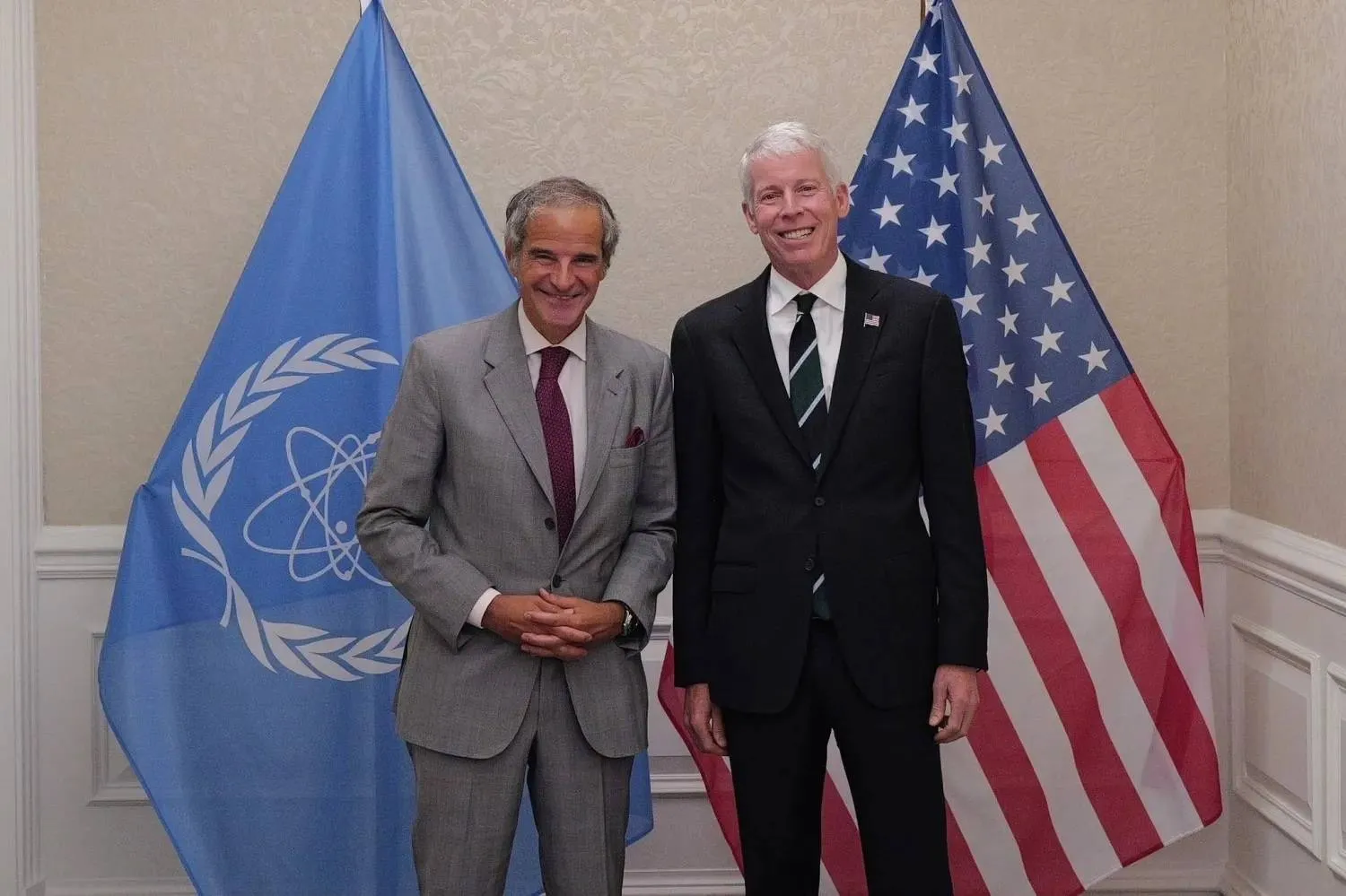

Grossi: Nuclear Talks with Iran Currently 'Stalled'

Rafael Grossi, Director General of the International Atomic Energy Agency (IAEA), and US Energy Secretary Chris Wright, in Washington. (Grossi on X)
TT

Grossi: Nuclear Talks with Iran Currently 'Stalled'

Rafael Grossi, Director General of the International Atomic Energy Agency (IAEA), and US Energy Secretary Chris Wright, in Washington. (Grossi on X)

Rafael Grossi, Director General of the International Atomic Energy Agency (IAEA), said on Thursday that talks on Tehran’s nuclear program remain stalled, adding that the nuclear file has reached an “impasse.”

At a press conference with US Energy Secretary Chris Wright in Washington, Grossi said the nuclear issue will not be a priority until key issues, including the situation surrounding the Strait of Hormuz and other broader matters, are clarified.

He said that, under the current circumstances, there is no clear channel for advancing discussions on the nuclear issue.

Grossi said contacts with both the US and Iran are continuing, noting that the IAEA remains engaged in dialogue with both sides.

He added that Iran’s position is that no progress on the nuclear issue can be achieved until broader progress is made in the overall negotiations.

However, the IAEA chief said both sides identified key nuclear issues and areas requiring joint cooperation.

He spoke about contacts between US special envoys, Steve Witkoff and Jared Kushner, and Iranian representatives, and expressed hope that the process could yield results in the near future.

Grossi also said that Iran still possesses around 440 kilograms of highly enriched uranium.

His remarks came while Tehran refuses to let IAEA inspectors visit facilities hit during the 12-day US-Israeli conflict in 2025.

For his part, Wright said Wednesday that Washington would prefer a diplomatic solution with Iran but was prepared to destroy its nuclear facilities “if necessary.”

“Iran has a nuclear weapons program and our goal is to stop it,” he said.

“An agreement must be reached with Iran under which it renounces nuclear armament,” he added.

The IAEA chief said he discussed with Wright nuclear non-proliferation issues, including Iran and his recent visit to Syria.

Grossi arrived in the US ahead of the launch of the IAEA's initiative ATLAS, designed to aid the deployment of civil nuclear applications at sea.

Meanwhile, Mohammad Eslami, head of the Atomic Energy Organization of Iran, said that any inspection of nuclear facilities damaged in military attacks must be carried out in accordance with Iranian law, with the approval of the Islamic Consultative Assembly, and only after specific security protocols have been established.

Eslami said that requests to inspect the affected facilities under the current circumstances are “not acceptable.”

He then accused the US and Israel of pressuring the IAEA to inspect Iranian nuclear facilities damaged by military strikes.

“At a time when the IAEA has no such protocol and is not taking a position either, it is only the United States and Israel that are applying pressure for the Agency to go to the damaged sites and inspect them,” he said.

“The reason for this pressure is that they want to see what happened to these sites as a result of the military operations they carried out,” Eslami added.



Iran’s Disfigured Supreme Leader Remains Invisible Six Months into an Existential War

A man holds a picture of Iranian Supreme Leader Mojtaba Khamenei during the funeral of former Supreme Leader Ali Khamenei in Tehran. (AP)
TT

Iran’s Disfigured Supreme Leader Remains Invisible Six Months into an Existential War

A man holds a picture of Iranian Supreme Leader Mojtaba Khamenei during the funeral of former Supreme Leader Ali Khamenei in Tehran. (AP)

Six months after the airstrikes that began the war and propelled a badly wounded Mojtaba Khamenei into the role of Iran's supreme leader, he remains entirely unseen and unheard by Iranians — a vacuum at the heart of his country's leadership. Questions over his condition and role are growing increasingly fraught, with Iran facing critical decisions over a war that has set the Middle East aflame while trashing the country's already fragile economy.

Iranian officials and other senior sources in the country say Khamenei remains in control, ruling from the shadows for security reasons as he recovers from disfiguring wounds while delegating broad daily authority to a coterie of top figures.

But with no photograph, video or audio message released since his appointment a week into the war, Iranians are ever more skeptical about his position in a regime in which the leader's voice is meant to be absolute.

"The question is no longer whether Mojtaba is alive, but whether Iran still has a functioning supreme leader," said Alex Vatanka of the Middle East Institute in Washington.

Khamenei's only messages to the Iranian people have come via a handful of written statements read aloud by news broadcasters and ‌he was even missing ‌from the extravagant week of funeral rites for his father last month.

Top officials and other insiders attribute ‌Khamenei's absence to ⁠assassination fears and ⁠say he holds frequent meetings with top figures, receives all major reports and takes the final decisions on every important issue.

President Masoud Pezeshkian said on August 10 that he had held a seven-hour meeting with Khamenei.

But even among the regime's most hardline supporters, doubts are creeping in.

"We need to hear our leader's voice, or see any sign that he is there on top and leading the country to give us more confidence," said a member of the Basij volunteer militia in Qom, the seminary city at the heart of Iran's theocratic state.

While the Basij member, who requested anonymity to discuss such a sensitive subject, said he believed Khamenei was indeed still making key decisions, the lack of even a photograph was damaging morale and not in Iran's interest.

Among Iranians who oppose the ruling hierarchy or want broad reforms, ⁠the message is blunter. "How do we know that Mojtaba has not been killed?" said Shahrokh, a pro-reform businessman ‌in Tehran who also requested anonymity.

"It is not logical that there is not a single sign ‌proving he is alive, let alone evidence that he is involved in decision-making," he added.

REVOLUTIONARY GUARDS KEY TO POWER STRUCTURE

Iran has weathered six months of war with its ‌most powerful enemies to emerge battered but still standing. Its political system has held. Its military retains the ability to choke off global energy supplies and ‌strike Gulf countries.

The clerical establishment has shown it can absorb the loss of a supreme leader and senior commanders without collapsing, maintaining a political and military chain of command loyal to their theocratic ideology.

But Iran's economy is buckling under the cost of the conflict and a months-long blockade of its oil exports, which has cratered the rial currency, risking a resumption of the mass protests that authorities crushed in January by killing thousands of demonstrators.

Meanwhile, the ruling establishment has reorganized around a clear imperative: preserve the state, restore ‌deterrence and stop the economic fallout from destabilizing the country.

The Revolutionary Guards, long a powerful force, grew in influence from the start of the war and remain central to strategic thinking at the top of a ⁠reconfigured ruling system around the Supreme National ⁠Security Council, the sources said.

That upper echelon includes the top Guards commanders as well as senior political figures such as Pezeshkian and parliament Speaker Mohammed Baqer Qalibaf.

Several senior sources reached by Reuters in Iran said Khamenei was in fact holding meetings with those top figures, was fully involved in deliberations and has the final say on all major questions.

A senior Iranian official said only a small number of officials retained direct contact with Khamenei in person and that no details of him had been published for fear of leaking information that could allow the US to target him.

His health is meanwhile improving significantly, said a person close to Khamenei's inner circle, describing him as sharp and involved in decision-making.

"Despite all the pressures, services to the people have not stopped. Our foreign policy line is unified and our decisions are coherent. All of this shows the supreme leader is in charge," a second official said.

Even before the war, Khamenei preferred a backroom role as his father's top aide, shunning public attention. His wounds in the early hours of February 28, when Israel and the United States launched their war with air strikes that killed his late father, disfigured his face according to senior sources.

But now elevated to a role seen as conferring divine guidance, and at the country's moment of greatest crisis since the 1979 revolution, such considerations look unconvincing.

"A genuine deal with Washington requires Mojtaba's unmistakable approval and so does any decision to sustain a long and costly conflict with the United States," said Vatanka.

"His prolonged absence has created a dangerous situation in which rival factions can all claim to know what the leader really wants," he added.


Kherson Residents Urged to Flee as Russian Attacks Intensify

 In this photo provided by the Ukrainian Emergency Service, cars burn as firefighters try to put out a fire following a Russian drone attack in Kyiv region, Ukraine, Friday, Aug. 28, 2026. (Ukrainian Emergency Service via AP)
In this photo provided by the Ukrainian Emergency Service, cars burn as firefighters try to put out a fire following a Russian drone attack in Kyiv region, Ukraine, Friday, Aug. 28, 2026. (Ukrainian Emergency Service via AP)
TT

Kherson Residents Urged to Flee as Russian Attacks Intensify

 In this photo provided by the Ukrainian Emergency Service, cars burn as firefighters try to put out a fire following a Russian drone attack in Kyiv region, Ukraine, Friday, Aug. 28, 2026. (Ukrainian Emergency Service via AP)
In this photo provided by the Ukrainian Emergency Service, cars burn as firefighters try to put out a fire following a Russian drone attack in Kyiv region, Ukraine, Friday, Aug. 28, 2026. (Ukrainian Emergency Service via AP)

A drone attack early Friday killed one man in Kherson, hours after authorities urged residents to leave as intensifying Russian attacks on the southern Ukrainian city risk cutting power supplies ahead of the long winter.

Russian forces are positioned on the opposite bank of the Dnipro River, which borders the city briefly occupied by Moscow in 2022, making it particularly vulnerable to shelling.

The drone attack early Friday in Kherson's Korabelnyi district killed a 61-year-old man who was taken to hospital with a "penetrating chest wound", Yaroslav Shanko, the head of the Kherson city administration, said.

Three others wounded were taken to hospital in the Dniprovsky district.

The attack came after regional governor Oleksandr Prokudin on Thursday urged residents of Kherson, "especially families with children and elderly people", to "please leave", in a Telegram post.

Prokudin said there was an "extremely difficult security situation" in the city, which had about 280,000 inhabitants before the start of Russia's invasion in February 2022. It was occupied by Russian forces from March to November of that year.

"The enemy is intensifying its attacks every day on the region's critical infrastructure," he said, adding that on Wednesday "Russian forces again attacked Kherson's district heating plant with glide bombs".

The facility "sustained very serious damage", he said, adding that Kherson may find itself "without electricity or heating not for hours or days but for a long period".

Ukrainian stocks of interceptor missiles have also started to dwindle.

"There is no way to destroy these types of drones or aerial bombs in any region of our country," he said.

Last winter, Russia repeatedly targeted Ukrainian power plants, plunging millions of people into cold and darkness.

President Volodymyr Zelensky warned earlier this month that Ukraine had "virtually no intact thermal power plants".

- Repeated attacks on Kyiv -

Russia and Ukraine have for several months been ramping up their long-range strikes, increasingly targeting civilian infrastructure such as logistics warehouses and oil and port facilities.

These attacks are causing a rising number of civilian casualties.

Further from the front line, Ukraine's capital Kyiv has been particularly targeted this summer.

On Thursday, the capital spent nearly 15 hours under air raid alert due to repeated drone attacks, according to local authorities.

This "shows another way Russia is using its weapons to disrupt civilian life", the Ukrainian Foreign Ministry said in response, warning that Moscow "continues to choose terror and war".

In the face of Russian bombardments, Zelensky has consistently appealed to allies for new air defense systems.

While Ukraine has in recent days received fresh promises of military aid from European countries, including France, it primarily relies on advanced US Patriot systems to protect its airspace.

Deliveries of these missiles have sharply decreased, however, as US stockpiles depleted because of the Middle East war.

Four and a half years after Russia's large-scale invasion of Ukraine, negotiations, briefly undertaken with US mediation to end the conflict, are at a standstill.

Russian Chief of General Staff Valery Gerasimov has nonetheless visited troops fighting on the Ukrainian front to congratulate them on their "successes" in the eastern Donetsk region.

During the visit he said the Russian army was now only a few kilometers from Sloviansk and Kramatorsk, cities whose capture is a key objective for the Kremlin.


South Korea Backs Trump Bid to Revive North Korea Talks, Seeks Nuclear Progress

US President Donald Trump meets with North Korean leader Kim Jong Un at the demilitarized zone separating the two Koreas, in Panmunjom, South Korea, June 30, 2019. (Reuters)
TT

South Korea Backs Trump Bid to Revive North Korea Talks, Seeks Nuclear Progress

US President Donald Trump meets with North Korean leader Kim Jong Un at the demilitarized zone separating the two Koreas, in Panmunjom, South Korea, June 30, 2019. (Reuters)

South Korea supports US President Donald Trump's efforts to resume dialogue with North Korea, but aims to ensure its security posture is not weakened and that Seoul is not sidelined, South Korea's national security adviser said on Friday.

Seoul believes the resumption of talks between the US ‌and North Korea ‌should focus on progress on the North Korean ‌nuclear weapons ⁠issue and must ⁠not undermine the country's security readiness, Wi Sung-lac told reporters.

"One point to keep in mind is the need to coordinate with the United States to ensure that any resumption of US-North Korea dialogue leads to substantive progress on the North Korean nuclear issue, alongside efforts to establish a peace regime on the Korean Peninsula," Wi said.

To achieve these ⁠aims, policy coordination and communication between South Korea and ‌the United States were more important than ‌ever, he said.

Wi cited Trump's order earlier this month to substantially scale ‌back major joint military drills between the two allies, saying the ‌US president was signaling a willingness to engage with North Korea.

At the same time, Seoul should ensure it was not "sidelined" in Washington's efforts to restart talks with Pyongyang, Wi said.

Trump cited in part Seoul's refusal to offer help ‌in the Iran war for cutting short the Ulchi Freedom Shield drills this month and said they sent ⁠a wrong ⁠message to North Korea. Trump has been seeking a new summit with North Korean leader Kim Jong Un.

The two met three times in 2018 and 2019.

South Korea, Japan and the United States will conduct joint military drills from September 9 to 11 to test readiness against North Korea's missile and nuclear weapons threats, South Korea said on Friday.

Wi said South Korea is seeking to deepen cooperation with Washington on a range of issues that have sometimes caused friction between the allies.

These include South Korean investment in the US agreed under a trade deal, the treatment of US-listed e-commerce firm Coupang, security cooperation, intelligence sharing and the transfer of wartime operational control, he said.