


Iran’s Disfigured Supreme Leader Remains Invisible Six Months into an Existential War

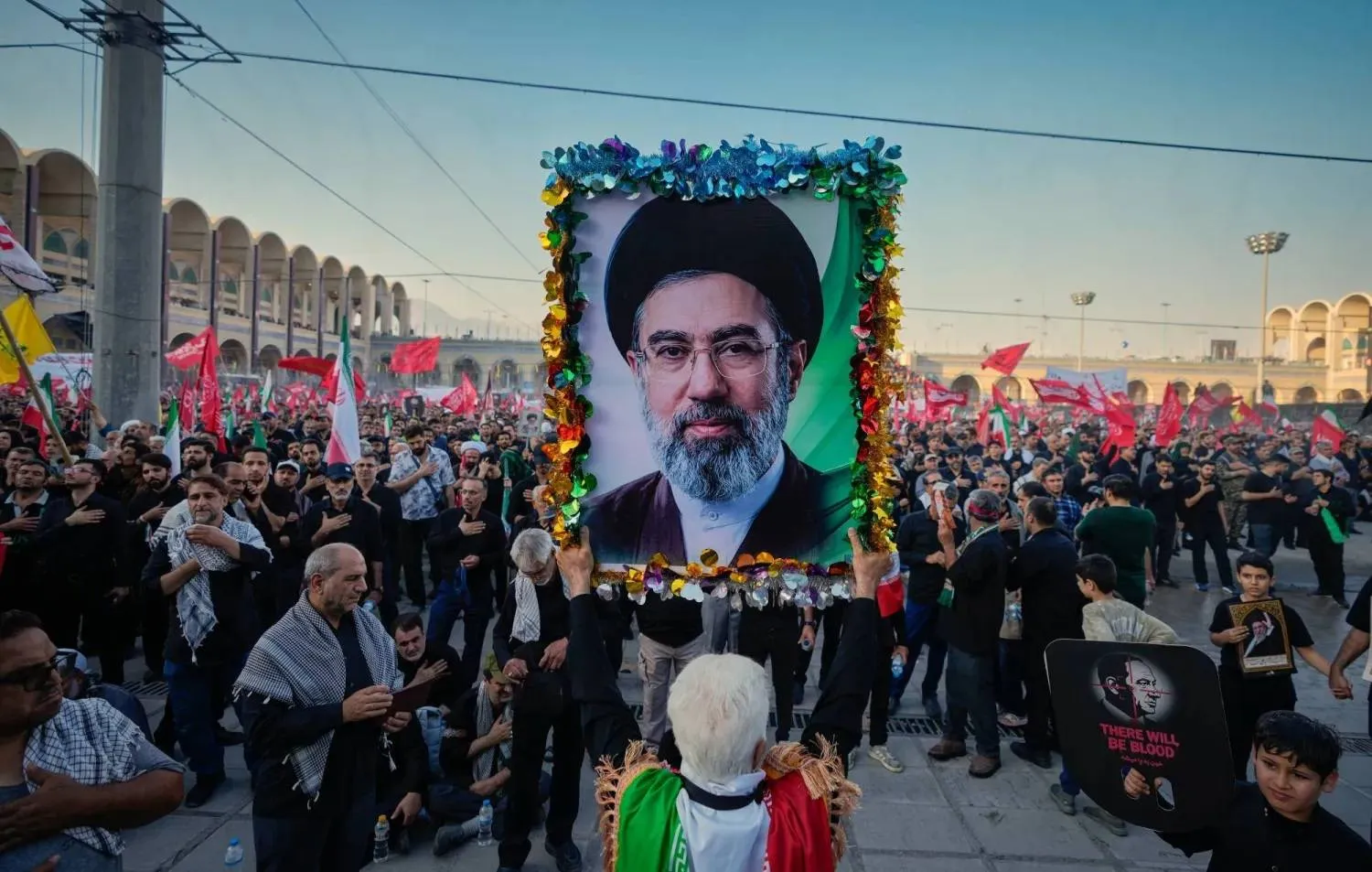
A man holds a picture of Iranian Supreme Leader Mojtaba Khamenei during the funeral of former Supreme Leader Ali Khamenei in Tehran. (AP)
TT

Iran’s Disfigured Supreme Leader Remains Invisible Six Months into an Existential War

A man holds a picture of Iranian Supreme Leader Mojtaba Khamenei during the funeral of former Supreme Leader Ali Khamenei in Tehran. (AP)

Six months after the airstrikes that began the war and propelled a badly wounded Mojtaba Khamenei into the role of Iran's supreme leader, he remains entirely unseen and unheard by Iranians — a vacuum at the heart of his country's leadership. Questions over his condition and role are growing increasingly fraught, with Iran facing critical decisions over a war that has set the Middle East aflame while trashing the country's already fragile economy.

Iranian officials and other senior sources in the country say Khamenei remains in control, ruling from the shadows for security reasons as he recovers from disfiguring wounds while delegating broad daily authority to a coterie of top figures.

But with no photograph, video or audio message released since his appointment a week into the war, Iranians are ever more skeptical about his position in a regime in which the leader's voice is meant to be absolute.

"The question is no longer whether Mojtaba is alive, but whether Iran still has a functioning supreme leader," said Alex Vatanka of the Middle East Institute in Washington.

Khamenei's only messages to the Iranian people have come via a handful of written statements read aloud by news broadcasters and ‌he was even missing ‌from the extravagant week of funeral rites for his father last month.

Top officials and other insiders attribute ‌Khamenei's absence to ⁠assassination fears and ⁠say he holds frequent meetings with top figures, receives all major reports and takes the final decisions on every important issue.

President Masoud Pezeshkian said on August 10 that he had held a seven-hour meeting with Khamenei.

But even among the regime's most hardline supporters, doubts are creeping in.

"We need to hear our leader's voice, or see any sign that he is there on top and leading the country to give us more confidence," said a member of the Basij volunteer militia in Qom, the seminary city at the heart of Iran's theocratic state.

While the Basij member, who requested anonymity to discuss such a sensitive subject, said he believed Khamenei was indeed still making key decisions, the lack of even a photograph was damaging morale and not in Iran's interest.

Among Iranians who oppose the ruling hierarchy or want broad reforms, ⁠the message is blunter. "How do we know that Mojtaba has not been killed?" said Shahrokh, a pro-reform businessman ‌in Tehran who also requested anonymity.

"It is not logical that there is not a single sign ‌proving he is alive, let alone evidence that he is involved in decision-making," he added.

REVOLUTIONARY GUARDS KEY TO POWER STRUCTURE

Iran has weathered six months of war with its ‌most powerful enemies to emerge battered but still standing. Its political system has held. Its military retains the ability to choke off global energy supplies and ‌strike Gulf countries.

The clerical establishment has shown it can absorb the loss of a supreme leader and senior commanders without collapsing, maintaining a political and military chain of command loyal to their theocratic ideology.

But Iran's economy is buckling under the cost of the conflict and a months-long blockade of its oil exports, which has cratered the rial currency, risking a resumption of the mass protests that authorities crushed in January by killing thousands of demonstrators.

Meanwhile, the ruling establishment has reorganized around a clear imperative: preserve the state, restore ‌deterrence and stop the economic fallout from destabilizing the country.

The Revolutionary Guards, long a powerful force, grew in influence from the start of the war and remain central to strategic thinking at the top of a ⁠reconfigured ruling system around the Supreme National ⁠Security Council, the sources said.

That upper echelon includes the top Guards commanders as well as senior political figures such as Pezeshkian and parliament Speaker Mohammed Baqer Qalibaf.

Several senior sources reached by Reuters in Iran said Khamenei was in fact holding meetings with those top figures, was fully involved in deliberations and has the final say on all major questions.

A senior Iranian official said only a small number of officials retained direct contact with Khamenei in person and that no details of him had been published for fear of leaking information that could allow the US to target him.

His health is meanwhile improving significantly, said a person close to Khamenei's inner circle, describing him as sharp and involved in decision-making.

"Despite all the pressures, services to the people have not stopped. Our foreign policy line is unified and our decisions are coherent. All of this shows the supreme leader is in charge," a second official said.

Even before the war, Khamenei preferred a backroom role as his father's top aide, shunning public attention. His wounds in the early hours of February 28, when Israel and the United States launched their war with air strikes that killed his late father, disfigured his face according to senior sources.

But now elevated to a role seen as conferring divine guidance, and at the country's moment of greatest crisis since the 1979 revolution, such considerations look unconvincing.

"A genuine deal with Washington requires Mojtaba's unmistakable approval and so does any decision to sustain a long and costly conflict with the United States," said Vatanka.

"His prolonged absence has created a dangerous situation in which rival factions can all claim to know what the leader really wants," he added.



US-hosted G20 Finance Meeting to Target Growth, Imbalances, Iran Sanctions, Treasury Official Says

US Secretary of the Treasury Scott Bessent (R) arrives during a press conference in Washington, DC on August 24, 2026.  (Photo by Kent NISHIMURA / AFP)
US Secretary of the Treasury Scott Bessent (R) arrives during a press conference in Washington, DC on August 24, 2026. (Photo by Kent NISHIMURA / AFP)
TT

US-hosted G20 Finance Meeting to Target Growth, Imbalances, Iran Sanctions, Treasury Official Says

US Secretary of the Treasury Scott Bessent (R) arrives during a press conference in Washington, DC on August 24, 2026.  (Photo by Kent NISHIMURA / AFP)
US Secretary of the Treasury Scott Bessent (R) arrives during a press conference in Washington, DC on August 24, 2026. (Photo by Kent NISHIMURA / AFP)

The Trump administration aims to have finance leaders from the Group of 20 major economies agree next week on steps to boost economic growth, reduce global imbalances and tackle sovereign debt challenges while pressing them to cut off Iran's economic lifelines, a senior US Treasury official said on Thursday.

After shunning the South Africa-led G20 process last year, US Treasury Secretary Scott Bessent will host G20 finance ministers and central bank governors on Monday and ‌Tuesday in the ‌Blue Ridge Mountains city of Asheville, North Carolina.

The Treasury official ‌said ⁠that the Trump ⁠administration has been focused on addressing global trade imbalances to benefit American workers and leveling the playing field for American firms.

"And so we're really focusing on this head on in our G20 discussions to ensure that our economies compete on productivity, innovation, and investment, and not on just sort of policies that push excess production and excess capacity into global markets," the official said, echoing terms often used by the Trump administration to describe China's export-oriented economic ⁠model.

The official said that other G20 economies have seen "tremendous ‌amounts of dumping on their shores" as the ‌US has tightened its trade barriers, without naming China directly as the source of these goods.

The ‌official said that the US-led growth discussions in the G20 meeting will focus on ‌supporting resilient supply chains for critical resources, including energy, and on supporting private-sector innovators who drive productivity growth.

G20 discussions will include business leaders to discuss barriers to investment, innovation, and productivity, and regulatory reforms.

Asked about how Bessent will address G20 finance leaders' concerns about rising US debt and ‌bond yields, the official said that bond yields, elevated since the start of the US-Israeli attacks on Iran in late February, would ⁠fall as inflation cools ⁠over time.

Nonetheless, the Treasury was focused on bringing longer-maturity bond yields lower, as evidenced by Bessent's move to increase buyback sizes of 10- to 30-year Treasuries, the official added.

After the Treasury warned countries on Monday that they face secondary US sanctions if they fail to cut remaining business ties to Iran, the official said that Bessent would be making a "strong statement" to G20 officials that they must adhere to the US sanctions campaign against Iran if they want to continue to do business in the dollar-based, Western financial system.

"I expect that this will come up in every single bilateral meeting that the secretary is hosting with our G20 counterparties over the coming days," the official said. "This is a critical aspect right now of our economic campaign against Iran, and so we want to ensure that there's consistency across all of the G20 members."


Trump Orders Lake Ontario to Be Renamed ‘Lake America’

A Canadian flag flies along the waterfront of Lake Ontario, in Toronto, Ontario, Canada, on August 27, 2026. (AFP)
TT

Trump Orders Lake Ontario to Be Renamed ‘Lake America’

A Canadian flag flies along the waterfront of Lake Ontario, in Toronto, Ontario, Canada, on August 27, 2026. (AFP)

US President Donald Trump on Thursday ordered Lake Ontario to be renamed "Lake America" as he escalated his trade war with Canada, sparking immediate pushback from Ottawa.

Trump stepped up his trolling of Canada by signing an executive order changing the name of the body of water on the border between the North American neighbors.

But Canadian Prime Minister Mark Carney swiftly rejected Trump's move, saying it would be called Lake Ontario "then, now and always."

The volatile US leader's move comes after US-Canada trade talks collapsed at the last minute last week, prompting the two longtime allies to slap tit-for-tat tariffs on each other.

"We're going to be changing the name of Lake Ontario effective immediately to Lake America," the 80-year-old Republican told journalists as he signed the order at the White House.

Asked by an AFP reporter why he was targeting an ally for punishment instead of America's adversaries, Trump replied: "The Canadian officials have treated us very badly. They're nasty people."

Behind Trump's desk in the Oval Office were two maps -- one with the words "Lake America" in red over the lake, and the other with the header, "Making the Great Lakes Even Greater."

- Canada strikes back -

Lake Ontario is the smallest by surface area of the five Great Lakes, which straddle the border between the United States and Canada. It borders the Canadian province of Ontario and the US state of New York.

The name change mirrors Trump's unilateral altering of the name of the Gulf of Mexico to the Gulf of America in January 2025 -- a move Mexico has also rejected.

Carney retorted that the name of the lake was 400 years old -- predating the formation of both the United States and Canada -- and came from an Indigenous word meaning "the lake is beautiful, the lake is big."

"We know that America is changing," he said in a post on X.

"Canadians also know that naming reality means calling it Lake Ontario -- then, now and always."

Carney's defiance of Trump in recent days has won plaudits at home.

In Toronto, Canada's largest city which lies on the lake's northwestern shore, Canadians and Americans alike criticized Trump's move.

"Typical Trump. He's being a bully, he goads, he antagonizes," said Mark Weicker, who lives in Kitchener, west of Toronto.

"He's just trying to egg us on," chimed in Jake Marchuk, who was visiting from Alberta province.

- 'All we need is an ocean' -

Trump's executive order tells the US Department of the Interior to update references to the lake in the official geographical naming service within 30 days and ensure the federal government calls it "Lake America."

It justifies the name change by saying that the deepest part of the lake is on the American side, meaning that the United States "claims most of the Lake's volume."

Trump -- who faces low approval ratings amid the Iran war and economic woes at home, with crucial US midterm elections around the corner in November -- said he had been thinking about the name change "for a long time."

The US president even hinted at renaming oceans that border the United States.

"We have a gulf and we have a lake. Now all we need is an ocean. So, maybe we'll have to change the name of the Atlantic and/or the Pacific. Maybe we'll change them both," he said.

During his second presidential term, Trump has irked a series of allies with his outlandish territorial claims, including that Canada should become the 51st US state.

Trump has also laid claim to Greenland, an autonomous territory of NATO ally Denmark, and talked about making Venezuela a state following the US capture of its leader Nicolas Maduro.

In recent days, he has also said that he will make the Strait of Hormuz between Iran and Oman a US territory, despite the fact that the war with Tehran remains ongoing.


Norway's King Harald Dead at 89

(FILE) Norway's King Harald during a press conference on the Royal Yacht Norge in Aarhus, Denmark, 16 June 2023  (reissued 28 August 2026). EPA/BO AMSTRUP DENMARK OUT
(FILE) Norway's King Harald during a press conference on the Royal Yacht Norge in Aarhus, Denmark, 16 June 2023 (reissued 28 August 2026). EPA/BO AMSTRUP DENMARK OUT
TT

Norway's King Harald Dead at 89

(FILE) Norway's King Harald during a press conference on the Royal Yacht Norge in Aarhus, Denmark, 16 June 2023  (reissued 28 August 2026). EPA/BO AMSTRUP DENMARK OUT
(FILE) Norway's King Harald during a press conference on the Royal Yacht Norge in Aarhus, Denmark, 16 June 2023 (reissued 28 August 2026). EPA/BO AMSTRUP DENMARK OUT

Norway's King Harald has died aged 89, the palace said on Friday, his 53-year-old son Crown Prince Haakon automatically succeeding him on the throne.

"It is with deep sadness that we announce that His Majesty King Harald passed away today. King Harald passed away peacefully at Oslo University Hospital on Friday, August 28 at 6:35 am," (0435 GMT) it said in a statement.

The flag at the royal palace in Oslo was lowered to half-mast, an AFP reporter at the scene said.

A few dozen people had gathered outside the palace in the morning, but after the flag was lowered to half-mast hundreds began making their way to the palace courtyard.

Hundreds of flowers had already been laid down the day before.

"Of course it's sad. He's a symbol of our country. And naturally, it's sad when something so beautiful comes to an end," 36-year-old Maja Otvik told AFP in front of the palace.

- 'Deep sorrow' -

Prime Minister Jonas Gahr Store said in a statement that he had received the news with "deep sorrow".

"An entire nation mourns, and at the same time remains profoundly grateful for a long life devoted to Norway," the head of government said.

"King Harald loved Norway. And Norway loved its king," he added.

The prime minister said the government would convene a conference "shortly" and thereafter meet the new king, Haakon, at the palace.

Europe's oldest reigning monarch, King Harald had been in hospital in Oslo since August 17 suffering from haemolytic anaemia, a condition caused by an abnormally rapid destruction of red blood cells which leads to fatigue and shortness of breath.

The royal family had rushed to his bedside on Thursday as the palace announced that Harald's condition was "extremely serious".

His wife Queen Sonja, Haakon and his wife Mette-Marit and their adult children spent much of Thursday at his bedside, with media reporting that Haakon kept vigil overnight.

Harald, who ascended the Norwegian throne in 1991, had had multiple health problems in recent years, forcing him to have a pacemaker fitted and to scale back his official schedule.

But he always ruled out abdicating, arguing that he took a lifelong oath before the Norwegian parliament.

Norwegian Prime Minister Jonas Gahr Store had cancelled a work trip to Germany early Thursday due to the king's deteriorating condition.

The past year has been a turbulent one for the Norwegian royal family.

In February, King Harald was hospitalized for an infection and dehydration in Tenerife, where he was on a private trip with Queen Sonja.

His wife, also 89, was briefly admitted to hospital in May due to heart problems.

Haakon's wife Mette-Marit is under scrutiny for her ties to the late US sex offender Jeffrey Epstein.

Documents published in January in the United States revealed her sustained and at times intimate correspondence with Epstein between 2011 and 2014, at a time when the American financier had already been convicted.

Mette-Marit's son from a relationship prior to her marriage to Haakon, Marius Borg Hoiby, is also in the spotlight as a result of his legal troubles.

He was sentenced in June to four years in prison for two rapes and 32 other charges, including violence against a former partner. He has appealed the verdict.

Suffering herself from a serious lung disease, Mette-Marit, 53, had to undergo a lung transplant in July.

The royals remain broadly popular with the Norwegian public, in large part to Harald's unifying status and his unassuming, modest lifestyle.