
War Weighs on Iran's Economy as US Intensifies Sanctions

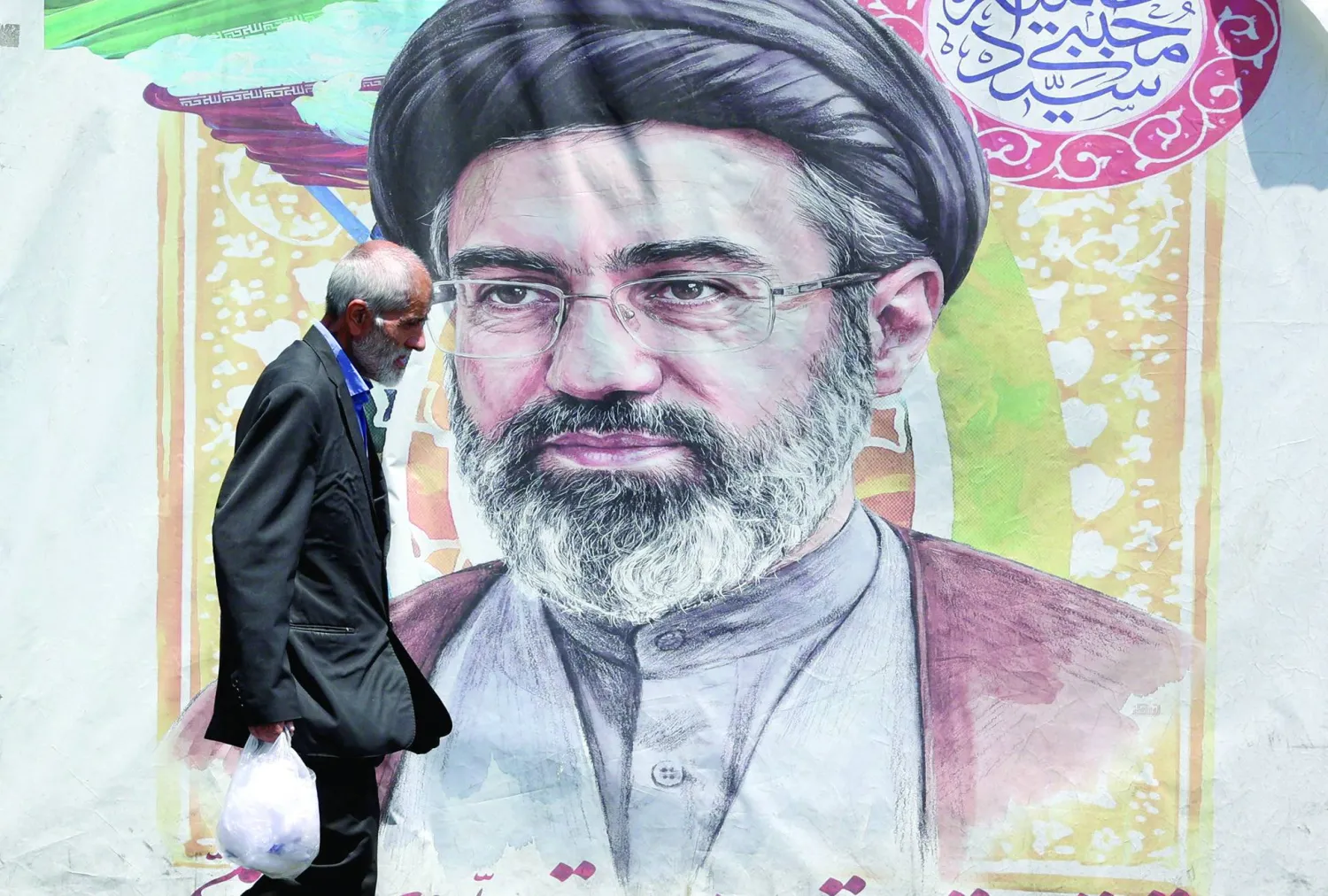
An Iranian man walks past a poster of Iranian supreme leader Mojtaba Khamenei in a street in Tehran, Iran, 18 June 2026. EPA/ABEDIN TAHERKENAREH
TT

War Weighs on Iran's Economy as US Intensifies Sanctions

An Iranian man walks past a poster of Iranian supreme leader Mojtaba Khamenei in a street in Tehran, Iran, 18 June 2026. EPA/ABEDIN TAHERKENAREH

Iranian leaders are acknowledging the economic toll of war with the US, with the supreme leader urging the government to address the hardship and the president saying foreign trade has shrunk by a third due to the American sanctions and blockade. 

Yet Tehran signaled no retreat on Saturday, vowing to withstand US pressure, pursue diplomacy and maintain what it said was control over the Strait of Hormuz, the strategic waterway giving Iran leverage through its ability to disrupt global energy markets. 

The government said in a statement on state media that addressing economic pressures caused by sanctions and war was a central focus, including curbing inflation, managing markets, creating jobs, directing investment towards domestic production and gradually reducing dependence on the dollar. 

Six months after the US and Israel launched the war, negotiations are at an impasse and President Donald Trump's administration has stepped up efforts to punish Iran financially with what it has billed as an "economic D-Day". 

SANCTIONS COMPOUND TOLL ON IRAN'S ECONOMY 

Washington has warned countries to ‌cut business ties with Iran ‌or face secondary sanctions, though the Treasury Department stopped short of imposing penalties against major Iranian ‌trade partners ⁠such as China ⁠and India, which could have repercussions for the US and global economies. 

The US has issued sanctions targeting an entity based in Hong Kong and a person linked to Iran's Bank Melli, according to a notice ⁠on the Treasury website. 

The sanctions drive compounds the toll of the war on Iran's economy, where ‌annual inflation hit 66% last month. 

Supreme Leader Mojtaba Khamenei — who has not been seen ‌publicly since he was injured in the initial February 28 attack that killed his father and former Supreme Leader, Ali Khamenei — called on the ‌government to tackle the economic hardship. 

"There is the need to seriously address the chain of economic and livelihood challenges, such as inflation, unemployment, ‌management of prices and the market for goods and services," he said, according to a written statement attributed to Khamenei. 

President Masoud Pezeshkian told state media that Iranian exports and imports had slumped nearly 35% because of US sanctions and a naval blockade of Iranian ports. 

But he said Iran was able to sell about 90 million barrels of oil during the short-lived memorandum of understanding that the US and Iran signed in June, when Washington permitted Iranian oil sales. 

Later on ‌Saturday, Pezeshkian called on state TV for a revival of the interim deal, which was signed on June 17 but quickly unraveled amid disagreements over what had been agreed, especially on the status ⁠of the Strait of Hormuz. 

"We can ⁠solve our problems and gain our privileges with the memorandum of understanding," he said of a document that had offered Iran, among other things, immediate relief from US sanctions and the release of its frozen assets. 

IRAN VOWS TO PURSUE DIPLOMACY AND DEFENSE 

With the US focused on its economic pressure campaign, others have sought to revive diplomatic efforts to end the war. 

Qatari Prime Minister Sheikh Mohammed bin Abdulrahman Al Thani met with Iranian leaders in Tehran on Thursday. He said he had stressed during the meeting the importance of returning to the pre-war status of open shipping through the Strait of Hormuz. 

Iranian Foreign Minister Abbas Araghchi on Friday described the talks with Sheikh Mohammed as "creative". 

In Saturday's statement, Iran said diplomacy and defense were "two complementary, coordinated and inseparable wings" for protecting the country's national interests, security and territorial integrity. It said it would pursue both tracks in a balanced manner. 

Qatar and Pakistan helped broker the June memorandum of understanding. 

Before the war, the Strait of Hormuz carried 20% of the world's oil and LNG. US military commanders say American forces have cleared sea mines from the strait that had been laid months ago by Iran's Revolutionary Guard Corps. 

Trump has repeatedly said the strait is open, but the Revolutionary Guards' navy said in a statement that such claims "are an obvious lie", reiterating that the waterway remained closed to ships without Iranian permission. 


Sources: US to Open Two New Military Bases in Greenland

People take part in the Arctic Basic Training managed by the Arctic Command, in Kangerlussuaq, Greenland February 20, 2026. Ritzau Scanpix/Bo Amstrupvia REUTERS
TT

Sources: US to Open Two New Military Bases in Greenland

People take part in the Arctic Basic Training managed by the Arctic Command, in Kangerlussuaq, Greenland February 20, 2026. Ritzau Scanpix/Bo Amstrupvia REUTERS

The US plans to re-establish a Cold War-era military base in southern Greenland and set up another on the east coast, now used by the Danish dog sled patrol, under a deal to be signed with Denmark and Greenland on Tuesday, according to three people familiar with the matter.

The sites are Narsarsuaq, whose population has dwindled to a few dozen people since the US closed its Bluie West One military base in the 1950s, and Mestersvig, a military outpost used by the Sirius Dog Sled Patrol, a Danish special forces unit, said two of the people.

Denmark, ⁠Greenland and the United ⁠States are expected to sign their new agreement at the United Nations General Assembly in New York City at 10:30 a.m. ET (1430 GMT) on Tuesday.

The text of the agreement has not been made public and the three people familiar with the deal, speaking on condition of anonymity, said its details will not be finalized until it is signed.

The ⁠governments of Denmark and Greenland did not immediately respond to a request by Reuters for comment.

A White House spokesperson declined to comment on the details of the agreement, repeating an earlier statement that its signing on Tuesday would "secure and defend the security of Greenland and the United States."

Denmark says the agreement puts Arctic security under the watch of the North Atlantic Treaty Organization, the military defense alliance, rather than leaving it solely to the US and Denmark.

The deal follows months of pressure from US President Donald Trump, who has long said he wants ⁠the US ⁠to control Greenland and has at times refused to rule out military or economic force to acquire the semi-autonomous Danish territory. The idea has been rejected by an overwhelming majority of Greenlanders, polling shows.

Trump's threats, which peaked in January, triggered a diplomatic crisis within NATO and pushed Denmark and Greenland into negotiations with Washington aimed at defusing the pressure.

During the Cold War, the US maintained 17 military installations and more than 10,000 personnel in Greenland. Today only Pituffik Space Base remains, with some 150 US military personnel.


Macron Says Talks with Trump on Red Sea, Ukraine ‘Constructive’

French President Emmanuel Macron (R) walks with Jerome Bonnafont (L), Permanent Representative of France to the United Nations and France’s Foreign Affairs Minister Jean-Noel Barrot (C) as they arrive at Trump Tower in New York City on September 21, 2026, ahead of a meeting with US President Donald Trump. (AFP)
TT

Macron Says Talks with Trump on Red Sea, Ukraine ‘Constructive’

French President Emmanuel Macron (R) walks with Jerome Bonnafont (L), Permanent Representative of France to the United Nations and France’s Foreign Affairs Minister Jean-Noel Barrot (C) as they arrive at Trump Tower in New York City on September 21, 2026, ahead of a meeting with US President Donald Trump. (AFP)

French President Emmanuel Macron said on Monday he had positive talks with his US counterpart Donald Trump on the conflicts in Ukraine and in the Red Sea. 

"The other issue we talked about was the situation in the Red Sea... It's important for global prices. Then we had a long discussion about Ukraine and Russia," said Macron after their New York meeting. 

"We had a very good discussion. It was very constructive." 

Going into the high-stakes meeting ahead of the United Nations' high-level week, a French official briefed that Macron was prepared to face Trump with "total candor." 

On Ukraine, Macron said he has pressed Trump on the issue of supplying defensive weapons systems to Ukraine. 

They discussed "the need to help our Ukrainian friends faster and more strongly in terms of (missile) interceptors, because that is... a defensive measure," Macron said. 

The French president said Trump was "very amenable and we were able to go into detail on these two conflicts, which are obviously important for peace in the world and for our security." 

The Red Sea has become a key oil shipping route with the Strait of Hormuz blocked, but the takeover of the Strait of Bab al-Mandab by the Iran-backed Houthi militants has complicated shipping operations there. 

The European Union's naval mission in the Red Sea would need more than 10 warships, its foreign policy chief said on Monday, adding ‌that for ‌now there weren’t ‌that ⁠many in the ⁠area.

"When Aspides (the EU military operation) was put in place, then the indication was that ⁠it needs at ‌least ‌10 ships. The situation, ‌I think, is ‌even more grave right now," she told reporters on the sidelines ‌of the annual gathering of world leaders ⁠at ⁠the United Nations.

Kallas last week sent a letter to member states asking them to contribute more naval and air assets in the region, diplomats said.

Macron traveled to New York from Saint Pierre and Miquelon, a small French territory off Canada's Atlantic coast, where he met with Canadian Prime Minister Mark Carney. 

Carney has been embroiled in a war of words with Trump over a failed effort between the US and Canada to strike a trade deal, resulting in tit-for-tat tariffs. 

The French president also plans to meet with Ukrainian President Volodymyr Zelensky on the sidelines of the UN General Assembly. 


Washington Mobilizes Allies in the Arctic

US Secretary of State Marco Rubio speaks to members of the media during a signing ceremony on the sidelines of the 81st United Nations General Assembly in New York City, on September 21, 2026. (AFP)
TT

Washington Mobilizes Allies in the Arctic

US Secretary of State Marco Rubio speaks to members of the media during a signing ceremony on the sidelines of the 81st United Nations General Assembly in New York City, on September 21, 2026. (AFP)

US Secretary of State Marco Rubio on Monday stressed the need for investment in the Arctic while meeting with his counterparts from seven countries in the region, on the eve of signing a security agreement on Greenland.

"Allies agreed that Arctic security requires continued investment to safeguard this vital region and deter strategic competitors," State Department spokesman Tommy Piggott said in a readout of the meeting.

"Discussions focused on taking greater responsibility for Arctic security by developing sovereign military and economic capabilities, ensuring investment security, and funding resilient critical infrastructure that ensures reliable access and supports our shared leadership in the Arctic."

The meeting convened top diplomats from Canada, Denmark, Finland, Iceland, Norway, Sweden, the Faroe Islands and Greenland, at a New York hotel on the sidelines of the United Nations General Assembly.

Greenland, Denmark and the United States are due to sign an agreement regarding the Arctic at the UN on Tuesday, the office of Danish Prime Minister Mette Frederiksen said Monday evening.

The agreement was announced Friday by US President Donald Trump, and has not yet been made publicly available.

But Frederiksen said it recognizes the sovereignty and territorial integrity of Denmark, and the right of self-determination for Greenland's people.

Washington said the agreement paves the way to strengthen US military presence in Greenland while ensuring that China and Russia will not be able to establish bases or carry out sensitive investments there without consent.

Monday's discussions also touched on cooperation to develop a fleet of icebreakers between the US, Canada and Finland.

In October, the United States announced the purchase of 11 icebreakers from Finland for the US Coast Guard to add to its fleet of three aging ships.

European Union foreign policy chief Kaja Kallas said recently that Europe needs icebreakers to strengthen its presence in the Arctic, as global warming draws the interest of major powers to the region.

Vast natural resources are becoming increasingly accessible in the Arctic as ice melts and new maritime routes open up due to climate change.

China, Russia and the United States are reinforcing their presence in the strategic Arctic as a result.