


Niamey Back to Normal After Soldier Mutiny

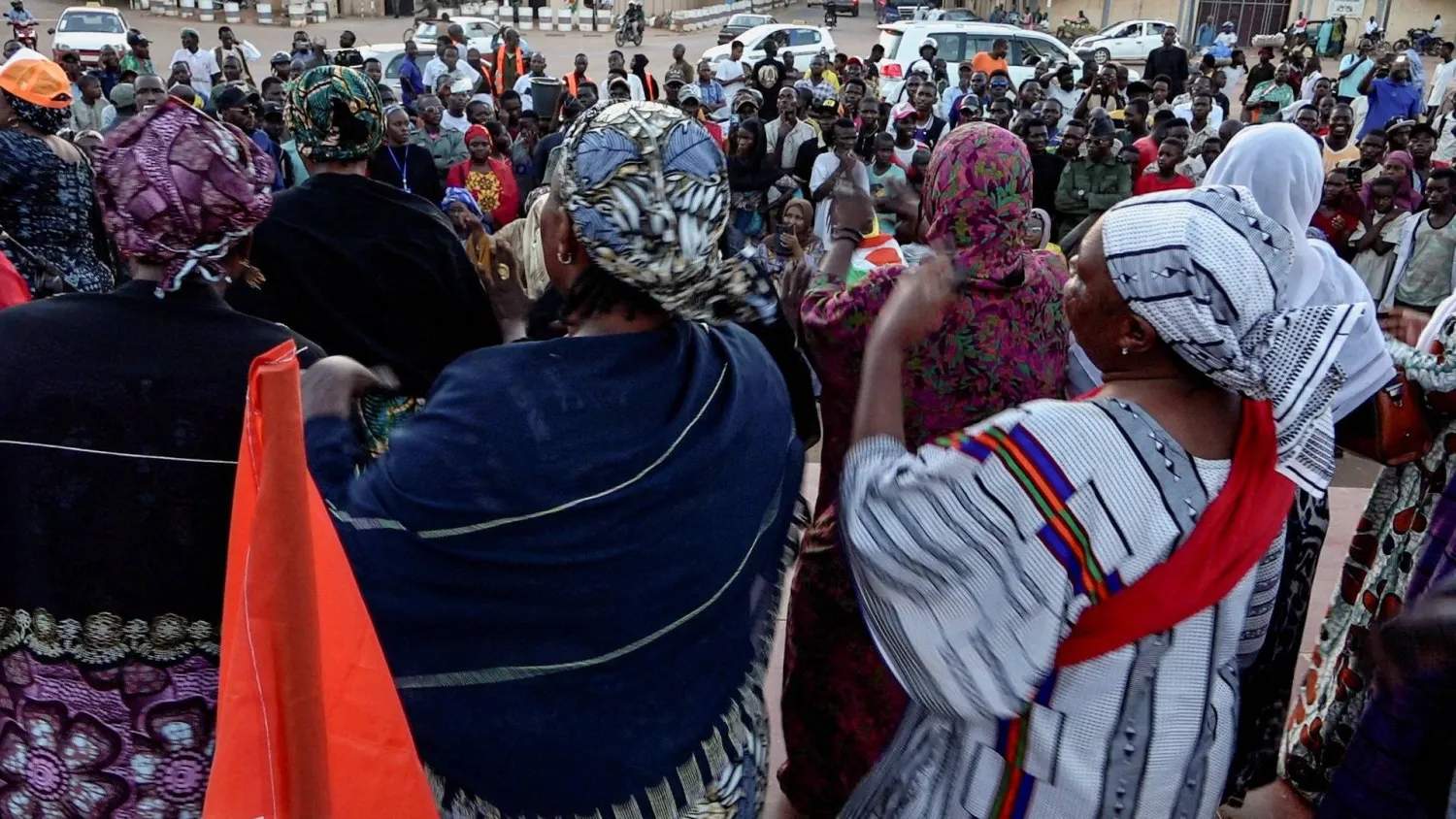
People gather at the Place de la Concertation following an attack by mutineers on the airport and the presidency in Niamey, Niger, August 29, 2026. (Reuters)
TT

Niamey Back to Normal After Soldier Mutiny

People gather at the Place de la Concertation following an attack by mutineers on the airport and the presidency in Niamey, Niger, August 29, 2026. (Reuters)

Life returned to normal in Niger's capital, Niamey, on Sunday, after the military regime and its Russian paramilitary partners put down a mutiny by soldiers.

Intense fighting took place overnight from Friday to Saturday, with the army and its Russian Africa Corps allies managing to take back control late in the day.

Mutineers notably tried to storm the presidential compound. Several were killed, according to a security source, while others were arrested.

Television pictures showed soldiers surrendering.

Niger has been led by General Abdourahamane Tiani since a coup in July 2023. He has moved the country closer to Russia and away from Western partners, notably former colonial power France.

On Sunday morning, access to the airbase at the airport, where the mutineers had barricaded themselves in, and to the presidency, were open again, residents said.

Local people were going about their business and shops that were shut on Saturday have reopened, as had Niamey's main market.

"We had a hellish night on Friday. This morning, it's like paradise because yesterday evening (Saturday) was very pleasant," said one resident in the Talladje area near the airbase.

A major security operation was nonetheless being maintained with soldiers screening people entering the presidency with metal detectors.

Vehicles mounted with machine guns and soldiers were also posted along approach roads to the presidency. A similar deployment was seen around the airport.

"What happened was between us Nigeriens," said one shopkeeper from the Route Tchanga neighborhood near the airport.

"From now on, such serious events must never happen again. The country is already facing terrorism."

- Prey to extremists -

The exchange of fire was the third such incident this year but in January and June involved extremists attacking the international airport and airbase.

They were pushed back in hours. Russian troops helped in the first incident.

Niger has been hit by extremist violence for more than a decade and, like its neighbors Burkina Faso and Mali, is struggling to contain it.

Both countries are also run by the military and have close links to Russia.

Although Niger has turned its back on almost all previous Western allies, Italy maintains a couple of hundred soldiers in the country to train Nigerien forces.

Italian Foreign Minister Antonio Tajani on Sunday said on X that he was "closely following developments in Niger following the attacks".

He added that the Italian military personnel there "are well" and continued to do their work.

"The stability of Niger is fundamental to the security of the entire Sahel region, crucial also for countering illicit trafficking and irregular migratory flows," Tajani said.

Washington Proposes Exchanging AI Safety Alerts with Beijing

US Treasury Secretary Scott Bessent stands next to US Trade Representative Jamieson Greer, speaking to the media, after meeting with China's Vice Premier He Lifeng (AFP) 
TT

Washington Proposes Exchanging AI Safety Alerts with Beijing

US Treasury Secretary Scott Bessent stands next to US Trade Representative Jamieson Greer, speaking to the media, after meeting with China's Vice Premier He Lifeng (AFP) 

US Treasury Secretary Scott Bessent said Sunday Washington has proposed a new “notification mechanism” for artificial intelligence incidents that could affect national security, part of weekend discussions ahead of talks at the White House this week between US President Donald Trump and China’s Xi Jinping.

“We want a shared vision of common goals and common threats,” Bessent told reporters after talks with Chinese Vice Premier He Lifeng in New York.

“We think that just like any cross-border activity, that moving from opaque to more transparency between the No 1 and the No 2 AI powers in the world is very important,” he added.

Trump has resisted calls to slow down AI development, saying that would help China catch up to US companies.

Standing together in the soaring lobby of the JPMorgan Chase headquarters late Sunday, Bessent and US Trade Representative Jamieson Greer said the groundwork had been laid for talks between Xi and Trump set to take place on Thursday.

They said the two sides had agreed to operationalize a new “Board of Trade” that the two leaders had discussed when they met in Beijing in May.

“Today those notions have become reality,” Greer said.

Greer said the countries were still discussing what “nonsensitive” items could be considered for lower tariffs, but that the list could potentially include consumer and agricultural goods, energy products and medical devices.


Russian Document Reveals How Moscow Sought to Deepen Ties with Iran to Evade US Sanctions

Russian President Vladimir Putin with Iran's President Masoud Pezeshkian during a session held on the sidelines of the BRICS summit (EPA) 
TT

Russian Document Reveals How Moscow Sought to Deepen Ties with Iran to Evade US Sanctions

Russian President Vladimir Putin with Iran's President Masoud Pezeshkian during a session held on the sidelines of the BRICS summit (EPA) 

An official Russian document obtained and reviewed by Fox News reveals how Moscow sought to deepen its relationship with Iran to bypass US sanctions, laying out plans for alternative financial channels, nuclear cooperation, Iranian production of Russian aircraft components, well as open new financial avenues.

The 44-page Russian-language document was approved on the Russian side on Sept. 2, 2024. It indicated that Russia had drawn up a comprehensive plan for the period 2024-2026, which included the creation of alternative financial channels, the use of national currencies in transactions, strengthening nuclear cooperation, projects in the oil and gas sectors, the production of spare parts for Russian aircraft in Iran, and the continuation of the operation of the Bushehr nuclear power plant by Rosatom.

The roadmap also calls for Russia to help establish production in Iran of individual parts and assemblies for Russian aircraft.

Russian authorities were instructed to determine which aircraft parts could be repaired or manufactured in Iran, identify Iranian companies capable of producing them, certify selected sites through Russia’s aviation regulator Rosaviatsiya and conclude a localization agreement, according to Fox News.

The document also proposed building a railway line from the Iranian border with Azerbaijan to ports on the Arabian Gulf. However, it remains unclear which of these projects are still being implemented, given the changes brought about by the current war.

Russia has maintained close ties with Iran for years, but those relations have intensified since Russia's invasion of Ukraine. US reports say Iran has provided drone support to Russia, but Tehran has categorically denied them.

This cooperation was further strengthened as the US exerted pressure on Iran through economic sanctions, amid reports that Moscow had offered Tehran assistance in the production of cruise missiles.

Keti Korkiya, a research analyst with the Foundation for Defense of Democracies’ Russia program, reviewed the document for Fox News Digital and said its significance lies less in any single project than in the architecture Moscow was trying to build around the relationship.

“The roadmap is not revelatory: people paying close attention to the relationship between Russia and Iran will see many collaborations between the two countries that have been public for years,” Korkiya said in written analysis provided to Fox News Digital.

“What is more revealing is the architecture of the relationship Moscow is trying to build,” she said, pointing to financial mechanisms, transportation routes, energy investment and aviation cooperation as different ways of reducing vulnerabilities created by sanctions and Western economic pressure.


Trump Administration Prepares Sanctions against International Criminal Court

(FILES) This general view shows the exterior of the International Criminal Court (ICC) in The Hague on March 28, 2026. (Photo by JOHN THYS / AFP)
TT

Trump Administration Prepares Sanctions against International Criminal Court

(FILES) This general view shows the exterior of the International Criminal Court (ICC) in The Hague on March 28, 2026. (Photo by JOHN THYS / AFP)

President Donald Trump's administration has prepared sanctions against the entire International Criminal Court and plans to announce them soon, two sources familiar with the matter said, a move that would step up its attack on the global tribunal that prosecutes war crimes and genocide worldwide.

The Trump administration has made no secret of its disdain for the court and has worked to undermine it. US officials want the ‌court to drop ‌its arrest warrants against Israeli leaders as well as ‌a ⁠past probe into American ⁠troops in Afghanistan, Reuters said.

US Secretary of State Marco Rubio in July announced a campaign to isolate the court, calling on other countries to withdraw from the tribunal. Washington has imposed sanctions on a number of ICC judges and prosecutors but has so far held off from imposing sanctions on the court itself, although the move has long been considered as one of the options.

The State Department did not immediately respond to a request ⁠for comment.

Sanctions against the court have been prepared, the sources said, ‌even though the exact timing of an ‌announcement remained unclear. The Wall Street Journal cited officials who said the decision could be finalized ‌as soon as this week during the United Nations General Assembly meeting.

Targeting the ‌entire organization directly, as well as entities that cooperate with it, could severely undermine the court's work.

Any entity-wide sanctions imposed by the US Treasury would prohibit US citizens and companies from providing funds, goods, or services to the court without a license from the US Treasury's Office ‌of Foreign Assets Control (OFAC). Banks often over-comply with such US sanctions because they depend on access to the American financial system.

Among ⁠the court's operations ⁠that could be affected by sanctions against the entire organization are the purchasing of IT services and insurance, the hiring of investigators and conducting everyday financial transactions, such as paying dozens of American employees, the ICC's registrar and president have warned.

Trump's opposition to the court goes back to his first term. It surfaced again with a plan to penalize ICC officials, an idea developed in November 2024 when Trump was reelected and the ICC issued an arrest warrant for Netanyahu for alleged war crimes and crimes against humanity in the Gaza conflict.

The ICC was established in 2002 by the international community to prosecute war crimes, genocide and crimes against humanity. It asserts jurisdiction only if a member state is unable or unwilling to prosecute atrocities itself.

The United States has never been a member.
