


How a Billion-dollar Sanctions Dodge Kept Chinese Goods Flowing to Iran

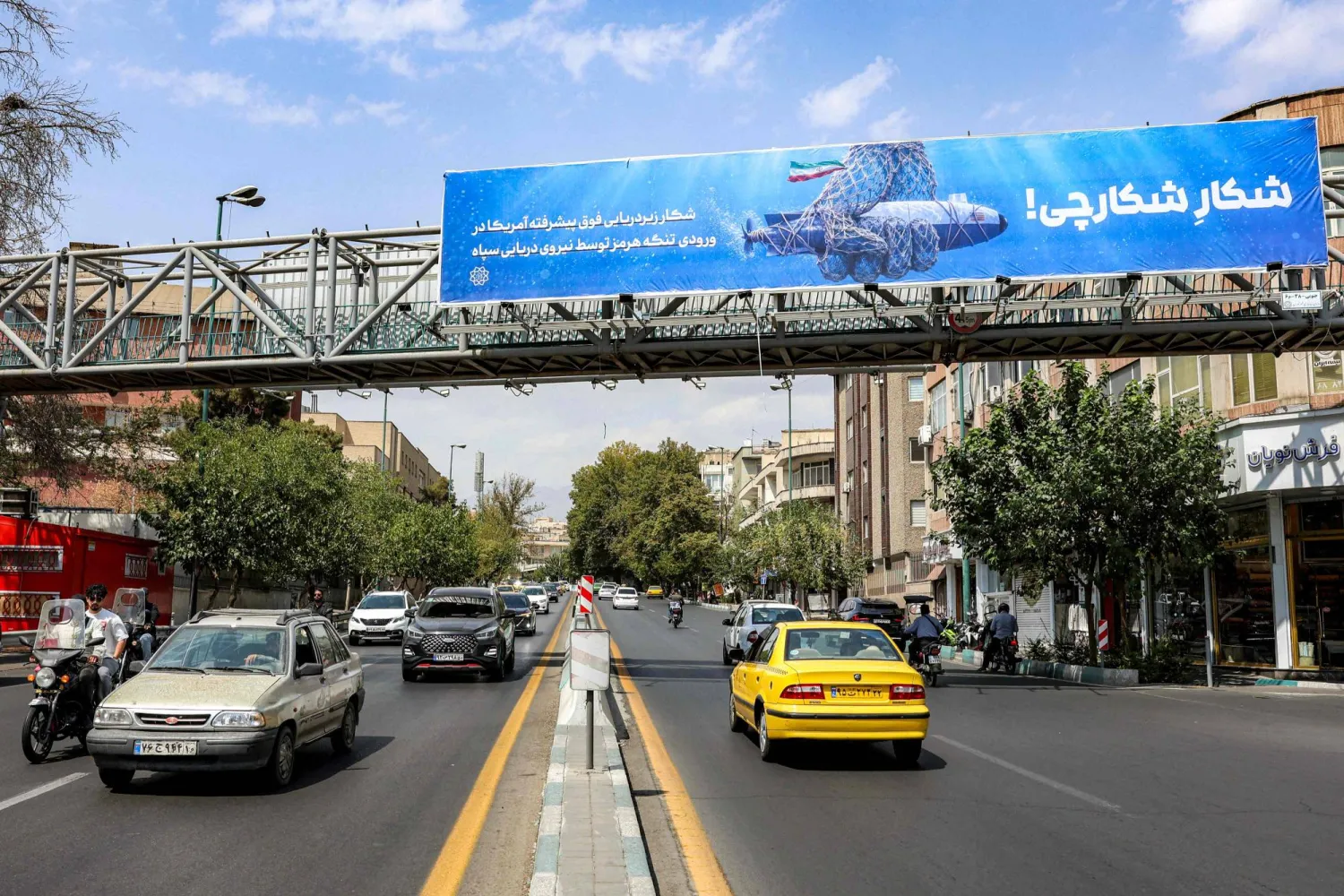
Vehicles move along a street near a pedestrian bridge displaying a billboard depicting a US underwater drone captured by the Iranian military with text in Persian reading "hunting the hunter", in Tehran on September 9, 2026.  (Photo by ATTA KENARE / AFP)
Vehicles move along a street near a pedestrian bridge displaying a billboard depicting a US underwater drone captured by the Iranian military with text in Persian reading "hunting the hunter", in Tehran on September 9, 2026. (Photo by ATTA KENARE / AFP)
TT

How a Billion-dollar Sanctions Dodge Kept Chinese Goods Flowing to Iran

Vehicles move along a street near a pedestrian bridge displaying a billboard depicting a US underwater drone captured by the Iranian military with text in Persian reading "hunting the hunter", in Tehran on September 9, 2026.  (Photo by ATTA KENARE / AFP)
Vehicles move along a street near a pedestrian bridge displaying a billboard depicting a US underwater drone captured by the Iranian military with text in Persian reading "hunting the hunter", in Tehran on September 9, 2026. (Photo by ATTA KENARE / AFP)

Iran has used a barter-like arrangement to bypass sanctions on its oil sales and buy billions of dollars’ worth of goods from China, including military gear, two senior Iranian sources and three other people familiar with the matter told Reuters.

The secretive trade mechanism, in which Iranian oil is exchanged for credits for Chinese imports, has provided a financial lifeline for Tehran in recent years as the United States stepped up economic and military pressure over its nuclear program, according to the sources, who spoke on condition of anonymity.

It has also helped China, the world’s biggest crude importer, retain access to discounted Iranian oil while shielding banks and companies that export to Iran from international scrutiny or penalties, they said.

The US has imposed sanctions on some smaller Chinese entities that buy or facilitate shipments of Iranian oil but has stopped short of the most punishing measures that could have repercussions on the global economy.

Washington has intensified the pressure as it tries to resolve its war with Iran and reopen the Strait of Hormuz. In August, Treasury Secretary Scott Bessent warned countries to cut business ties with Iran or risk being forced out of the dollar-based financial system.

Reuters could not determine the impact on the barter-like arrangement of the US naval blockade imposed on Iran as part of the six-month war. No Iranian crude cargoes have successfully transited the Strait of Hormuz to China since the blockade was reinstated on July 14, the news agency reported last week.

China and Iran have repeatedly denounced what they regard as illegal unilateral Western sanctions and have vowed to protect their interests. The countries are longstanding economic and political partners but have said little publicly about how they keep trade flowing despite international restrictions.

Iran has used the arrangement to buy medicines, vehicles and communication equipment from China, all the sources said. The manufacturers were not ⁠dealing directly with ⁠Iran, and there is no indication they were in breach of sanctions.

The mechanism was also used at least once in the past year in connection with contracts to supply Iran with air defense equipment worth millions of dollars, the sources said.

They did not provide details about any of the alleged transactions with Chinese manufacturers, and Reuters could not independently verify that they took place.

A UN embargo on the export of most major conventional weapons to Iran was reinstated with other sanctions in September 2025 after the US withdrew from a 2015 nuclear accord between Iran and world powers during President Donald Trump’s first term, and Tehran stopped complying with some of its provisions.

Iran and China said the move by European countries to automatically restore the sanctions through a “snapback” mechanism was “legally and procedurally flawed.”

Responding to Reuters questions about the barter-like trade, China’s foreign ministry said it was “not familiar with the situation you describe.”

“China has consistently opposed unilateral sanctions that have no basis in international law and have not been authorized by the United Nations Security Council,” it said.

Iran’s UN missions in New York and Geneva did not respond to requests for comment.

In response to questions to the ⁠White House, a US official said the Trump administration works with economic partners including the European Union to “deprive Iran of the material means of furthering its nuclear ambitions.” The official did not comment on the arrangement described to Reuters.

Decades of US sanctions have left Iran with few oil customers. China is the main buyer, accounting for more than 80% of Iran’s shipped oil in 2025, or an average 1.4 million barrels per day, according to commodities data and analytics firm Kpler.

In 2021, the two countries signed a 25-year strategic partnership accord covering sectors such as energy and infrastructure, but public details remain scarce.

The arrangement described to Reuters is one of a number of mechanisms through which Iran purchases goods and services from China without paying Chinese companies directly through international banking channels, three of the sources said.

A Western official and two other people familiar with the matter said a buyer acting on behalf of Chinese state-owned oil trader Zhuhai Zhenrong was at least until this year depositing hundreds of millions of dollars a month with an obscure, China-based financial entity known as ChuXin.

The deposits covered purchases agreed with a Hong Kong-registered company linked to Iran’s national oil company, the people said, citing material gathered by intelligence agencies.

ChuXin would then send funds to Chinese exporters and companies that build infrastructure in Iran, likely via other Chinese financial institutions.

Roughly 70% of the Iranian oil proceeds handled by ChuXin are allocated to infrastructure projects, the three sources said, an arrangement first reported by the Wall Street Journal last October. The rest go into accounts belonging to a special purpose vehicle (SPV) used to pay companies that supply goods to Iran.

The Iranian sources, who are close to the country’s decision-making circle, confirmed the existence of the SPV, which has ⁠not previously been reported.

All five sources said funds in ⁠the SPV are managed by two entities: a firm acting on behalf of China's Ministry of Commerce and one linked to Iran’s central bank. The Iran-linked firm notifies the Chinese one when Iran’s central bank authorizes importers to access funds in the SPV so payments can be sent to the suppliers, three said.

Reuters could find no record of a financial institution called ChuXin in Chinese company registries or of the firms said to be acting on behalf of China’s commerce ministry and Iran’s central bank. One source said ChuXin might only exist on a spreadsheet.

Companies with the same names as those said to be acting on behalf of the National Iranian Oil Company (NIOC) and Zhuhai Zhenrong are listed in the Hong Kong companies registry, but Reuters could find no public records of their ownership structure or business dealings.

Neither responded to questions delivered to their registered addresses, which are in offices belonging to secretarial services companies.

Zhuhai Zhenrong has been a target of US sanctions over its alleged dealings with Iran. One source shared what appeared to be a July 22, 2025, letter from NIOC to the Chinese oil trader requesting confirmation of an outstanding balance – evidence, the person said, of a business relationship.

Reuters could not independently authenticate the document. NIOC and Zhuhai Zhenrong did not respond to questions about it or their alleged roles in the trade mechanism.

Iran’s central bank and China’s commerce ministry also did not respond to requests for comment.

The mechanism described to Reuters has been in place since at least 2021 and was first used to supply medicines and COVID-19 vaccines to Iran, three sources said.

As Washington has stepped up pressure on companies that do business with Iran, it has become increasingly important for trade, they said. They estimated that between $2 billion and $2.5 billion flowed through the SPV over the last year.

China is using such arrangements to push back against the US and show it cannot be coerced with the threat of secondary sanctions, said Andrea Ghiselli, an international politics lecturer at the University of Exeter who studies Beijing’s relations with the Middle East.

But he said China’s leaders do not want their banks or companies excluded from the international financial system.

“They want plausible deniability.”


Türkiye Nabs Suspect in 2013 Attack by Syria Border

A Turkish flag with the Bosphorus Bridge in the background, flies on a passenger ferry in Istanbul, Türkiye, September 30, 2020. (Reuters)
TT

Türkiye Nabs Suspect in 2013 Attack by Syria Border

A Turkish flag with the Bosphorus Bridge in the background, flies on a passenger ferry in Istanbul, Türkiye, September 30, 2020. (Reuters)

Türkiye's intelligence agency has captured a key suspect from a deadly 2013 attack near the Syrian border while he was attempting to flee to Europe, state media said Thursday, citing a security source.

The twin bombings in the southern Reyhanli district, which killed 53 people, was the deadliest attack in Türkiye linked to fallout from Syria's civil war that began two years earlier, said AFP.

Omar al-Khatib, a Syrian who was the subject of an Interpol red notice, is believed to have coordinated between the attackers and intelligence officials loyal to Syria's then president Bashar al-Assad, Anadolu news agency reported.

Türkiye's National Intelligence Organization (MIT) detained al-Khatib as he prepared to leave for Europe by sea, Anadolu said, without saying exactly where or when he was caught.

Ankara blamed Turkish extremist groups allegedly backed by the Syrian government for the Reyhanli attack, accusations Damascus denied.

Türkiye was a strong supporter of Syrian rebels seeking to overthrow Assad and has hosted millions of Syrians who fled the conflict.

Since Assad's ouster nearly two years ago, Ankara has built close ties with Syria's new leadership under President Ahmed al-Sharaa.


Explosions Heard Overnight in Ethiopia's Capital

(FILES) Tigray People's Liberation Front (TPLF) fighters prepare to leave for another field at Tigray Martyr's Memorial Monument Center  in Mekele, the capital of Tigray region, Ethiopia, on June 30, 2021. (Photo by Yasuyoshi Chiba / AFP)
(FILES) Tigray People's Liberation Front (TPLF) fighters prepare to leave for another field at Tigray Martyr's Memorial Monument Center in Mekele, the capital of Tigray region, Ethiopia, on June 30, 2021. (Photo by Yasuyoshi Chiba / AFP)
TT

Explosions Heard Overnight in Ethiopia's Capital

(FILES) Tigray People's Liberation Front (TPLF) fighters prepare to leave for another field at Tigray Martyr's Memorial Monument Center  in Mekele, the capital of Tigray region, Ethiopia, on June 30, 2021. (Photo by Yasuyoshi Chiba / AFP)
(FILES) Tigray People's Liberation Front (TPLF) fighters prepare to leave for another field at Tigray Martyr's Memorial Monument Center in Mekele, the capital of Tigray region, Ethiopia, on June 30, 2021. (Photo by Yasuyoshi Chiba / AFP)

Explosions were heard overnight in Ethiopia's capital Addis Ababa, three diplomatic sources told Reuters.

A source linked to the opposition alliance that has been fighting federal forces in northern Ethiopia since last week said the alliance had carried out several drone strikes in Addis Ababa, including some targeting the military's headquarters there.

Reuters could ‌not independently ‌verify the claim.

If confirmed, ‌the ⁠strikes would mark ⁠the first known drone attack by anti-government forces on the Ethiopian capital.

Spokespeople for Prime Minister Abiy Ahmed's office, the federal government and the military did not immediately respond to requests for comment.

Last ⁠week's clashes in northern Ethiopia ‌were the biggest escalation ‌of violence in Ethiopia since the end ‌of a 2020-2022 civil war.

The national intelligence ‌service announced on Wednesday that it was banning for an indefinite period all drone flights over Addis Ababa and its surroundings for ‌security reasons.

Opposition alliance forces were not previously known to operate armed ⁠drones. ⁠However, there is growing evidence they may possess at least some drone capability.

On Tuesday, a pro-government militia in the northern region of Tigray said it had captured drone frames and batteries from forces linked to the Tigray People's Liberation Front (TPLF), one of the alliance's main members.

Reuters could not independently verify that claim.


Immigration Judge Rules US Can Deport President of Wisconsin's Largest Mosque

FILE - This photo provided by Yaseen Jajeeb shows Islamic Society of Milwaukee President Salah Sarsour on June 18, 2026, shortly after his release from Clay County Jail in Brazil, Indiana, where he was detained after his arrest by US Immigration and Customs Enforcement agents in March. (Yaseen Najeeb via AP, File)
TT

Immigration Judge Rules US Can Deport President of Wisconsin's Largest Mosque

FILE - This photo provided by Yaseen Jajeeb shows Islamic Society of Milwaukee President Salah Sarsour on June 18, 2026, shortly after his release from Clay County Jail in Brazil, Indiana, where he was detained after his arrest by US Immigration and Customs Enforcement agents in March. (Yaseen Najeeb via AP, File)

An immigration judge ruled that the US government can deport Palestinian American Salah Sarsour, who is the president of Wisconsin's largest mosque and a US permanent resident, under a Cold War-era law.
Sarsour, who grew up in the Israeli-occupied West Bank, was detained by the Immigration and Customs Enforcement agency in late March and released in mid-June after a federal judge said he had raised a substantial free speech retaliation claim that would render his detention unlawful, reported Reuters.
Chicago Immigration ‌Court Judge Jayme ‌Salinardi sided late on Tuesday with the government's argument that ‌Sarsour ⁠posed a security and ⁠foreign policy threat under the Cold War-era Immigration and Nationality Act, while rejecting the government's allegation that he lied on his green card application.
The US Department of Homeland Security welcomed the ruling, saying the judge "sustained multiple grounds of removability" in the case.
Sarsour said his legal team will appeal the ruling, which he called "deeply disappointing."
"I will not stop standing up for what's right and for justice in Palestine," he said in a statement. Sarsour cannot ⁠be deported until all legal avenues available to him are ‌exhausted. He says his life will be at risk ‌if deported to the West Bank.
Islamic Society of Milwaukee, Wisconsin's largest mosque, says Sarsour has ‌lived in the US for over three decades.
The mosque has said Sarsour ‌was "being targeted on the basis of his Palestinian and Muslim background, and his advocacy for Palestinian rights."
He has type 2 diabetes and lost more than 30 pounds in ICE detention, his legal team said.
Sarsour has no criminal record in the US and was convicted as a teenager ‌in Israeli military court before he came to the United States, which the Trump administration noted to cast him as a ⁠threat. Sarsour says ⁠the government has known that information for decades.
Israeli rights group B'Tselem says military courts in the West Bank, where Palestinians are tried for alleged crimes, have a 96% conviction rate and a history of extracting confessions through torture.
President Donald Trump's administration says Sarsour was convicted of throwing Molotov cocktails at the homes of Israeli armed forces.
Sarsour denies committing such crimes and says he was tortured and coerced into past confessions.
Trump has attempted to deport foreign pro-Palestinian protesters, threatened funding freezes for universities where protests were held, enforced a social media screening of immigrants and sanctioned Israel's critics.
Trump alleges pro-Palestinian voices are antisemitic and support extremists. Advocates, including some Jewish groups, say their criticism of Israeli attacks on Gaza and of Israel's occupation of Palestinian territories does not amount to antisemitism, and their advocacy for Palestinian rights should not be conflated with supporting extremism.
