

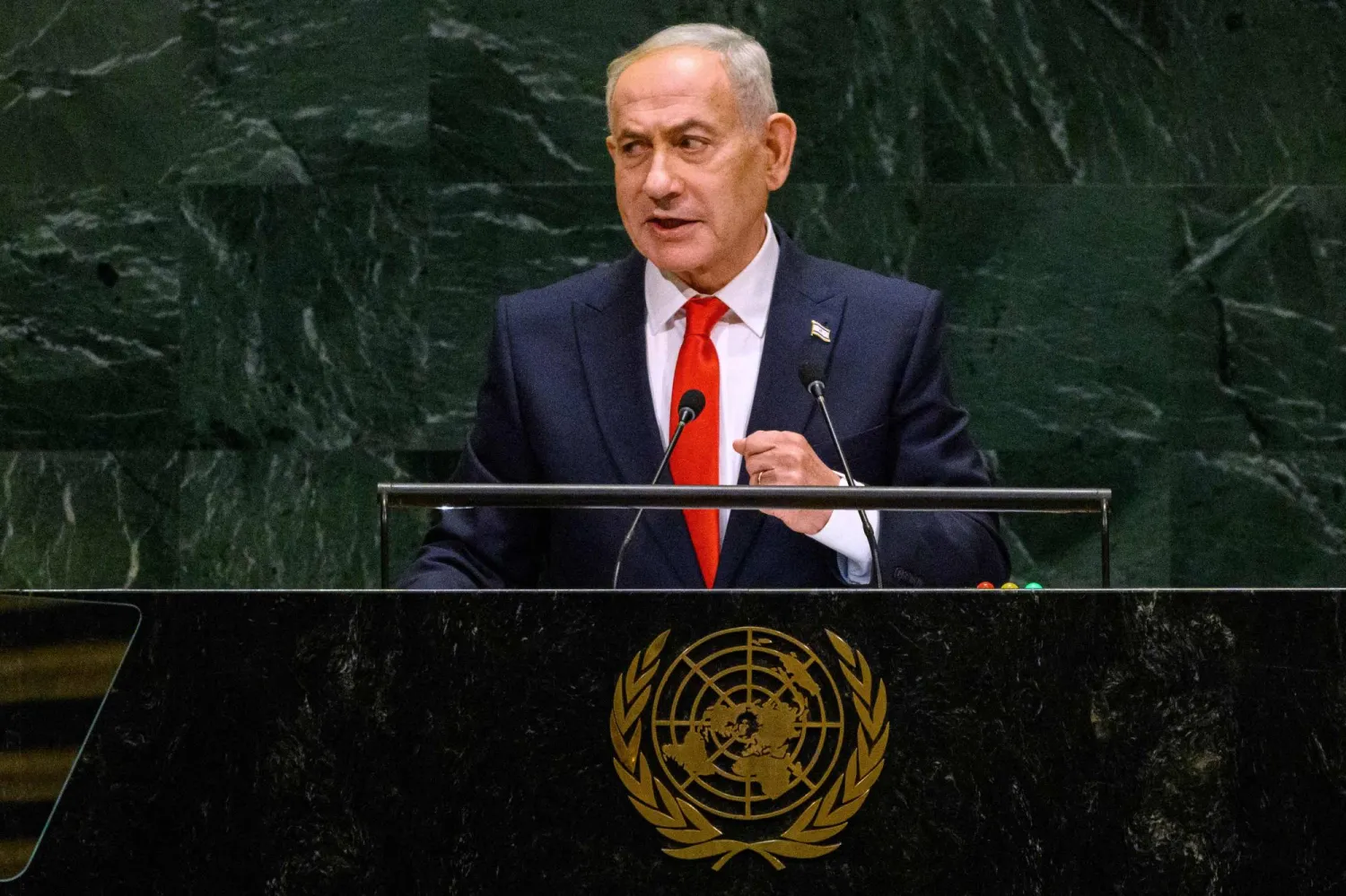

Israel’s Netanyahu Denounces Enemies, Allies in Fiery UN Speech

Prime Minister of Israel Benjamin Netanyahu addresses the 81st session of the UN General Assembly at UN Headquarters on September 24, 2026 in New York City. (Getty Images via AFP)
TT

Israel’s Netanyahu Denounces Enemies, Allies in Fiery UN Speech

Prime Minister of Israel Benjamin Netanyahu addresses the 81st session of the UN General Assembly at UN Headquarters on September 24, 2026 in New York City. (Getty Images via AFP)

Israel's Prime Minister Benjamin Netanyahu, facing a difficult reelection campaign at home, delivered a fiery UN speech Thursday assailing enemies and allies alike -- and sparking uproar in the chamber.

Locked in a tight race to stay in power in October 27 elections, Netanyahu used the global platform at the UN General Assembly to attack everyone from the leaders of Iran to New York's first Muslim mayor and partners Britain, France and Türkiye.

Dozens of envoys from across the world walked out, some jeering and booing, while Netanyahu's own team stood and applauded, and the speaker of the session shouted for order.

"If there are any other moral cowards who haven't left this hall, please do so now," Netanyahu told those turning their backs on him.

He lashed out at New York's popular, leftist Mayor Zohran Mamdani as "antisemitic" and claimed that "since you were elected mayor of this city, many Jews no longer feel safe."

Mamdani had threatened to execute an ICC arrest warrant against Netanyahu, before conceding he did not have the authority.

The Hague-based International Criminal Court (ICC) said in 2024 it had reasonable grounds to believe Netanyahu was responsible for war crimes in the Gaza campaign, which responded to Hamas' deadly October 7, 2023 attacks. Netanyahu denies the ICC claims.

"Netanyahu used his speech to repeat baseless lies meant to sanitize his genocide of Palestinians," Mamdani said in response.

"Yet no lie can change the fact that he remains the subject of an International Criminal Court arrest warrant alleging war crimes and crimes against humanity."

Adding to tensions, dozens of protesters, some brandishing "stop the genocide" banners, gathered near the UN. Several demonstrators were detained, including Hollywood star actor Susan Sarandon.

One of Netanyahu's fiercest critics, Palestinian President Mahmoud Abbas, was unable to attend the UN gathering after the Trump administration refused him a visa.

In a video message played ahead of Netanyahu's speech, Abbas said, "We reject these unlawful punitive measures, and we reject the accusations and justifications on which they were based."

Britain and France, historic partners of Israel that have become increasingly outspoken in their criticism, were also in Netanyahu's firing line.

- Netanyahu attacks Britain, France -

Britain and France have both imposed limited sanctions on Israeli exports from the occupied West Bank.

French President Emmanuel Macron drew Israel's ire for claiming in his own UN speech that Hamas was not active in the West Bank. Hamas' stronghold has traditionally been Gaza.

Netanyahu attacked Britain and France for their past colonial empires during his turn at the lectern.

"They accuse Israel, tiny Israel, of colonialism -- some colonialism. And who's accusing us? Among them are people in Britain and in France. For God's sakes, they invented the term," he said.

Netanyahu already had poor relations with Macron, who led a push by Western nations at last year's UN General Assembly to recognize a Palestinian state.

- Iran's 'murderous dictatorship' -

Netanyahu had especially harsh language on Iran, calling it a "murderous dictatorship."

He said the war in which Israeli and US forces have attacked Iran for close to seven months had stopped Tehran from being able to develop nuclear weapons.

"I vowed to prevent Iran's murderous dictatorship from developing atomic bombs, nuclear weapons aimed at destroying Israel, nuclear weapons that could threaten the entire world," he said.

He said the fall of Iran's leadership, whose envoy at the UN displayed a portrait of slain Quds Force commander Qasem Soleimani on their vacant desk, was not "far."

Despite the onslaught, Iran's government has retained control and continues to defy the United States by effectively blocking the Strait of Hormuz.

- Pager bombs -

During his speech, Netanyahu brandished a pager device like those that Israeli intelligence reportedly engineered with explosives before having them shipped to operatives of Iran-backed Lebanese group Hezbollah.

They were later detonated, maiming dozens of Hezbollah operatives but also civilian bystanders.

He accused Türkiye of backing Iran-backed group Hamas, going on to call the country's leader Recep Tayyip Erdogan a "tyrant."

Netanyahu is only making a whirlwind stop in New York before rushing back to Israel, where the election campaign is in full swing. He is not scheduled to meet any top US leaders.



Some 60 Ships Passed Through Strait of Hormuz on Wednesday, US Official Says

A gull flies overhead as a boy stands with his bicycle on a beach overlooking commercial vessels anchored in the Strait of Hormuz off Bandar Abbas, Iran, Monday, Sept. 7, 2026. (AP)
TT

Some 60 Ships Passed Through Strait of Hormuz on Wednesday, US Official Says

A gull flies overhead as a boy stands with his bicycle on a beach overlooking commercial vessels anchored in the Strait of Hormuz off Bandar Abbas, Iran, Monday, Sept. 7, 2026. (AP)

Some 60 commercial vessels transited the Strait of Hormuz on Wednesday carrying the highest daily volume of crude oil since early July, despite the ongoing war between the US and Iran, a US official told Reuters, speaking on condition of anonymity.

About 40 of those vessels coordinated with ‌the US ‌military for protection, the US ‌official ⁠added. A total ⁠of about 22 million barrels of oil exited the maritime chokepoint.

Reuters could not independently verify the US official's figures.

The Strait of Hormuz has become central to efforts to end the nearly seven-month US-Iran ⁠conflict, with Iran seeking relief from ‌a US ‌blockade that is choking its economy and Washington pressuring ‌Iran to halt interference with ‌shipping through the global oil supply route.

Before the US-Israeli war on Iran started on February 28, the strait typically handled about 125 large, ‌commercial vessels a day, including tankers, gas carriers, bulkers and container vessels, ⁠accounting ⁠for some 20% of the world’s daily crude oil and liquefied natural gas supply.

Reuters reported earlier on Thursday that US and Iranian negotiators in New York are exploring a phased path out of the war that would involve Tehran reopening the Strait of Hormuz and Washington lifting its economic blockade of Iran, sources close to the talks said.


US Senate Rejects Resolution to Halt the Iran War as Gas Prices Upend Midterms

 Vessels at the Strait of Hormuz, as seen from Musandam, Oman, September 23, 2026. (Reuters)
Vessels at the Strait of Hormuz, as seen from Musandam, Oman, September 23, 2026. (Reuters)
TT

US Senate Rejects Resolution to Halt the Iran War as Gas Prices Upend Midterms

 Vessels at the Strait of Hormuz, as seen from Musandam, Oman, September 23, 2026. (Reuters)
Vessels at the Strait of Hormuz, as seen from Musandam, Oman, September 23, 2026. (Reuters)

Despite rising political anxiety over the Iran war, senators on Thursday narrowly rejected a war powers resolution seeking to halt President Donald Trump 's military action, which has been largely blamed for the spike in gas prices and become a flashpoint in the midterm election.

The Senate tally, 49-50, coming days after Trump's bombastic address to the United Nations in which he threatened to “annihilate” Iran, was likely the last chance for lawmakers to go on record about the war ahead of November.

More Republicans are peeling way from the president as the war drags on, a rare slap back to Trump, as they campaign for control of Congress. The Senate outcome fell short, with four GOP senators joining most Democrats in favor of the resolution.

“They have been carrying water for this ridiculous and illegal war for months and months and months and not listening to their constituents,” said Sen. Tim Kaine, D-Va., who pushed the war powers resolution forward.

About half of rural American voters believe the economy is worse off now than when Trump returned to office, according to a new survey from The Associated Press in partnership with KFF. The costs of groceries, gas and healthcare rank as top pain points for the rural voters.

"We’ve got to break the cycle,” said Sen. Thom Tillis, R-N.C., who joined in voting yes.

Republican Sens. Susan Collins of Maine, Lisa Murkowski of Alaska, Rand Paul of Kentucky also voted for the resolution to end the war, as they have in many previous tallies, and Democratic Sen. John Fetterman voted against.

This was the 14th time the Senate has considered a war powers resolution, since Trump launched the conflict on Feb. 28.

War powers resolutions are largely political statements, without the full force of law, but stand among the sharper tools the House and Senate have to express disapproval of the White House, short of halting funds for Trump's military actions. As resolutions, they do not go to the president's desk for his signature.

As gas prices climb, Republicans start to question the war

Republicans in control of Congress have shied away from directly confronting Trump over the war, now stretching past the seven-month mark. But their unrest is surfacing as stubbornly high gas prices leave voters in a cash crunch back home.

Diesel costs, in particular, have almost doubled, topping $6 a gallon, according to AAA.

Just returning from a swing through Iowa, Kansas and Nebraska stumping for GOP candidates who are suddenly at risk in their elections, Sen. John Kennedy of Louisiana called on Trump to hold a prime-time address to the nation to explain the Iran war strategy and the end game.

“People are confused about the war and upset about the cost of living,” he said.

But he and others were not yet ready to vote against the war.

“My own view is that the focus right now needs to be on attacking the cost of living issues,” said Sen. Josh Hawley, R-Mo., who opposes the war powers resolution and believes the president is acting within his authority to conduct the military action.

House Democratic Leader Hakeem Jeffries scoffed at the handful of Republicans now trying to distance themselves from what he called Trump's failed economy. “Now all of a sudden they’re waking up,” he said.

Democrats keep pushing war powers votes in Congress

Earlier this month, the House for a third time approved a war powers resolution, this time with seven Republicans joining the Democrats, including two from battleground Iowa, Rep. Zach Nunn and Rep. Mariannette Miller Meeks, where affordability issues among rural voters are dominating the campaigns.

Senators, though, have rarely been able to confront Trump by passing a war powers resolution.

In June, the Senate approved a war powers resolution after four GOP senators joined Democrats, but Republicans abruptly reversed course the next day after Trump berated them during a private lunch over the outcome.

At the time, Sen. Bill Cassidy of Louisiana, stood up to defend his vote only to end up in a shouting match with Trump. He later switched to oppose the war powers resolution after receiving a personal briefing from the White House.

Thursday's vote was on a resolution that had passed the House in July with GOP support. Rep. Pramila Jayapal, D-Wash., who authored the House resolution, said the Senate outcome was "a slap in the face to the millions of American people who want this war to end."

Other options to halt the Iran war

As the war drags on, costing $43.5 billion so far, Congress is also seeking other ways to force Trump to rethink his military strategy in Iran.

Rep. Thomas Massie, the renegade Republican from Kentucky, pushed forward articles of impeachment against Secretary of Defense Pete Hegseth before the GOP leadership abruptly adjourned the House and sent lawmakers home to campaign for the election, avoiding any potential vote on the matter.

Lawmakers also have the power of the purse to curtail military spending, something Republicans have been reluctant to do but Democrats are sure to tackle if they win power in the midterm election. The White House's request for an additional $87.6 billion funding package for the war and other needs has idled in Congress.

First created in the aftermath of the Vietnam War as a way to hold a president accountable for military actions, the war powers act has long posed a test of the balance of power between the executive and legislative branches of government.

While the Constitution says only Congress can declare war, the president as commander-in-chief is also able to engage the military. The war powers act seeks to provide clarity by requiring the president, within 60 days of any such action, to seek approval — or risk disapproval — from Congress.


Trump-Xi Summit in Washington Features Great Fanfare but Low Expectations

 President Donald Trump and China's President Xi Jinping meet in the Oval Office of the White House, Thursday, Sept. 24, 2026, in Washington. (AP)
President Donald Trump and China's President Xi Jinping meet in the Oval Office of the White House, Thursday, Sept. 24, 2026, in Washington. (AP)
TT

Trump-Xi Summit in Washington Features Great Fanfare but Low Expectations

 President Donald Trump and China's President Xi Jinping meet in the Oval Office of the White House, Thursday, Sept. 24, 2026, in Washington. (AP)
President Donald Trump and China's President Xi Jinping meet in the Oval Office of the White House, Thursday, Sept. 24, 2026, in Washington. (AP)

US President Donald Trump welcomed Chinese President Xi Jinping to the White House on Thursday for a lavish state summit that was heavy on symbolism but light on substance, with no sign that a closed-door meeting yielded breakthroughs on thorny issues such as AI, trade, Taiwan and the war with Iran.

During a bilateral discussion in the afternoon, Xi urged the US to oppose "Taiwan independence," according to a readout from the official Chinese news agency Xinhua shortly after it concluded. The White House did not immediately provide its own summary of the talks.

Xi had been expected to press Trump this week to halt arms sales to Taiwan. Following his visit to China in May, Trump said he was holding in abeyance an arms package to Taiwan worth some $14 billion and called it a "very good negotiating chip."

That move left some US allies in Asia and even some of Trump's fellow Republicans concerned that he may be tempted to soften Washington's support for Taipei in exchange for economic wins. China claims democratically governed Taiwan as its own territory and has not ruled out using force to gain control over the island.

The summit between the two leaders came shortly after Trump forcefully defended his use of military power in a speech at the UN earlier this week, suggesting he could "annihilate" Iran. He took a strikingly different tone with Xi on Thursday, reflecting a power balance that has shifted toward the Chinese leader after a trade war that ended ‌with a US climbdown ‌on tariffs.

In remarks after Xi's arrival on Thursday, Trump emphasized his "truly great friendship" with Xi, rather than focusing on policy differences, and ‌said the ⁠two powers had ⁠made strides on trade since his trip to China in May.

"During this visit, we will also discuss pressing issues concerning security, technology, and 'super intelligence,'" Trump said, using his alternative name for artificial intelligence.

In somewhat more pointed remarks, Xi said the two countries' interests were deeply intertwined and that competition between them should be a "healthy one." US companies were welcome in China, he said, adding that he hopes "Chinese companies are treated fairly here in the United States."

Xi also said both militaries should maintain regular dialogue to improve crisis prevention.

Edgard Kagan, a former senior White House official for East Asia, said the contrasting rhetoric demonstrates the different strategy of each leader.

"The president is casting it very much as about his personal relationship with Xi," said Kagan, now with the Center for Strategic and International Studies. "What I found interesting was Xi is being much more cautious and suggesting that it's less about the personal relationship than the national relationship."

The summit, Xi's first visit to Washington in more than a decade, is the second meeting this year between the leaders ⁠of the world's two biggest economies.

POMP AND CIRCUMSTANCE

For Trump, who relishes ceremony and prizes his ties with powerful leaders, the visit is as ‌much a matter of national prestige as an opportunity for high-stakes diplomacy.

But Trump and Xi's remarks were not carried live ‌by any US television networks, which refused to provide footage in protest of the White House's ban of CNN, MS Now and Politico.

Trump greeted Xi on arrival on Wednesday evening with a red carpet on ‌the tarmac, the first time a US president has welcomed a foreign leader at Joint Base Andrews since President Barack Obama met Pope Francis in 2015, according to C-SPAN.

Following their ‌remarks on Thursday, the two leaders observed a military ceremony including a flyover at the Rose Garden. After their closed-door meeting, Trump gave Xi a tour of the new helipad he had recently constructed on the White House's South Lawn.

"He loves good granite," Trump told reporters, adding that the two men had a "great meeting" without elaborating.

Trump's embrace of Xi could complicate his campaign message at home ahead of November's midterm elections, when Republicans' narrow congressional majorities are at stake as voters fret about inflation and the war on Iran.

The president for months has labeled Democrats "communists" in an effort to paint them as too extreme, but he welcomed Xi, the head ‌of the Chinese Communist Party, as a dear personal friend, with Chinese flags adorning the roof above the Oval Office alongside US flags.

BREAKTHROUGHS UNLIKELY

Despite the fanfare, major breakthroughs appeared unlikely, analysts said.

US Treasury Secretary Scott Bessent told Fox News on Wednesday after talks with Chinese ⁠Vice Premier He Lifeng that they had agreed ⁠to extend until January 10 an agreement pausing their trade war.

Trump wrote in a Truth Social post on Thursday morning that the two leaders would discuss "super intelligence" but again indicated little interest in new regulations, despite concerns from industry leaders that AI could eventually pose a threat to humans.

"Super Intelligence (SI) will be a big topic of discussion, but I want to leave it exactly where it is," Trump wrote. "That is China's position also."

During his comments on Thursday, Xi said both countries must "ensure that the development of AI is always under human control."

Analysts say intense competition between the two powers in AI is likely to limit the scope for anything beyond symbolic agreements.

KEEPING TIES STABLE

People familiar with the plans say the talks could also yield deals to lower some tariffs, combat drug trafficking and expand military-to-military dialogue, while Trump is expected to seek the release of Americans and others detained in China.

Xi appears to be in a stronger position, having overseen a surge in China's trade and firmly in control of supplies of rare earth minerals that give him powerful leverage.

Both leaders see advantages in keeping relations stable, with Trump mired in the unpopular Iran war and Xi grappling with domestic economic challenges.

But beneath the surface are challenges that could reignite tensions, including disputes over Taiwan, export controls, AI and the war with Iran, a Chinese ally.

There has been little sign Beijing is willing to exert pressure on Iran to yield to US demands. During Thursday's meeting, Xi expressed support for the US and Iran to return to a ceasefire and eventually negotiate a peace deal, Xinhua reported.

The guest list for Thursday's state dinner includes CEOs like Apple's Tim Cook, Amazon's Jeff Bezos, Alphabet's Sundar Pichai, OpenAI's Sam Altman, Tesla's Elon Musk and Nvidia's Jensen Huang. Despite such an array, people familiar with US plans say Trump is likely to maintain firm export controls on US tech Xi wants loosened.