


Germany Announces $1.5 Billion in Military Aid for Ukraine

Ukraine's President Volodymyr Zelensky and German Chancellor Friedrich Merz pay tribute at the makeshift memorial to fallen Ukrainian defenders, amid Russia's attack on Ukraine, at the Independence Square in Kyiv, Ukraine, October 4, 2026 (EPA) 
TT

Germany Announces $1.5 Billion in Military Aid for Ukraine

Ukraine's President Volodymyr Zelensky and German Chancellor Friedrich Merz pay tribute at the makeshift memorial to fallen Ukrainian defenders, amid Russia's attack on Ukraine, at the Independence Square in Kyiv, Ukraine, October 4, 2026 (EPA) 

Ukraine and Germany have signed a $1.5 billion arms deal to help counter a surge in Russian drone attacks, as a solidarity visit by German Chancellor Friedrich Merz on Sunday coincided with fresh strikes and air-raid sirens in Kyiv.

The aid for weapons includes combat drones and supporting Ukraine's battered energy sector, which Russia is targeting to cut off heating and power during the freezing winter months, Ukrainian President Volodymyr Zelensky wrote on his X account.

The new package was announced after Merz arrived in Kyiv on Sunday, where he reaffirmed European support for Ukraine.

Air raid sirens blared across the Ukrainian capital throughout the morning, as Kyiv's mayor announced one of the city's bridges had been hit by a Russian drone.

Speaking alongside Ukrainian President at the badly damaged building of Ukraine's Academy of Sciences, where at least two people died in a drone strike last week, Merz said, “We are ‌ready to discuss bringing this war to an end, but these barbaric attacks on the civilian population of Ukraine must stop. I can only repeat once again: Mr Putin, put an end to this senseless war.”

Russia Attacks Bridge in Kyiv

One of the Russian strikes on Sunday hit the Northern Bridge across the Dnipro River, damaging its roadway, Kyiv Mayor Vitali Klitschko said on Telegram. The explosion injured two people and damaged a hot water supply system in the area, he said.

Klitschko has said the capital – largely spared from the devastation wrought near the front line in more than four years of conflict – should now be on a war footing.

Round-the-clock attacks have hit residential areas, petrol stations, schools, rail and communications infrastructure, while the near-constant air raid sirens disrupt daily life and put people on edge.

Zelensky said US peace envoy Steve Witkoff has messaged him to urge a return to ⁠trilateral talks as soon as possible. He said Ukraine was willing to meet this month and hoped Russia would join, but he said Western allies needed to apply more pressure to Moscow to bring the war to an end.

Upon arrival, Merz said Germany remained Ukraine's strongest backer.

“We do this not only to protect Ukraine's territorial integrity; we do it ⁠deeply in our own interest, for it is a matter of Europe's security,” he said, noting that Russia was carrying out cyberattacks and disinformation campaigns that struck at Europe's democratic order.

“If Russia is not stopped, it will turn its war machine against us sooner or later,” Merz added.

Joint Drone Production

The latest deal provides for the joint production of anti-jet drones, Merz told a joint news conference with Zelensky.

“Significant technical breakthroughs have already been achieved in this area in recent weeks,” he added.

“Production is now being ramped up. This strengthens Ukrainian air defense quickly and significantly. We are supplying standoff weapons, combat drones and satellite technology so that Ukraine can also target Russian launch sites,” the German chancellor said.

Last week, Merz called for NATO and European unity against Russia, as well as in his own country, where the far-right, Moscow-friendly AfD opposition is on the rise.

Russia’s Ministry of Defense said Sunday it would intensify its strikes against military-industrial facilities and related infrastructure in Kyiv and other regions of Ukraine, in response to Zelensky’s comments in an interview with Reuters published Saturday that Ukraine would escalate its attacks on Russian oil refineries.

Also, Russia warned foreigners and diplomats to leave Kyiv, saying “massive” new airstrikes would hit the city.

Leaders from countries allied to Ukraine have continued to make visits despite a similar threat made in May.

“The EU Delegation is staying,” European Union ambassador Katarina Mathernova wrote on X on Sunday.

“Threatening us will not stop Europe's support for Ukraine,” she added. “It only reminds us why that support matters!”

Merz told reporters he was unfazed by the threat but did not know if it had been made to coincide with his visit.

In Kyiv, home to some three million people, residents are mulling what to do if that happens again, and there have been calls for the vulnerable and disabled to consider leaving.

Merz said Berlin's winter support program will help provide generators, transformer stations and for grid repairs.
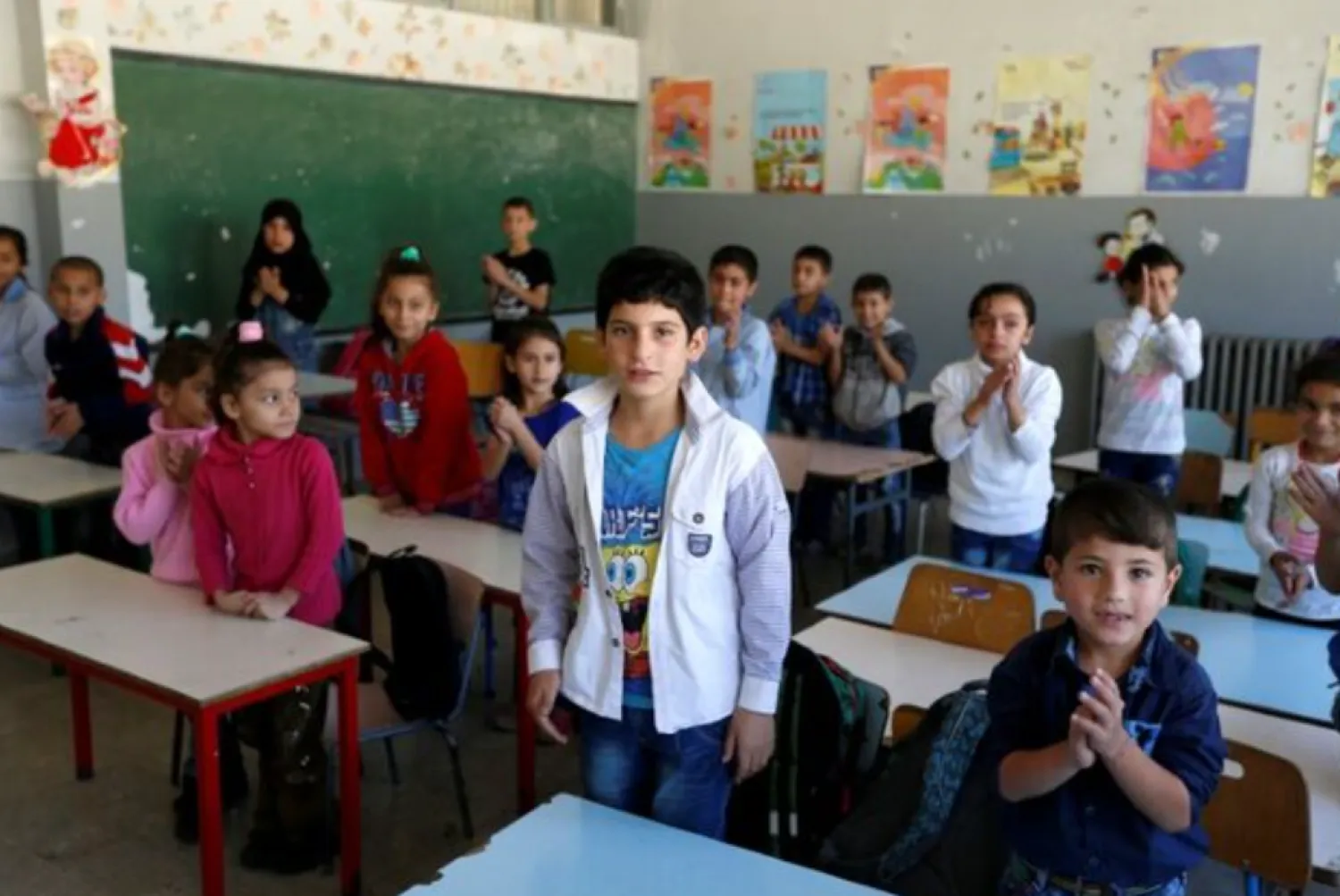



UN Says 5.8 mn Refugee Children Out of School

Syrian refugee children attend a class at a school in Mount Lebanon, October 7, 2016. REUTERS/Mohamed Azaki
TT

UN Says 5.8 mn Refugee Children Out of School

Syrian refugee children attend a class at a school in Mount Lebanon, October 7, 2016. REUTERS/Mohamed Azaki

Some 5.8 million refugee children were out of school in 2025, the United Nations said Friday, warning that funding cuts threatened to make the situation worse.

UNHCR, the UN refugee agency, said 44 percent of the world's 13.1 million school-age refugee children were out of school last year.

"Education is protection. But it is also a pathway to opportunity and self-reliance," said Barham Salih, the UN high commissioner for refugees, AFP reported.

"At a time of severe pressure on humanitarian and development financing, cuts to education risk reversing decades of collective investment and closing opportunities for a generation of young people."

The former Iraqi president, who was a refugee, said that looking back on his own life, "education gave me opportunities that displacement might otherwise have denied me".

"Displacement should not determine the limits of a child's life."

UNHCR said that while 65 percent of refugee children of primary school age were enrolled in education in 2025, only 32 percent were enrolled in secondary.

Refugee tertiary education enrolment reached a record 11 percent in 2025.

Earlier this week, UNHCR said its available funding had fallen from $5.2 billion in 2024 to $3.9 billion in 2025, while the number of people it is mandated to protect is hovering around historically high levels.

UNHCR said it needed $8.5 billion this year to protect refugees, but by the end of July had received only 32 percent of that amount ($2.7 billion).

UNHCR said nearly 8.3 million refugees and other forcibly displaced people faced losing vital assistance from the agency as protection services crumble due to the "severe" funding cuts.


Iran: Strait of Hormuz Will Not Reopen Until Conditions Are Met

Iran: Strait of Hormuz Will Not Reopen Until Conditions Are Met
TT

Iran: Strait of Hormuz Will Not Reopen Until Conditions Are Met

Iran: Strait of Hormuz Will Not Reopen Until Conditions Are Met

The Strait of Hormuz will not reopen until seven Iranian conditions set out in a June interim agreement with the US are met, Nournews reported Iran's parliament speaker Mohammad Baqer Qalibaf as saying on Sunday, a few days after Tehran received Washington's reply to its diplomatic proposal.

“The Americans, who say something different in the media, have recently put forward proposals through a mediator. ⁠But they must understand that ⁠the period of dragging out the process and dictating one-sided demands is over," Qalibaf was quoted as saying.

"The position of the Islamic Republic of Iran is completely clear and firm, and the Strait of Hormuz ⁠will not be opened until our seven conditions, based on the Islamabad Memorandum of Understanding, are met."

Meanwhile, army spokesperson Mohammad Akraminia told Fars news on Sunday that Iran will upgrade the range of its missiles following the war with the US as American forces are now ⁠positioned as much ⁠as 1,000 km (621 miles) away from the Iranian ⁠coast.

"During this war, we concluded that we absolutely must increase the ⁠range of ⁠our missiles, and we have now moved in that direction," he said.


Iran Tells US There is No Military Solution to Mideast War

(FILES) Vehicles drive past a giant billboard reading 'The Strait of Hormuz remains closed' at the Revolution Square in Tehran on April 28, 2026. (Photo by ATTA KENARE / AFP)
TT

Iran Tells US There is No Military Solution to Mideast War

(FILES) Vehicles drive past a giant billboard reading 'The Strait of Hormuz remains closed' at the Revolution Square in Tehran on April 28, 2026. (Photo by ATTA KENARE / AFP)

Iran's top diplomat insisted on Sunday that there would be no military solution to the United States' war against Iran, with talks on ending the conflict apparently at an impasse.

A campaign of heavy bombardment failed to bring a decisive close to the war launched by the US and Israel in late February, and Washington in recent weeks has dialed back military operations in favor of economic pressure.

The main point of contention remains Iran's attempt to blockade the Strait of Hormuz where a UK maritime agency reported on Sunday another tanker struck by an unknown projectile.

"If our enemies again choose the path of military confrontation, our response will be stronger than before, and we will defend ourselves with even more force," Iranian Foreign Minister Abbas Araghchi said at a gathering of foreign ambassadors.

"There is no military solution, nor any solution based on new sanctions," he continued, adding "only negotiations based on justice and fairness" could end the conflict.

The two sides agreed a memorandum of understanding in June that spelled out a framework for a permanent resolution, but Iranian attacks on vessels in the Hormuz prompted a return to US military operations.

On Sunday, the British maritime security agency UKMTO said a tanker in the Hormuz "reported being struck by an unknown projectile, causing damage to the engine room", though the crew were reported safe and no environmental impact was recorded.

The agency did not specify the date of the incident, the vessel's origin or destination, or whether it was an oil tanker or LNG carrier.

Iranian and US officials last week held indirect talks on the sidelines of the UN General Assembly, with Tehran saying it presented seven conditions for reopening the strait.

Iran has demanded, among other things, a ceasefire across the Middle East, the unfreezing of its assets abroad, the lifting of sanctions on its oil sector and an end to the US naval blockade.

Trump, however, rejected the proposal, while leaving the door open both to further talks or renewed military operations.

Iranian foreign ministry spokesman Esmaeil Baqaei on Sunday characterized the latest US counterproposal as being "in line with their previous proposals concerning nuclear issues".

"We have clearly indicated that we are focusing on the issue of the Strait of Hormuz," he said, adding that reopening the waterway required "an end to the disruptions to Iranian commercial maritime traffic and the lifting of sanctions".