Russia Hits Ukraine with Drones and Missiles, At Least 19 Dead

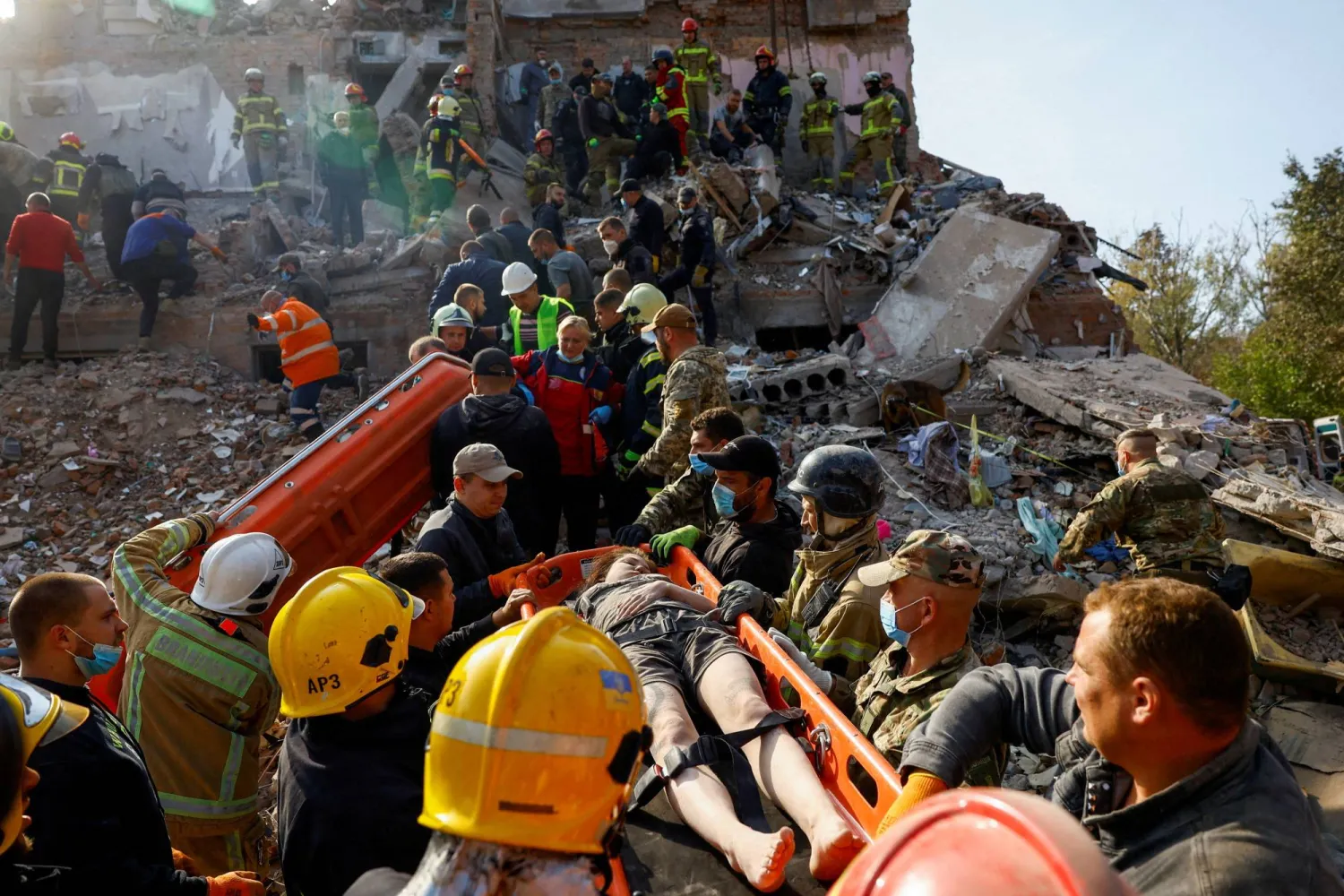
Emergency services work to rescue residents from under the debris at the site of an apartment building which was hit by a Russian missile strike in the town of Pryluky, amid Russia’s attack on Ukraine, in the Chernihiv region, Ukraine, October 7, 2026. REUTERS/Valentyn Ogirenko
TT

Russia Hits Ukraine with Drones and Missiles, At Least 19 Dead

Emergency services work to rescue residents from under the debris at the site of an apartment building which was hit by a Russian missile strike in the town of Pryluky, amid Russia’s attack on Ukraine, in the Chernihiv region, Ukraine, October 7, 2026. REUTERS/Valentyn Ogirenko

Russia pounded Ukraine with waves of missiles and drones on Wednesday, killing at least 19 people and hitting residential buildings, industrial facilities and infrastructure, Ukrainian officials said.

One Russian missile slammed into an apartment block in the northern city of Pryluky, killing at least 13 people including four children, regional governor Vyacheslav Chaus said.

Dozens of rescuers picked through the rubble at the site where several sections of the five-story building collapsed, Reuters video showed.

Emergency workers used ladders to get to the upper floors of what remained of the building. Around 50 people were wounded, the governor said.

President Volodymyr Zelenskiy said six other people were killed in Kyiv, Oleksandria and Kremenchuk during the heavy overnight attack.

"This was one of the most vile strikes: 70 missiles in total, many of them ballistic," Zelenskiy said on the Telegram app. "One of the key targets was ⁠our energy infrastructure. ⁠The Russians wanted to strike painfully and demonstratively."

Russia's defense ministry said its forces had carried out a "massive strike" on military-industrial facilities in Kyiv and other Ukrainian regions, using high-precision land-, sea- and air-launched weapons, as well as drones.

Ukraine's air force said it had downed just over 80% of the 46 jet-powered drones launched by Russia — a sharp increase from recent weeks when, on average, air defenses took down 50% to 60%.

Since the summer, Russia has used increasing numbers of the new high-velocity drones in round-the-clock attacks on Kyiv and other cities, stretching Ukraine's air defenses which have struggled to cope with their speed.

The air force ⁠did not explain the jump in the interception rate and did not immediately respond to requests for comment.

Zelenskiy said that the Russian ballistic missiles remained the major challenge for Ukraine, adding that he and his team were "every day looking for Patriot (missile interception) systems that can and must protect people's lives.”

The US-made Patriot system is the only weapon in Ukraine's arsenal capable of stopping high-velocity ballistic missiles but tight global supplies have been drained by the Iran war this year as well as the Ukraine conflict.

Ukraine's energy ministry said that it had started to roll out partial emergency power cuts in five Ukrainian regions due to the attacks.

Russia's defense ministry said its targets included sites where Ukrainian defense company Fire Point manufactures and stores its Flamingo cruise missiles and medium- and long-range drones in Kyiv as well as regions of Kyiv, Chernihiv, Kirovohrad, Dnipropetrovsk, Poltava and Kharkiv.

Last week, Zelenskiy said Ukraine had fired its first domestically made ballistic missile in combat, produced ⁠by Fire Point.

In an interview with ⁠Reuters last week, Zelenskiy said he expected the company to have a longer-range FP-9 missile ready by the autumn. The company has said that weapon will be able to reach Moscow.

Zelenskiy said Ukrainian troops hit four targets in Russia over the past 24 hours, including two Russian oil facilities and a training ground in the Perm, Samara, and Astrakhan regions.

In the Reuters interview, Zelenskiy said Ukraine would hit Russia's energy assets in response to Moscow's escalating strikes on civilian infrastructure.

Many Kyiv residents took shelter in the city's deep underground metro stations as warnings of the upcoming attacks were shared by Ukrainian officials and military intelligence.

Several loud explosions reverberated through the capital during the night, Reuters witnesses said.

"The metro is better, because we live on the 9th floor of a high-rise, and it's really scary when you're on the 9th floor and missiles are flying at you," Lesia, a 49-year-old Kyiv resident, told Reuters.

Ukrainian officials said Russian ballistic missiles targeted Kyiv in addition to the drones.

Overnight air strikes on the southeastern city of Dnipro damaged an industrial facility, transport infrastructure in Zaporizhzhia and apartment buildings in Kremenchuk, regional officials said on the Telegram messaging app.


Tanker Catches Fire After Projectile Strike Near Strait of Hormuz, UKMTO Says

Vessels at the Strait of Hormuz, as seen from Musandam, Oman, November 17, 2026. (Reuters)
TT

Tanker Catches Fire After Projectile Strike Near Strait of Hormuz, UKMTO Says

Vessels at the Strait of Hormuz, as seen from Musandam, Oman, November 17, 2026. (Reuters)

A tanker caught fire after being struck by an unknown projectile while sailing outbound through the Strait of Hormuz, the United Kingdom Maritime Trade Operations (UKMTO) agency said on Friday.

The British navy-affiliated agency ‌UKMTO said ‌that the incident occurred ‌8 ⁠nautical miles north ⁠of the Omani town of Khasab, adding that no casualties or environmental impact were reported.

Iran's Revolutionary Guards said shortly afterwards that ⁠an oil tanker had caught ‌fire ‌after hitting a mine while ‌attempting to transit the Strait ‌of Hormuz near Khasab, Iranian state media reported.

Khasab lies on Oman's Musandam Peninsula at the ‌entrance to the Strait of Hormuz, a strategic waterway ⁠that ⁠carried nearly one-fifth of global crude oil supplies before the US-Israeli conflict with Iran.

Shipping through the Strait of Hormuz has been disrupted since Iran moved to close the waterway following the eruption of the conflict on February 28.


Myanmar Genocide Judgment May Bolster Gaza Case Against Israel

19 November 2026, Palestinian Territories, Deir al-Balah: Palestinians inspect widespread destruction of homes and displacement shelters following demolition operations carried out by the Israeli army in the early morning hours east of al-Maghazi refugee camp, central Gaza Strip. (dpa)
TT

Myanmar Genocide Judgment May Bolster Gaza Case Against Israel

19 November 2026, Palestinian Territories, Deir al-Balah: Palestinians inspect widespread destruction of homes and displacement shelters following demolition operations carried out by the Israeli army in the early morning hours east of al-Maghazi refugee camp, central Gaza Strip. (dpa)

The International Court of Justice's landmark ruling that Myanmar committed genocide against the Rohingya will strengthen South Africa's genocide case against Israel over the war in Gaza, legal experts said, establishing a precedent that genocidal intent can coexist with a military objective.

While the conflicts in Gaza and Myanmar are legally distinct, both cases before the World Court are based on allegations that states breached their obligations under the 1948 Genocide Convention.

On Thursday, the court found that Myanmar had violated the convention on multiple grounds stemming from mistreatment of the Muslim Rohingya minority by the armed forces.

South Africa, which has brought a genocide case against Israel over its conduct in Gaza, welcomed the judgment. Foreign Minister Ronald Lamola said it set an important precedent by establishing for the first time that a state had committed genocide.

He said it was of "great significance" to the case against Israel, which is not expected to be argued until 2029.

Both Myanmar and Israel have defended the actions of their armed forces as legitimate responses to insurgencies. But a majority of nine judges on the 15-member ‌bench found that ‌around 10,000 killings, including of children, the razing of homes, widespread sexual violence and the forced exodus of ‌more ⁠than 700,000 people in ⁠2017 amounted to state-sponsored genocide.

The ruling also handed other major legal victories to Gambia, which brought the case seven years ago on behalf of Muslim-majority countries.

The judges found that Myanmar had failed in its obligation to prevent genocide and said it must facilitate the return of Rohingya refugees and pay unspecified reparations.

The court also adopted conclusions from UN fact-finding reports, including one stating that mass deaths and rapes showed genocidal intent.

IMPORTANT PRECEDENT

Israeli legal scholar Yuval Shany said the ruling could broaden the arguments available to South Africa in its case against Israel.

He said the court maintained a requirement that genocidal intent be the “only reasonable inference,” but expanded the contextual factors it can consider beyond a pattern of conduct, to include the scale and systematic nature of acts and ⁠the history of persecution.

The approach “gives South Africa more avenues to argue for genocide” in Gaza, Shany said.

Proving genocide ‌is notoriously difficult because it requires establishing an "intent to destroy, in whole or in part, a ‌national, ethnical, racial or religious group, as such."

Five criminal acts can constitute genocide: killing members of a group, causing them serious bodily or mental harm, ‌creating conditions calculated to destroy them, preventing births, or forcibly transferring children to other groups.

Lamola said South Africa would study the judgment carefully with ‌a view to demonstrating, as the court had in the Rohingya case, that a state's actions, including ethnic cleansing, the killing of children, sexual violence and destruction of civilian infrastructure, can fall within the definition of genocide.

TARGETING OF CHILDREN, WOMEN

Another aspect of the ruling that could resonate in the Israel case was the court's emphasis on the systematic nature and scale of the crimes committed in Myanmar, said Marieke de Hoon, professor of international criminal law at the University of Amsterdam.

South ‌Africa alleges that Israel's military operations created conditions intended to prevent births and disproportionately affected women and children in Gaza. In its filing to the ICJ, it said an estimated 70% of those killed ⁠were non-combatants.

Israel rejects those allegations ⁠and says its operations have been conducted in accordance with international law.

"Arguments that a military intent or military objective would erase the idea that there could be a genocide intent are now rejected by the court," said De Hoon.

She said the judges found that some acts, including attacks on children and women and sexual violence, could not be explained by military objectives alone, leaving genocide as the only reasonable inference.

The Hague Initiative for International Cooperation (Thinc), a think tank funded by pro-Israeli groups, said the judgment would fundamentally alter how courts assess allegations of genocide by imposing a "lower threshold for proving genocidal intent, with serious consequences for Western militaries engaged in confronting terror," such as after Hamas' October 7, 2023 attack on Israel.

It is "not only a verdict in a particular case but a template," Thinc's director, Andrew Tucker, wrote in a reaction.

"Its propositions will be used in future cases: that genocidal intent may coexist with legitimate military objectives...that UN reports compiled without access can carry decisive weight; and that a state can breach the duty to prevent genocide without any finding that genocide occurred."

While the World Court judgment unequivocally found Myanmar responsible for genocide, proving the crime in court remains difficult, said Richard Horsey, senior adviser for Asia at the International Crisis Group.

"The ICJ has never before found that a state committed genocide. The legal bar is extremely high, but what this case shows is that it is surmountable,” he said.


Young Protesters Hit the Streets Across Europe

People use flares and display a banner as they take part in a march as part of a general strike, in Milan, Italy, 20 November 2026. (EPA)
TT

Young Protesters Hit the Streets Across Europe

People use flares and display a banner as they take part in a march as part of a general strike, in Milan, Italy, 20 November 2026. (EPA)

Protesters rallied across Europe Friday to vent their anger over issues from high living costs to military spending and the climate crisis, ramping up pressure on political leaders they accuse of ignoring the concerns of young people.

Demonstrators hit the streets in cities from Italy to Germany, Austria and Britain, many waving signs emblazoned with "fight for our future", setting off flares and burning cardboard models of tanks.

The rallies, coordinated by a youth-led coalition of over 50 groups, are fueled by grievances that vary from place to place, including Israel's war in Gaza, high rents and deteriorating learning conditions at schools and universities.

But a common theme runs through them -- a sense that governments across the continent are too busy with geopolitical crises and helping big business and not investing enough in the well-being of younger generations.

Olivia Ferrario, an 18-year-old high school student at a protest in the Italian city of Milan, told AFP that young people were displaying their "dynamism and determination" by taking to the streets.

"If the government does not listen to us, we cannot remain silent," she said at the demonstration that attracted tens of thousands of protesters.

Police are deploying in large numbers due to fears of a repeat of the street violence that has marred recent major protests in France and other countries.

- 'Lost so much hope' -

In Berlin, about 1,000 university students and school pupils protested over concerns including Germany's rapid rearmament, which has fueled fears of a return to compulsory military service.

"I simply think it's indefensible... to force someone to learn how to fight and kill, and then send them to war," Helena Kossatz, 18, who finished high school last year, told AFP.

While Europe seeks to rearm in the face of a hostile Russia, organizers of the continent-wide protests say funds allocated to rearmament should be spent on education, youth policies and housing.

Several hundred protesters, some in school uniform, gathered at demonstrations in London outside parliament and in nearby Trafalgar Square, waving placards that said "save higher education" and "Fight for our futures not their wars".

"I've lost so much hope," Eliz, who had taken the day off from college and gave only one name, told AFP.

The 18-year-old said she was unsure whether she would go to university, "because of money. Because most jobs are getting taken over by AI. Everyone's just kind of more depressed".

There were scuffles between groups of right-wing and anti-fascist demonstrators, and AFP saw a handful of arrests.

Chants of "Palestine will live forever" rang out at the London protests, and Palestinian flags were on display at several of the demonstrations across Europe.

In Rome, high school students marched behind a banner that read: "We will take freedom if no one gives it to us -- against the government, the war and the high cost of living."

There were scuffles in the Italian capital, with some protesters throwing bottles and smoke bombs at police.

- 'Dreadful' schools -

Demonstrators called for more funding for education and railed against increased military spending during protests in the Spanish capital Madrid.

Gabriela Gimeno Serrano, a 16-year-old high school student, said there were 33 students in her class with just one teacher.

"Classrooms are very small, the facilities are in an absolutely dreadful state," she told AFP, adding some schools were even plagued by rats and cockroaches.

Protests are set to extend into the weekend, with trade unions and housing associations calling for further demonstrations.

The protests come around the anniversary of the Yellow Vests movement in France, which rattled President Emmanuel Macron in 2018 and 2019. Demonstrations are planned there on Saturday.

The protests in European countries have in part been inspired by recent demonstrations in France, which have sometimes turned violent.

Those began when students demonstrated at high schools in mid-September to demand better learning conditions, fueling a nationwide campaign against soaring prices, inadequate public services and police brutality.