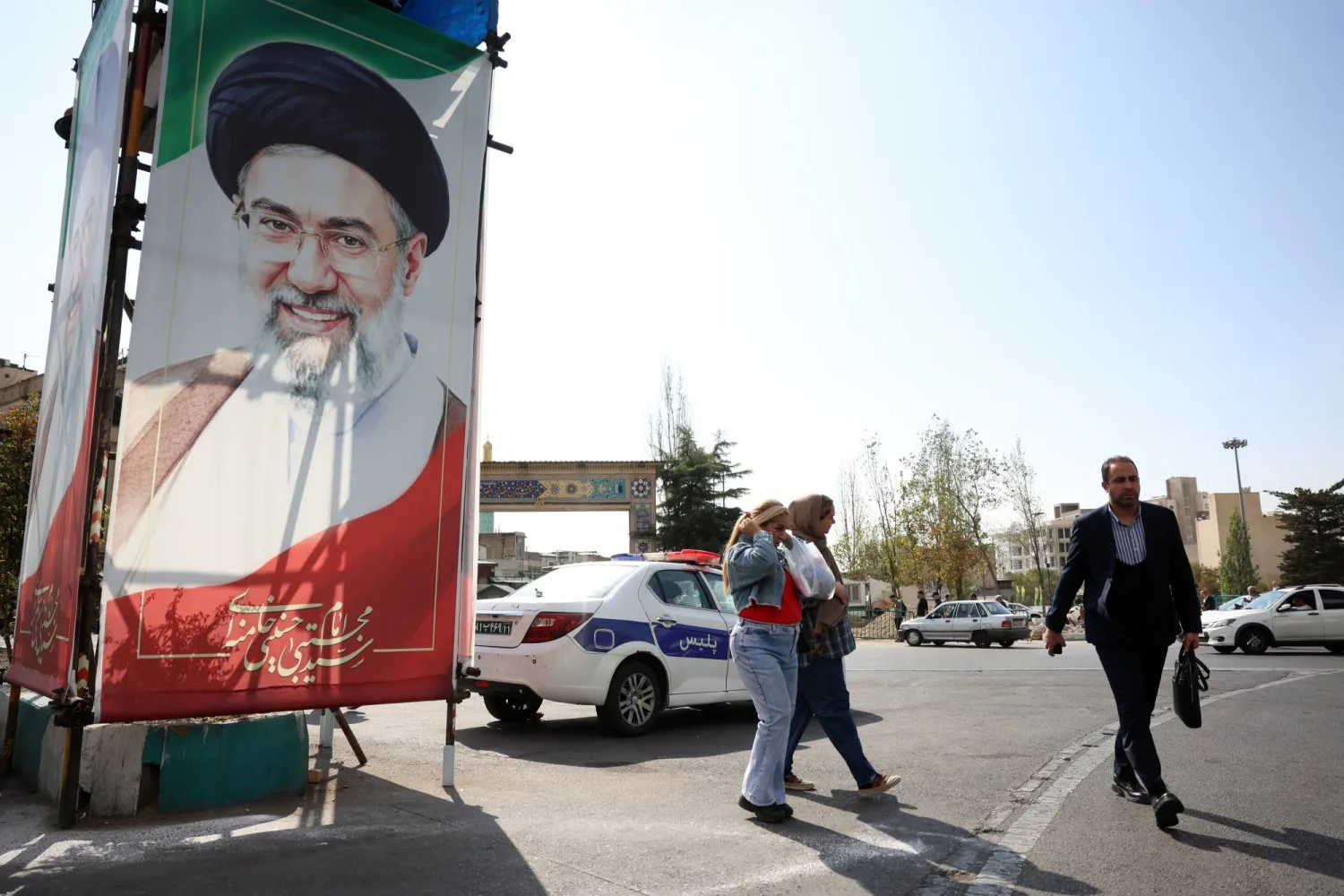
Qatari Delegation in Tehran for Talks

Iranians walk past billboards featuring Iran’s Supreme Leader Mojtaba Khamenei on a street in Tehran, Iran, 28 October 2026, amid the ongoing US-Iran conflict. (EPA)
TT

Qatari Delegation in Tehran for Talks

Iranians walk past billboards featuring Iran’s Supreme Leader Mojtaba Khamenei on a street in Tehran, Iran, 28 October 2026, amid the ongoing US-Iran conflict. (EPA)

A Qatari delegation arrived in Tehran on Friday for talks with Iranian officials, state media reported, as mediators press efforts to revive peace talks with the United States.

According to the IRNA state news agency, the delegation, headed by a senior adviser to Qatar's prime minister, came to discuss "bilateral relations... as well as regional developments" with senior Iranian officials.

Senior officials from several countries have flown to Tehran in recent days as fears rise of a return to hostilities in the Middle East war, which started eight months ago.

The reported Qatari visit came a day after Iranian media said Iran had received a letter from US Vice President JD Vance addressed to security chief Mohsen Rezaei.

The Wall Street Journal said the letter focused on a possible framework for negotiations rather than specific terms for a peace deal.

The New York Times reported that Vance "made the outreach in a letter sent last week via Qatari mediators and delivered Sunday to Gen. Mohsen Rezaei".

Qatar and Pakistan have been mediating efforts to revive peace talks following a ceasefire agreement in April. A Qatari delegation was also in Tehran on Sunday, according to a senior Iranian official.

Qatari Emir Sheikh Tamim bin Hamad Al Thani and Iranian President Masoud Pezeshkian discussed the war on the sidelines of a meeting in Moscow on Tuesday.

The Middle East war began on February 28 with US-Israeli strikes on Iran that killed former supreme leader Ali Khamenei and senior military commanders in Tehran.

Iran retaliated with attacks on Israel and US assets across the region, while stopping ships using the Strait of Hormuz, a waterway that normally carries around one-fifth of global oil consumption.

On Wednesday, Iranian Foreign Minister Abbas Araghchi said Tehran was discussing a plan with both mediators, Qatar and Pakistan, to end the war and reopen the waterway.

The US has meanwhile imposed a blockade on Iranian ports, further restricting Tehran's ability to export oil and conduct trade.

Tehran insists that Washington meet seven conditions for reopening the strait, including a ceasefire across the Middle East, unfreezing Iranian assets abroad, lifting sanctions on its oil sector and ending the US naval blockade.


Sydney Man Charged with Car Bomb Plot, Downloading ISIS Material

FILE - Police patrol in the early morning at Sydney's Bondi Beach, Dec. 15, 2025, following the previous day's shooting. (AP Photo/Mark Baker, File)
TT

Sydney Man Charged with Car Bomb Plot, Downloading ISIS Material

FILE - Police patrol in the early morning at Sydney's Bondi Beach, Dec. 15, 2025, following the previous day's shooting. (AP Photo/Mark Baker, File)

Australian police on Friday arrested a man in the greater Sydney area on charges of researching how to build a car bomb and downloading violent material inspired by ISIS.

Police stressed they found no evidence of a link to the upcoming first anniversary of an ISIS-inspired attack at Sydney’s Bondi Beach. Two gunmen opened fire on a Dec. 14 Hanukkah celebration, leaving 15 people dead and 40 wounded.

Nowroz Rayed Amin, 35, from Ingleburn on Sydney’s southwestern outskirts, was charged with collecting documents likely to facilitate terrorist acts and possessing violent extremist material obtained online, Australian Federal Police Deputy Commissioner Hilda Sirec said.

“It will be alleged in court that the man was researching how to build a vehicle-borne, improvised explosive device, which we allege, for use in a potential terrorist act,” Sirec told reporters, according to The Associated Press.

Amin appeared in the Campbelltown Local Court later Friday on the two charges, which carry a potential combined maximum penalty of 20 years in prison.

Amin did not enter pleas or apply for release on bail. He was remanded in custody to appear in court on Thursday next week, court documents show.

Investigators decided to make the arrest Friday because there was sufficient evidence and not because of any imminent threat to the community, according to Sirec, who said police suspected he had acted alone.

“I want to stress this point because we acknowledge we are just weeks away from the first anniversary of the Bondi Beach attack,” Sirec said. “There is no information to suggest that this alleged offending is connected to the anniversary of that attack. However, we know the fear that this will cause.”

The attack at Bondi Beach was Australia's worst mass shooting since 1996.

Police killed one gunman, Sajid Akram, at the scene. His son, Naveed Akram, was wounded and faces trial next year on 78 charges including 15 counts of murder, 43 of attempted murder and one of committing a terrorist act. Akram has yet to enter any plea.

Police executed 10 search warrants in the greater Sydney area Friday and made three arrests.

As well as Amin, police arrested a 33-year-old man for weapons offenses and a 34-year-old man for hindering police, Sirec said.


For the 1st Time, ICJ Finds a Country Responsible for Genocide: Myanmar

Rohingya refugees attend a rally addressed by United Nations General Assembly President Khalilur Rahman, following the International Court of Justice verdict that Myanmar committed genocide against the Rohingya, at a refugee camp in Cox's Bazar, Bangladesh, November 20, 2026, REUTERS/Mohammad Ponir Hossain
TT

For the 1st Time, ICJ Finds a Country Responsible for Genocide: Myanmar

Rohingya refugees attend a rally addressed by United Nations General Assembly President Khalilur Rahman, following the International Court of Justice verdict that Myanmar committed genocide against the Rohingya, at a refugee camp in Cox's Bazar, Bangladesh, November 20, 2026, REUTERS/Mohammad Ponir Hossain

In a landmark judgment, the United Nations’ top court ruled Thursday that Myanmar committed genocide against the Rohingya minority in a brutal 2017 military operation and ordered the Southeast Asian nation to allow people who fled the violence to return home.

The decision marks the first time the court has ruled that a state committed genocide and comes as the World Court also is handling genocide allegations linked to the Gaza conflict and the war in Ukraine.

But it remains to be seen how much of the ruling can be implemented. The court’s rulings are final and legally binding, but it has no way to enforce them beyond reporting noncompliance to the UN Security Council.

International Court of Justice President Yuji Iwasawa said the court, in a 9-6 decision, found that Myanmar “has committed genocide against the Rohingya group in northern Rakhine state, in violation of its obligations under the Genocide Convention.”

The 15-judge panel of the World Court, which included Navi Pillay, the respected international jurist who won the Nobel Peace Prize last month, rejected Myanmar’s defense that the 2017 campaign was a legitimate operation against insurgents.

According to The Associated Press, Iwasawa said that “the court finds that Myanmar’s security forces killed thousands of Rohingya civilians, perpetrated widespread acts of sexual violence, as well as acts of extreme violence against children, and attacked fleeing Rohingya as they sought to flee in large numbers.”

The atmosphere following the hearing was electric, with lawyers and members of the Rohingya, some of whom had traveled thousands of miles to attend the reading, hugging and crying.

“I’m beyond ecstatic today, hearing the judgment, being read out in detail. A lot of those moments and instances that the judges really went into detail, it really validates the kind of experience that Rohingya have,” said Yasmin Ullah, a Rohingya rights activist who sat in the court’s ornate, wood-paneled Great Hall of Justice for the nearly three-hour reading of the ruling.

In Cox's Bazar, Bangladesh, refugee Mohammad Rofik welcomed the recognition of the plight of the Rohingya.

“Today, the world could recognize and give the victory to the Rohingya community, not only the Rohingya community. It is the victory of the whole community of ... Myanmar," he said.

There was no immediate reaction from the Myanmar delegation in The Hague or from the government in Myanmar.

The court also ordered Myanmar to commit to reparations including allowing Rohingya “safe, voluntary and dignified return to their place of residence.” It ordered Myanmar to investigate, prosecute and punish people found to have committed genocidal acts and to pay compensation to Rohingya. The amount will be decided in later court proceedings.

An umbrella organization of Myanmar opposition groups said in a statement that “the struggle for justice will continue, and this judgment must now be enforced,” calling on the international community to ensure it is fully implemented.

UN Secretary-General Antonio Guterres called the ruling “a demonstration of international justice and a reaffirmation that impunity for such horrific acts must not stand.”

Shortly after the ruling was read, UK Foreign Secretary Ed Miliband said his government was expelling Myanmar’s defense attache from the UK and “calling urgently for a UN Security Council session to discuss the judgment.”

The Trump administration, meanwhile, said it is withholding judgment on the verdict. The president has taken a dim view of international law.

The US State Department said Thursday that it was “studying the decision to fully assess its implications” before weighing in with an opinion.


Nearly a Quarter of World's Children Live in Conflict Zone

Palestinian children play at a displacement camp in Deir al-Balah, central Gaza Strip, Thursday, Nov. 19, 2026. (AP Photo/Abdel Kareem Hana)
TT

Nearly a Quarter of World's Children Live in Conflict Zone

Palestinian children play at a displacement camp in Deir al-Balah, central Gaza Strip, Thursday, Nov. 19, 2026. (AP Photo/Abdel Kareem Hana)

Nearly a quarter of the world's children are currently living in a conflict zone, a record rate since statistics were first recorded in the 1990s, the charity Save the Children said on Thursday.

"Almost one in four children worldwide are now living in conflict zones, the highest number since records began in 1990," the London-based charity said, according to Reuters.

"The figure represents an increase of more than 50% in a decade, jumping from 378 million in 2015 to 589 million in 2025," it added.

The report was titled "Stop the War on Children: Changing the Odds" and drew on statistics from the Peace Research Institute Oslo (PRIO).

The percentage of children living in conflict zones has doubled from 10 percent in the mid-1990s to 23.4 percent in 2025.

"These record-high figures are a stark reminder that conflict is devastating the daily lives, education, health and future prospects of hundreds of millions of children," said Gudrun Ostby, a research professor at PRIO.

"Unless greater efforts are made to protect children in conflict settings, the consequences of today's wars will be felt for decades to come," he added.

The report defines conflict zones as areas existing within a 50-kilometer radius in which at least one armed attack took place.

Africa has the largest number of children living in conflict zones, at about 260 million, or 44 percent of the total across the globe, the report found.

Rates have surged in the Middle East as well, from 52 million children in 2024 to 67 million in 2025, a 29 percent increase.

An average of two in five children in Africa and the Middle East are living in conflict zones, it added.

"The scale of this crisis is rapidly growing, and the systems meant to protect children are being pushed to breaking point," said Inger Ashing, chief executive of Save The Children International.