


Israel President Urges Compromise After Divisive Election

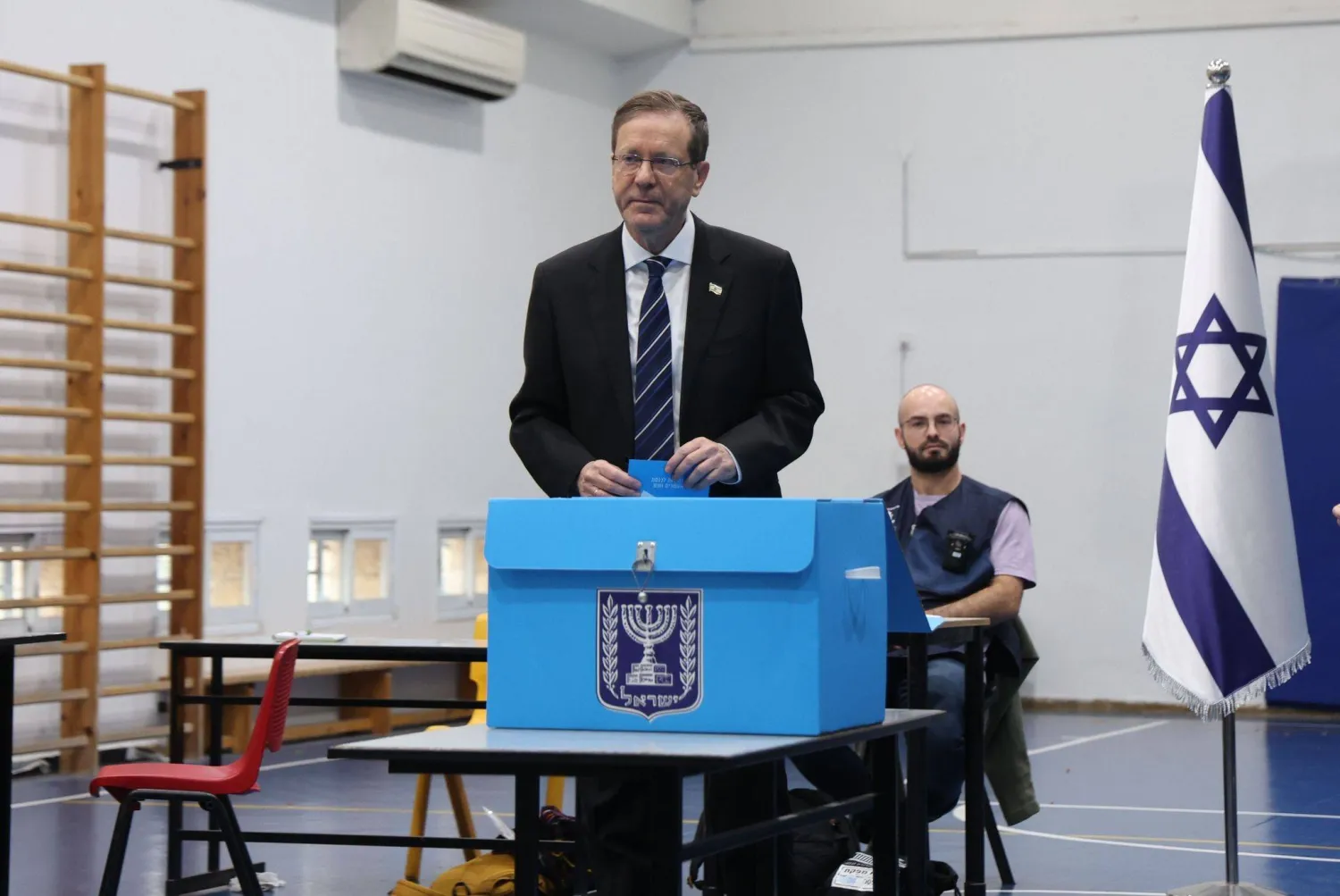
 27 October 2026, Jerusalem: Israeli President Isaac Herzog casts his ballot at a polling station in West Jerusalem during Israel's legislative election. (dpa)
27 October 2026, Jerusalem: Israeli President Isaac Herzog casts his ballot at a polling station in West Jerusalem during Israel's legislative election. (dpa)
TT

Israel President Urges Compromise After Divisive Election

 27 October 2026, Jerusalem: Israeli President Isaac Herzog casts his ballot at a polling station in West Jerusalem during Israel's legislative election. (dpa)
27 October 2026, Jerusalem: Israeli President Isaac Herzog casts his ballot at a polling station in West Jerusalem during Israel's legislative election. (dpa)

Israel's president on Wednesday opened talks on forming a new government with a call for compromise, saying neither side had won divisive elections, as he also condemned "racist" rhetoric against Arab parties that made sharp gains. 

More than a week after Israel's first election since the trauma of the October 7, 2023 Hamas attacks, President Isaac Herzog began meeting party leaders to decide whether to give Prime Minister Benjamin Netanyahu or his rival Gadi Eisenkot the first chance to form a government in the deeply polarized country. 

With neither bloc holding a majority in the 120-seat parliament after the October 27 vote, Herzog said both sides needed to accept that "not every commitment and promise can be fulfilled" and to avoid new elections. 

"In the current reality, in which there is no clear winner after the elections, I ask for originality and creativity, courage and goodwill, so that the State of Israel emerges the winner," Herzog said. 

The election saw soaring support for lists from the Arab minority, descendants of Palestinians who stayed in Israel after its 1948 creation and who have often been outraged by the harsh rhetoric and actions of Netanyahu's hard-right government. 

Netanyahu has gone on the offensive against Arab-majority lists, who have the power to put Eisenkot in power if they team up. 

Netanyahu has pointed to the arrests of several people with envelopes of cash on election day in what authorities called localized incidents. 

Without naming any leader, Herzog, whose role is usually ceremonial, said he had "great respect" for the Arab minority, which makes up around 20 percent of Israel's population. 

"I condemn the coarseness and racist expressions that we have heard recently. There is no place for them (to be made) toward any community in Israel," Herzog said. 

- No evidence found - 

The Central Elections Committee said it had conducted an audit of 9,069 polling stations following complaints and found no evidence that would question the results' integrity. 

The committee, which reflects the makeup of the outgoing parliament, approved the results with 15 members in favor and two against but 14 others abstaining. 

Itamar Ben-Gvir, the ultranationalist national security minister known for his provocative calls for Palestinian suffering, said his party did not accept the results and he urged the arrest of Arab-Israeli party leaders. 

Several Israeli media outlets said authorities were investigating Arab lawmaker Ayman Odeh for allegedly taking foreign money. He is part of the largest Arab group, the Joint List, which in a statement denounced "political persecution". 

Eisenkot, a former military chief who has vowed to turn the page on Netanyahu's long, divisive reign, accused the prime minister of trying to "undermine Israeli democracy" and inflame sentiment against elected officials. 

"We will not allow the State of Israel to be dragged into a dark abyss, far beyond the bounds of democratic conduct," Eisenkot said, as he marked the 1995 assassination of prime minister Yitzhak Rabin. 

- Buoyed by US elections - 

Eisenkot has warned Netanyahu against launching a new war with his ally US President Donald Trump against Iran, which could help the Israeli prime minister push for a unity government or to run out the clock until new elections. 

Opposition lawmakers said Tuesday's midterm elections in the United States, in which Democrats trounced Trump's Republicans, reinforced the need to remove Netanyahu. 

Democrats have vowed a tougher line on Israel amid outrage over the devastation wrought by the war in Gaza. Trump said as voting was underway that he had agreed with Netanyahu to end nearly $4 billion in annual US military aid to Israel by the end of the year. 

"The continued tenure of Netanyahu and Ben-Gvir could lead Israel down a path of international sanctions, international isolation and a clash with the US, our friend and most important ally," said Yair Golan, who heads the most left-wing party within the opposition bloc. 

Netanyahu, Israel's longest-serving prime minister who has been in power on and off for nearly two decades, has called for a "broad national government" -- with himself at the top. He faces corruption charges that could land him in jail if he leaves office. 

Herzog's statements have raised speculation that he could sound out leaders on a possible unity government, but Eisenkot and his allies have ruled that out. 

Herzog will hold an initial two days of consultations and then give a contender 28 days to form a government, with a potential 14-day extension. 

It took Netanyahu, who at the time had a better showing by Likud, 58 days to form a government after the last election in November 2022. 

Israel held five elections between 2019 and 2022 after repeated deadlocks. 


Trump Says Takes ‘Very Seriously’ Possible Iran Threat to Washington

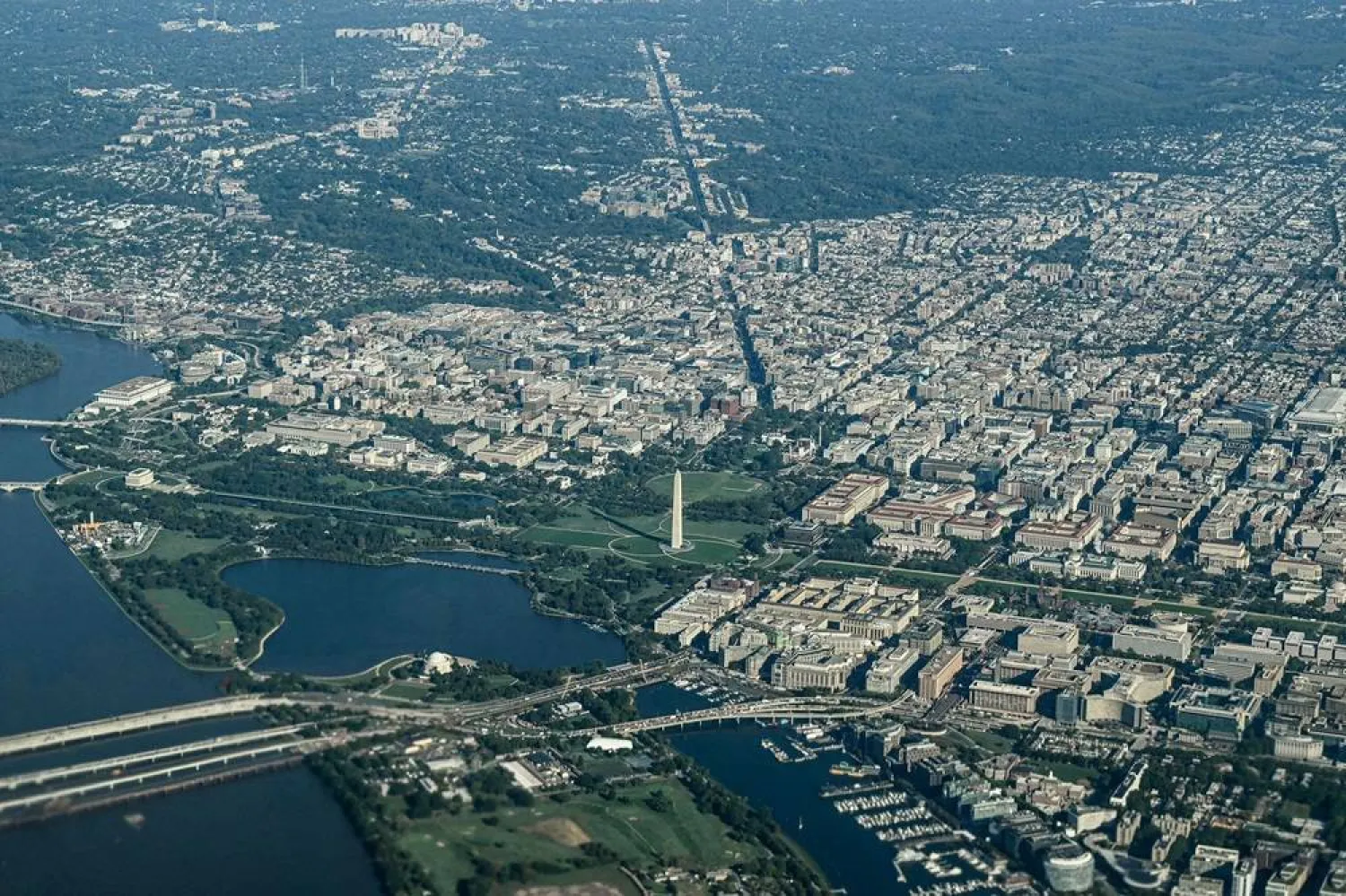
 An aerial view of Washington, DC is seen on October 13. (AFP/Getty Images)
An aerial view of Washington, DC is seen on October 13. (AFP/Getty Images)
TT

Trump Says Takes ‘Very Seriously’ Possible Iran Threat to Washington

 An aerial view of Washington, DC is seen on October 13. (AFP/Getty Images)
An aerial view of Washington, DC is seen on October 13. (AFP/Getty Images)

President Donald Trump said Tuesday that US authorities take "very seriously" any possible threat to Washington, after reports of Iran preparing a so-called dirty bomb plot.

"They will pay a price the likes of which no other country has ever paid before," Trump said, referring to Iran. "We take it very seriously because they happen to be crazy."

Earlier on Tuesday, Iran's Foreign Ministry spokesperson denied a CNN report that it ‌planned to ‌detonate a dirty ‌bomb ⁠in Washington, saying ⁠the allegations were "baseless".

CNN ‌cited ‌sources as saying that US intelligence ‌indicates that Tehran is developing ⁠plans ⁠to potentially detonate a dirty bomb in Washington DC.

Sources familiar with the latest intelligence characterized the Iranian planning as, for now, an effort to give itself options rather than an indicator of an imminent attack, reported CNN. But the plotting picked up by the US has been very specific and includes locations and targets, two of the sources said, and has sparked a flurry of US contingency planning.  

In a statement, White House spokesperson Lauren Bis said that the US is “monitoring any and all potential threats, but at this time there are no credible threats to the homeland.” 


Trump Arrives in Manila for Quad Talks Ahead of China Visit

US President Donald Trump waves as he walks to board Air Force One at Joint Base Andrews, Maryland, on November 16, 2026. (AFP)
TT

Trump Arrives in Manila for Quad Talks Ahead of China Visit

US President Donald Trump waves as he walks to board Air Force One at Joint Base Andrews, Maryland, on November 16, 2026. (AFP)

US President Donald Trump arrived in the Philippines on Tuesday at the tail end of a Southeast Asian summit, with protests awaiting him as he prepares for the first meeting in two years of the Quad group of Indo-Pacific countries.

Trump's Asia trip, which includes the Asia-Pacific Economic Cooperation (APEC) forum in Shenzhen and a much-anticipated trilateral meeting with his Chinese and Russian counterparts, comes after his Republican Party's defeat in midterm elections, plus spy allegations and new US curbs on China's access to AI chips that could complicate a fragile trade-war truce.

Demonstrators gathered in Manila for a fifth day of protests that have included the burning of Trump effigies, calls for an end to the Middle East war and scrapping of the US-led Pax Silica supply chain initiative.

Trump arrived late afternoon at the end of the Association of Southeast Asian Nations summit ‌and will join a ‌US-ASEAN "Special Summit" later on Tuesday.

He will first hold a meeting of the Quad – ‌the ⁠US, Japan, Australia and ⁠India – which will be his first and takes place two years after the last gathering of the group, which Trump's predecessor Joe Biden regarded as a signature foreign policy initiative.

It comes ahead of the APEC gathering hosted by Chinese President Xi Jinping, who has previously objected to the Quad as an effort to encircle Beijing. Quad members have said the grouping is not directed against any one country.

QUAD MEETING THE 'BEST POSSIBLE SIGNAL'

At the ASEAN summit on Monday, Chinese Premier Li Qiang hailed what he called "truly extraordinary" economic achievements of China and ASEAN in the face of global trade restrictions, expressing Beijing's commitment to free trade and the need to "stand united, ward off interference, and work together".

China ⁠is ASEAN's largest trading partner and a key source of investment, but the biggest economies ‌of the 11-member bloc – which has a combined GDP of more than $3.9 trillion – ‌want to deepen ties with the US despite protracted trade and diplomatic uncertainty under the Trump administration.

Former US Deputy Secretary of State Kurt ‌Campbell credited Washington's top diplomat, Marco Rubio, with the timing and reconvening of the Quad, which he said had lost ambition ‌under Trump.

"Part of what he (Rubio) is thinking is that this is probably the best possible signal if you're going to go into a trilateral meeting," said Campbell, co-founder of The Asia Group, referring to Thursday's US-China-Russia talks.

"The linchpin of everything that we do in Asia is the US-Japan relationship, and a perception that this is not at the top of the president's mind would concern me."

White House spokesperson Olivia Wales on Friday ‌said that under Trump's leadership, the Quad had demonstrated it is "a partnership of action, tackling the region's toughest challenges and driving opportunities to ensure a free and open Indo-Pacific".

A Japanese foreign ⁠ministry official said it was ⁠expected that Quad leaders would try to show unity, with maritime security, export restrictions, critical-minerals supply-chain diversification and AI among potential discussion points.

Undersea cables, emerging technology and disaster relief were also likely to be covered, a source familiar with the matter said.

JAPAN TO PLAY MORE PROACTIVE ROLE, PM SAYS

ASEAN's leaders held meetings on Tuesday involving counterparts of Japan, South Korea, China and India.

Japanese Prime Minister Sanae Takaichi pledged to work with ASEAN to boost regional economic and energy resilience to address export restrictions and vulnerabilities from rapid AI development, and strengthen supply chains, including on critical minerals.

"While the international order is experiencing a period of great instability, Japan will play an ever more proactive role," Takaichi said.

Trump will sign a joint statement with Thai Prime Minister Anutin Charnvirakul on Tuesday on an agreement on reciprocal trade. Thai media have reported the two would hold talks and the statement would be about progress on negotiations.

The US is Thailand's largest export market, accounting for 24% of its total shipments this year. The US designated Thailand as a major non-NATO ally in 2003.

Trump will on Wednesday meet Ferdinand Marcos Jr, president of US defense ally the Philippines, before heading to Shenzhen.


Pakistan Army Chief and Iran FM Discuss Regional Peace, Security

Vessels at the Strait of Hormuz, as seen from Musandam, Oman, November 17, 2026. (Reuters)
TT

Pakistan Army Chief and Iran FM Discuss Regional Peace, Security

Vessels at the Strait of Hormuz, as seen from Musandam, Oman, November 17, 2026. (Reuters)

Asim Munir, the powerful army chief of mediating country Pakistan, met with Iranian foreign minister Abbas Araghchi, the Pakistani military said Tuesday, during continued efforts to end the war between the United States and Iran.

Pakistan brokered a June accord that led to a brief halt in fighting between the United States and Iran and set a roadmap for further agreement on reopening the crucial Strait of Hormuz waterway and for negotiations on Tehran's nuclear program.

But the truce collapsed with Washington and Tehran accusing each other of violating the agreement and prompting months of shuttle diplomacy to resuscitate the ceasefire, led principally by mediators Qatar and Pakistan.

During the meeting on Monday, "matters of mutual interest, regional security dynamics and evolving geopolitical developments were discussed," the Pakistani military's media wing said in a statement.

Munir "underscored the importance of sustained engagement, mutual trust and close coordination between the two brotherly countries for promoting regional peace and stability", it added.

Araghchi arrived in Pakistan late on Sunday for a meeting of the Economic Cooperation Organization, a group of nations from Central and South Asia and the Middle East.

Pakistani Foreign Minister Ishaq Dar said on Monday he had held "very candid, very frank" discussions with Araghchi, during the conference confirming that Iran had put forward a two-day proposal to reopen the Strait of Hormuz as part of efforts to end the war with the United States.

He said Washington had not yet responded.

The United States and Israel launched the war on February 28, killing members of Iran's leadership and demanding it cease any nuclear-related activities.

The war plunged the Middle East into violence, with Tehran's retaliatory strikes targeting Gulf countries and sending global energy prices skyrocketing.

Tehran has insisted that Washington meet conditions including the release of frozen assets abroad, sanctions relief and an end to the US naval blockade of Iranian ports in exchange for reopening the Strait of Hormuz.
