Ukraine’s Zelensky Welcomes ‘Changes’ in US Approach During Talks with Russia

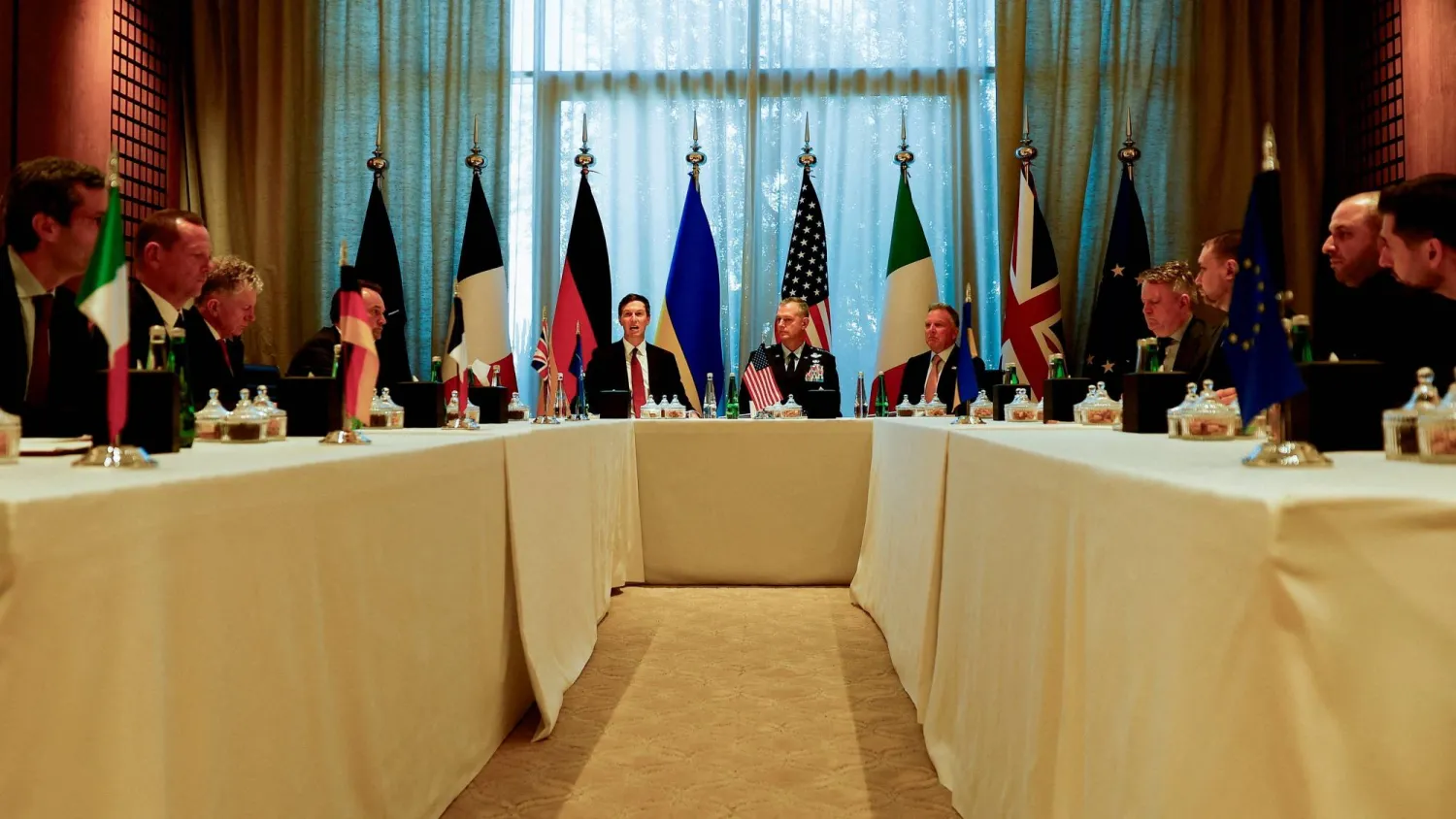
Delegates including US officials, led by United States Special Envoy Steve Witkoff and Jared Kushner, US President Donald Trump's son-in-law, members of the Russian delegation, led by Vladimir Medinsky, an aide to Russia's President Vladimir Putin, and members of the Ukrainian delegation, led by head of Ukraine's Foreign Intelligence Service Rustem Umerov, attend the UAE-hosted trilateral talks between the United States, Russian and Ukrainian delegations, in Abu Dhabi, United Arab Emirates, November 10, 2026. (Reuters)
TT

Ukraine’s Zelensky Welcomes ‘Changes’ in US Approach During Talks with Russia

Delegates including US officials, led by United States Special Envoy Steve Witkoff and Jared Kushner, US President Donald Trump's son-in-law, members of the Russian delegation, led by Vladimir Medinsky, an aide to Russia's President Vladimir Putin, and members of the Ukrainian delegation, led by head of Ukraine's Foreign Intelligence Service Rustem Umerov, attend the UAE-hosted trilateral talks between the United States, Russian and Ukrainian delegations, in Abu Dhabi, United Arab Emirates, November 10, 2026. (Reuters)

Ukraine's President Volodymyr Zelensky said he was "happy" with US mediators' change in approach during talks with Russia in Abu Dhabi, set to continue into a second day on Wednesday, but emphasized the need for security guarantees for his country.

Representatives from Kyiv and Moscow began negotiations in the Emirati capital on Tuesday, the first since February when discussions reached a stalemate and Washington was sidetracked by the Iran war.

US envoys, including President Donald Trump's son-in-law Jared Kushner and businessman Steve Witkoff, are mediating the talks.

The first meeting lasted several hours and aimed to make progress towards resolving the war in Ukraine and -- according to Washington -- working on a "new" security framework that includes Europe.

A source on Russia's delegation said further talks on Wednesday would start at 12 noon in Abu Dhabi (0800 GMT).

Kushner told delegates the United States had "narrowed the gaps" between the warring sides, without providing details, and hoped to move towards a "solution" to Europe's worst conflict since World War II.

Zelensky, speaking in Copenhagen on Tuesday, said the talks were "constructive and quite substantive", adding his team had reported that humanitarian issues and security guarantees were among the topics discussed.

Asked about changes in the approach to peace talks by Kushner and Witkoff, Zelensky said: "I see changes. I'm very happy with what I hear."

The Ukrainian president said negotiators in Abu Dhabi were working on a "large-scale exchange of prisoners", adding that US officials would travel to Russia to discuss the matter further.

However, fighting continued overnight. The governor of Russia's Leningrad region, Aleksandr Drozdenko, posted on Telegram that a Ukrainian drone barrage had sparked a fire at Ust-Luga, a key Baltic port for oil exports.

The attack wounded three workers, he said in a later post on Wednesday, adding that Russian air defenses had downed 150 drones in the region during the night.

- 'New' security framework -

In Paris, US Secretary of State Marco Rubio hailed this week's discussions as "very productive" and called for Europeans to be eventually included at the negotiating table "because they are part of solving this problem".

Europe has been rattled as Trump floated a deal with Russia on rewriting European post-war security, also worrying that Washington will force Kyiv to accept a de-facto defeat.

Kushner said the United States hoped to "create a new framework" of security between Ukraine, Russia and Europe that will secure "decades, if not centuries, of peace".

Moscow, which several weeks before invading Ukraine issued an ultimatum to Western countries to roll back troops from eastern Europe, had also said this was a priority.

Ukraine has warned against a "Yalta 2.0", referring to Western leaders dividing Europe with the Soviet Union after World War II, and the EU has said security arrangements can only be discussed after a ceasefire.

"Putin wants the USSR back," Zelensky told Danish media.

Putin has repeatedly turned down broader ceasefire offers and vowed his troops will press on in Ukraine.

- Moscow pushes security review -

In a sign it is serious about reviving its demand to review Europe's decades-old security arrangement, Russia included a diplomat, Sergei Ryabkov, who lodged Moscow's pre-invasion demand for NATO to pull back from eastern Europe.

A Russian delegation source had said that settling the war was "merely one item on the agenda", and that Moscow's main objective was reviewing security "for the entire continent".

Kyiv's chief negotiator Rustem Umerov met the US envoys and European, EU and NATO officials before the negotiations.

The top US and NATO general in Europe, Alexus Grynkewich, is also taking part.

In a joint statement, the Europeans, Ukraine, the United States and NATO reaffirmed their "shared commitment to a strong post-war European security architecture".

- Ukraine pushes for truces -

Umerov said Kyiv's priorities remained securing a ceasefire and security guarantees. "Our people are waiting to end this war," he said.

Ukrainian and French foreign ministers in Paris commended US efforts to push for "partial truces", which could serve as a "first step toward a complete and unconditional ceasefire".

Last month, a local truce in Ukraine's Kherson region brokered by US First Lady Melania Trump became the longest pause in fighting during the war.

Kyiv is also pushing post-war support for its army.

A senior Ukrainian source told AFP Ukraine wanted at least 10 years of financial support to sustain an 800,000-strong army able to defend any future Russian attack.

Trump hinted before the talks that Kyiv might have to give up land, saying: "They're going to end up with a little bit different shape."

Russia's troops have ground westwards but have not been able to seize the whole of the coveted Donetsk region, and Moscow demands Kyiv surrender the parts of the embattled area it controls.

Russia continues to pound Ukraine and its energy network, raising fears of another winter without heating, running water or electricity for millions of Ukrainians.


US House Blocks Bid to Impeach Defense Secretary Hegseth

A view of the US Capitol ahead of a procedural vote related to the potential impeachment of US Defense Secretary Pete Hegseth in Washington, DC, US, November 10, 2026. (Reuters)
TT

US House Blocks Bid to Impeach Defense Secretary Hegseth

A view of the US Capitol ahead of a procedural vote related to the potential impeachment of US Defense Secretary Pete Hegseth in Washington, DC, US, November 10, 2026. (Reuters)

Republicans in the US House of Representatives blocked an effort on Tuesday to impeach Defense Secretary Pete Hegseth, winning a reprieve for the polarizing Pentagon chief before Democrats take control of Congress next year and possibly try again.

The vote on a procedural motion came just hours after Hegseth blasted efforts to impeach him as a farce and delivered a defiant defense of his record at the helm of the US military, winning praise from President Donald Trump.

The chamber voted 211 to 204 in favor of a motion to refer eight articles of impeachment to the Republican-led House Judiciary Committee, a move that the sponsor of the impeachment push, US Representative Thomas Massie, warned would kill it.

Massie, an outgoing Kentucky Republican, had hoped to draw votes from Republicans upset with Hegseth's policies and wary of the unpopularity of the eight-month-old Iran war but no other Republicans joined him. The US-Israeli led conflict has never been approved by Congress, which is the only branch of government constitutionally permitted to declare war.

Democrats had voiced strong support for the ‌impeachment articles, which accuse ‌Hegseth of the "high crimes and misdemeanors" of illegally ordering the military to wage war in Iran and ‌Yemen, attack ⁠boats in the ⁠Caribbean Sea and capture Venezuelan President Nicolas Maduro in January. But 11 Democrats, including former House Speaker Nancy Pelosi of California, did not vote.

If eight of them had, the procedural measure would have been defeated, paving the way for a full House impeachment vote.

Ian Krager, a spokesperson for Pelosi, said she had missed the vote because she had returned to San Francisco for an annual event to honor veterans, but would have voted against the procedural measure.

Trump cheered the results in a social media post, saying the effort to impeach Hegseth "has miserably FAILED!" He wrote that Hegseth's performance on Iran, Venezuela and other issues "led to the EXONERATION of a Great American Patriot."

Hegseth would have been the first US defense secretary to be impeached. The last time any civilian leader ⁠of the US military was impeached was in 1876, when William Belknap held the title "secretary of war."

Hegseth calls ‌himself secretary of war, part of his effort to rebrand a military he said was ‌too weak and "woke" when he took office last year. Trump cannot change the name of the Defense Department without approval from Congress.

IRAN WAR ANGER

Voter anger over ‌the Iran war, which has settled into an effective stalemate focused on securing the Strait of Hormuz, helped Democrats win control of Congress ‌in last week's midterm elections.

A Reuters/Ipsos poll published on Tuesday found a majority of Americans want the newly elected Democratic-majority US Congress, which takes office in January, to act to end the war with Iran once and for all.

Although Vice President JD Vance has publicly questioned the war and blamed it for the Republicans' midterm rout, he voiced support for Hegseth on Tuesday.

"This isn't about Iran, this is about the fact that Pete took on the bureaucracy at the Pentagon," Vance wrote ‌on social media.

Before the vote, House Democratic leader Hakeem Jeffries said on Monday: "Pete Hegseth has abused his power, undermined America's national security, and he's the architect of the reckless and costly failed war of choice ⁠in Iran."

Hegseth has repeatedly defended the ⁠conflict, calling Trump courageous and saying Iran's military has been left in ruins. He also said his orders to US forces were lawful, despite Massie's accusations of "high crimes and misdemeanors".

"History will judge the Iran war quite differently than the conventional wisdom right now," Hegseth said on Tuesday at his first Pentagon briefing in six months.

Jeffries said he would talk to members about whether to mount a new impeachment effort in the next Congress. "We'll have that conversation at the appropriate time," he said.

A Democratic-led push to impeach Hegseth could be far more intense, with lawmakers calling in top brass to testify, including generals and admirals fired by Hegseth who have remained silent so far. Hegseth, who has railed against diversity efforts at the Pentagon, fired the chairman of the Joint Chiefs of Staff, who is Black, and the Navy's top admiral, a woman, among others.

In such an effort, Democrats could also raise other issues of concern to voters including Pentagon policy toward Ukraine and the US military's strikes on suspected drug trafficking boats in Caribbean and Pacific waters.

Some Republicans say Hegseth's strained relations with Congress are becoming a political liability as the Trump administration seeks a huge increase in the military's budget to $1.5 trillion from $950 billion.

Massie said he was disappointed by the vote, comparing Republicans to passengers content to go down with the Titanic.

"They know it's a sinking ship but committed to stay on board," he said.


Ukraine’s Zelensky Welcomes ‘Changes’ in US Approach During Talks with Russia

Delegates including US officials, led by United States Special Envoy Steve Witkoff and Jared Kushner, US President Donald Trump's son-in-law, members of the Russian delegation, led by Vladimir Medinsky, an aide to Russia's President Vladimir Putin, and members of the Ukrainian delegation, led by head of Ukraine's Foreign Intelligence Service Rustem Umerov, attend the UAE-hosted trilateral talks between the United States, Russian and Ukrainian delegations, in Abu Dhabi, United Arab Emirates, November 10, 2026. (Reuters)
TT

Ukraine’s Zelensky Welcomes ‘Changes’ in US Approach During Talks with Russia

Delegates including US officials, led by United States Special Envoy Steve Witkoff and Jared Kushner, US President Donald Trump's son-in-law, members of the Russian delegation, led by Vladimir Medinsky, an aide to Russia's President Vladimir Putin, and members of the Ukrainian delegation, led by head of Ukraine's Foreign Intelligence Service Rustem Umerov, attend the UAE-hosted trilateral talks between the United States, Russian and Ukrainian delegations, in Abu Dhabi, United Arab Emirates, November 10, 2026. (Reuters)

Ukraine's President Volodymyr Zelensky said he was "happy" with US mediators' change in approach during talks with Russia in Abu Dhabi, set to continue into a second day on Wednesday, but emphasized the need for security guarantees for his country.

Representatives from Kyiv and Moscow began negotiations in the Emirati capital on Tuesday, the first since February when discussions reached a stalemate and Washington was sidetracked by the Iran war.

US envoys, including President Donald Trump's son-in-law Jared Kushner and businessman Steve Witkoff, are mediating the talks.

The first meeting lasted several hours and aimed to make progress towards resolving the war in Ukraine and -- according to Washington -- working on a "new" security framework that includes Europe.

A source on Russia's delegation said further talks on Wednesday would start at 12 noon in Abu Dhabi (0800 GMT).

Kushner told delegates the United States had "narrowed the gaps" between the warring sides, without providing details, and hoped to move towards a "solution" to Europe's worst conflict since World War II.

Zelensky, speaking in Copenhagen on Tuesday, said the talks were "constructive and quite substantive", adding his team had reported that humanitarian issues and security guarantees were among the topics discussed.

Asked about changes in the approach to peace talks by Kushner and Witkoff, Zelensky said: "I see changes. I'm very happy with what I hear."

The Ukrainian president said negotiators in Abu Dhabi were working on a "large-scale exchange of prisoners", adding that US officials would travel to Russia to discuss the matter further.

However, fighting continued overnight. The governor of Russia's Leningrad region, Aleksandr Drozdenko, posted on Telegram that a Ukrainian drone barrage had sparked a fire at Ust-Luga, a key Baltic port for oil exports.

The attack wounded three workers, he said in a later post on Wednesday, adding that Russian air defenses had downed 150 drones in the region during the night.

- 'New' security framework -

In Paris, US Secretary of State Marco Rubio hailed this week's discussions as "very productive" and called for Europeans to be eventually included at the negotiating table "because they are part of solving this problem".

Europe has been rattled as Trump floated a deal with Russia on rewriting European post-war security, also worrying that Washington will force Kyiv to accept a de-facto defeat.

Kushner said the United States hoped to "create a new framework" of security between Ukraine, Russia and Europe that will secure "decades, if not centuries, of peace".

Moscow, which several weeks before invading Ukraine issued an ultimatum to Western countries to roll back troops from eastern Europe, had also said this was a priority.

Ukraine has warned against a "Yalta 2.0", referring to Western leaders dividing Europe with the Soviet Union after World War II, and the EU has said security arrangements can only be discussed after a ceasefire.

"Putin wants the USSR back," Zelensky told Danish media.

Putin has repeatedly turned down broader ceasefire offers and vowed his troops will press on in Ukraine.

- Moscow pushes security review -

In a sign it is serious about reviving its demand to review Europe's decades-old security arrangement, Russia included a diplomat, Sergei Ryabkov, who lodged Moscow's pre-invasion demand for NATO to pull back from eastern Europe.

A Russian delegation source had said that settling the war was "merely one item on the agenda", and that Moscow's main objective was reviewing security "for the entire continent".

Kyiv's chief negotiator Rustem Umerov met the US envoys and European, EU and NATO officials before the negotiations.

The top US and NATO general in Europe, Alexus Grynkewich, is also taking part.

In a joint statement, the Europeans, Ukraine, the United States and NATO reaffirmed their "shared commitment to a strong post-war European security architecture".

- Ukraine pushes for truces -

Umerov said Kyiv's priorities remained securing a ceasefire and security guarantees. "Our people are waiting to end this war," he said.

Ukrainian and French foreign ministers in Paris commended US efforts to push for "partial truces", which could serve as a "first step toward a complete and unconditional ceasefire".

Last month, a local truce in Ukraine's Kherson region brokered by US First Lady Melania Trump became the longest pause in fighting during the war.

Kyiv is also pushing post-war support for its army.

A senior Ukrainian source told AFP Ukraine wanted at least 10 years of financial support to sustain an 800,000-strong army able to defend any future Russian attack.

Trump hinted before the talks that Kyiv might have to give up land, saying: "They're going to end up with a little bit different shape."

Russia's troops have ground westwards but have not been able to seize the whole of the coveted Donetsk region, and Moscow demands Kyiv surrender the parts of the embattled area it controls.

Russia continues to pound Ukraine and its energy network, raising fears of another winter without heating, running water or electricity for millions of Ukrainians.


Iran Designates Argentina’s Navy and Air Force as ‘Terrorist Organizations’

Iranians take part in a military course for volunteers at a training camp set up for women at the Azadi Square in Tehran on November 10, 2026. (AFP)
TT

Iran Designates Argentina’s Navy and Air Force as ‘Terrorist Organizations’

Iranians take part in a military course for volunteers at a training camp set up for women at the Azadi Square in Tehran on November 10, 2026. (AFP)

Tehran ‌has designated Argentina's navy and air force as "terrorist organizations," Iran's Foreign Ministry said on Wednesday, in a reciprocal move following Buenos Aires' designation of the Iranian Revolutionary Guards Corps (IRGC) as a terrorist entity in April.

Argentina had designated IRGC as a terrorist organization, following ‌a push ‌from US President Donald ‌Trump's ⁠administration for allies ⁠to do so.

Iran's Foreign Ministry said in a statement on Wednesday that Tehran considers the Argentinian air force and navy terrorist organizations "based on the principle of reciprocity".

"It is ⁠evident that the responsibility ‌for all ‌consequences arising from this matter will lie with ‌the Argentine government," the ministry added, ‌without elaborating. It made no mention of Argentina's army.

Argentina said in April that the measure it took against Iran's ‌IRGC was due to its backing for Lebanon-based Hezbollah, which ⁠Buenos ⁠Aires blames for the deadliest bombing in the South American nation's history, a 1994 attack on the AMIA Jewish community center in the Argentinian capital that killed 85 and injured hundreds.

The IRGC is an elite military force that protects the clerical rule in Iran and controls large parts of Iran's economy.