


Hundreds More Palestinians Killed as Israel Pursues Hamas in South Gaza

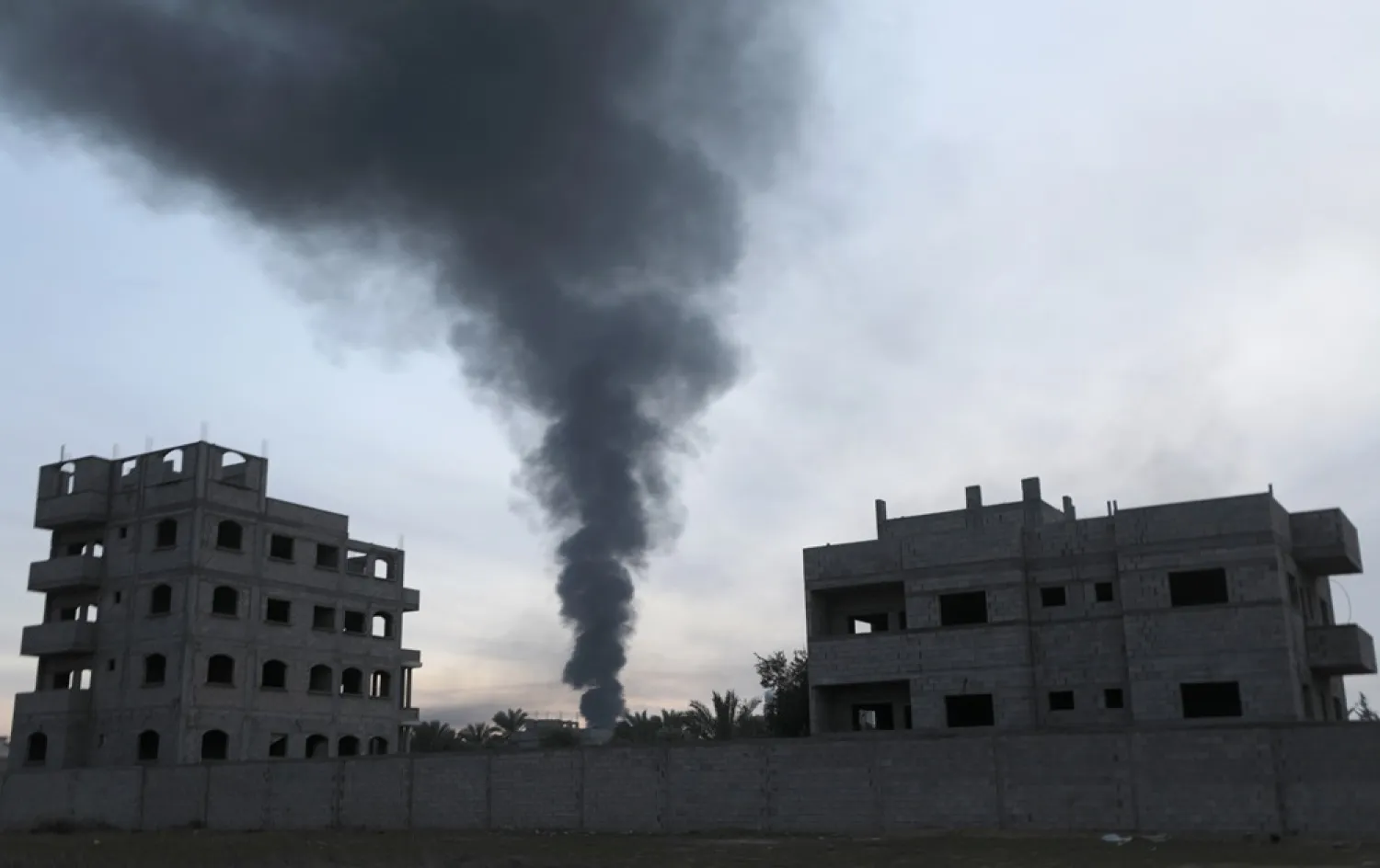
Smoke rises above Khan Younis following Israeli air strikes in the southern Gaza Strip, 07 December 2023. (EPA)
TT

Hundreds More Palestinians Killed as Israel Pursues Hamas in South Gaza

Smoke rises above Khan Younis following Israeli air strikes in the southern Gaza Strip, 07 December 2023. (EPA)

Israel battled Hamas militants in the Gaza Strip's biggest cities on Thursday and said it had attacked dozens of targets, leaving 350 Palestinians dead and the rest struggling to survive in rapidly shrinking areas of refuge.

Gazans crammed into Rafah on the southern border with Egypt, heeding Israeli leaflets and messages saying that they would be safe in the city after successive warnings to head south.

But more than 20 people were killed in apartments there late on Wednesday sheltering displaced civilians from the north, said Eyad al-Hobi, a relative of some of those killed.

"All apartments in the building suffered serious damage," he said as people brought out two apparently lifeless children.

Another relative, Bassam al-Hobi, said the building had been hit by three rockets.

"They targeted women and children, as you can see, and the guests who were told the south would be safe," he said, gesturing to bodies wrapped in white cloth, some small, lined up on the ground and surrounded by mourners.

Israel said militants had fired at least one rocket from Rafah and 12 from the desolate area of Al Mawasi on Gaza's southern Mediterranean coast where it has also advised displaced people to gather, leaving the status of the areas unclear.

In southern Gaza's largest city, Khan Younis, Israel said its forces killed a number of gunmen, including two militants who emerged firing from a tunnel. Residents reported several Israeli air strikes and non-stop tank fire in the city's east.

In Washington, a senior State Department official said US Secretary of State Antony Blinken spoke with Israel's strategic affairs minister on Thursday, and told him Israel needs to do more to protect civilians in its offensive in southern Gaza.

New phase

Israeli troops reached the heart of Khan Younis on Wednesday in a new phase of the war, now entering its third month. Health officials said three people were killed there on Thursday.

Ambulances and relatives rushed the wounded into the city's Nasser hospital, but even the floor space inside was full. Two badly wounded children lay on a trolley and a bloodstained young boy lay screaming among the patients on the floor.

"The injuries are very severe," said doctor Mohamed Matar. "The situation is catastrophic in all senses of the word... We can't treat the injured in this state."

Those who escape violence face an increasingly desperate struggle to survive.

Ibrahim Mahram, who fled to Al Mawasi, said five families were sharing a tent in the former Bedouin village, which refugee organizations say lacks shelter, food and other necessities.

"We suffered from the war of cannons and escaped it to arrive at the war of starvation," he told Reuters.

"We divide one tomato between all of us."

The UN Palestinian Refugee Agency (UNRWA) said 1.9 million people - 85 percent of Gaza's population - had been displaced and its shelters were four times over capacity.

UN refugee chief Filippo Grandi said pressure was growing in the south of the enclave near Egypt.

"People are piling up in the little sliver of land between Khan Younis and the Rafah border," he told Reuters.

Egypt said it would not allow Gazans to be pushed across its border. Diaa Rashwan, head of the State Information Service, added that Egypt believed Israel was also trying to force Palestinians in the West Bank towards Jordan.

The Gaza health ministry said 17,177 Palestinians had been killed and 46,000 wounded since Oct 7, when Israel began bombing Gaza in response to an assault by Hamas militants who control the enclave. In the past 24 hours alone, 350 people had been killed, ministry spokesman Ashraf Al-Qidra said.

Israel says it must wipe out Hamas and is doing everything possible to get civilians out of harm's way.

Bombing and gunbattles

Israel said it had raided a Hamas compound in Jabalia, killing several gunmen and found tunnels, a training area and weapons. Israeli television showed scores of men, stripped to their underwear, sitting on a road. Maariv newspaper said they were Hamas fighters captured in Gaza City.

The armed wing of Hamas said fighters had destroyed or damaged 79 army vehicles in Gaza City in the past three days but did not produce evidence.

The surprise Hamas incursion on Oct 7. killed 1,200 people, with 240 people taken hostage, according to Israel's tally.

The Israeli military says 88 soldiers have been killed in ground incursions into Gaza that began on Oct. 20.

The UN has been unable to distribute aid in any part of Gaza except for the area around Rafah for the past four days, it said in its daily humanitarian report on Thursday.

A senior Hamas official told Reuters mediators were still exploring opportunities for a truce and reiterated its demand that Israel cease its attacks.

UN aid chief Martin Griffiths said on Thursday there were promising signs that the Kerem Shalom crossing in Israel could soon be opened to allow more humanitarian aid into Gaza.

A guided-missile attack from Lebanon killed a 60-year-old farmer in northern Israel on Thursday, Israel's public broadcaster Kan said, and Prime Minister Benjamin Netanyahu warned that Beirut would be turned "into Gaza" if Hezbollah, a Hamas ally, started an all-out war.



US Pays $160 Million of More than $4 Billion Owed to UN

US President Donald Trump during the Board of Peace meeting at the Donald J. Trump US Institute of Peace in Washington, USA, 19 February 2026. EPA/ALESSANDRO DI MEO
TT

US Pays $160 Million of More than $4 Billion Owed to UN

US President Donald Trump during the Board of Peace meeting at the Donald J. Trump US Institute of Peace in Washington, USA, 19 February 2026. EPA/ALESSANDRO DI MEO

The United States has paid about $160 million of the more than $4 billion it owes to the UN, a United Nations spokesperson said on Thursday as President Donald Trump hosted the first meeting of his "Board of Peace" initiative that experts say could undermine the United Nations.

"Last week, we received about $160 million from the United States as a partial payment of its past dues for the UN regular budget," the UN spokesperson said ‌in a ‌statement.

Trump said during his comments at the opening "Board of Peace" ‌meeting ⁠that Washington would ⁠give the United Nations money to strengthen it.

The US is the biggest contributor to the UN budget, but under the Trump administration it has refused to make mandatory payments to regular and peacekeeping budgets, and slashed voluntary funding to UN agencies with their own budgets.

Washington has withdrawn from dozens of UN agencies.

UN officials say the US owed $2.19 billion to the regular UN budget as of the start ⁠of February, more than 95% of the total owed by ‌countries globally. The US also owes another $2.4 billion ‌for current and past peacekeeping missions and $43.6 million for UN tribunals.

"We're going to help ‌them (UN) money-wise, and we're going to make sure the United Nations is viable," ‌Trump said.

"I think the United Nations has great potential, really great potential. It has not lived up to (that) potential."

Countries, including major powers of the Global South and key US allies in the West, have been reluctant to join Trump's "Board of Peace" where ‌Trump himself is the chair. Many experts have said such an initiative undermines the United Nations.

Trump launched the board ⁠last month ⁠and proposed it late last year as part of his plan to end Israel's war in Gaza.

A UN Security Council resolution recognized the board late last year through 2027, limiting its scope to Gaza, the Palestinian territory it was meant to oversee following Israel's devastating more than two-year assault. Under Trump's plan to end Israel's war in Gaza, the board was meant to oversee Gaza's temporary governance. Trump subsequently said the board will tackle global conflicts and look beyond Gaza as well.

UN experts say that Trump's oversight of a board to supervise a foreign territory's affairs resembles a colonial structure and criticized the board for not having Palestinian representation. There was no UN representative at the "Board of Peace" meeting on Thursday.


Mohammed bin Salman, Graham Discuss Relations between Saudi Arabia, US 

Prince Mohammed bin Salman bin Abdulaziz Al Saud, Crown Prince and Prime Minister, meets with US Senator Lindsey Graham in Riyadh on Thursday. (SPA)
TT

Mohammed bin Salman, Graham Discuss Relations between Saudi Arabia, US 

Prince Mohammed bin Salman bin Abdulaziz Al Saud, Crown Prince and Prime Minister, meets with US Senator Lindsey Graham in Riyadh on Thursday. (SPA)

Prince Mohammed bin Salman bin Abdulaziz Al Saud, Crown Prince and Prime Minister, held talks in Riyadh on Thursday with US Senator Lindsey Graham.

Talks focused on the ties of friendship between Saudi Arabia and the United States. They discussed regional and international developments and several issues of common interest.

The meeting was attended by Saudi Defense Minister Prince Khalid bin Salman bin Abdulaziz, Foreign Minister Prince Faisal bin Farhan bin Abdullah and Minister of State, Member of the Cabinet, and National Security Advisor Dr. Musaed bin Al-Aiban.


Yemen PM Announces Comprehensive Reform Plan with Saudi Support

Zindani government holds first meeting after ministers return to Aden (Saba News Agency)
TT

Yemen PM Announces Comprehensive Reform Plan with Saudi Support

Zindani government holds first meeting after ministers return to Aden (Saba News Agency)

Yemen’s new government convened its first cabinet meeting on Thursday in the temporary capital Aden, with Prime Minister Shayea al-Zindani presiding after ministers completed their return to the country to resume duties, in what officials cast as the start of a hands-on push to stabilize security, revive services and shore up a battered economy with broad Saudi backing.

The meeting coincided with remarks by Presidential Leadership Council member Abdulrahman al-Mahrami, who warned against unrest in Aden, in an apparent reference to attempts led by elements of the dissolved Southern Transitional Council. “We will not allow any attempts to destabilize public order or drag our city into chaos or futile conflicts,” he said.

At the cabinet’s first meeting following its return to Aden, Zindani stressed that “there is no room for any government member to remain outside the country,” affirming that the government would be present on the ground, living among the population and addressing their daily needs, in a move aimed at restoring public trust and strengthening direct government performance.

The Yemeni prime minister, who also retains the foreign affairs portfolio, said his government would enter a new phase of field-based work from Aden, emphasizing that the next stage would rely on direct engagement with citizens, enhancing the effectiveness of state institutions and achieving tangible improvements in services and economic and security stability.

He said improvements in some basic services in recent weeks were not temporary, but the result of disciplined measures and practical reforms, alongside significant Saudi support, which he said had once again proven to be a pillar of the Yemeni state and a key partner in achieving peace and ensuring stability. He added that Saudi moves in support of the Yemeni people were consistent with international law.

Zindani said the government was working to ensure the sustainability of service delivery so that citizens feel a real and lasting difference, not a fleeting improvement, noting that the coming phase would include serious steps to combat corruption, enhance transparency and enforce the law as key pillars for building effective state institutions.

Reforms on all fronts

On the economic front, Zindani announced that the government would present a realistic 2026 budget for the first time in years, giving top priority to the regular payment of public-sector salaries as a legal and moral obligation.

Measures would also be taken to curb inflation and contain the erosion of citizens’ purchasing power, thereby easing living burdens.

On the security and military fronts, he said the government was committed to removing all military camps from Aden and other cities and to unifying military and security decision-making under the state’s authority, to strengthen stability and prevent multiple centers of influence.

He stressed the importance of respecting rights and equality for all citizens, and of not allowing calls that promote chaos or threaten public order.

Regarding the southern issue, the prime minister expressed confidence that south-south dialogue would open a genuine window to address it, calling on southerners to abandon the rhetoric of treason and avoid fueling strife and grudges, and to entrench a culture of tolerance and move beyond past conflicts.

He said southerners are the ones concerned with determining their present and future through dialogue, away from the imposition of individual or factional will, stressing there was no room to politicize or diminish the southern issue, which he described as a national cause concerning all Yemenis.

On the peace track, Zindani said the state retained all options to restore its institutions if the Houthis remained intransigent, while affirming that the internationally recognized government continues to extend its hand for peace and to end the Houthi coup, alongside efforts to launch a broad process of reconstruction, development and modernization.

Gradual work

Upon his arrival at Aden International Airport, Zindani said the government’s return to the country represents a practical commitment to shoulder national responsibilities and directly address accumulated challenges facing citizens, particularly amid difficult economic conditions and the repercussions of the ongoing war.

In his first interview after being sworn in as prime minister, Zindani said his government would soon relocate to Aden, noting that being inside the country was not a symbolic step but a prerequisite for effective decision-making and restoring the regular functioning of state institutions.

Speaking to Asharq Al-Awsat, he said the current phase “does not tolerate broad rhetoric,” but requires gradual work to rebuild trust and restore institutional rhythm, stressing that improving living conditions, services, and economic recovery are urgent priorities.

He justified retaining the foreign affairs portfolio as necessary to complete organizational and diplomatic reforms he had previously begun.

Zindani said his cabinet was formed based on professional criteria, away from quota-based arrangements, with a focus on competence, specialization and national balance.

Economically, he adopted what he described as a realistic tone, avoiding quick promises, and said recovery requires restructuring financial administration, controlling resources, enhancing transparency and activating oversight.

He said unifying political and military decision-making would enable state institutions to enforce the law, make accountability possible and give the government a more cohesive negotiating position in any upcoming peace process with the Houthis.

No tolerance for unrest

In support of Zindani’s government, Presidential Leadership Council member Abdulrahman al-Mahrami said security and stability in Aden would remain a non-negotiable priority.

He stressed that no attempts would be allowed to undermine public order or drag Aden into chaos and futile conflicts.

In a statement on his official X account, he reaffirmed that Aden’s security and stability will remain a priority and the government will accept no compromise or negligence.

"We will not allow any attempts to destabilize public order or drag our city into chaos or futile conflicts, without detracting from the political path of the south and its cause," he said.

He added: “We look forward to a South-South dialogue sponsored by Riyadh. It is a historic opportunity that we value and hold on to, and we thank the Kingdom’s leadership for it. We also affirm our full support for the government headed by Dr. Shayea al-Zindani, urging all its members to provide services and improve living conditions in a way that citizens can feel.”

Al-Mahrami pledged to follow up on performance “with care, transparency and responsibility,” calling on “everyone to unite, reject rumors, strengthen the spirit of national responsibility and stand together to protect the capital and safeguard state institutions.”

He added: “We trust that all understand the importance of preserving security and stability as the foundation for government and institutional work and the provision of services, away from political direction or exploitation by any party to harm people’s lives and increase their suffering, without detracting from our just cause.”