


UN Votes to Establish Independent Body to Clarify Fate of over 130,000 Syrians Missing in Conflict

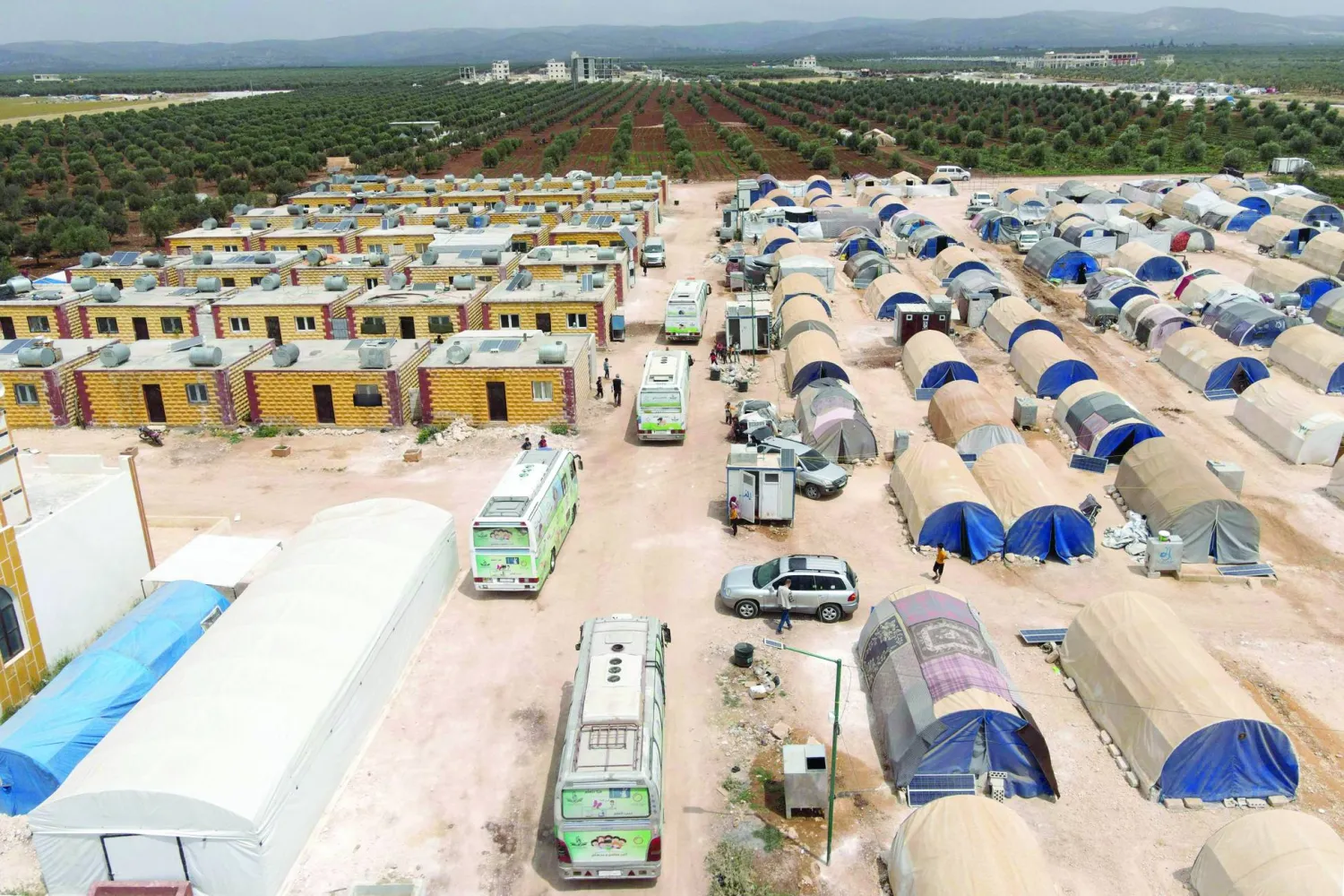
Buses turned into travelling classrooms pull into at a displacement camp in Jindayris in the opposition-held northwestern Syrian province of Aleppo on May 23, 2023, following a devastating earthquake more than three months ago. (Photo by Rami al SAYED / AFP)
TT

UN Votes to Establish Independent Body to Clarify Fate of over 130,000 Syrians Missing in Conflict

Buses turned into travelling classrooms pull into at a displacement camp in Jindayris in the opposition-held northwestern Syrian province of Aleppo on May 23, 2023, following a devastating earthquake more than three months ago. (Photo by Rami al SAYED / AFP)

The UN General Assembly approved a resolution Thursday that will establish an independent body to determine what happened to more than 130,000 people missing as a result of the conflict in Syria.

The resolution, an important response to appeals by their families and loved ones, was adopted by the 193-member world body on a vote of 83-11 with 62 abstentions. Among those opposing the resolution was Syria, which said it will not cooperate with the new institution. Russia, China, North Korea, Venezuela, Cuba and Iran also voted no.

The resolution, spearheaded by Luxembourg, noted that after 12 years of fighting in Syria “little progress has been achieved in alleviating the suffering of families by providing answers as to the fate and whereabouts of all missing persons”, reported The Associated Press.

It authorizes the establishment of an Independent Institution of Missing Persons in the Syrian Arab Republic, under UN auspices, “to clarify the fate and whereabouts of all missing persons ... and to provide adequate support to victims, survivors and the families of those missing.”

It says victims, survivors and the families of the missing should be represented in the new body, which will be guided by principles including “do no harm,” impartiality, transparency and the confidentiality of sources and information.

Under the resolution, UN Secretary-General Antonio Guterres must present terms of reference for the new institution within 80 working days and take steps to speedily establish the body and put it in operation. It requests the UN chief to report on implementation of the resolution within 100 working days.

Luxembourg’s UN ambassador, Olivier Maes, told the General Assembly before the vote that “every day families, especially women, face administrative and legal difficulties, financial uncertainties and deep trauma as they continue to search for their missing loved ones.”

He noted that Guterres recommended in a report last August that UN members consider establishing an independent institution to clarify the fate of the missing. The UN chief cited insufficient coordination among current bodies dealing with Syria’s missing and said families often had to report disappearances to multiple places.

Maes said the new institution will be “a one-stop shop” and serve as a single place to collect and compare data and ensure coordination and communication with all parties.

Syrian Ambassador Bassam Sabbagh called the resolution “politicized,” saying it clearly reflects “flagrant interference in our internal affairs” and provides new evidence of the “hostile approach” of the United States and other Western nations to his country.

Urging a "no" vote, he said Syria has addressed the issue of missing persons, processed all claims of disappearances submitted to law enforcement authorities and carried out “independent investigations in accordance with Syrian law and on the basis of available information and resources.”

US deputy ambassador Jeffrey DeLaurentis said many of the missing were unjustly detained or taken by the parties to the conflict, including individuals believed to be missing at the hands of the ISIS extremist movement and other terrorist groups.

"Nearly every Syrian family is affected by this issue," he said. “Confirming the fate and whereabouts of the missing, securing their release, and returning the remains of those who perished to their families is a moral and humanitarian imperative.”

DeLaurentis said that “even with limited or no initial cooperation from Damascus, we believe this institution will make meaningful progress.”

Syria’s uprising-turned conflict, now in its 13th year, has killed nearly a half million people and displaced half of its prewar population of 23 million. The International Commission on Missing Persons cites UN estimates that in 2021 more than 130,000 Syrians were missing as a result of the conflict.

In the run-up to the vote, over 100 civil society organizations and 23 UN human rights experts had urged the General Assembly to establish an independent institution.

The organizations, including Amnesty International and Human Rights Watch and a dozen Syrian groups, called on UN member nations “to support the families’ right to truth.” They noted that the call was also supported by the International Committee of the Red Cross and others.

UN Human Rights Commissioner Calls for Accountability for Atrocity Crimes in Sudan

UN Human Rights commissioner Volker Turk 
TT

UN Human Rights Commissioner Calls for Accountability for Atrocity Crimes in Sudan

UN Human Rights commissioner Volker Turk 

UN Human Rights commissioner Volker Turk said on Sunday he is alarmed by the increasing militarization of society by all parties to the conflict in Sudan, also expressing his worries that the atrocity crimes committed during and after the takeover of El Fasher would be repeated in the Kordofan region.

Speaking at a press conference in Port Sudan, where the government had been operating as a temporary capital since the conflict began, the UN envoy said the proliferation of advanced military equipment, in particular drones, across Sudan has enhanced the military capabilities of both the Sudanese army (SAF) and the Rapid Support Forces (RSF), prolonging hostilities and deepening the crisis for civilians.

“I am deeply alarmed by the increasing militarization of society by all parties to the conflict, including through the arming of civilians and recruitment and use of children,” Turk noted.

The envoy said that during his visit to refugee camps in north Sudan, he heard accounts of widespread summary executions by RSF during the offensive on El Fasher, the capital of North Darfur region – for revenge, for suspected affiliation with the Sudanese Army or its allied Joint Forces.

He added, “I am very worried that the atrocity crimes committed during and after the takeover of El Fasher are at grave risk of repeating themselves in the Kordofan region, where the conflict has been rapidly escalating since late October.”

Horror and Hell

Turk also said the Sudanese population had endured “horror and hell,” especially with the expansion of the fighting in Kordofan.

“The Kordofan states are extremely volatile, with relentless military engagements, heavy shelling, drone bombardments and airstrikes causing widespread destruction and collapse of essential services,” he warned.

Since the end of October, and after taking control of El Fasher in Darfur, the RSF attacks have expanded into the neighboring Kordofan region, resulting in a continued displacement of civilians from the besieged city – all in the context of extreme food insecurity, with famine conditions confirmed in Kadugli, and risk of famine in other areas including Dilling, according to Turk.

The latest UN figures show that more than 65,000 people have been displaced since October.

At his press conference at Port Sudan airport, the envoy said that during his four-day visit to Port Sudan, Dongola, Ad Dabba and Merowe, he has met with those who have been hardest hit by brutal violence and injustice in this war.

“The terrifying experiences of these survivors must provoke action to end this conflict, and to make sure they can access what they need: medical care, psychosocial care, justice and support to pursue education and a livelihood”.

End This Madness

Turk and his UN team had visited the Al Afad site for internally displaced people (IDPs) in Ad Dabba, where they met with a large number of displaced people from the regions of Darfur and Kordofan.

“In my meetings with more than 50 local and international organizations in Dongola and Port Sudan, I heard appeals directed to those waging this war and the international community to end this madness,” he said.

“And to allow NGOs, journalists, lawyers and humanitarian actors to do their essential work without undue restrictions and reprisals,” Turk added.

He said the RSF and the Sudanese army must cease intolerable attacks against civilian objects that are indispensable to the civilian population, including markets, health facilities, schools and shelters.

“Attacks on critical civilian infrastructure are serious violations that can amount to war crimes,” Turk affirmed.

The UN envoy said the international community must ensure that the perpetrators of the horrific violations in Sudan face justice, regardless of their affiliation.

My Office, he said, is working to document and report on these violations and abuses to pave the way for accountability.

Turk described as “despicable” the fact that large sums of money are being spent on procuring increasingly advanced weaponry – funds he said that should be used to alleviate the suffering of the population.

Protection of Civilians

The envoy then called on all parties to the conflict to ensure the protection of civilians and civilian infrastructure, to guarantee safe passage for civilians to leave areas of active conflict – including Kadugli and Dilling – and for humanitarian aid to enter where it is needed.

He also repeated his call from three years ago, when he last visited Sudan, urging all those involved to set aside entrenched positions, power games, and personal interests, and to focus on the common interests of the Sudanese people.

The envoy then left Sudan with a plea that human rights be central to building confidence and bringing this war to an end, to resuming the difficult task of building a sustainable peace.

“It is difficult, but certainly not impossible, with the resilience and power of the Sudanese people,” he affirmed.


Syrian Government Announces Ceasefire with Kurdish-led SDF

Syrian President Ahmed al-Sharaa after signing an agreement at the presidential palace in Damascus on January 18, 2026. (EPA)
TT

Syrian Government Announces Ceasefire with Kurdish-led SDF

Syrian President Ahmed al-Sharaa after signing an agreement at the presidential palace in Damascus on January 18, 2026. (EPA)

The Syrian government Sunday announced a ceasefire with the Syrian Democratic Forces, taking almost full control of the country and dismantling the Kurdish-led forces that controlled the northeast for over a decade.

The announcement comes as tensions between government forces and the SDF boiled over earlier this month, eventually resulting in a major push by government forces toward the east. The SDF appeared to have largely retreated after initial clashes on a tense front line area in eastern Aleppo province.

Hours after the government announced the deal, SDF leader Mazloum Abdi confirmed it in a video statement, saying the group had accepted the agreement, which stipulates their withdrawal from Raqqa and Deir Ezzor provinces “to stop the bloodshed.”

“We will explain the terms of the agreement to our people in the coming days,” he said.

Syria’s Defense Ministry said it ordered the fighting to halt on the front lines after the agreement was announced.

Syria’s new leaders, since toppling Bashar al-Assad in December 2024, have struggled to assert their full authority over the war-torn country. An agreement was reached in March that would merge the SDF with Damascus, but it didn't gain traction as both sides accused each other of violating the deal.

Since the push, the government has largely asserted control of the Deir Ezzor and Raqqa provinces, critical areas under the SDF that include oil and gas fields, river dams along the Euphrates, and border crossings.

Syria’s state-run news agency SANA showed President Ahmed al-Sharaa signing and holding the agreement. Abdi, who was scheduled to meet with the president in Damascus was not seen, though his signature appeared on the document.

Sharaa told journalists that Abdi could not travel due to bad weather and will visit Damascus on Monday.

“It’s a victory for all Syrians of all backgrounds,” Sharaa told journalists in Damascus after signing the agreement. “Hopefully Syria will end its state of division and move to a state of unity and progress.”

US Envoy Tom Barrack met with Sharaa earlier Sunday as government forces were sweeping into the city of Raqqa and across Deir Ezzor. Abdi reportedly joined the meeting over the phone.

Barrack praised the agreement, saying it will lead to “renewed dialogue and cooperation toward a unified Syria,” ahead of working on the details of implementing the integration.

“This agreement and ceasefire represent a pivotal inflection point, where former adversaries embrace partnership over division,” said Barrack in a post on X.

The agreement includes dismantling the SDF and having its forces join Syria’s military and security forces, while senior military and civilian officials would be given high-ranking positions in state institutions.

The SDF would have to give up the Raqqa and Deir Ezzor provinces — both Arab-majority areas — to the Syrian military and government, as well as its border crossings and oil and gas fields.

Hassakah province, the heartland of the Kurdish population, is only expected to give its civilian administration back to Damascus, while the Kurdish-led agencies that handled prisons and sprawling camps with thousands of detained ISIS group fighters and families would be handed over to Damascus.

Agreement will be implemented gradually

There was no clear timeline on when and how the different elements of the agreement will take effect. Sharaa told journalists that it will be gradually implemented, beginning with the cessation of hostilities.

It appeared that tensions following clashes in Aleppo earlier this month had calmed after Abdi announced that his troops will withdraw east of the Euphrates River, and Sharaa issued a presidential decree that would strengthen Kurdish rights in the country.

Initially the withdrawal appeared to be going as planned, but then new clashes broke out and the Syrian military seized Tabqa, continuing into Raqqa province.

A senior Syrian government official who spoke on condition of anonymity because he was not authorized to speak publicly said government forces pushed eastward because the SDF despite saying they will withdraw east of the Euphrates by 7 a.m. did not do so.

Armed Arab clans in Raqqa and Deir Ezzor that largely do not support the SDF backed Damascus. By Sunday evening, the SDF lost control of large swaths of its territory and infrastructure, including dams and oil and gas fields.

The SDF took Raqqa from the ISIS group in 2017 as part of its military campaign to take down the group’s so-called "caliphate", which at its peak stretched across large parts of Syria and Iraq.

An Associated Press reporter in the area said that large military convoys swept into Raqqa city Sunday evening and were greeted by residents. It appeared that the SDF had withdrawn.

Raqqa celebrates

Crowds in Raqqa celebrated in the streets late into the evening, waving Syrian flags and setting off fireworks, while some fired into the air.

“Today, everyone is born anew,” said Yahya Al Ahmad, who was among the revelers.

A couple of thousand Kurdish families who lived in the areas captured by government forces fled to the SDF-controlled city of Qamishli amid the offensive. Many of them had previously been displaced from other areas multiple times during Syria’s 14-year civil war and were living in tents camps. A cultural center in the city was turned into a temporary shelter for them.

Residents of Qamishli expressed both hope and skepticism about the deal.

“The Kurds have become victims of international agreements and international deception,” said Goran Ibrahim, a doctor. But he said, “With regards to this agreement, the positive part is the end of the fighting in the region.”

Syria's ambassador to the UN, Ibrahim Olabi, told the AP, “Really this is now a moment to show that Syrians are able to put differences aside and move ahead...It’s a victory for Syria.”


Video Shows Fires in Palestinian Village in West Bank During Israeli Settler Attack

 People stand in an area with destroyed vehicles and a structure, which Palestinians say were burned by Israeli settlers on Saturday, in the Palestinian town of Mikhmas, near Ramallah in the Israeli-occupied West Bank, January 18, 2026. (Reuters)
People stand in an area with destroyed vehicles and a structure, which Palestinians say were burned by Israeli settlers on Saturday, in the Palestinian town of Mikhmas, near Ramallah in the Israeli-occupied West Bank, January 18, 2026. (Reuters)
TT

Video Shows Fires in Palestinian Village in West Bank During Israeli Settler Attack

 People stand in an area with destroyed vehicles and a structure, which Palestinians say were burned by Israeli settlers on Saturday, in the Palestinian town of Mikhmas, near Ramallah in the Israeli-occupied West Bank, January 18, 2026. (Reuters)
People stand in an area with destroyed vehicles and a structure, which Palestinians say were burned by Israeli settlers on Saturday, in the Palestinian town of Mikhmas, near Ramallah in the Israeli-occupied West Bank, January 18, 2026. (Reuters)

Israeli settlers rampaged through a Palestinian village in the West Bank, setting fire to a series of structures, according to security camera footage obtained by The Associated Press on Sunday, in an overnight onslaught that has become a common phenomenon in the occupied territory.

In the video, time-stamped at around 10 p.m. Saturday, several structures in the village go up in flames as the sound of gunfire, screaming and barking echoes in the background. At one point in the video, the fires grow so large that they illuminate the bands of settlers, dressed in black, pacing freely through the village.

Also Sunday, at least four more countries said they had been invited to join US President Donald Trump’s Board of Peace, the international body expected to oversee his Gaza ceasefire plan and perhaps other conflict resolutions.

Meanwhile, an Israeli Cabinet minister said that he'd ordered officials to disconnect the water and electricity for facilities of the UN Relief and Works Agency for Palestinian Refugees, or UNRWA. It's the latest action in Israel’s long-running campaign to shut down the agency. UNRWA fears the shutdown could hamper its work in east Jerusalem.

Settler attack video

The footage obtained by the AP showed the moment dozens of settlers descended on the small Bedouin hamlet of Khirbet al-Sidra, north of Jerusalem, attacking Palestinians and international activists and burning cars and homes, according to the Palestinian Authority's Jerusalem governate, which monitors Palestinian affairs in the area.

In a statement, it said that eight homes and at least two cars were burned in the attack.

Israel’s military said that soldiers dispatched to the village found an Israeli vehicle with clubs inside. It said that Palestinians, Israelis and foreign nationals were injured, and troops were searching the area to make arrests. As of Sunday afternoon, no arrests had been reported.

It marked the latest assault in the tense territory as settler violence spikes in recent months.

Around 500,000 Israelis have settled in the West Bank since Israel captured the territory, along with east Jerusalem and the Gaza Strip, in the 1967 Mideast war. Their presence is viewed by most of the international community as illegal and a major obstacle to peace.

The Palestinians seek all three areas for a future state. Israel has sought to play down the violence as the work of a small, radical minority. But Israel's far-right government, dominated by settlers and their supporters, has done little to stop the attacks.

Board of Peace invites

Jordan, Greece, Cyprus and Pakistan on Sunday announced that they had received invitations to Trump's Board of Peace. Albania, Egypt, Paraguay, Argentina and Türkiye have already said they were invited.

The board, made up of world leaders, was initially seen as a mechanism focused on ending the Israel-Hamas war in Gaza. It's now taking shape with ambitions to have a far broader mandate to address other global crises, potentially rivaling the United Nations.

The US hasn't yet announced the official list of members. In letters sent Friday to various world leaders inviting them to be “founding members” of the board, Trump says the body would “embark on a bold new approach to resolving global conflict.”

Israel moves against UNRWA

Israeli Energy Minister Eli Cohen said on X Sunday he'd issued formal notices to disconnect water and electricity from facilities belonging to UNRWA.

The UN agency said on X that the shutdown could take effect within two weeks. It comes after Israel's parliament in December passed a bill to cut the supply of electricity and water to the facilities.

The earlier ban already closed many of UNRWA’s services in east Jerusalem, though it continues to operate a vocational training center in east Jerusalem.

The agency provides aid and services, including health and education, to around 2.5 million Palestinian refugees in Gaza and the occupied West Bank and east Jerusalem, as well as 3 million more in Syria, Jordan and Lebanon.

Earlier last year, Israel banned the agency from operating on its territory. The ban followed months of attacks on the agency by Israel, which says it's deeply infiltrated by Hamas. UNRWA rejects that accusation.
