Syrian Kurds Urge the US-led Coalition to Say Clearly Where It Stands on Turkish Drone Attackshttps://english.aawsat.com/arab-world/4470631-syrian-kurds-urge-us-led-coalition-say-clearly-where-it-stands-turkish-drone
Syrian Kurds Urge the US-led Coalition to Say Clearly Where It Stands on Turkish Drone Attacks
People shop at the Azra Alyahoodi (Azra the Jew) market also known as the "Jewish market", in the city of Qamishli in northeastern Syria, on July 27, 2023. (AFP)
TT
TT
Syrian Kurds Urge the US-led Coalition to Say Clearly Where It Stands on Turkish Drone Attacks
People shop at the Azra Alyahoodi (Azra the Jew) market also known as the "Jewish market", in the city of Qamishli in northeastern Syria, on July 27, 2023. (AFP)
The Kurdish-led authorities in northeastern Syria on Friday called on the US-led coalition to make clear where it stands regarding Turkish drone strikes that have killed and wounded dozens of Syrian Kurdish fighters over the past months.
The appeal by the local authorities — known as the Autonomous Administration of North and East Syria — came a day after a Turkish drone hit a car, killing four members of the Kurdish-led and US-backed Syrian Democratic Forces and wounding two.
Ankara says the main Syrian Kurdish militia is allied with Türkiye's outlawed Kurdistan Workers’ Party, which has led an insurgency against Türkiye since 1984 that has killed tens of thousands of people. Ankara has declared the PKK a terrorist group.
Syrian Kurdish forces were a major US ally in the war against the militant ISIS group, which was defeated in Syria in March 2019.
Thursday’s drone attack was the latest in a monthslong escalation between Türkiye and Kurdish fighters in Syria.
The Syrian Democratic Forces said its six members were in a car, heading to their homes for a break when they were attacked on a road near the town of Qamishili on Thursday night.
Friday's statement said the US-led coalition needs “to have a clear stance ... regarding the targeting of our people and fighters."
There was no immediate reaction from the coalition.
A fighter with the Iran-backed Kataib Hezbollah carries a rocket-propelled grenade launcher in Jurf al-Sakhar, in Iraq's Babil province, south of Baghdad, Tuesday, Nov. 17, 2026. (AP)
TT
TT
Kataib Hezbollah Warns Iraqi Forces Against Entering Jurf al-Sakhar
A fighter with the Iran-backed Kataib Hezbollah carries a rocket-propelled grenade launcher in Jurf al-Sakhar, in Iraq's Babil province, south of Baghdad, Tuesday, Nov. 17, 2026. (AP)
The Iran-backed Kataib Hezbollah in Iraq vowed on Tuesday to confront government forces if they try to enter its main stronghold near Baghdad, denying allegations that it is smuggling oil from the area.
The standoff between Kataib Hezbollah and Iraqi authorities is shaping up to be the first major test of the new government’s resolve to disarm nonstate armed groups.
Abu Taleb al-Saidi of Kataib Hezbollah made the comments a day after Iraqi Prime Minister Ali al-Zaidi said security forces would enter Jurf al-Sakhar, south of Baghdad in Babil province, later this week. Local media reported that the group had until Friday to leave.
Kataib Hezbollah, one of Iraq’s most powerful armed groups, wields considerable influence in Jurf al-Sakhar and has maintained an armed presence there for more than a decade.
The planned move by al-Zaidi is part of his push to disarm Iran-backed groups by mid-2027. The move by both rival sides raises alarms of internal fighting that has been mostly avoided since the 2003 US-led invasion that removed Saddam Hussein from power.
Two officials from Kataib Hezbollah told The Associated Press that Gen. Esmail Qaani, who heads the foreign wing of Iran’s Revolutionary Guard, arrived in Baghdad on Monday to take part in mediation to end the tension. The officials, who spoke on condition of anonymity because they were not authorized to comment publicly, gave no further details.
The United States backs efforts to disarm Iran-backed groups in Iraq as part of its push to reduce Tehran’s influence in the region, including in Iraq and Lebanon. Washington has described Kataib Hezbollah as an “Iran-backed terrorist organization.”
Lebanese authorities will likely be watching the standoff in Jurf al-Sakhar closely. They have made little progress in carrying out their own plan to disarm Lebanon’s Hezbollah, which is allied with but separate from Kataib Hezbollah.
Also Tuesday, an Iraqi judicial committee inspected Jurf al-Sakhar following allegations by authorities that Kataib Hezbollah had used the area to smuggle oil worth tens of millions of dollars.
The state news agency quoted an unnamed senior official as saying the judicial committee was accompanied by a government committee. The inspection aimed to examine the circumstances of the alleged smuggling and identify sites where violations had occurred.
The agency quoted al-Zaidi as saying that all suspects involved in the oil smuggling operations will be referred to the judiciary and that legal measures will be taken against them. He also ordered the dismissal of nine security and administrative officials in Babil governorate, including the Babil police chief, commanders and directors of security and intelligence agencies, and the director of the State Company for Oil Pipelines.
Ali al-Nheir, a member of the parliament’s investigative committee, told the state news agency that the investigation that included thermal imaging showed 25 tanker trucks each carrying 36,000 liters.
“The reports reviewed by the committee were shocking, and included evidence and documents proving the existence of smuggling operations,” al-Nheir said about Jurf al-Sakhar.
Another Kataib Hezbollah official, who spoke on condition of anonymity, told journalists touring Jurf al-Sakhar on Tuesday that two facilities in the area refine oil. He said the fuel was used only to run the group’s vehicles and power generators and denied allegations of smuggling.
The official said Jurf al-Sakhar had been hit more than 35 times since the US and Israel began attacking Iran in late February.
He warned that if “a war is imposed on us we will fight.”
Yemen’s Government Activates Emergency Plans to Protect Airports and Border Crossingshttps://english.aawsat.com/arab-world/5342275-yemen%E2%80%99s-government-activates-emergency-plans-protect-airports-and-border
A displaced boy wearing an FC Barcelona jersey walks outside a tent at a displacement camp on the outskirts of Aden, Yemen, Wednesday, Nov. 11, 2026. (AP Photo/Abdulnasser Alseddik)
Yemen’s Government Activates Emergency Plans to Protect Airports and Border Crossings
A displaced boy wearing an FC Barcelona jersey walks outside a tent at a displacement camp on the outskirts of Aden, Yemen, Wednesday, Nov. 11, 2026. (AP Photo/Abdulnasser Alseddik)
Military developments in Yemen have prompted the government to raise the level of preparedness at vital facilities and activate emergency plans at airports and land border crossings.
The move comes as displacement caused by Houthi escalation has expanded, surpassing 347,000 people, while the United Nations warns that civilian casualties since last August have exceeded 300 killed and wounded.
The latest measures reflect concerns that the repercussions of the fighting could spread to transportation, navigation, and supply sectors, particularly amid growing threats linked to the Bab al-Mandab Strait, one of the world's most important maritime trade routes.
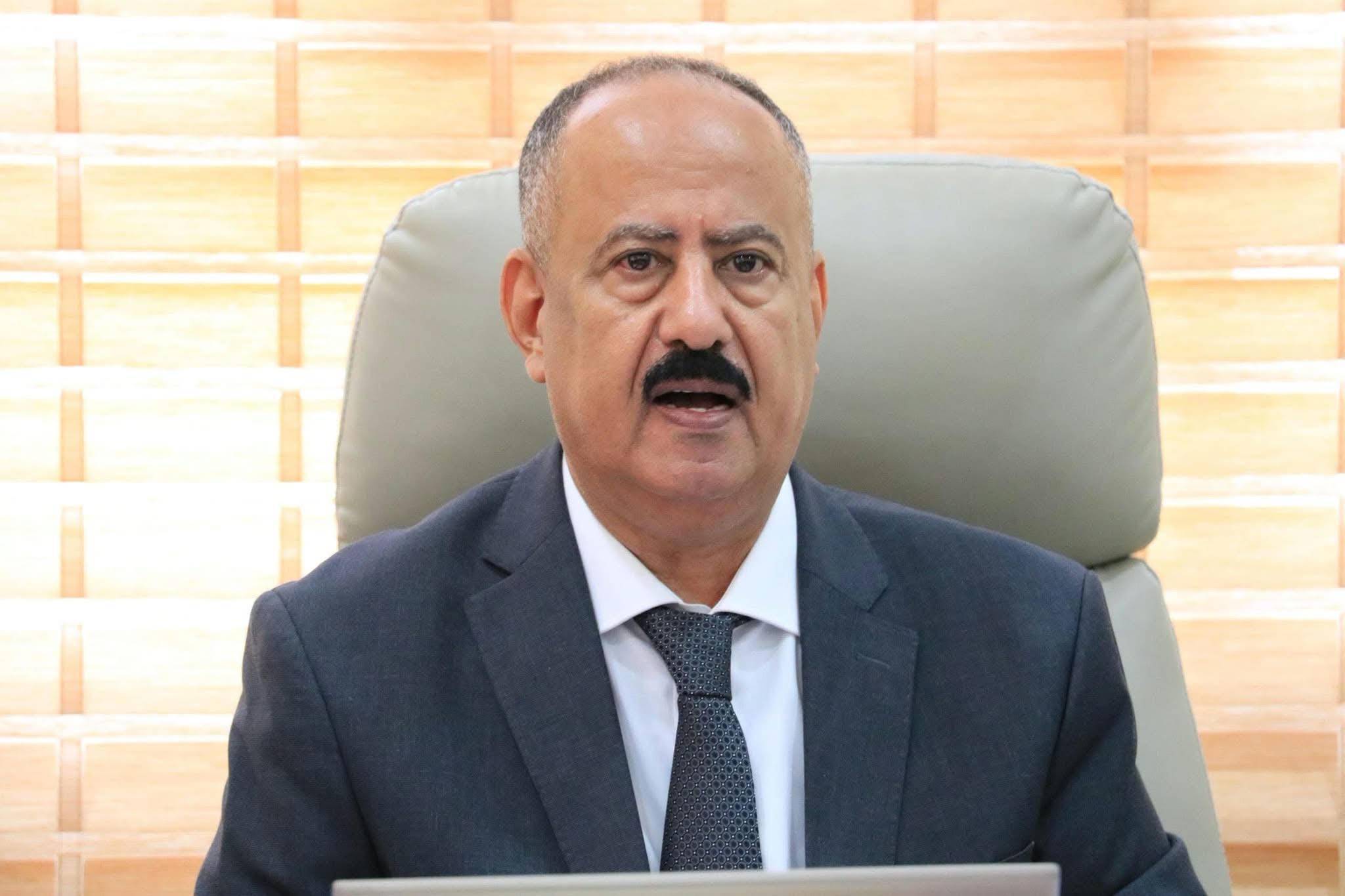
Yemeni Transport Minister Mohsen al-Omari instructed authorities to increase readiness and vigilance at airports and land crossings, activate emergency plans, tighten security and monitoring procedures, and strengthen coordination with local authorities and security agencies to ensure uninterrupted operations and the safety of critical infrastructure.
Yemeni Transport Minister Mohsen al-Omari (goverment media)
The directives were issued during a meeting with officials from the Civil Aviation and Meteorology Authority, the Land Transport Regulatory Authority, and directors of airports and border crossings to review emergency plans and the level of preparedness across ministry-affiliated institutions.
Al-Omari stressed that current circumstances require greater coordination and preparedness, noting the strategic importance of Bab al-Mandab as a vital waterway for global shipping and commerce.
He warned that any threat to international maritime routes would have consequences extending far beyond Yemen and impact global trade, and stressed that safeguarding maritime security is a shared responsibility requiring serious international action and close coordination with the Yemeni government and Saudi Arabia, which he said continues to support Yemen.
The minister also stated that Yemen has “no future under the Houthis,” describing the militias as an extremist sectarian and ideological project backed by Iran. He called for continued vigilance and strict adherence to government directives regarding developments in Bab al-Mandab and other vital areas.
Rising Wave of Displacement
Alongside the government measures, the humanitarian impact of the conflict continues to worsen. The International Organization for Migration (IOM) reported that the number of displaced people in Yemen has exceeded 347,000, including more than 14,000 individuals displaced during the last three days of the reporting period.
The organization documented the displacement of 18,780 people, representing 3,130 families, between November 8 and 14, indicating the continued flight of civilians from conflict zones and insecure areas.
Taiz Governorate has received the largest number of displaced people, hosting 143,130 individuals (41% of all recorded cases), followed by Lahj with 91,314 people (26%) and Aden with 70,404 people (20%). Additional displaced populations were recorded in Abyan, Hodeidah, Shabwa, Marib, Hadramawt, Al-Mahra, and Al-Dhalea.
The UN Office for the Coordination of Humanitarian Affairs (OCHA) reported that humanitarian agencies and partners have managed to deliver emergency assistance to more than 270,000 displaced people, roughly two-thirds of the total displaced population. More than 202,000 people have received emergency cash assistance.
In the health sector, aid programs reached over 103,000 displaced individuals, while a measles and rubella vaccination campaign launched on November 7 vaccinated more than 600,000 children.
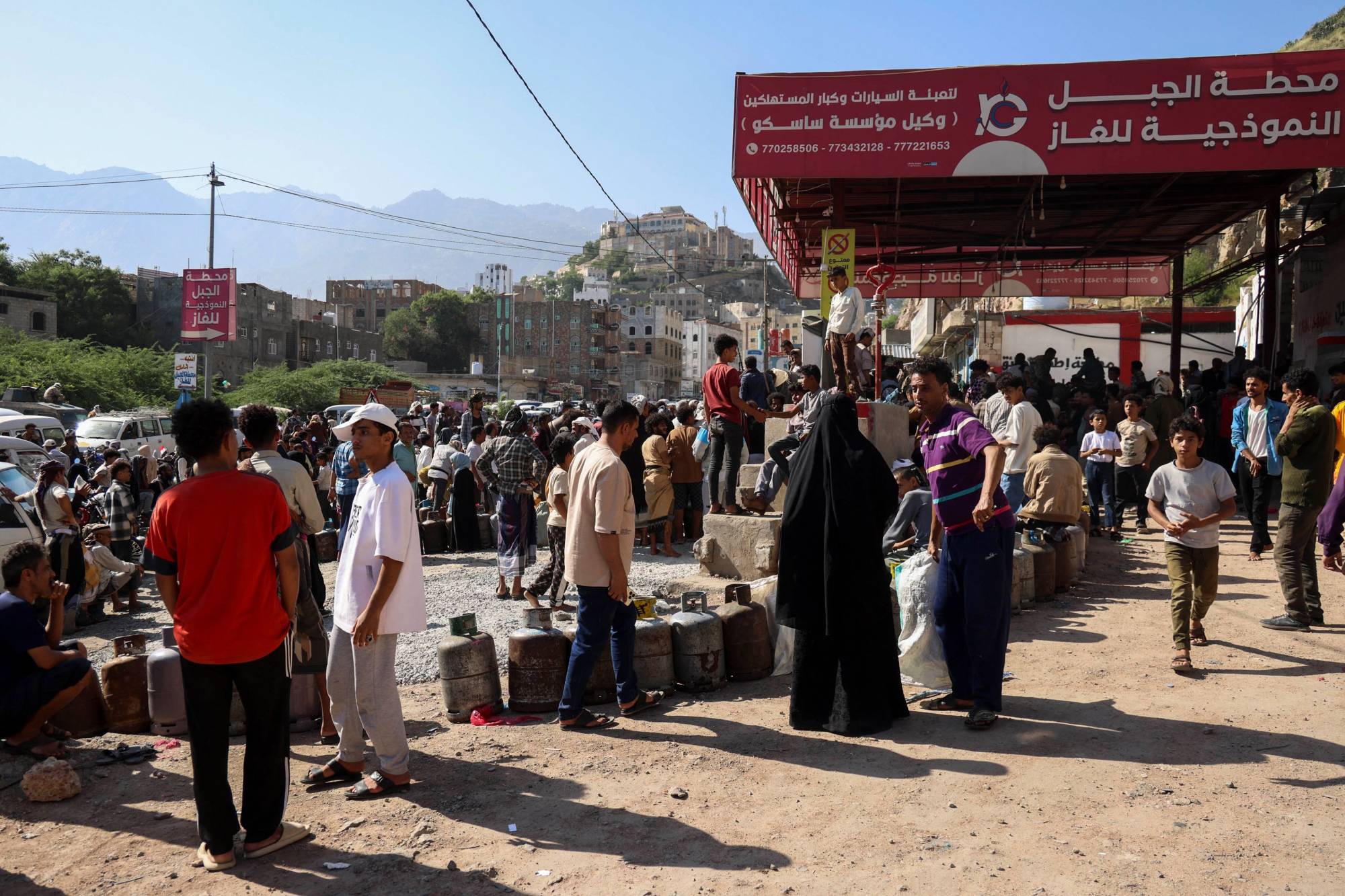
Yemenis line up to refill gas bottles at a refilling station in Taiz on October 19, 2026. (Photo by Ahmad AL-BASHA / AFP)
Civilian Casualties
The UN Human Rights Office documented more than 300 civilian casualties (killed and wounded) since the beginning of August, including over 70 deaths in cases verified by the organization.
According to the office, children account for more than one-third of all victims and nearly half of those killed. It warned that the true toll is likely much higher because the published figures include only cases independently verified by the UN.
These figures underscore the growing humanitarian consequences of the escalation, as fighting and displacement continue while the government seeks to secure critical infrastructure and reduce risks to transportation, shipping, and trade.
Syria FM Says Working Towards New Deal with EUhttps://english.aawsat.com/arab-world/5342274-syria-fm-says-working-towards-new-deal-eu
Foreign Minister Asaad al-Shaibani speaks at the Syria Partnership Coordination Forum in Damascus on Tuesday. (SANA)
TT
TT
Syria FM Says Working Towards New Deal with EU
Foreign Minister Asaad al-Shaibani speaks at the Syria Partnership Coordination Forum in Damascus on Tuesday. (SANA)
Foreign Minister Asaad al-Shaibani said Tuesday that Syria was working towards a new agreement with the European Union as the sides seek to deepen ties nearly two years after the ouster of longtime ruler Bashar al-Assad.
Shaibani's remarks came a day after EU top diplomat Kaja Kallas said the bloc would look to sign a nearly 20-year-old association deal with Syria, as the country seeks recover and rebuild after more than 13 years of civil war.
Shaibani told the Syria Partnership Coordination Forum, held with the EU in Damascus, that "we are currently working with the (European) Union on a joint scope paper for a new agreement" that would "open doors to trade and investment, and make political dialogue and institutional cooperation a firm commitment".
Syria and the EU signed a cooperation agreement including on economy and trade in 1977.
In 2008, they preliminarily inked an association agreement to replace the earlier deal but it never went into force due to human rights concerns.
Kallas on Monday said that EU foreign ministers meeting in Brussels had "supported moving ahead" with the 2008 deal and launching talks for an updated one.
"Syria needs investment and a successful transition," she said, adding: "The aim is to give Europe and Syria a framework for trade, political dialogue, and closer cooperation as soon as possible."
Syria's conflict killed more than half a million people, sent millions fleeing internally and abroad, and ravaged the country's infrastructure and industry.
The EU in 2025 removed its sanctions on Syria's economy in a bid to help its post-war recovery, while in May this year the bloc restored the cooperation agreement with Syria.
On Tuesday, European Commissioner for the Mediterranean, Dubravka Suica, told the event in Damascus that "the EU wants to deepen the political dialogue, strengthen trade and economic cooperation, and support Syria's reintegration" into the European-Mediterranean space.
"Respect for human rights and the protection of minorities is fundamental to our relationship with Syria. All Syrians must have a say in their country's future," she added.
The bloc has emphasized the need for Syria to carry out reforms and for its transition to be inclusive, particularly after sectarian violence last year.
لم تشترك بعد
انشئ حساباً خاصاً بك لتحصل على أخبار مخصصة لك ولتتمتع بخاصية حفظ المقالات وتتلقى نشراتنا البريدية المتنوعة