

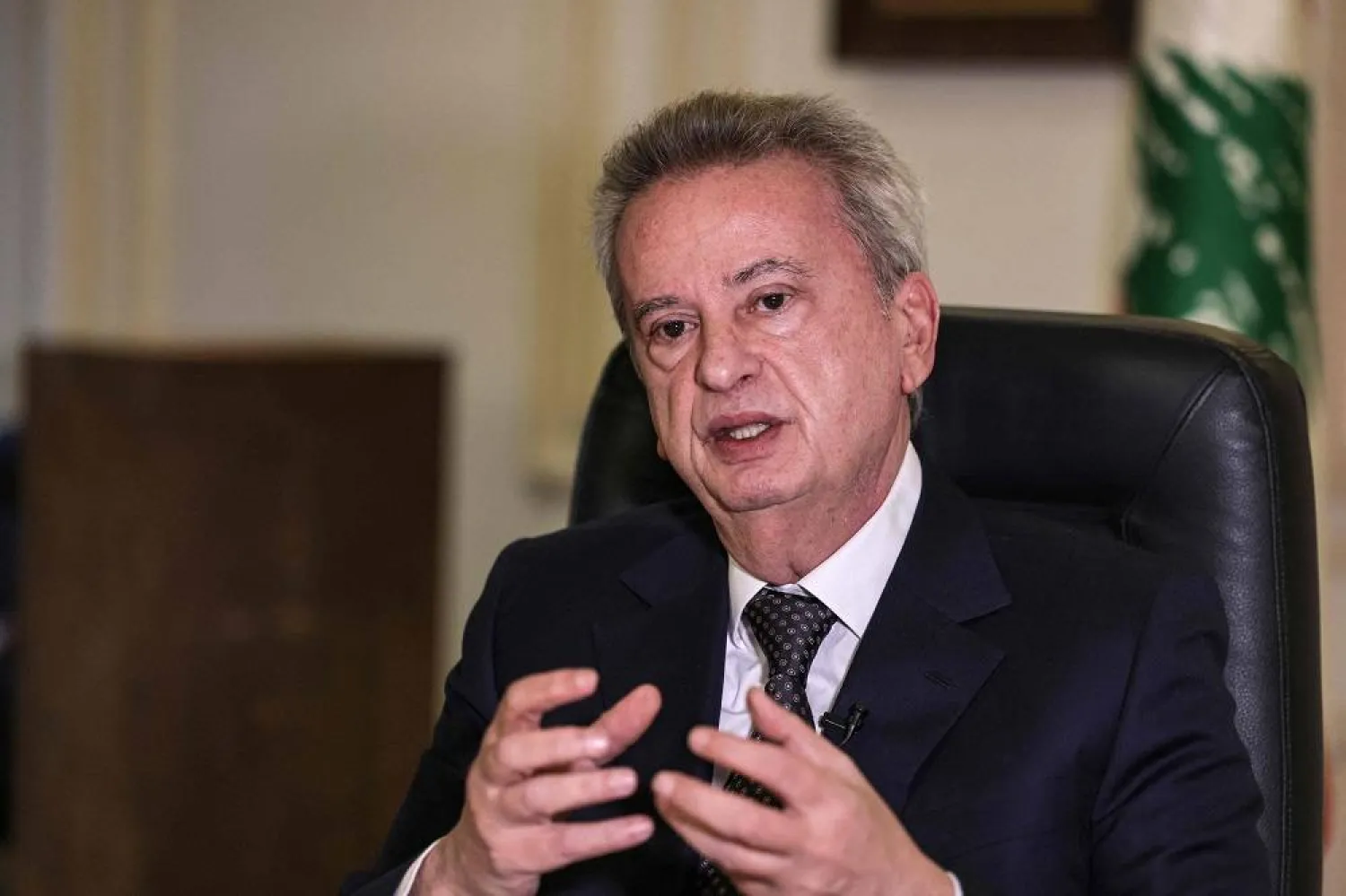

US, UK, and Canada Sanction Lebanon’s Former Central Bank Governor over Corruption Allegations

Lebanon's Central Bank Governor Riad Salameh gives an interview with AFP at his office in the capital Beirut on December 20, 2021. (AFP)
TT

US, UK, and Canada Sanction Lebanon’s Former Central Bank Governor over Corruption Allegations

Lebanon's Central Bank Governor Riad Salameh gives an interview with AFP at his office in the capital Beirut on December 20, 2021. (AFP)

The United States, United Kingdom, and Canada slapped sanctions Thursday on Lebanon's embattled former central bank governor and a handful of close relatives and associates over allegations of corruption, the US Treasury Department said.

Riad Salameh, 73, ended his 30-year tenure on July 31 under a cloud of investigation and blame for his country's historic economic crisis.

France, Germany, and Luxembourg are investigating Salameh and close associates over alleged financial crimes, including illicit enrichment and the laundering of $330 million. Paris and Berlin issued Interpol notices on Salameh in May, though Lebanon does not hand over its citizens to foreign countries.

“Salameh abused his position of power, likely in violation of Lebanese law, to enrich himself and his associates by funneling hundreds of millions of dollars through layered shell companies to invest in European real estate,” a US Treasury Department statement said.

The statement said the US coordinated the sanctions with the UK and Canada and that assets connected to Salameh would be frozen. The US also sanctioned Salameh’s son Nady, brother Raja, close associate Marianne Howayek and “former partner” Anna Kosakova. The UK sanctioned the same list of people except Nady Salameh, and Canada sanctioned only Salameh, his brother and Howayek.

Salameh has repeatedly denied allegations of corruption, embezzlement, and illicit enrichment. He insists that his wealth comes from inherited properties, investments and his previous job as an investment banker at Merrill Lynch.

Salameh's lawyer did not immediately respond to a request from The Associated Press for comment on the sanctions.

US officials said Salameh allegedly hid his identity through Panama shell companies and a trust in Luxembourg in a scheme where he purchased shares in a company his son Nady worked for as an investment advisor. He then sold those shares to a Lebanese bank regulated by the Central Bank, which the US Treasury said was a conflict of interest and likely violated a Lebanese law that banned central bank employees from profiting from private businesses.

Raja has been accused of supporting his brother's embezzlement through a brokerage firm he owns called Forry Associates Ltd, which the US Treasury described as a shell company based in the Virgin Islands.

Howayek, meanwhile, was accused of transferring hundreds of millions of dollars to the Salamehs from her bank account, which was “far more” than what could be accounted for with her central bank salary.

Nady Salameh was sanctioned as “the publicly registered officer” of companies registered in Luxembourg that purchased high-end real estate worth tens of millions of dollars through subsidiary companies in Belgium and Germany.

France-based Kosakova was accused of using funds funneled from Forry to purchase luxury properties in Paris, including apartments in high-end neighborhoods, and an office building on the touristic Champs-Elysées avenue for the central bank as a “continuity of operations” center.

Salameh is also being investigated in Lebanon. The Lebanese judiciary had taken his passports and imposed a travel ban soon after receiving the Interpol notices.

Salameh has criticized the European probe and said it was part of a media and political campaign to scapegoat him.

Once hailed as Lebanon’s guardian of financial stability, Salameh has been among the officials most blamed for policies that led to the country’s economic crisis, which has decimated the value of the Lebanese pound by around 90% against the US dollar and sparked triple-digit inflation.

Lebanon has not appointed a new central bank governor, but a vice governor, Wassim Mansouri, has been named acting governor. The crisis-hit country has also been without a president for almost a year and is run by a caretaker Cabinet with limited functions.

“The only way to put Lebanon on the path to much-needed economic recovery is for its leaders to stamp out corruption and implement real reforms,” the UK’s minister of state for the Middle East, Lord Ahmad of Wimbledon, said in a statement from the Foreign, Commonwealth and Development Office announcing the sanctions.



Türkiye Begins Black Box Analysis of Jet Crash That Killed Libyan Military Chief and 7 Others

Libyan national flags fly at half-mast in Tripoli on December 24, 2025, after the head of Libya's armed forces and his four aides died in a plane crash in Türkiye. (AFP)
TT

Türkiye Begins Black Box Analysis of Jet Crash That Killed Libyan Military Chief and 7 Others

Libyan national flags fly at half-mast in Tripoli on December 24, 2025, after the head of Libya's armed forces and his four aides died in a plane crash in Türkiye. (AFP)

The technical analysis of the recovered black boxes from a jet crash that killed eight people, including western Libya’s military chief, began as the investigation proceeded in cooperation with Libyan authorities, the Turkish Ministry of Defense said Thursday.

The private jet with Gen. Muhammad Ali Ahmad al-Haddad, four other military officials and three crew members crashed on Tuesday after taking off from Türkiye’s capital, Ankara, killing everyone on board. Libyan officials said the cause of the crash was a technical malfunction on the plane.

The high-level Libyan delegation was on its way back to Tripoli after holding defense talks in Ankara aimed at boosting military cooperation between the two countries.

The wreckage was scattered across an area covering 3 square kilometers (more than a square mile), complicating recovery efforts, according to the Turkish Interior Minister Ali Yerlikaya.

A 22-person delegation, including five family members, arrived from Libya early on Wednesday to assist in the investigation.


Lebanese President: We are Determined to Hold Parliamentary Elections on Time

President Joseph Aoun between Prime Minister Nawaf Salam and Speaker Nabih Berri (Lebanese Presidency file photo)
TT

Lebanese President: We are Determined to Hold Parliamentary Elections on Time

President Joseph Aoun between Prime Minister Nawaf Salam and Speaker Nabih Berri (Lebanese Presidency file photo)

Lebanese President Joseph Aoun reiterated on Thursday that the country’s parliamentary elections are a constitutional obligation that must be carried out on time.

Lebanon’s state-run National News Agency quoted Aoun as saying that he, alongside Prime Minister Nawaf Salam and Parliament Speaker Nabih Berri, is determined to hold the elections on schedule.

Aoun also emphasized that diplomatic efforts have continued unabated to keep the specter of war at bay, noting that "things are heading in a positive direction".

The agency also cited Berri reaffirming that the elections will take place as planned, with "no delays, no extensions".

The Lebanese parliamentary elections are scheduled for May next year.


Israel Calls Countries Condemning New West Bank Settlements ‘Morally Wrong’

Newly constructed buildings are pictured in the Israeli settlement of Givat Zeev near the Palestinian city of Ramallah in the occupied West Bank on October 24, 2025. (AFP)
TT

Israel Calls Countries Condemning New West Bank Settlements ‘Morally Wrong’

Newly constructed buildings are pictured in the Israeli settlement of Givat Zeev near the Palestinian city of Ramallah in the occupied West Bank on October 24, 2025. (AFP)

Israel reacted furiously on Thursday to a condemnation by 14 countries including France and Britain of its approval of new settlements in the occupied West Bank, calling the criticism discriminatory against Jews.

"Foreign governments will not restrict the right of Jews to live in the Land of Israel, and any such call is morally wrong and discriminatory against Jews," Foreign Minister Gideon Saar said.

"The cabinet decision to establish 11 new settlements and to formalize eight additional settlements is intended, among other things, to help address the security threats Israel is facing."

On Sunday, Israel's far-right Finance Minister Bezalel Smotrich announced that authorities had greenlit the settlements, saying the move was aimed at preventing the establishment of a Palestinian state.

Fourteen countries, including Britain, France, Germany, Spain and Canada, then issued a statement urging Israel to reverse its decision, "as well as the expansion of settlements".

Such unilateral actions, they said, "violate international law", and risk undermining a fragile ceasefire in Gaza in force since October 10.

They also reaffirmed their "unwavering commitment to a comprehensive, just and lasting peace based on the two-state solution... where two democratic states, Israel and Palestine, live side-by-side in peace and security".

Israel has occupied the West Bank following the 1967 Arab-Israeli war.

Excluding east Jerusalem, which was occupied and annexed by Israel in 1967, more than 500,000 Israelis live in the West Bank, along with about three million Palestinian residents.

Earlier this month, the United Nations said the expansion of Israeli settlements in the West Bank, all of which are illegal under international law, had reached its highest level since at least 2017.