France’s Macron Says He Stands in Solidarity with Israel’s Fight Against ‘Terrorism’ 

French President Emmanuel Macron, left, shakes hands with Israel's President Isaac Herzog after their talks in Jerusalem, Tuesday, Oct. 24, 2023. (Reuters)
TT

France’s Macron Says He Stands in Solidarity with Israel’s Fight Against ‘Terrorism’ 

French President Emmanuel Macron, left, shakes hands with Israel's President Isaac Herzog after their talks in Jerusalem, Tuesday, Oct. 24, 2023. (Reuters)

French President Emmanuel Macron vowed on Tuesday not to leave Israel isolated in its fight against militants, but warned against the risks of a regional conflict as he arrived in Israel. 

After meeting with families of French victims at Tel Aviv airport, Macron told President Isaac Herzog in Jerusalem that France stood "shoulder to shoulder" with Israel and that the first objective should be to free hostages in Gaza. 

"I want you to be sure that you're not left alone in this war against terrorism," Macron said. "It is our duty to fight against terrorism, without any confusion and without enlarging this conflict." 

Beyond showing solidarity with Israel, Macron wanted to make "proposals that are as operational as possible" to prevent an escalation, to free hostages, and guarantee Israel's security and work towards a two-state solution, presidential advisers said. He will push for a humanitarian truce, they added. 

Macron's visit comes after European Union foreign ministers on Monday struggled to agree on a call for a "humanitarian pause" in the war between Israel and Palestinian militant group Hamas to allow much more aid to reach civilians. 

Macron was also due to meet Israeli Prime Minister Benjamin Netanyahu and centrist opposition leaders Benny Gantz and Yair Lapid, the Elysee said. 

Mahmoud Abbas's office said Macron would meet with the Palestinian president in Ramallah, West Bank. 

However, Macron's ability to influence events in the region appears limited by what some analysts say is a shift towards a more pro-Israel Anglo-American line, in contrast with the traditionally distinctive and more pro-Arab French Gaullist approach. 

"France's soft power south of the Mediterranean has considerably faded," said Karim Emile Bitar, a Beirut-based foreign policy expert at French think tank IRIS. 

"We're under the impression that nothing distinguishes France from other Western countries now," he said. 

The French government's decision to adopt a blanket ban on pro-Palestinian protests, before it was struck down by courts, is one reason Macron has lost credit in the Arab world, he said. 

French officials contest the idea that Macron's policy is biased. They say Macron has constantly reaffirmed the rights of Palestinians and the position of a two-state solution. "It's a goal France has never veered from," the adviser said. 

Thirty French citizens were killed on Oct. 7 and nine are still missing. One appeared in a video released by Hamas, but the fate of the others remains unknown. 

Macron has vowed that France would "not abandon any of its children" in Gaza and has expressed hope that Qatar's mediation can help free hostages. 

Macron's visit will also have a special resonance at home, where France's large Muslim and Jewish communities are on tenterhooks following the killing of a teacher by an extremist militant that French officials have linked to the events in Gaza. 

The French leader will have to tread a fine line during his tour of the region, the Israeli-Palestinian conflict having often stoked tension back home and France's fractious opposition being ready to pounce on any faux pas.  


Funerals Held in Lebanon for Three Journalists Killed in Israeli Strike

A woman stands amid Hezbollah flags on March 29, 2026, in the Choueifat area on the outskirts of Beirut during the funeral of journalists killed the previous day in an Israeli strike in south Lebanon. (AFP)
TT

Funerals Held in Lebanon for Three Journalists Killed in Israeli Strike

A woman stands amid Hezbollah flags on March 29, 2026, in the Choueifat area on the outskirts of Beirut during the funeral of journalists killed the previous day in an Israeli strike in south Lebanon. (AFP)

Mourners gathered on Sunday in Choueifat, south of Beirut, for the funerals of three journalists killed by an Israeli airstrike.

Ali Shoeib, a correspondent with Hezbollah’s al-Manar TV, Fatima Ftouni, a reporter with the pan-Arab al-Mayadeen TV, and her brother Mohammed, a cameraman with the station, were killed in a strike on their car while covering the Israel-Hezbollah war in southern Lebanon on Saturday.

Israel’s military said it had targeted Shoeib, accusing him of being a Hezbollah intelligence operative, without providing evidence. Lebanese officials have condemned the strike as a war crime.

Mourners chanted, “Death to America” and “Death to Israel” as the bodies were buried in an empty lot converted into a temporary graveyard during the war.

“It’s not the first time our colleagues are killed,” said Mohammad Ali Badreddine, an SNG engineer with al-Mayadeen. “It’s a big loss... they were among the brightest and most professional people and also among the kindest people.”


Former Algerian President Liamine Zeroual Dies

 Former Algerian President Liamine Zeroual casts his vote in the 1997 parliamentary elections. (AFP)
Former Algerian President Liamine Zeroual casts his vote in the 1997 parliamentary elections. (AFP)
TT

Former Algerian President Liamine Zeroual Dies

 Former Algerian President Liamine Zeroual casts his vote in the 1997 parliamentary elections. (AFP)
Former Algerian President Liamine Zeroual casts his vote in the 1997 parliamentary elections. (AFP)

Algeria announced three days of national mourning on Sunday after the death of 84-year-old Liamine Zeroual, the former soldier who served as the country's president from 1994 to 1999.

Born on July 3, 1941 in the eastern city of Batna, Zeroual served in Algeria's National Liberation Army (FLN), which fought for independence from French rule.

After leading a transitional administration during a later civil war, Zeroual organized the country's first multi-party presidential election in 1995, winning by a wide margin.

In 1998, however, he unexpectedly cut short his five-year term, making way for Abdelaziz Bouteflika to succeed him and run the country for 20 years.

Zeroual remained respected in retirement. Algeria's presidency said he had died at a military hospital in Algiers after a serious illness and that flags would fly at half-mast across the country.


Lebanon Kids Struggle to Keep Up Studies as War Slams School Doors Shut

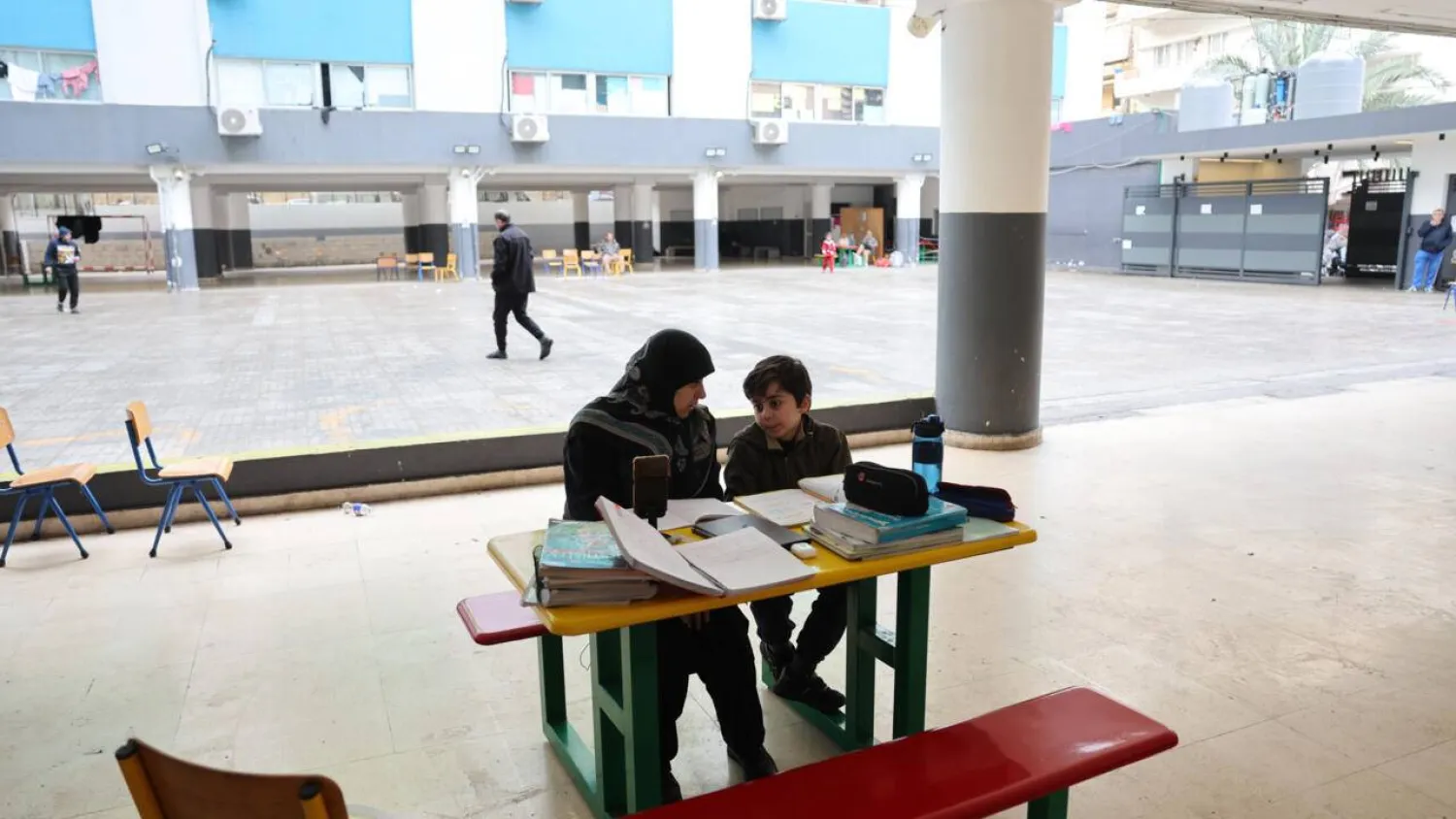
UNICEF says the war has left almost half a million students out of school in Lebanon. Anwar AMRO / AFP
TT

Lebanon Kids Struggle to Keep Up Studies as War Slams School Doors Shut

UNICEF says the war has left almost half a million students out of school in Lebanon. Anwar AMRO / AFP

In a classroom turned shelter for displaced families, teenager Ahmad Melhem follows a recorded lesson on a tablet as the war between Hezbollah and Israel interrupts education for hundreds of thousands of students in Lebanon.

"I don't want to regret not finishing my studies despite the difficult circumstances," said Melhem, whose family was displaced from Beirut's southern suburbs, the site of repeated Israeli bombardment.

"We took a risk and went back to get schoolbooks," he told AFP.

"We're trying with everything we have to continue our education so we can achieve our goals," said the 17-year-old, who hopes to study engineering after finishing high school.

Crisis-hit Lebanon was pulled into the Middle East war on March 2 when militant group Hezbollah fired rockets towards Israel to avenge the US-Israeli killing of Iran's supreme leader Ali Khamenei.

Israel has responded with large-scale strikes on Lebanon and a ground offensive in the country's south, killing more than 1,100 people -- including 122 children -- and displacing more than one million people, according to authorities.

The United Nations children's agency UNICEF says the war has left almost half a million students out of school in Lebanon, after more than 350 public schools were turned into shelters and many in areas under Israeli bombardment were closed.

Melhem's family and others are sharing a classroom divided up by plastic curtains at a school in a central Beirut district, the room scattered with thin mattresses and blankets, a table and small stove serving as a shared kitchen.

- 'Digital divide' -

In the corner, Melhem has set up his books and a computer screen, but there is no internet in the room.

An NGO has provided internet access in the schoolyard, crowded with children playing and families socializing, but Melhem says he cannot concentrate because of the noise, so he watches the recorded classes later.

His private school resumed distance learning two weeks after the war began, after cancelling subjects and shortening lessons.

"In-person (class) is better and more engaging," he said. "I miss group work and the science projects we used to do."

According to a 2023 World Bank report, each day of public school closures costs the Lebanese economy three million dollars.

In the courtyard, Melhem's mother helps her other son, aged eight, to follow his online classes.

"If I leave him alone, his mind wanders and he can't keep up with the lesson," says Salameh, 41.

"The war has destroyed everything," she added.

"Education is the only thing left for my children."

UNICEF's head of education in Lebanon, Atif Rafique, expressed particular concern about the future of students who are preparing to enter university while the war continues.

He warned of the dangers of children dropping out of school, especially "girls and adolescent young women" who face additional risks, including early marriage.

'Not even pens'

In Dekwaneh, north of Beirut, at a vocational institute that is now a shelter, Aya Zahran said she spends her day "preparing food and working to make the place livable".

"We have only one phone that my siblings and I share," said Zahran, 17, who is also displaced from Beirut's southern suburbs.

But "the link the school sent us (for online classes) doesn't work", she said.

Rafique said hundreds of public schools lack the resources for distance learning, and noted a "big digital divide" when it comes to internet access, with teachers also affected.

UNICEF has helped launch an online platform with recorded lessons, and a hotline allowing students to access materials through a phone call, without needing internet access.

He said children in south Lebanon have been disproportionately affected by education interruptions since the last round of hostilities between Israel and Hezbollah broke out in October 2023.

Just a week before the latest war began, UNICEF reopened 30 schools in the south that had been damaged in the previous conflict, he said.

At the vocational institute's entrance, an education ministry employee was registering children to assess what educational services they need.

"The situation here is very difficult... there's no internet here, and not even pens," said Nasima Ismail, who has been displaced from the northeast Bekaa region, as she signed up her children.

"My children are top students. I don't want them to miss out on their education, as happened to us when we were kids," said Ismail, recalling Lebanon's devastating 1975-1990 civil war.

"I want them to complete their education, even if we are left with nothing," she said.

"I wish them days better than ours."