
Lebanon Kids Struggle to Keep Up Studies as War Slams School Doors Shut

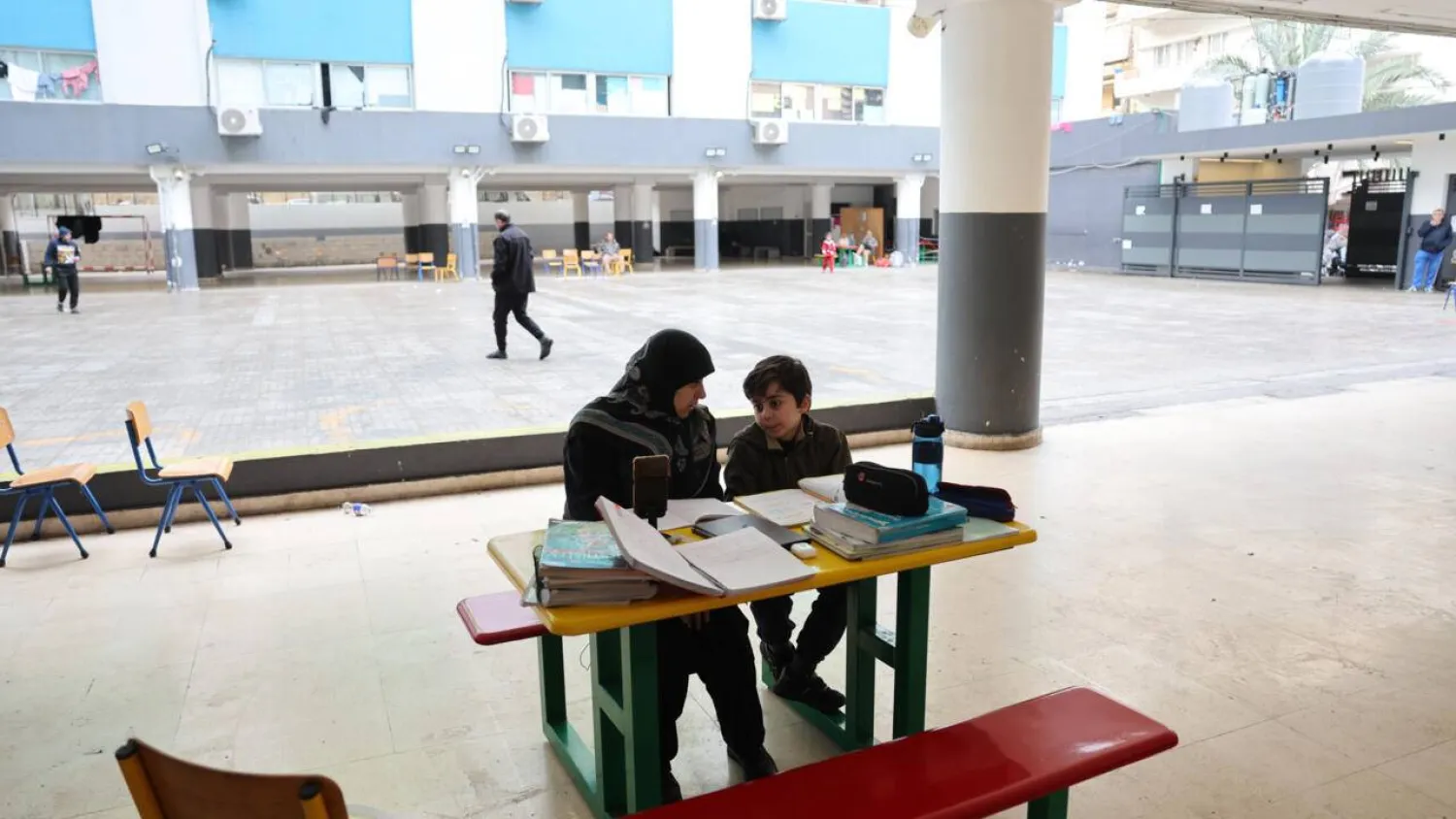
UNICEF says the war has left almost half a million students out of school in Lebanon. Anwar AMRO / AFP
TT

Lebanon Kids Struggle to Keep Up Studies as War Slams School Doors Shut

UNICEF says the war has left almost half a million students out of school in Lebanon. Anwar AMRO / AFP

In a classroom turned shelter for displaced families, teenager Ahmad Melhem follows a recorded lesson on a tablet as the war between Hezbollah and Israel interrupts education for hundreds of thousands of students in Lebanon.

"I don't want to regret not finishing my studies despite the difficult circumstances," said Melhem, whose family was displaced from Beirut's southern suburbs, the site of repeated Israeli bombardment.

"We took a risk and went back to get schoolbooks," he told AFP.

"We're trying with everything we have to continue our education so we can achieve our goals," said the 17-year-old, who hopes to study engineering after finishing high school.

Crisis-hit Lebanon was pulled into the Middle East war on March 2 when militant group Hezbollah fired rockets towards Israel to avenge the US-Israeli killing of Iran's supreme leader Ali Khamenei.

Israel has responded with large-scale strikes on Lebanon and a ground offensive in the country's south, killing more than 1,100 people -- including 122 children -- and displacing more than one million people, according to authorities.

The United Nations children's agency UNICEF says the war has left almost half a million students out of school in Lebanon, after more than 350 public schools were turned into shelters and many in areas under Israeli bombardment were closed.

Melhem's family and others are sharing a classroom divided up by plastic curtains at a school in a central Beirut district, the room scattered with thin mattresses and blankets, a table and small stove serving as a shared kitchen.

- 'Digital divide' -

In the corner, Melhem has set up his books and a computer screen, but there is no internet in the room.

An NGO has provided internet access in the schoolyard, crowded with children playing and families socializing, but Melhem says he cannot concentrate because of the noise, so he watches the recorded classes later.

His private school resumed distance learning two weeks after the war began, after cancelling subjects and shortening lessons.

"In-person (class) is better and more engaging," he said. "I miss group work and the science projects we used to do."

According to a 2023 World Bank report, each day of public school closures costs the Lebanese economy three million dollars.

In the courtyard, Melhem's mother helps her other son, aged eight, to follow his online classes.

"If I leave him alone, his mind wanders and he can't keep up with the lesson," says Salameh, 41.

"The war has destroyed everything," she added.

"Education is the only thing left for my children."

UNICEF's head of education in Lebanon, Atif Rafique, expressed particular concern about the future of students who are preparing to enter university while the war continues.

He warned of the dangers of children dropping out of school, especially "girls and adolescent young women" who face additional risks, including early marriage.

'Not even pens'

In Dekwaneh, north of Beirut, at a vocational institute that is now a shelter, Aya Zahran said she spends her day "preparing food and working to make the place livable".

"We have only one phone that my siblings and I share," said Zahran, 17, who is also displaced from Beirut's southern suburbs.

But "the link the school sent us (for online classes) doesn't work", she said.

Rafique said hundreds of public schools lack the resources for distance learning, and noted a "big digital divide" when it comes to internet access, with teachers also affected.

UNICEF has helped launch an online platform with recorded lessons, and a hotline allowing students to access materials through a phone call, without needing internet access.

He said children in south Lebanon have been disproportionately affected by education interruptions since the last round of hostilities between Israel and Hezbollah broke out in October 2023.

Just a week before the latest war began, UNICEF reopened 30 schools in the south that had been damaged in the previous conflict, he said.

At the vocational institute's entrance, an education ministry employee was registering children to assess what educational services they need.

"The situation here is very difficult... there's no internet here, and not even pens," said Nasima Ismail, who has been displaced from the northeast Bekaa region, as she signed up her children.

"My children are top students. I don't want them to miss out on their education, as happened to us when we were kids," said Ismail, recalling Lebanon's devastating 1975-1990 civil war.

"I want them to complete their education, even if we are left with nothing," she said.

"I wish them days better than ours."


Report: Iran’s Ambassador Won’t Leave Lebanon Despite Expulsion

Iranian Ambassador to Syria Mohammad Reza Sheibani, shows his ink-stained finger as he votes in the first round of the Iranian presidential election on June 14, 2013 at the Iranian embassy in the Syrian capital, Damascus. (AFP)
TT

Report: Iran’s Ambassador Won’t Leave Lebanon Despite Expulsion

Iranian Ambassador to Syria Mohammad Reza Sheibani, shows his ink-stained finger as he votes in the first round of the Iranian presidential election on June 14, 2013 at the Iranian embassy in the Syrian capital, Damascus. (AFP)

Iran's ambassador will not leave Lebanon despite being declared persona non grata and ordered to leave the country by Sunday, an Iranian diplomatic source told AFP.

"The ambassador will not leave Lebanon, in accordance with the wishes of the speaker of parliament Nabih Berri and of Hezbollah," the source said, speaking on condition of anonymity.

Hezbollah has denounced the decision while Berri's Amal party joined Hezbollah ministers in boycotting a cabinet session this week in protest at the order to expel Mohammad Reza Sheibani.

The foreign ministry this week gave Tehran's envoy until Sunday to leave in the latest unprecedented step by Lebanese authorities since a new war erupted on March 2 between Israel and Hezbollah.

The ministry accused him of making statements "interfering in Lebanon's internal politics".

French Foreign Minister Jean-Noel Barrot called the expulsion "a courageous decision".

The Lebanese authorities have banned Hezbollah's military and security activities. It is the only armed non-state group in the country and a close ally of Iran.

It has also banned the presence and operations of Iran's Revolutionary Guards whom Prime Minister Nawaf Salam accused of directing Hezbollah operations against Israel.


Netanyahu Says Israel Will Widen Its Invasion of Southern Lebanon

Israeli army soldiers walk next to a self-propelled Howitzer artillery gun positioned in the upper Galilee in northern Israel near the border with southern Lebanon on March 29, 2026. (AFP)
TT

Netanyahu Says Israel Will Widen Its Invasion of Southern Lebanon

Israeli army soldiers walk next to a self-propelled Howitzer artillery gun positioned in the upper Galilee in northern Israel near the border with southern Lebanon on March 29, 2026. (AFP)

Prime Minister Benjamin Netanyahu announced Sunday that Israel will widen its invasion of southern Lebanon.

Netanyahu said Israel would expand what he called the “existing security strip” in Lebanon as Israeli forces continue to target the Iranian-backed Hezbollah militant group.

“We are determined to fundamentally change the situation in the north,” he said on a visit to northern Israel.

Netanyahu said Hezbollah still retained "residual capabilities" to fire rockets at Israel, but the group had been severely hit by Israeli forces.

"Iran is no longer the same Iran, Hezbollah is no longer the same Hezbollah, and Hamas is no longer the same Hamas," he added.

"These are no longer terrorist armies threatening our existence -- they are defeated enemies, fighting for their own survival."

"We are determined, we are fighting, and with God's help -- we are winning," Netanyahu said.

There were no immediate details.

In Lebanon, officials say more than 1,100 people have been killed and more than one million displaced since the Iran war began.


France Condemns Houthis for Entering Middle East War

A satellite image shows Bab el-Mandab Strait off the coast of Yemen, February 27, 2026. (2026 Planet Labs PBC/Handout via Reuters)
TT

France Condemns Houthis for Entering Middle East War

A satellite image shows Bab el-Mandab Strait off the coast of Yemen, February 27, 2026. (2026 Planet Labs PBC/Handout via Reuters)

France condemned on Sunday two attacks by Yemen's Houthi militants on Israeli targets, accusing them of escalating tension in the Middle East by entering the regional war.

A Houthi spokesman said on Saturday the Iranian-backed group had fired missiles and drones towards "several vital and military sites" in Israel, the same day that Israel said it had intensified attacks on Iran's military industry.

The escalation came after more than a month of Israeli and US bombardment of Iran, to which Iran has responded by attacking US-linked interests in wealthy Gulf states.

"The Houthis should abstain from all attacks," French foreign ministry spokesman Pascal Confavreux said. He accused them of being "irresponsible".

He said everything should be done "to avoid an even greater escalation of the conflict", which has killed thousands across the region and sent energy markets into a tailspin.

The war has disrupted global maritime traffic through the Strait of Hormuz, a key waterway in the Gulf through which a fifth of the world's crude supplies pass, along with substantial shipments of gas and fertilizers.

The only alternative routes are to sail through the Red Sea on the other side of the Arabian peninsula or make the much lengthier journey around the tip of southern Africa.

From Yemen, the Houthis could potentially disrupt shipping through the Red Sea, as they did at the height of Israel's war on Gaza.

The European Union said on March 16 it would not extend the bloc's existing naval mission in the Red Sea to help re-open the Strait of Hormuz.

US President Donald Trump had lashed out at EU and NATO countries for not agreeing to escort ships through the strait.