


Paris Int’l Conference Focuses on Humanitarian Aid for Gaza, Discusses War's Political Aspects

International Humanitarian Conference for the Civilian Population in Gaza at the Elysee Palace in Paris on Thursday (AP)
TT

Paris Int’l Conference Focuses on Humanitarian Aid for Gaza, Discusses War's Political Aspects

International Humanitarian Conference for the Civilian Population in Gaza at the Elysee Palace in Paris on Thursday (AP)

France hosted a conference Thursday on humanitarian aid for Gaza, calling for a "humanitarian pause" in the Israel-Hamas war so countries can "work towards a ceasefire."

French President Emmanuel Macron chaired the only session of the "International Humanitarian Conference for the Civilian Population in Gaza."

France divided the session into two parts: one open to the public and the media, while the second was closed and limited to the participating official eighty delegations, including representatives of international organizations and civil society organizations.

The conference did not include strong representation, while the Elysee Palace was counting on a summit that brought together several heads of state and government.

Palestinian Prime Minister Ahmed Shtayyeh was the only Arab top official at the summit, along with the Presidents of Ireland and Cyprus and the prime ministers of Greece and Luxembourg.

Paris did not extend invitations to Israel, Iran, and Russia. However, no official representatives from Lebanon, Syria, Yemen, Libya, and Sudan attended the summit for various reasons, including wars or economic hardship.

- Four themes

During the conference, four main themes dominated the speeches of state and international organizations representatives.

The first theme focused on the insufficient aid delivered to Gaza, mainly through the Rafah crossing on the border with Egypt, noting that two other crossings must be considered, such as the Kerem Shalom crossing and another based on a Cypriot proposal.

Cyprus President Nikos Christodoulides detailed his 25-page plan to open a direct path by sea to provide a continued rapid, safe, and unhindered flow of humanitarian aid pragmatically and effectively.

According to Christodoulides, the proposal is carefully studied and can be implemented, provided that there is political cover, primarily meaning Israel and the Palestinians accept the establishment of the necessary infrastructure for the humanitarian maritime corridor to Gaza.

The Cypriot President noted that "humanitarian" ships, which can be escorted by military personnel to reach their destination, can transport thousands of tons, unlike land transport.

- Obstacles to Rafah port

The Greek Prime Minister praised the Cypriot project and suggested providing Greek naval ships for this purpose.

However, given the obstacles that Israel imposes regarding the Rafah port to slow down the movement of trucks toward Gaza, the Cypriot proposal could require intense political and diplomatic pressure until it sees the light.

Furthermore, the conference witnessed several proposals to establish field hospitals, remove the wounded from Gaza, and provide financial aid to UNRWA and humanitarian organizations.

The second theme emerged unanimously and strongly through speeches and discussions, asserting the need for humanitarian truces and ceasefires. It aimed to facilitate the arrival and distribution of humanitarian aid and end the Israeli massacres in the enclave.

Opinions varied between parties calling for temporary humanitarian truces and others insisting on a complete ceasefire. Still, the general atmosphere that dominated the conference demonstrated the need to take action.

During his speech, Shtayyeh wondered how many Palestinians must be killed for the war to stop.

"Is killing 10,000 people in 30 days enough?"

Shtayyeh gave a quick presentation of the 75 years of Palestinian suffering in Gaza, Jerusalem, and the West Bank.

Shtayyeh said that it was the sixth and not the first war carried out by Israel against Gaza, concluding that it was a war against the Palestinian people.

- The two-state solution

The third theme of the Paris Conference reiterated the necessity of reactivating the political track and the two-state solution.

Macron referred to the humanitarian and security axes in his opening speech, including fighting Hamas and restricting funding sources. He also addressed the political path of diplomatic work, asserting the need to resume bringing peace to the Middle East with a two-state solution.

"We must learn from our errors and no longer accept that peace in the Middle East always be pushed back to later," he said.

As the fighting continues, the humanitarian situation "is worsening more and more each day," Macron said.

The last theme of the conference warned that the situation could be out of control with the ongoing fighting, escalation, bombing, and casualties, adding that it could expand to other fronts and perhaps lead to a regional war.

The conference also included influential speeches from the United Nations, UNRWA, and the International Committee of Red Cross Committee (ICRC).

UNRWA Commissioner-General Philippe Lazzarini described the situation in Gaza as "catastrophic," refusing to consider civilian casualties, especially children, as "collateral damage."

In his speech, Lazzarini referred to the destruction of entire neighborhoods, including schools, mosques, hospitals, and churches.

He condemned depriving civilians of food, water, and medicine, saying it was collective punishment.

The UN official called for an immediate ceasefire, asserting the need to protect civilian infrastructure necessary for life and an acceleration of the flow of humanitarian aid.

Lazzarini also addressed the situation in the West Bank, warning that military incursions by the Israeli Forces and settler violence have caused "record high death tolls among Palestinians.

If we did not have Gaza today, all our attention would be on the West Bank."

- Immediate ceasefire

Also at the conference, Under-Secretary-General for Humanitarian Affairs and Emergency Relief Coordinator Martin Griffiths said the "so-called safe zones" are nonsense, pointing to serious concerns about the safety of the civilians.

Griffiths warned that "unless multilateral and diplomatic efforts can be maximized to ensure the protection of civilians, enhance humanitarian access and secure the release of the hostages so viciously taken on October 7th, I have real fears that this could just be the beginning."

For her part, President of the French section of Doctors Without Borders (MSF) Isabelle Dufourny said there were no safe zones in Gaza, and a third of the Gazan victims were killed in those areas.

Dufourny informed the conference that 700 humanitarian organizations and associations demanded an immediate ceasefire.

ICRC President Mirjana Spoljaric denounced Israel's targeting of all buildings in northern Gaza as military targets, adding: "We are confronted with a catastrophic moral failing, one that the world must not tolerate."

Egypt denounced the international silence regarding Israeli violations of international humanitarian law in the Palestinian territories.

Foreign Minister Sameh Shoukry said the Israeli government is going beyond the "right to self-defense," expressing his regret at the "double standards."

Shoukry believed that the aid that entered the Strip did not meet the needs, criticizing Israel and the "complex procedures" it imposes on the entry of aid into the enclave.

- Respect international humanitarian law

The attendees condemned Israel's war on Gazans and demanded respect for international humanitarian law. They also blamed Hamas "terrorist act" calling for the "immediate and unconditional release" of all captives with the organization.

The conference sought to mobilize financial resources, identifying several sectors to receive emergency support based on United Nations assessments of urgent needs amounting to $1.1 billion.

They also discussed restoring water, fuel, and electricity supplies and establishing accountability to ensure that aid is not diverted to Hamas.

Macron revealed that France will increase aid to the Palestinians from €20 million to €100 million in 2023.

The European Commission also reported that the European Union decided to quadruple the planned aid to Gaza to reach €100 million, in addition to the air bridge to transport aid through al-Arish Airport.
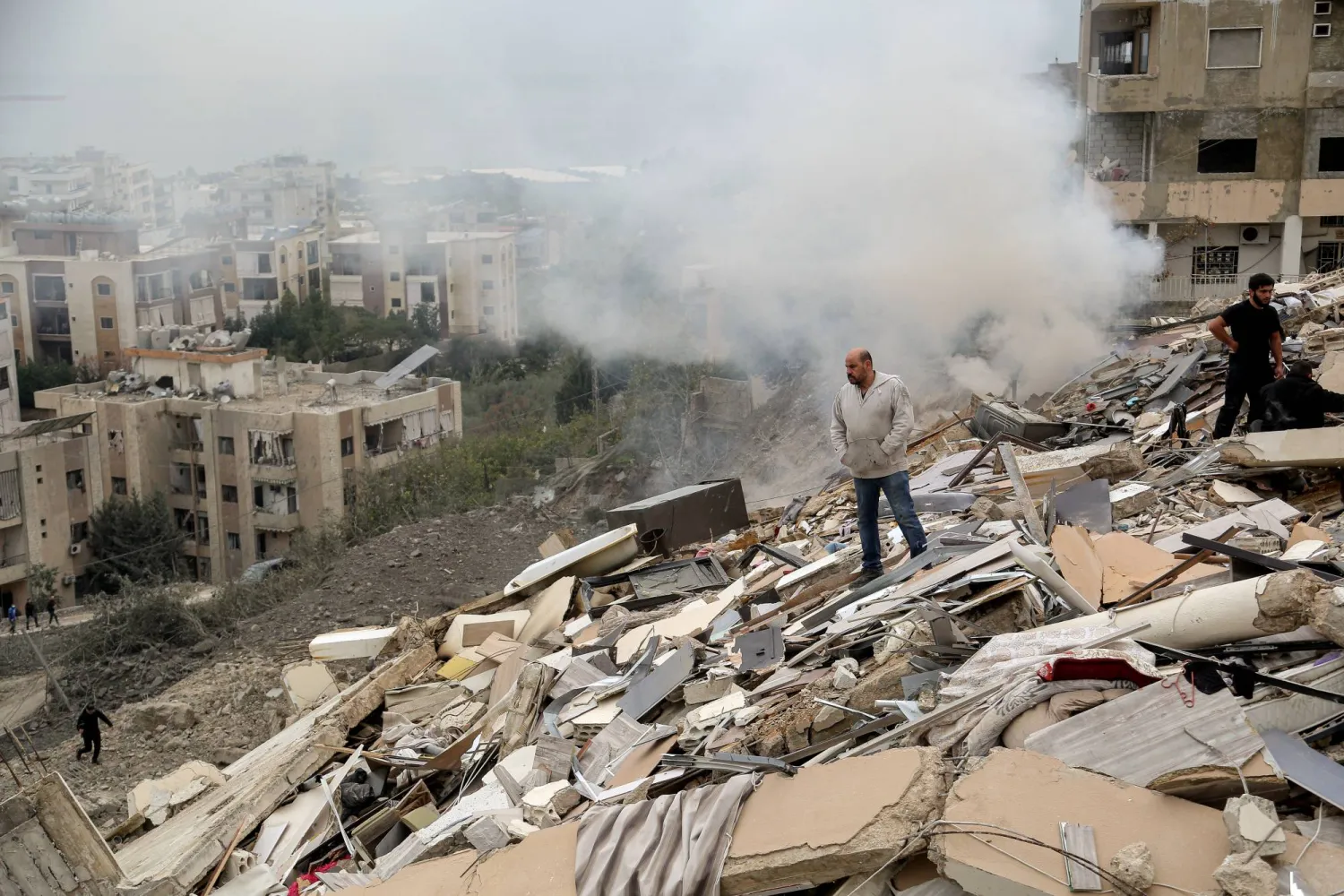


Lebanon Says Two Killed in Israeli Strike on Palestinian Refugee Camp

22 January 2026, Lebanon, Qnarit: People inspect the damage of a building that was destroyed by an Israeli air raid on the southern Lebanese village of Qnarit. (dpa)
TT

Lebanon Says Two Killed in Israeli Strike on Palestinian Refugee Camp

22 January 2026, Lebanon, Qnarit: People inspect the damage of a building that was destroyed by an Israeli air raid on the southern Lebanese village of Qnarit. (dpa)

Lebanon said an Israeli strike on the country's largest Palestinian refugee camp killed two people on Friday, with Israel's army saying it had targeted the Palestinian group Hamas. 

The official National News Agency said "an Israeli drone" targeted a neighborhood of the Ain al-Hilweh camp, which is located on the outskirts of the southern city of Sidon. 

Lebanon's health ministry said two people were killed in the raid. The NNA had earlier reported one dead and an unspecified number of wounded. 

An AFP correspondent saw smoke rising from a building in the densely populated camp as ambulances headed to the scene. 

The Israeli army said in a statement that its forces "struck a Hamas command center from which terrorists operated", calling activity there "a violation of the ceasefire understandings between Israel and Lebanon" and a threat to Israel. 

The Israeli military "is operating against the entrenchment" of the Palestinian group in Lebanon and will "continue to act decisively against Hamas terrorists wherever they operate", it added. 

Israel has kept up regular strikes on Lebanon despite a November 2024 ceasefire that sought to halt more than a year of hostilities with Hezbollah. 

Israel has also struck targets belonging to Hezbollah's Palestinian ally Hamas, including in a raid on Ain al-Hilweh last November that killed 13 people. 

The UN rights office had said 11 children were killed in that strike, which Israel said targeted a Hamas training compound, though the group denied it had military installations in Palestinian camps in Lebanon. 

In October 2023, Hezbollah began launching rockets at Israel in support of Hamas at the outset of the Gaza war, triggering hostilities that culminated in two months of all-out war between Israel and the Iran-backed Lebanese group. 

On Sunday, Lebanon said an Israeli strike near the Syrian border in the country's east killed four people, as Israel said it targeted operatives from Palestinian group Islamic Jihad. 


UN Says It Risks Halting Somalia Aid Due to Funding Cuts 

A Somali trader marks watermelons for sale at an open-air grocery market as Muslims start the fasting month of Ramadan, the holiest month in the Islamic calendar, within Bakara market in Mogadishu, Somalia, February 18, 2026. (Reuters)
TT

UN Says It Risks Halting Somalia Aid Due to Funding Cuts 

A Somali trader marks watermelons for sale at an open-air grocery market as Muslims start the fasting month of Ramadan, the holiest month in the Islamic calendar, within Bakara market in Mogadishu, Somalia, February 18, 2026. (Reuters)

The UN's World Food Program (WFP) warned Friday it would have to stop humanitarian assistance in Somalia by April if it did not receive new funding.

The Rome-based agency said it had already been forced to reduce the number of people receiving emergency food assistance from 2.2 million in early 2025 to just over 600,000 today.

"Without immediate funding, WFP will be forced to halt humanitarian assistance by April," it said in a statement.

In early January, the United States suspended aid to Somalia over reports of theft and government interference, following the destruction of a US-funded WFP warehouse in the capital Mogadishu's port.

The US announced a resumption of WFP food distribution on January 29.

However, all UN agencies have warned of serious funding shortfalls since Washington began slashing aid across the world following President Donald Trump's return to the White House last year.

"The situation is deteriorating at an alarming rate," said Ross Smith, WFP Director of Emergency Preparedness and Response, in Friday's statement.

"Families have lost everything, and many are already being pushed to the brink. Without immediate emergency food support, conditions will worsen quickly.

"We are at the cusp of a decisive moment; without urgent action, we may be unable to reach the most vulnerable in time, most of them women and children."

Some 4.4 million people in Somalia are facing crisis-levels of food insecurity, according to the WFP, the largest humanitarian agency in the country.

The Horn of Africa country has been plagued by conflict and also suffered two consecutive failed rainy seasons.


Hamas Says Path for Gaza Must Begin with End to ‘Aggression’ 

Makeshift tents of displaced Palestinian families among the ruins of their homes at sunset during the holy month of Ramadan in Jabaliya northern Gaza Strip on, 19 February 2026. (EPA)
TT

Hamas Says Path for Gaza Must Begin with End to ‘Aggression’ 

Makeshift tents of displaced Palestinian families among the ruins of their homes at sunset during the holy month of Ramadan in Jabaliya northern Gaza Strip on, 19 February 2026. (EPA)

Discussions on Gaza's future must begin with a total halt to Israeli "aggression", the Palestinian movement Hamas said after US President Donald Trump's Board of Peace met for the first time.

"Any political process or any arrangement under discussion concerning the Gaza Strip and the future of our Palestinian people must start with the total halt of aggression, the lifting of the blockade, and the guarantee of our people's legitimate national rights, first and foremost their right to freedom and self-determination," Hamas said in a statement Thursday.

Trump's board met for its inaugural session in Washington on Thursday, with a number of countries pledging money and personnel to rebuild the Palestinian territory, more than four months into a fragile ceasefire between Israel and Hamas.

Israeli Prime Minister Benjamin Netanyahu has insisted however that Hamas must disarm before any reconstruction begins.

"We agreed with our ally the US that there will be no reconstruction of Gaza before the demilitarization of Gaza," Netanyahu said.

The Israeli leader did not attend the Washington meeting but was represented by his foreign minister Gideon Saar.

Trump said several countries had pledged more than seven billion dollars to rebuild the territory.

Muslim-majority Indonesia will take a deputy commander role in a nascent International Stabilization Force, the unit's American chief Major General Jasper Jeffers said.

Trump, whose plan for Gaza was endorsed by the UN Security Council in November, also said five countries had committed to providing troops, including Morocco, Kazakhstan, Kosovo and Albania.
