Israeli Military Chief Says More than 1,000 Captives Taken in Gaza

Chief of the Israeli General Staff Major-General Herzi Halevi (Israeli Defense Ministry)
TT

Israeli Military Chief Says More than 1,000 Captives Taken in Gaza

Chief of the Israeli General Staff Major-General Herzi Halevi (Israeli Defense Ministry)

The Israeli army have taken more than 1,000 people captive in the war against Hamas in Gaza, Israel's military chief said on Sunday.

Addressing soldiers inside the bombarded enclave, Chief of the General Staff Major-General Herzi Halevi said that when combatants “lay down their arms and raise their hands, we arrest them, we don't shoot them,” according to Reuters.

“We get a lot of intelligence from the captives we have, we already have over a thousand,” Halevi said in a video distributed by the military.

Halevi's comments came after soldiers accidentally shot dead three Israeli hostages who the army says were waving a white flag and trying to be rescued.


Funerals Held in Lebanon for Three Journalists Killed in Israeli Strike

A woman stands amid Hezbollah flags on March 29, 2026, in the Choueifat area on the outskirts of Beirut during the funeral of journalists killed the previous day in an Israeli strike in south Lebanon. (AFP)
TT

Funerals Held in Lebanon for Three Journalists Killed in Israeli Strike

A woman stands amid Hezbollah flags on March 29, 2026, in the Choueifat area on the outskirts of Beirut during the funeral of journalists killed the previous day in an Israeli strike in south Lebanon. (AFP)

Mourners gathered on Sunday in Choueifat, south of Beirut, for the funerals of three journalists killed by an Israeli airstrike.

Ali Shoeib, a correspondent with Hezbollah’s al-Manar TV, Fatima Ftouni, a reporter with the pan-Arab al-Mayadeen TV, and her brother Mohammed, a cameraman with the station, were killed in a strike on their car while covering the Israel-Hezbollah war in southern Lebanon on Saturday.

Israel’s military said it had targeted Shoeib, accusing him of being a Hezbollah intelligence operative, without providing evidence. Lebanese officials have condemned the strike as a war crime.

Mourners chanted, “Death to America” and “Death to Israel” as the bodies were buried in an empty lot converted into a temporary graveyard during the war.

“It’s not the first time our colleagues are killed,” said Mohammad Ali Badreddine, an SNG engineer with al-Mayadeen. “It’s a big loss... they were among the brightest and most professional people and also among the kindest people.”


Former Algerian President Liamine Zeroual Dies

 Former Algerian President Liamine Zeroual casts his vote in the 1997 parliamentary elections. (AFP)
Former Algerian President Liamine Zeroual casts his vote in the 1997 parliamentary elections. (AFP)
TT

Former Algerian President Liamine Zeroual Dies

 Former Algerian President Liamine Zeroual casts his vote in the 1997 parliamentary elections. (AFP)
Former Algerian President Liamine Zeroual casts his vote in the 1997 parliamentary elections. (AFP)

Algeria announced three days of national mourning on Sunday after the death of 84-year-old Liamine Zeroual, the former soldier who served as the country's president from 1994 to 1999.

Born on July 3, 1941 in the eastern city of Batna, Zeroual served in Algeria's National Liberation Army (FLN), which fought for independence from French rule.

After leading a transitional administration during a later civil war, Zeroual organized the country's first multi-party presidential election in 1995, winning by a wide margin.

In 1998, however, he unexpectedly cut short his five-year term, making way for Abdelaziz Bouteflika to succeed him and run the country for 20 years.

Zeroual remained respected in retirement. Algeria's presidency said he had died at a military hospital in Algiers after a serious illness and that flags would fly at half-mast across the country.


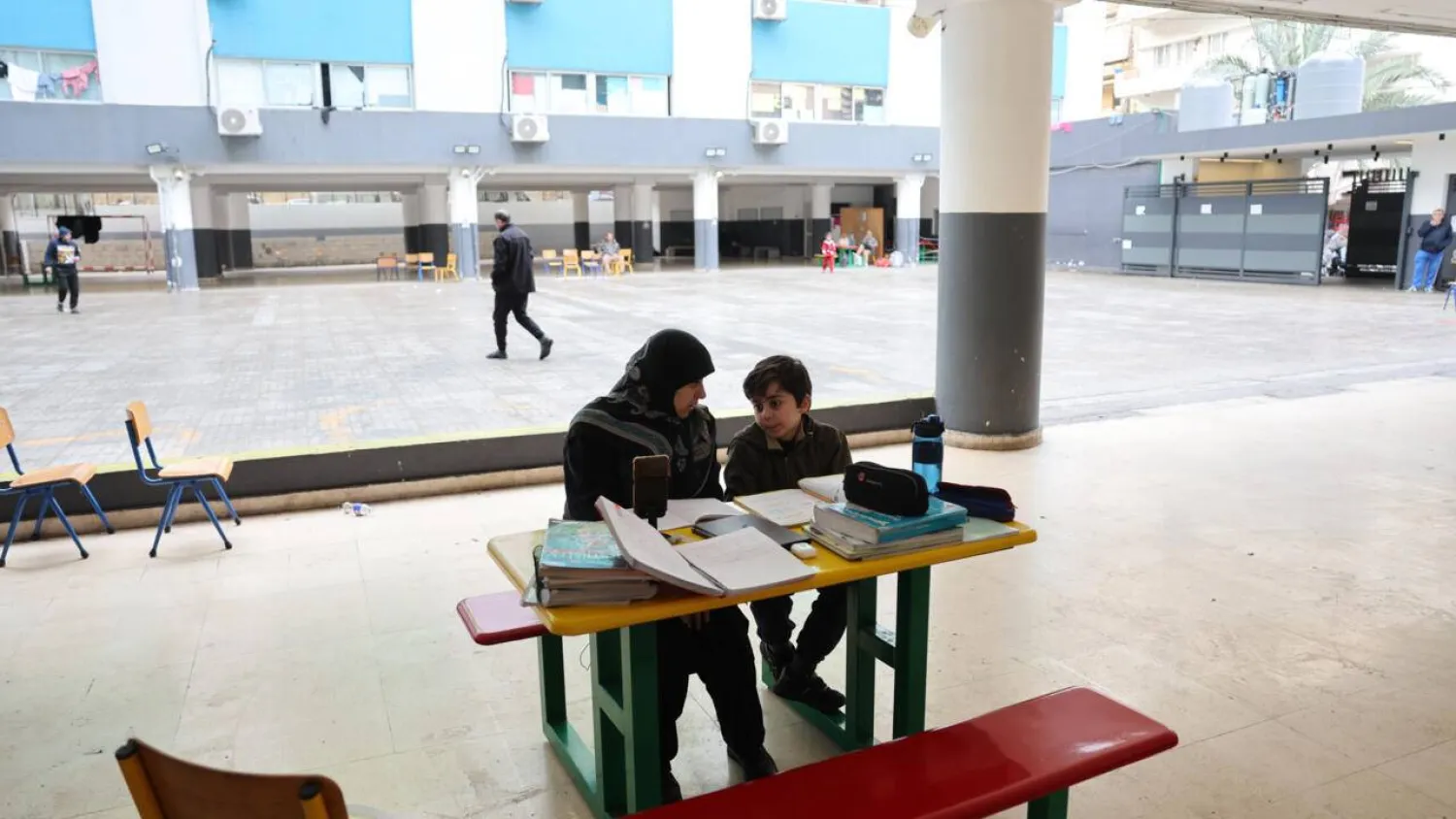
Lebanon Kids Struggle to Keep Up Studies as War Slams School Doors Shut

UNICEF says the war has left almost half a million students out of school in Lebanon. Anwar AMRO / AFP
TT

Lebanon Kids Struggle to Keep Up Studies as War Slams School Doors Shut

UNICEF says the war has left almost half a million students out of school in Lebanon. Anwar AMRO / AFP

In a classroom turned shelter for displaced families, teenager Ahmad Melhem follows a recorded lesson on a tablet as the war between Hezbollah and Israel interrupts education for hundreds of thousands of students in Lebanon.

"I don't want to regret not finishing my studies despite the difficult circumstances," said Melhem, whose family was displaced from Beirut's southern suburbs, the site of repeated Israeli bombardment.

"We took a risk and went back to get schoolbooks," he told AFP.

"We're trying with everything we have to continue our education so we can achieve our goals," said the 17-year-old, who hopes to study engineering after finishing high school.

Crisis-hit Lebanon was pulled into the Middle East war on March 2 when militant group Hezbollah fired rockets towards Israel to avenge the US-Israeli killing of Iran's supreme leader Ali Khamenei.

Israel has responded with large-scale strikes on Lebanon and a ground offensive in the country's south, killing more than 1,100 people -- including 122 children -- and displacing more than one million people, according to authorities.

The United Nations children's agency UNICEF says the war has left almost half a million students out of school in Lebanon, after more than 350 public schools were turned into shelters and many in areas under Israeli bombardment were closed.

Melhem's family and others are sharing a classroom divided up by plastic curtains at a school in a central Beirut district, the room scattered with thin mattresses and blankets, a table and small stove serving as a shared kitchen.

- 'Digital divide' -

In the corner, Melhem has set up his books and a computer screen, but there is no internet in the room.

An NGO has provided internet access in the schoolyard, crowded with children playing and families socializing, but Melhem says he cannot concentrate because of the noise, so he watches the recorded classes later.

His private school resumed distance learning two weeks after the war began, after cancelling subjects and shortening lessons.

"In-person (class) is better and more engaging," he said. "I miss group work and the science projects we used to do."

According to a 2023 World Bank report, each day of public school closures costs the Lebanese economy three million dollars.

In the courtyard, Melhem's mother helps her other son, aged eight, to follow his online classes.

"If I leave him alone, his mind wanders and he can't keep up with the lesson," says Salameh, 41.

"The war has destroyed everything," she added.

"Education is the only thing left for my children."

UNICEF's head of education in Lebanon, Atif Rafique, expressed particular concern about the future of students who are preparing to enter university while the war continues.

He warned of the dangers of children dropping out of school, especially "girls and adolescent young women" who face additional risks, including early marriage.

'Not even pens'

In Dekwaneh, north of Beirut, at a vocational institute that is now a shelter, Aya Zahran said she spends her day "preparing food and working to make the place livable".

"We have only one phone that my siblings and I share," said Zahran, 17, who is also displaced from Beirut's southern suburbs.

But "the link the school sent us (for online classes) doesn't work", she said.

Rafique said hundreds of public schools lack the resources for distance learning, and noted a "big digital divide" when it comes to internet access, with teachers also affected.

UNICEF has helped launch an online platform with recorded lessons, and a hotline allowing students to access materials through a phone call, without needing internet access.

He said children in south Lebanon have been disproportionately affected by education interruptions since the last round of hostilities between Israel and Hezbollah broke out in October 2023.

Just a week before the latest war began, UNICEF reopened 30 schools in the south that had been damaged in the previous conflict, he said.

At the vocational institute's entrance, an education ministry employee was registering children to assess what educational services they need.

"The situation here is very difficult... there's no internet here, and not even pens," said Nasima Ismail, who has been displaced from the northeast Bekaa region, as she signed up her children.

"My children are top students. I don't want them to miss out on their education, as happened to us when we were kids," said Ismail, recalling Lebanon's devastating 1975-1990 civil war.

"I want them to complete their education, even if we are left with nothing," she said.

"I wish them days better than ours."