Jordan: Smugglers Retreat into Syria following Air Strikes

Weapons and drugs seized by the Jordanian Guard Forces (Photo: Jordanian Armed Forces - Arab Army)
TT

Jordan: Smugglers Retreat into Syria following Air Strikes

Weapons and drugs seized by the Jordanian Guard Forces (Photo: Jordanian Armed Forces - Arab Army)

Informed Jordanian sources said that military operations on the northern border eased over the past hours, as smuggling militias retreated into Syria.

While official sources did neither confirm nor deny raids carried out by the Jordanian Air Force inside Syrian territory to strike drug production facilities, major smugglers, and militias still active along the border, media leaks spoke of confirmed air strikes that hit targets in southern Syria.

Speaking to Asharq Al-Awsat, the sources confirmed that the continued attempts to infiltrate across the border prompted the Jordanian Armed Forces to increase military operations, as smugglers were active during the night to benefit from the climate conditions and the dense fog.

The sources stressed that information was made available about the connection of smuggling gangs coming from inside Syria with local groups, within the framework of drug trade. They also expected the coming hours to witness qualitative operations and raids on a number of locations suspected of sheltering local smugglers in possession of drugs and weapons.

Asharq Al-Awsat learned from security sources that drug smuggling operations - carried out by militias affiliated with Iranian factions and the Lebanese Hezbollah, and others by pro-Syrian regime factions - were intended to be “simultaneous” to confuse border guards.

But after follow-up and monitoring, the army was able to confront the terrorist plot.

Amman has expressed frustration, on more than one occasion, about Syria’s failure to fulfill its military and security obligations on the border, noting that the area has become unilaterally protected.

At dawn on Monday, the Border Guards, in coordination with the Anti-Narcotics Administration and the military security services, clashed with armed groups that attempted to illegally cross the border from Syrian territory into Jordan.

The confrontation lasted 14 hours, and resulted in the death and injury of a number of smugglers, the arrest of nine persons, and the seizure of large quantities of drugs, weapons and rockets.

The Chairman of the Joint Chiefs of Staff of the Jordanian Armed Forces, Yousef Al-Huneiti, affirmed “the use of all the capabilities and resources to prevent infiltration and smuggling operations and confront them with force.”

His remarks came during a visit on Monday to the Eastern Military Region, which had seen a qualitative operation that led to the seizure of large quantities of narcotic drugs and weapons, and the arrest of a group of smugglers coming from Syrian territory into Jordan.


Hamas Says Path for Gaza Must Begin with End to ‘Aggression’ 

Makeshift tents of displaced Palestinian families among the ruins of their homes at sunset during the holy month of Ramadan in Jabaliya northern Gaza Strip on, 19 February 2026. (EPA)
TT

Hamas Says Path for Gaza Must Begin with End to ‘Aggression’ 

Makeshift tents of displaced Palestinian families among the ruins of their homes at sunset during the holy month of Ramadan in Jabaliya northern Gaza Strip on, 19 February 2026. (EPA)

Discussions on Gaza's future must begin with a total halt to Israeli "aggression", the Palestinian movement Hamas said after US President Donald Trump's Board of Peace met for the first time.

"Any political process or any arrangement under discussion concerning the Gaza Strip and the future of our Palestinian people must start with the total halt of aggression, the lifting of the blockade, and the guarantee of our people's legitimate national rights, first and foremost their right to freedom and self-determination," Hamas said in a statement Thursday.

Trump's board met for its inaugural session in Washington on Thursday, with a number of countries pledging money and personnel to rebuild the Palestinian territory, more than four months into a fragile ceasefire between Israel and Hamas.

Israeli Prime Minister Benjamin Netanyahu has insisted however that Hamas must disarm before any reconstruction begins.

"We agreed with our ally the US that there will be no reconstruction of Gaza before the demilitarization of Gaza," Netanyahu said.

The Israeli leader did not attend the Washington meeting but was represented by his foreign minister Gideon Saar.

Trump said several countries had pledged more than seven billion dollars to rebuild the territory.

Muslim-majority Indonesia will take a deputy commander role in a nascent International Stabilization Force, the unit's American chief Major General Jasper Jeffers said.

Trump, whose plan for Gaza was endorsed by the UN Security Council in November, also said five countries had committed to providing troops, including Morocco, Kazakhstan, Kosovo and Albania.


Official Contacts Aim to Keep Lebanon out of War on Iran as Israel Raises Readiness on Northern Front 

This photograph shows a memorial for slain Lebanese Hezbollah longtime leader Hassan Nasrallah at the entrance of the southern village of Qannarit on February 16, 2026. (AFP)
TT

Official Contacts Aim to Keep Lebanon out of War on Iran as Israel Raises Readiness on Northern Front 

This photograph shows a memorial for slain Lebanese Hezbollah longtime leader Hassan Nasrallah at the entrance of the southern village of Qannarit on February 16, 2026. (AFP)

Israel has raised the alert level of its military along the border with Lebanon, raising questions that Lebanon’s south may again be involved in a regional confrontation should the US attack Iran.

Given the heightened tensions between the US and Iran, questions have been asked over whether Hezbollah will become involved in a new war. Its Secretary-General Sheikh Naim Qassem had recently announced that the party will not remain on the side if Iran is attacked.

On the ground, Israel blew up houses in southern Lebanon border towns and carried out air strikes in the south. Israeli military spokesman Avichay Adraee said the raids targeted “Hezbollah infrastructure,” including arms caches and rocket launchers.

Their presence in the south is a violation of current agreements, he added.

Amid the high regional tensions, Israel’s Maariv quoted a military source as saying that the army has come up with plans, including a preemptive strike against Hezbollah, which would drag the south and the whole of Lebanon into a new war.

Ministerial sources told Asharq Al-Awsat that the presidency has been carrying out internal and foreign contacts since Thursday morning to keep Lebanon out of any escalation.

Hezbollah had launched a “support front” war against Israel a day after Hamas’ October 7, 2023 attack. In 2024, the war spiraled into an all-out conflict, with Israel decimating the Hezbollah leadership and severely weakening the party.

Israel believes that Hezbollah has been rebuilding its capabilities since the ceasefire that was struck in November 2024.

Kassim Kassir, a political analyst who is close to Hezbollah, told Asharq Al-Awsat: “No one knows what Hezbollah will do because the situation is tied the extent of the attack, should it happen.”

He noted that Qassem was ambiguous when he said the party will decide what to do when the time is right, but at any rate, he stressed that the party will not remain on the sidelines or abandon Iran.

“No one knows what Hezbollah’s abilities are, so everything is possible,” Kassir said.

Riad Kahwaji, a security and defense affairs expert, said he does not rule out the possibility that Hezbollah would join the war should the US attack Iran.

Speaking to Asharq Al-Awsat, he stressed that Iran is now the United States’ main target, when previously it used to confront its proxies.

It has now taken the fight directly to the heart of the problem, which is the Iranian regime, he remarked.

The extent of the military mobilization in the region and the frequent American statements about regime change all indicate that a major military operation may be imminent, he added.

Israel’s military also favors preemptive operations, so it is watching Hezbollah, which remains Iran’s most powerful regional proxy despite the blows it received in 2024 war, Kahwaji said.

Hezbollah still possesses a rocket arsenal that can threaten Israel, he remarked.

Israel’s high level of alert on the border with Lebanon could be in readiness for any development. Should Tel Aviv receive word from Washington that it intends to attack Iran, then it could launch operations against Hezbollah as part of preemptive strikes aimed at preventing the party from launching attacks against it, Kahwaji said.

“As long as Hezbollah possesses heavy weapons, such as rockets, and drones, that it has not handed over to the army, then Lebanon will continue to be vulnerable to attacks in the next confrontation. It will be exposed to Israeli strikes as long as this issue remains unresolved,” he added.


Israel Keen to Attack Iran’s Regional Proxies before they Can Join the War

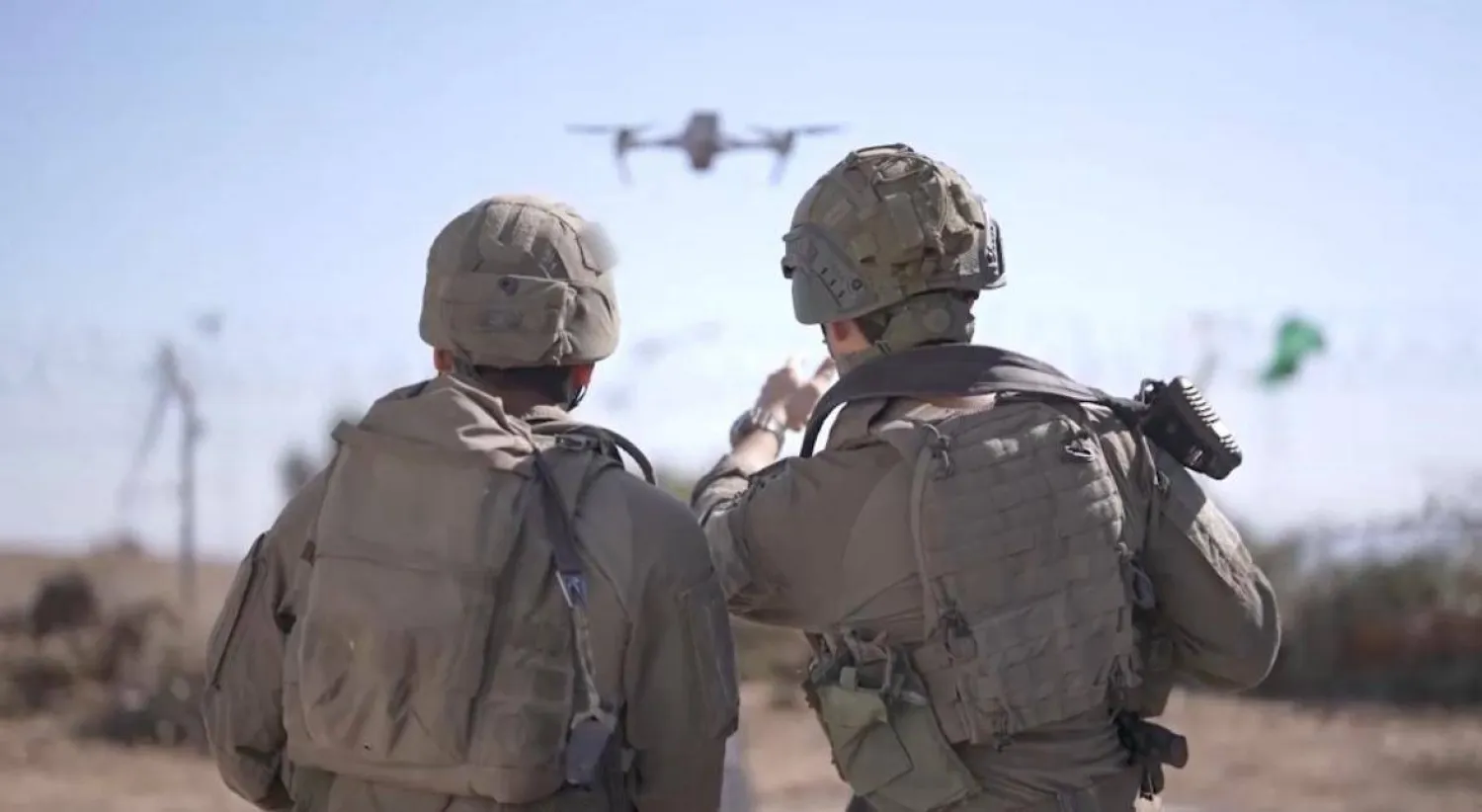
Two Israeli soldiers launch a drone. (Israeli Army)
TT

Israel Keen to Attack Iran’s Regional Proxies before they Can Join the War

Two Israeli soldiers launch a drone. (Israeli Army)

The Israeli army is preparing to carry out “massive and unprecedented” strikes against groups backed by Iran, including the Houthis in Yemen, Hezbollah in Lebanon and armed factions in Iraq, should they join a potential war in the region, revealed Israeli military sources.

Iran is applying great pressure on these groups to take part in any upcoming conflict because the regime in Tehran concluded that their staying on the sidelines during the 12-day June war in 2025 was a strategic error, the sources said according to Israeli estimates.

Israeli Prime Minister Benjamin Netanyahu had on Thursday warned Iran that his country is making its own preparations for possible Iranian missile strikes in response to any US action.

“We are prepared for any scenario,” he said, adding that if Iran attacks Israel, “they will experience a response they cannot even imagine.”

A military source said the Houthis pose a “direct threat not just to Israel, but to the whole world.” He accused the Houthis of impeding international trade in the Red Sea.

Even though the Houthis are not firing at all ships, they are still a threat to everyone, added the source. The militants are producing weapons and possess advanced technology, he warned, comparing them to a “dangerous ticking timebomb that must be swiftly neutralized.”

Israeli and foreign experts revealed that Iran is providing large financial support to its allied armed groups in the region in order for them to join a war should US President Donald Trump act on his threat to strike Iran.

In 2025, Iran allotted a billion dollars to these groups so that they can carry out rocket attacks against Israel.

It remains to be seen if these groups will respond to Iran’s pressure. Israeli estimates believe that the Kataib Hezbollah in Iraq are unlikely to join a war, while Hezbollah and the Houthis are more prepared to do so.

Israel has turned to mediators to warn these parties that any attack against it will be met with a “massive and unprecedented response.”

In Lebanon, the sources said that the military operations Israel is carrying out against Hezbollah and other armed groups are aimed at undermining the party’s efforts to bolster its combat abilities.

They acknowledged, however, that the Israeli military establishment senses that Hezbollah is rebuilding its capabilities at a faster pace than Israel’s operations at reining it in.

The Houthis, meanwhile, have a relatively greater margin of independence, but they are always ready to take part in any regional war to shift attention away from the situation inside Yemen, said Israeli estimates.

The Houthis are receiving Iranian funds to boost their military capabilities and produce more weapons. They also continue to smuggle weapons to Hamas in Gaza. Israel also accuses them of extorting several countries, whereby they pledge not to attack their ships in exchange for money.

The Houthis are ultimately fully supportive of Iran’s goals despite the blows they have been dealt by Israel. The Houthis are suffering from a drop in combat abilities. The pace of their training of fighters has also dropped, while their airports have been damaged in Israeli attacks and the Houthis are facing difficulties in rebuilding them.

Despite the losses, the Houthis are still a threat. They possess heavy long-range missiles and drones and still have the ability to shut Israel’s southern Eilat port.