
Palestinian Death Toll in Gaza Surpasses 25,000 While the Prolonged War Divides Israelis

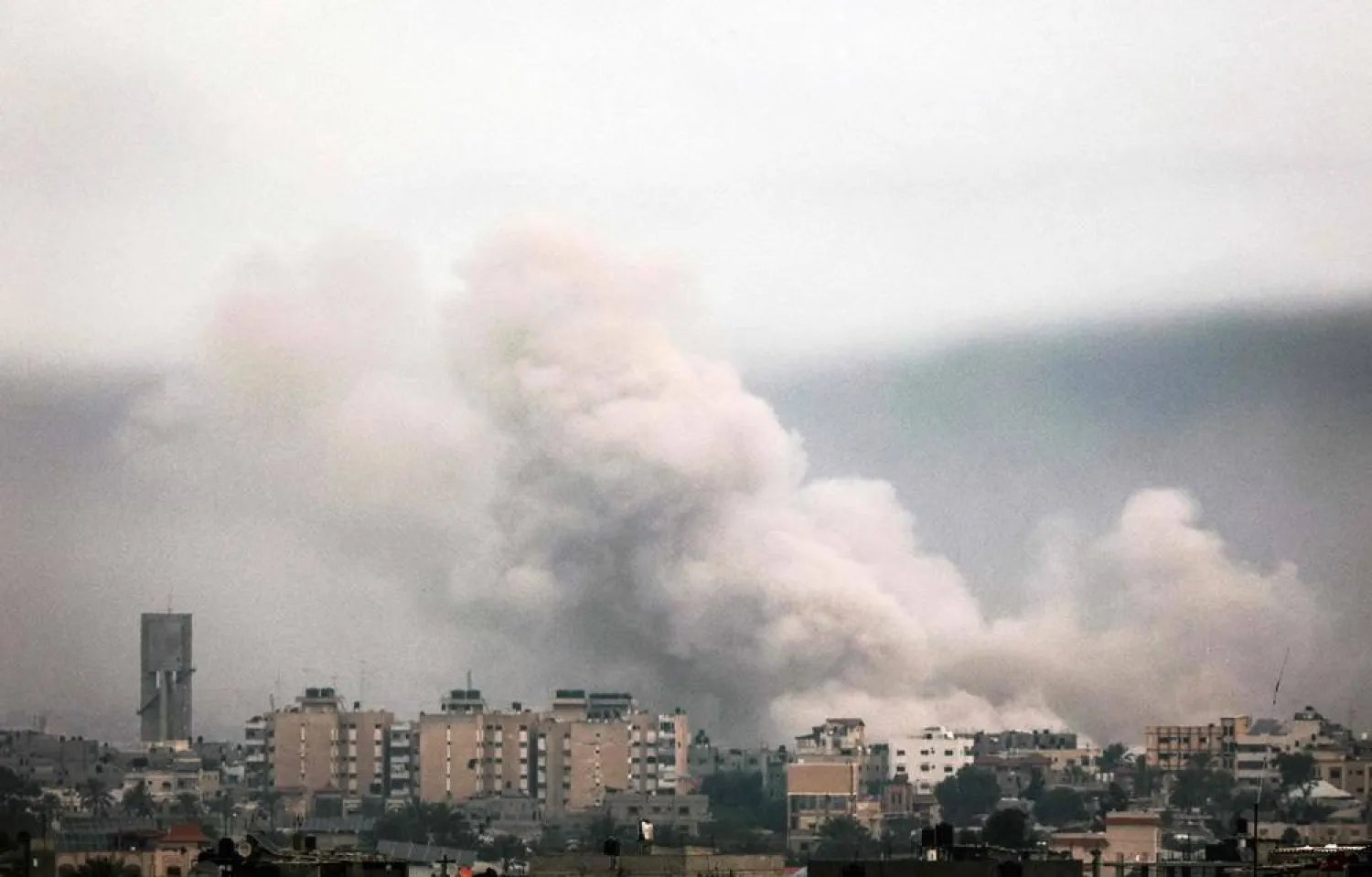
 A picture taken from Rafah shows smoke billowing over Khan Younis in the southern Gaza Strip during Israeli bombardment on January 21, 2024, amid ongoing battles between Israel and the Palestinian militant group Hamas. (AFP)
A picture taken from Rafah shows smoke billowing over Khan Younis in the southern Gaza Strip during Israeli bombardment on January 21, 2024, amid ongoing battles between Israel and the Palestinian militant group Hamas. (AFP)
TT

Palestinian Death Toll in Gaza Surpasses 25,000 While the Prolonged War Divides Israelis

 A picture taken from Rafah shows smoke billowing over Khan Younis in the southern Gaza Strip during Israeli bombardment on January 21, 2024, amid ongoing battles between Israel and the Palestinian militant group Hamas. (AFP)
A picture taken from Rafah shows smoke billowing over Khan Younis in the southern Gaza Strip during Israeli bombardment on January 21, 2024, amid ongoing battles between Israel and the Palestinian militant group Hamas. (AFP)

The Palestinian death toll from the war between Israel and Hamas has soared past 25,000, the Health Ministry in the Gaza Strip said Sunday, while the Israeli government appeared far from achieving its goals of crushing the militant group and freeing more than 100 hostages.

The death, destruction and displacement from the war is without precedent in the decades-old Israeli-Palestinian conflict. Israeli officials say the fighting is likely to continue for several more months.

The conflict has divided ordinary Israelis and their leaders while the offensive threatens to ignite a wider war involving Iran-backed groups in Lebanon, Syria, Iraq and Yemen that support the Palestinians. In Lebanon, Hezbollah forces have engaged in near-daily clashes with Israeli troops along the border.

An Israeli airstrike on Sunday hit a car near a Lebanese army checkpoint in the southern town of Kafra, killing at least one person and injuring several others, Lebanese state media reported. Their identities were not immediately clear. Israel's military said its aircraft and tanks struck a number of Hezbollah targets in southern Lebanon.

The United States, which has provided diplomatic and military support for Israel's offensive, has had limited success in persuading Israel to put civilians at less risk and to facilitate the delivery of more humanitarian aid.

Israeli Prime Minister Benjamin Netanyahu has rejected US and international calls for postwar plans that would include a path to Palestinian statehood. UN Secretary-General Antonio Guterres called the refusal to accept a two-state solution "totally unacceptable.”

“The Middle East is a tinderbox. We must do all we can to prevent conflict igniting across the region," Guterres added Sunday. "And that starts with an immediate humanitarian ceasefire to relieve the suffering in Gaza.”

GAZA DEATH TOLL CLIMBS The war began with Hamas’ attack in southern Israel on Oct. 7. Palestinian militants killed some 1,200 people, mostly civilians, and took around 250 hostages back to Gaza.

Israel responded with a bombing campaign and ground invasion that laid waste to entire neighborhoods in northern Gaza and spread south. Ground operations are now focused on the southern city of Khan Younis and built-up refugee camps in central Gaza dating back to the 1948 war surrounding Israel's creation.

Israel continues to carry out airstrikes throughout the besieged territory, including areas in the south where it told civilians to seek refuge. Many Palestinians have ignored evacuation orders, saying nowhere feels safe.

On Sunday, Israel's military said the demolition last week of a key building at Israa University in Gaza was under review. It asserted that preliminary findings indicated Hamas had used the compound for military purposes. The university said earlier that the “attack” came weeks after Israeli forces occupied the building.

Since the war started, 25,105 Palestinians have been killed in Gaza, while another 62,681 have been wounded, the Health Ministry said. The toll included the 178 bodies brought to Gaza’s hospitals since Saturday, Health Ministry spokesperson Ashraf al-Qidra said. Another 300 people were wounded in the past day, he said.

The overall toll is thought to be higher because many casualties remain buried under the rubble or in areas where medics cannot reach them, Al-Qidra said.

The Health Ministry does not differentiate between civilians and combatants in its figures but says around two-thirds of the people killed in Gaza were women and minors. The ministry is part of the Hamas-run government, but its casualty figures from previous wars were largely consistent with those of UN agencies and even the Israeli military.

The Israeli military says it has killed around 9,000 militants, without providing evidence, and blames the high civilian death toll on Hamas because it positions fighters, tunnels and other militant infrastructure in dense neighborhoods, often near homes, schools or mosques.

The military says 195 soldiers have been killed.

The war has displaced some 85% of Gaza’s residents, with hundreds of thousands packing into UN-run shelters and camps in the southern part of the tiny coastal enclave. UN officials say a quarter of the population of 2.3 million is starving as a trickle of humanitarian aid reaches them because of the fighting and Israeli restrictions.

“Bread does not suffice for one hour,” said Ahmad Al-Nashawi, who accepted donated food at a camp of plastic tents in the southern city of Rafah. “You can see how many children we have other than women and men. What matters most for a child is to eat.”

ISRAELIS INCREASINGLY DIVIDED Netanyahu has vowed to keep up the offensive until Israel achieves “complete victory” over Hamas and returns all remaining hostages. But even some top Israeli officials have begun to acknowledge that those goals might be mutually exclusive.

Hamas is believed to be holding the captives in tunnels and using them as shields for its top leaders. Israel has rescued one hostage, and Hamas says several have been killed in Israeli airstrikes or during failed rescue operations.

A member of Israel’s War Cabinet, former army chief Gadi Eisenkot, said last week that the only way to free the hostages was through a ceasefire. In an implicit criticism of Netanyahu, he said claims to the contrary amounted to “illusions.”

Hamas has said it will not free more hostages until Israel ends its offensive. The group is expected to make any further releases conditional on securing freedom for thousands of Palestinians imprisoned in Israel, including high-profile militants involved in attacks that killed Israelis.

Israel's government has ruled that out for now, but it faces growing pressure from families of the hostages, who want an exchange like the one that took place during a weeklong November ceasefire.

Some Israelis are frustrated by the security failures that preceded the Oct. 7 attack and by Netanyahu's handling of the war. Thousands of people gathered in Tel Aviv over the weekend to call for new elections.

But Netanyahu's far-right coalition partners are pushing him to step up the offensive, with some calling for the “voluntary” emigration of hundreds of thousands of Palestinians from Gaza and the re-establishment of Jewish settlements there. Israel withdrew soldiers and settlers from the territory in 2005, two years before Hamas seized power from rival Palestinian forces.

Near the site of an Oct. 7 massacre during a music festival, families of Israeli victims planted trees Sunday.

“What happened after 109 days? Nothing. We’re just still waiting,” said one father, Idan Bahat.


Türkiye Calls Israel’s Recognition of Somaliland ‘Illegitimate’

This handout photograph taken and released by the Turkish presidential press service on December 30, 2025, shows Türkiye’s President Recep Tayyip Erdogan (R) and Somalia's President Hassan Sheikh Mohamud (L) shaking hands before their meeting in Istanbul. (Photo by Handout / Turkish Presidential Press Service / AFP)
TT

Türkiye Calls Israel’s Recognition of Somaliland ‘Illegitimate’

This handout photograph taken and released by the Turkish presidential press service on December 30, 2025, shows Türkiye’s President Recep Tayyip Erdogan (R) and Somalia's President Hassan Sheikh Mohamud (L) shaking hands before their meeting in Istanbul. (Photo by Handout / Turkish Presidential Press Service / AFP)

Türkiye’s president on Tuesday called Israel's recognition of Somaliland "illegitimate and unacceptable" as he hosted a visit by his Somali counterpart.

"Preserving the unity and integrity of Somalia in all circumstances holds special importance in our view. Israel's decision to recognize Somaliland is illegitimate and unacceptable," Turkish leader Recep Tayyip Erdogan said in a press conference alongside Somali President Hassan Sheikh Mohamud.

Israel sparked criticism last Friday when it said it was officially recognizing Somaliland -- a breakaway territory in Somalia's north.

The declaration was a first for the territory, which in 1991 had unilaterally declared secession from Somalia.

Israel's move has drawn widespread criticism from the African Union, Egypt and the European Union, which insist on war-torn Somalia's sovereignty.

Türkiye has frequently clashed with Israel over a range of issues, especially over the conflict in Gaza and Israeli obstruction of aid to the Palestinian territory.

Mohamud said Israeli Prime Minister Benjamin Netanyahu's "aggressive position, which also includes Somalia, is unacceptable".

He called Netanyahu's Somaliland declaration "a violation of international law" and "the start of insecurity and instability, especially for Somalia and the African region".


10 Countries Warn of ‘Catastrophic’ Gaza Situation

 Palestinians stand next to a tent set up on the rubble of buildings destroyed during Israeli air and ground operations in the Sheikh Radwan neighborhood, in Gaza City, Tuesday, Dec. 30, 2025. (AP)
Palestinians stand next to a tent set up on the rubble of buildings destroyed during Israeli air and ground operations in the Sheikh Radwan neighborhood, in Gaza City, Tuesday, Dec. 30, 2025. (AP)
TT

10 Countries Warn of ‘Catastrophic’ Gaza Situation

 Palestinians stand next to a tent set up on the rubble of buildings destroyed during Israeli air and ground operations in the Sheikh Radwan neighborhood, in Gaza City, Tuesday, Dec. 30, 2025. (AP)
Palestinians stand next to a tent set up on the rubble of buildings destroyed during Israeli air and ground operations in the Sheikh Radwan neighborhood, in Gaza City, Tuesday, Dec. 30, 2025. (AP)

The foreign ministers of 10 nations on Tuesday expressed "serious concerns" about a "renewed deterioration of the humanitarian situation" in Gaza, saying the situation was "catastrophic". 

"As winter draws in, civilians in Gaza are facing appalling conditions with heavy rainfall and temperatures dropping," the ministers of Britain, Canada, Denmark, Finland, France, Iceland, Japan, Norway, Sweden and Switzerland said in a joint statement released by the UK's Foreign Office. 

"1.3 million people still require urgent shelter support. More than half of health facilities are only partially functional and face shortages of essential medical equipment and supplies. The total collapse of sanitation infrastructure has left 740,000 people vulnerable to toxic flooding," the statement added. 

The ministers said they welcomed the progress that had been made to end the bloodshed in Gaza and secure the release of Israeli hostages. 

"However, we will not lose focus on the plight of civilians in Gaza," they said, calling on the government of Israel to take a string of "urgent and essential" steps. 

These included ensuring that international NGOs could operate in Gaza in a "sustained and predictable" way. 

"As 31 December approaches, many established international NGO partners are at risk of being de-registered because of the government of Israel's restrictive new requirements," the statement said. 

It also called for the UN and its partners to be able to continue their work in Gaza and for the lifting of "unreasonable restricts on imports considered to have a dual use". 

This included medical and shelter equipment. 

The foreign ministers also called for the opening of crossings to boost the flows of humanitarian aid into Gaza. 

While welcoming the partial opening of the Allenby crossing, they said other corridors for moving goods remained closed or severely restricted for humanitarian aid, including Rafah. 

"Bureaucratic customs processes and extensive screenings are causing delays, while commercial cargo is being allowed in more freely," the statement said. 

"The target of 4,200 trucks per week, including an allocation of 250 UN trucks per day, should be a floor not a ceiling. These targets should be lifted so we can be sure the vital supplies are getting in at the vast scale needed," it added. 


UN Condemns Israel's Moves against Agency for Palestinian Refugees

UNRWA center targeted by Israeli shelling in northern Gaza (DPA)
TT

UN Condemns Israel's Moves against Agency for Palestinian Refugees

UNRWA center targeted by Israeli shelling in northern Gaza (DPA)

The United Nations warned Tuesday that recent actions by Israel against the UN agency for Palestinian refugees risked depriving millions of people of basic services such as education and healthcare.

Israel's parliament passed new legislation on Monday formally stripping the United Nations Relief and Works Agency (UNRWA) of diplomatic immunity, and barring Israeli companies from providing water or electricity to the agency's institutions, AFP reported.

According to UNRWA, the legislation also grants the Israeli government the authority to expropriate the agency's properties in East Jerusalem, including its headquarters and main vocational training center.

UNRWA chief Philippe Lazzarini condemned the legislation as "outrageous", decrying it on social media as "part of an ongoing, systematic campaign to discredit UNRWA and thereby obstruct the core role that the agency plays providing human-development assistance and services to Palestine refugees".

Filippo Grandi, the outgoing head of the UN refugee agency, UNHCR, and a former UNRWA chief, also criticised the move as "very unfortunate".

In an interview with AFP, he highlighted that UNRWA, unlike other UN agencies, provides basic public services such as education and healthcare to the millions of registered Palestinian refugees it serves across Gaza and the West Bank, as well as in Lebanon, Jordan and Syria.

"If you deprive those people of those services... then you had better find a substitute," he said, warning: "I think it would be very difficult."

"At the moment, there is a great risk that millions of people will be deprived of basic services if UNRWA is further deprived of space to work, and resources to work."

Israel has been ratcheting up pressure on UNRWA over the past two years.

It has accused the agency of providing cover for Hamas militants, claiming that some UNRWA employees took part in the militant group's October 7, 2023 assault on Israel, which sparked the war in Gaza.

A series of UN-linked internal and external investigations found some "neutrality-related issues" at UNRWA, but stressed Israel had not provided conclusive evidence for its headline allegation.

Grandi criticised the torrent of accusations that have swirled around the agency.

"UNRWA is a very indispensable organization in the Middle East," he said.

"Contrary to much of the frankly baseless rhetoric that we have heard in the past couple of years, UNRWA is a force for peace and stability," he added.

"In a region in which you need every bit of stability and efforts towards peace, it would be really irresponsible to let such an important organization decline further."