
UN Refugee Agency Tells Cyprus to Stick to the Law in Its Efforts at Sea to Thwart Refugee Boats

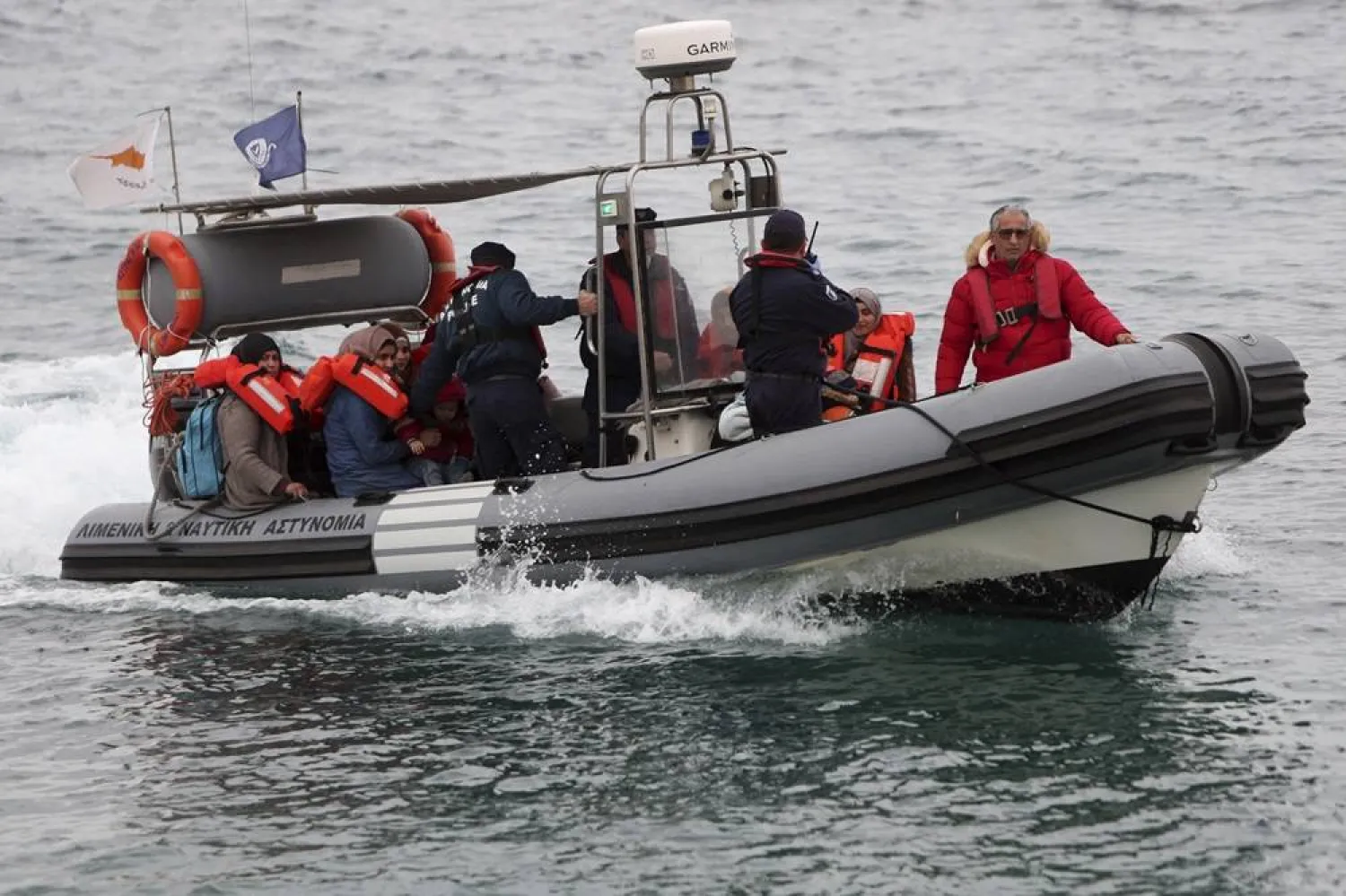
Migrants sit on a Cyprus marine police boat as they are brought to a harbor after being rescued from their own vessel off the Mediterranean island nation's southeastern coast of Protaras, Cyprus, on Jan. 14, 2020. (AP)
TT

UN Refugee Agency Tells Cyprus to Stick to the Law in Its Efforts at Sea to Thwart Refugee Boats

Migrants sit on a Cyprus marine police boat as they are brought to a harbor after being rescued from their own vessel off the Mediterranean island nation's southeastern coast of Protaras, Cyprus, on Jan. 14, 2020. (AP)

The United Nations' refugee agency said Friday that Cypriot efforts at sea to stop numerous Syrian refugee-laden boats departing Lebanon from reaching the European Union-member island nation mustn’t contravene international human rights laws or put passengers at risk.

Cypriot authorities have reportedly dispatched police patrol vessels just outside Lebanese territorial waters to thwart boat loads of Syrian refugees from reaching the island about 110 miles (180 kilometers) away.

The Cypriot government says a crumbling Lebanese economy coupled with the uncertainty brought on by the Israeli-Hamas war and the recent tit-for-tat strikes between Israel and Lebanon has resulted in a huge number of rickety boats overloaded with migrants – almost all Syrians – reaching the island.

Earlier this week, Cypriot patrol craft reportedly intercepted five boats carrying hundreds of Syrian refugees and migrants. The boats turned back and the passengers disembarked safely.

UNCHR spokesperson in Cyprus Emilia Strovolidou told The Associated Press that according to testimonies of passengers’ relatives, Cypriot authorities “forcibly pushed back” the boats using “violence” and “techniques to destabilize the boat.”

Strovolidou said the UN agency was “not in a position to confirm” those testimonies.

A Cypriot senior official strenuously denied that any coercion was used in any way to get the boats to return to Lebanon, insisting that the Cypriot government doesn’t engage in any pushbacks and acts “fully in accordance with international law.”

The official, who spoke on condition of anonymity because he cannot disclose details of ongoing operations, dismissed as “lies” allegations that Cypriot authorities resorted to using any type of force.

Strovolidou said Cyprus is also bound by international law not to return individuals to any country which could in turn deport them to their homeland where they could be at risk of harm or persecution.

The Lebanon office of UNHCR said in a statement that it was aware of more than 220 people who had disembarked from the returned boats in northern Lebanon on Wednesday. Of those, 110 were refugees registered with UNHCR and all of them were released, it said.

Saadeddine Shatila, executive director of the Cedar Center for Legal Studies, a Lebanon-based human rights organization that tracks migration issues, said his group had information that the Lebanese army had detained and possibly deported Syrians from at least one of the returning boats who weren’t registered with UNCHR.

The Lebanese army has in the past occasionally deported all Syrians aboard seized migrant boats, including registered refugees, a practice that drew an outcry from human rights organizations.

Lebanese political officials have been calling for years for the international community to either resettle the refugees in other countries or assist in returning them to Syria, and security forces have stepped up deportations of Syrians over the past year. Some of the deportees have reportedly faced detention and torture upon their return.

The Cypriot official said the Cyprus government in coordination with the European Commission is preparing an additional financial support package for Lebanon to help the country stop migrant boat departures. He said that support is conditional on Lebanon’s effectiveness in stopping migrant boat departures.

Cypriot President Nikos Christodoulides and European Commission Chief Ursula von der Leyen are due in Beirut May 2 to discuss the aid package.

The official said people smugglers are exploiting people’s fears over the ongoing conflicts in the region and are brazenly advertising in Lebanese coffee shops available seats on boats to Cyprus for $3,000 a head – a bargain compared to the $7,000 required for a trip to Italy.

Cyprus will convene a meeting of other EU countries next month to elicit additional support for its initiative for the bloc to formally redesignate some areas of Syria as safe zones. The Czech Republic and Denmark are behind the idea.

According to the Cypriot official, doing so wouldn’t mean that Syrians hailing from those safe zones are deported back to their country, but they would lose any allowances, benefits and the right to work, creating a disincentive to others to come to Cyprus.

He said Denmark is already implementing such a policy on its own and it’s a measure that the Cypriot government could consider if arrivals continue to increase.

Sharaa: Syria Is a Safe Artery Linking Central Asia, Gulf, Europe

Syrian President Ahmed Al-Sharaa attends a press conference on the day of a summit of the European Union and regional partners' leaders in Nicosia (Lefkosia), Cyprus, April 24, 2026. (Reuters)
TT

Sharaa: Syria Is a Safe Artery Linking Central Asia, Gulf, Europe

Syrian President Ahmed Al-Sharaa attends a press conference on the day of a summit of the European Union and regional partners' leaders in Nicosia (Lefkosia), Cyprus, April 24, 2026. (Reuters)

Syrian President Ahmed al-Sharaa said on Friday that a meeting of European Union leaders and regional partners in Nicosia marked a new level of political and strategic maturity, reflecting a shift toward a geopolitical reality that goes beyond traditional cooperation frameworks.

Speaking at a press conference after the informal gathering, al-Sharaa said Syria had presented the “Four Seas” and “Nine Corridors” initiatives as a safe alternative artery linking Central Asia and the Gulf to the heart of Europe.

“Standing on the shores of our shared Mediterranean confirms a firm reality that the security of the European continent and the stability of the region form a geopolitical balance that cannot be divided, and requires a spirit of partnership and collective responsibility,” he said.

He added that the weight of that responsibility was evident amid mounting challenges affecting regional security and global trade, warning that any closure of the Strait of Hormuz would pose a major risk and require a new strategy rooted in the region itself.

Syrian President Ahmed al-Sharaa (L) and Cypriot President Nikos Christodoulides (R) among other leaders during a family photo following lunch with regional partners at an informal meeting of EU Heads of State or Government in Nicosia, Cyprus, 24 April 2026. (EPA)

Al-Sharaa said Europe needs Syria as much as Syria needs Europe, describing the Euro-Arab Mediterranean partnership as an inevitable path and a safe haven for sustaining energy flows and ensuring global supply security.

He urged the international community to assume its responsibilities over what he described as ongoing Israeli violations of Syrian sovereignty, including ground incursions, airstrikes and near-daily breaches of Syrian territory and airspace, in violation of the 1974 Disengagement Agreement and international law.

“These attacks not only target Syrian security, but also undermine recovery and reconstruction efforts and destabilize the region, which forms the basis of partnership with the European Union,” he said.

Al-Sharaa called on European partners to take a firm stance obliging Israel to immediately halt its attacks, saying that protecting the political track launched at the meeting begins with safeguarding the territory on which it stands.

Syria, once a battleground for others’ conflicts, was now choosing to become “a bridge for stability and a cornerstone for solutions,” he remarked, stressing that “geography is our destiny and partnership is our decision.”

Al-Sharaa said the meeting marked a confident starting point ahead of a larger event in Brussels on May 11, where a high-level Syrian-European political dialogue would be launched.

“We have 17 days of intensive work ahead to consolidate Syria’s role as a strategic partner contributing to building Europe’s future and ensuring stability in our region,” he said.

Al-Sharaa attended the informal meeting in Nicosia at the invitation of Cypriot President Nikos Christodoulides and European Council President Antonio Costa, where he stressed the need to strengthen regional stability and boost international coordination to address shared challenges.


Iraq Deadlock Persists Over Next Prime Minister

 The Shorja wholesale market, as the US administration suspends shipments of US dollars to Iraq, in central Baghdad, Iraq, April 23, 2026. (Reuters)
The Shorja wholesale market, as the US administration suspends shipments of US dollars to Iraq, in central Baghdad, Iraq, April 23, 2026. (Reuters)
TT

Iraq Deadlock Persists Over Next Prime Minister

 The Shorja wholesale market, as the US administration suspends shipments of US dollars to Iraq, in central Baghdad, Iraq, April 23, 2026. (Reuters)
The Shorja wholesale market, as the US administration suspends shipments of US dollars to Iraq, in central Baghdad, Iraq, April 23, 2026. (Reuters)

Iraq's main Shiite alliance failed on Friday to agree on a new candidate for prime minister after US pressure stymied the chances of frontrunner Nouri al-Maliki.

Leaders of the Coordination Framework -- a ruling coalition of Shiite groups with varying ties to Iran who had initially nominated Maliki -- have been locked in intense discussions to settle the question of the premiership, but to no avail.

They have met three times this week.

After Friday's meeting, the INA state news agency reported that they would meet again on Saturday to "decide on the candidate for the prime minister".

In January, US President Donald Trump threatened to stop supporting Iraq if Maliki -- a two-time former premier with close ties to Iran -- returned to the post.

In Iraq, a nomination by the largest Shiite bloc effectively brings a candidate to power through presidential appointment, but Trump's threats reshuffled the cards.

Although the Coordination Framework has not yet officially withdrawn its backing for Maliki, its leaders are discussing other potential candidates.

They include incumbent premier Mohammed Shia al-Sudani, intelligence chief Hamid al-Shatri, and Bassem al-Badri who heads a committee that bars members of Saddam Hussein's Baath party from public office.

Iraq has long walked a tightrope between the competing influences of its allies, neighboring Iran and its archfoe the United States.


Aoun: Lebanon Rejects Being A Bargaining Chip in Regional Conflicts

 Lebanese President Joseph Aoun delivers his address at an informal European Union leaders’ meeting in Cyprus (AP)
Lebanese President Joseph Aoun delivers his address at an informal European Union leaders’ meeting in Cyprus (AP)
TT

Aoun: Lebanon Rejects Being A Bargaining Chip in Regional Conflicts

 Lebanese President Joseph Aoun delivers his address at an informal European Union leaders’ meeting in Cyprus (AP)
Lebanese President Joseph Aoun delivers his address at an informal European Union leaders’ meeting in Cyprus (AP)

Lebanese President Joseph Aoun said Lebanon “refuses to be a bargaining chip in regional conflicts,” stressing it “negotiates in its own name, in defense of its national interests and sovereignty,” as Beirut pursues a US-sponsored diplomatic track backed by European and Arab support to reach a lasting end to the war and ensure arms are held exclusively by the state.

Aoun made the remarks in Lebanon’s address to an informal meeting of European Union leaders, attended by southern neighbors and convened by Nikos Christodoulides during Cyprus’ EU presidency.

He said Lebanon had “engaged in a diplomatic negotiation process under US sponsorship, with support from the European Union and Arab countries,” aimed at a “sustainable solution” that ends Israeli attacks and secures a full Israeli withdrawal behind internationally recognized borders, allowing the state to extend authority over all its territory.

“Lebanon today refuses to be a bargaining chip in regional conflicts. It negotiates in its own name, in defense of its national interests and sovereignty,” he said, adding the country “places great importance on de-escalation and achieving stability and peace,” and that diplomacy, not escalation, is the only path to a lasting solution.

Severe humanitarian situation

Aoun described conditions on the ground as “extremely dangerous,” citing “more than 1,300 evacuation orders affecting 311 towns and over 6,800 airstrikes up to April 11,” leaving “more than 10,000 casualties, killed and wounded.”

He accused Israel of “violating international law” by targeting medical teams, hospitals, schools, journalists and places of worship, and by the “systematic destruction” of villages and civilian infrastructure to prevent residents from returning. Displacement has “exceeded one million,” he said.

Only 13% of the displaced are in shelters, mostly in public schools and universities, increasing pressure on the education system, he added. Lebanon still hosts around one million Syrian refugees, placing “significant strain” on infrastructure, services and host communities. He described the crisis as “not a conventional humanitarian crisis, but an existential one by all measures.”

Economic losses mount

More than 150,000 people are expected to have no homes to return to after the war.

Aoun urged the EU to convene an international conference on reconstruction and recovery, alongside boosting humanitarian funding, and called for reviving a France-backed conference to support the Lebanese army, which he described as “a guarantor of national unity and a cornerstone of local and regional stability.”

Syrian refugees

Aoun called for coordination with Syrian authorities, backed by international partners, to step up efforts for the safe and dignified return of Syrian refugees, saying Syria’s recovery offers “a real opportunity” to advance the process gradually and in an organized manner.

He said Lebanon is “not merely a humanitarian case,” but is directly tied to regional stability, migration, counterterrorism and energy security, urging stronger cooperation with Europe.

Nicosia meetings: French and Italian support

On the sidelines, Aoun met French President Emmanuel Macron, briefing him on efforts to end the conflict and ease the suffering of the Lebanese people.

He said Lebanon had pressed in talks at the US State Department and the White House for a ceasefire, followed by a three-week extension to halt hostilities, stop the destruction of homes in villages occupied by Israeli forces, and end attacks on medics, Red Cross and civil defense personnel, journalists and civilians.

Aoun also outlined Lebanon’s post-ceasefire position, thanking France for aid to displaced Lebanese and expressing hope for continued support from France and EU countries.

Macron reaffirmed France’s backing, saying he had contacted European leaders and partners to support Lebanon’s push to consolidate a ceasefire and begin bilateral negotiations, adding Paris would continue efforts to bolster Lebanon’s position.

Aoun also met Italian Prime Minister Giorgia Meloni, briefing her on ceasefire contacts and two rounds of talks in Washington, the first attended by US Secretary of State Marco Rubio and the second by US President Donald Trump.

“The option of war leads to no result,” he said.

Meloni reaffirmed Italy’s support for Lebanon, particularly for direct bilateral negotiations, and said Rome was ready to assist efforts to achieve stability, while continuing aid.