EU Announces 1 Billion Euros in Aid for Lebanon amid a Surge in Irregular Migration

In this Monday, April 23, 2018 photo, Syrian refugee children play outside their family tents at a Syrian refugee camp in the town of Bar Elias, in Lebanon's Bekaa Valley. (AP Photo/Bilal Hussein)
TT

EU Announces 1 Billion Euros in Aid for Lebanon amid a Surge in Irregular Migration

In this Monday, April 23, 2018 photo, Syrian refugee children play outside their family tents at a Syrian refugee camp in the town of Bar Elias, in Lebanon's Bekaa Valley. (AP Photo/Bilal Hussein)

The European Union announced on Thursday an aid package for Lebanon of 1 billion euros — about $1.06 billion — that will mostly go to strengthening border control to halt the flow of asylum seekers and migrants from the small, crisis-wracked country across the Mediterranean Sea to Cyprus and Italy.
The deal follows other recent deals by the EU to provide funds to countries such as Egypt, Tunisia and Mauritania to fortify their borders. It comes against a backdrop of increasing hostility toward Syrian refugees in Lebanon and a major surge in irregular migration of Syrian refugees from Lebanon to Cyprus.
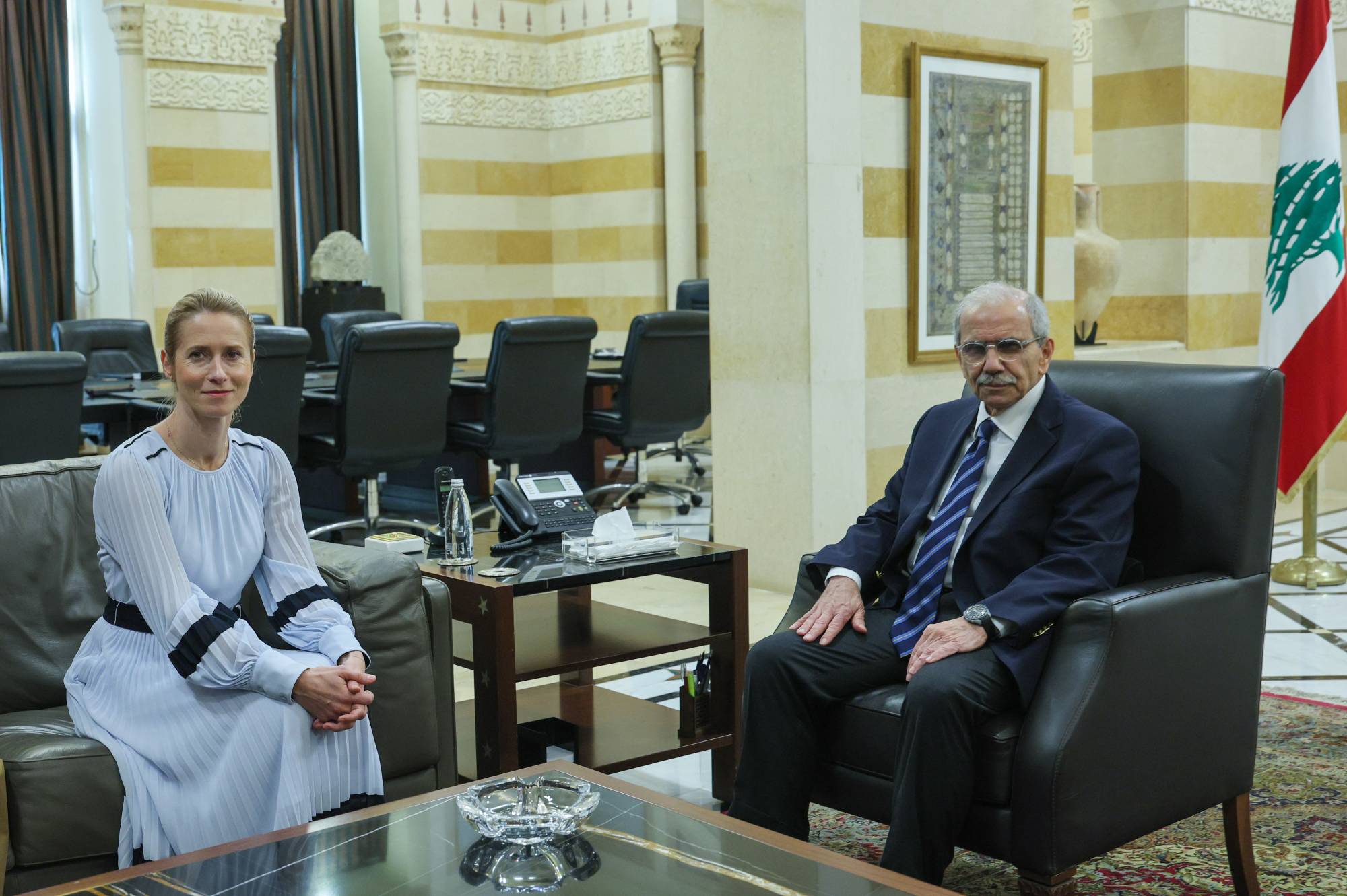
European Union Commission President Ursula von der Leyen announced the aid, which will be distributed between this year and 2027, during a visit to Beirut alongside Cypriot President Nikos Christodoulides.
Von der Leyen said the EU will also be “exploring how to work on a more structured approach to voluntary return to Syria in close cooperation with” the UN refugee agency, or UNHCR, and called for more international support for humanitarian and early recovery projects in Syria.
Europe will also continue to maintain “legal pathways” for resettlement of refugees in Europe, she said.
Lebanon's Caretaker Prime Minister Najib Mikati praised the aid package, saying that "Lebanon’s security is security for European countries and vice versa.”
“Any blowup related to the issue of displaced persons will not be limited to Lebanon but will extend to Europe to become a regional and international crisis,” he said.
Lebanon, which has been in the throes of a severe financial crisis since 2019, hosts nearly 785,000 registered Syrian refugees and hundreds of thousands more who are unregistered, the highest population of refugees per capita in the world.
Lebanese political officials have been calling for years for the international community to either resettle the refugees in other countries or assist in returning them to Syria — voluntarily or not. Lebanese security forces have stepped up deportations of Syrians over the past year.
Tensions around the presence of refugees have further flared since an official with the Christian nationalist Lebanese Forces party, Pascal Suleiman, was killed last month in what military officials said was a botched carjacking by a Syrian gang. The incident prompted outbreaks of anti-Syrian violence by vigilante groups.
Meanwhile, Cypriot authorities have been complaining that their country has been overwhelmed by a wave of irregular migration of Syrian asylum seekers, many of them coming on boats from Lebanon.
The Lebanon office of the UNHCR said it had verified 59 “actual or attempted” departures by boats carrying a total of 3,191 passengers from Lebanon between January and mid-April, compared to three documented boat movements carrying 54 passengers in the same period last year.
Usually, few boats attempt the crossing in the winter, when the passage becomes more dangerous. In total, UNHCR recorded 65 boat departures carrying 3,927 passengers in all of 2023.
Cyprus has taken increasingly aggressive tactics to halt the flow of migrants. Last month, it suspended processing of Syrian asylum applications, and human rights groups accused the Cypriot coast guard of forcibly pushing back five boats carrying about 500 asylum seekers coming from Lebanon.
Christodoulides hailed Thursday's visit as a “historic day” and praised the EU decision, calling for European officials to go farther and declare some areas of Syria safe for return.
“The current situation is not sustainable for Lebanon. It is not sustainable for Cyprus, it is not sustainable for the European Union,” he said.
The new funding announcement comes ahead of the annual fundraising conference for the Syrian crisis in Brussels later this month. After 13 years of civil war in Syria, donor fatigue has set in while the world’s attention is occupied by the humanitarian fallout of more recent conflicts in Ukraine and Gaza.



Syria: Pending Issues, Including Arrests Delay SDF Integration

Protest by families of SDF detainees held by the Syrian government outside the Democratic Union Party building in Qamishli (Ronahi)
TT

Syria: Pending Issues, Including Arrests Delay SDF Integration

Protest by families of SDF detainees held by the Syrian government outside the Democratic Union Party building in Qamishli (Ronahi)

The exchange of prisoners and detainees between the Syrian government and the Syrian Democratic Forces (SDF) has stalled since mid-April after becoming tied to political issues, hampering efforts to integrate the SDF and implement an agreement reached last January.

Abdulkarim Omar, a senior official in the Kurdish Autonomous Administration, told Asharq Al-Awsat that several issues still require “further discussion and consensus.”

He said the top priority remains the detainees file and the return of displaced people, stressing that both the Autonomous Administration and the SDF are fully committed to the agreement.

The remarks came as families of SDF detainees held by the Syrian government staged a protest demanding the release of their sons, according to Kurdish media, amid reports of reciprocal arrest campaigns in Hasakah and Raqqa provinces.

Omar said the detainees and prisoners file was still receiving “careful attention and follow-up” from the SDF and the Autonomous Administration.

“This reflects our commitment to fully implementing the provisions of the Jan. 29 agreement, which represents an important framework for cooperation and understanding between the Autonomous Administration and the transitional government,” he said.

He said the Autonomous Administration and the SDF were committed to implementing all provisions of the agreement, including the integration of military, security and administrative institutions, while taking into account the particularity of Kurdish areas.

He said there was “full awareness that the integration process requires building trust and a genuine will from all parties, in addition to overcoming any rhetoric that could obstruct this path.”

According to the Kurdish news agency Hawar, families of SDF detainees held by the Syrian government complained that they had been prevented from seeing their sons in detention centers in Aleppo.

Families of detainees also staged protests in Hasakah city to demand their release. Video clips aired by Kurdish media showed a group of families demonstrating outside the Hasakah governorate building on Tuesday.

“We are seeking urgent solutions that ensure the release of all detainees in order to ease the suffering of their families,” Omar said.

He added that the return of displaced people to their original areas remained a top priority. About 1,400 families have so far returned to Afrin, while around 7,000 families in Jazira and Kobani are still waiting to return to their hometowns.

Work is also continuing to allow other families displaced from Ras al-Ain, Tal Abyad and other areas to return “with dignity and safety,” he said.

Outstanding Issues

Omar said several issues require further discussion and agreement. These include integrating the Women’s Protection Units into the Syrian Defense Ministry and developing mother-tongue education in Kurdish areas.

He added that other issues include accrediting certificates issued by Autonomous Administration institutions on par with other areas, as well as matters related to courthouses and other technical and administrative issues.

“We are confident that through shared will, continued and transparent dialogue and trust-building, tangible progress can be achieved on these files in a way that serves the interests of all Syrians and strengthens national stability,” he said.

He said progress on these files represented “a real opportunity to strengthen trust among all parties,” adding that commitment to agreements was the best path toward “solid national unity, lasting stability and a shared future marked by security and dignity for all Syrians.”

The prisoner and detainee exchange file had made notable progress in March and April under understandings aimed at “emptying prisons” and building confidence as part of the implementation of the agreement.

In the latest batch, around 400 SDF detainees were released in exchange for 91 detainees held by the Syrian government.

That followed earlier batches in March that saw 300 detainees released in exchange for 300 others, and before that, 159 detainees were released in exchange for 100.

Sipan Hamo, also known as Samir Oso, assistant defense minister in Syria’s interim government for eastern region affairs, described linking the detainees issues to political pressure as “immoral.”

In an interview with Hawar, he said the mechanism used in recent exchanges was “wrong,” adding that all prisoners should have been released on the day integration was announced, without batches.

Ahmed al-Hilali, spokesman for the presidential team tasked with overseeing the implementation of the Jan. 29 agreement, said in press remarks that the delay in taking over courthouses, especially in Qamishli, had negatively affected other files, most notably detainees.

He said the issue had shifted from an exchange approach to release procedures after the Syrian government took over prisons in Hasakah, but that the process was still facing delays.

Hilali said the integration track was linked to several overlapping issues, including the detainees, whom he described as “non-negotiable.”

But he said it was still affected by progress in implementing the agreement, while expressing optimism that a breakthrough could be achieved in the coming days.

Reciprocal arrests

In a parallel development, local media said SDF forces carried out an arrest campaign on Monday in Hasakah city and its surroundings.

The Hasakah Media Center said the campaign took place in the city’s Salihiya neighborhood and in the village of al-Fahd near Panorama roundabout, leading to the arrest of a young man in Hasakah and several residents of the village.

Syrian security forces had earlier arrested a number of people affiliated with the SDF in Raqqa. Asharq Al-Awsat sought details from government and Kurdish sources on the nature of those arrests but received no response.


Factions Tighten Grip on Iraq Gov’t Formation Talks

Mourners attend the funeral of members of the Iraqi armed group Kataib Hezbollah who were killed in an airstrike that targeted a PMF headquarters near the western al‑Qaim district on the Syrian border, amid the US-Israel conflict with Iran, in Baghdad, Iraq, March 2, 2026. REUTERS/Thaier Al-Suda
TT

Factions Tighten Grip on Iraq Gov’t Formation Talks

Mourners attend the funeral of members of the Iraqi armed group Kataib Hezbollah who were killed in an airstrike that targeted a PMF headquarters near the western al‑Qaim district on the Syrian border, amid the US-Israel conflict with Iran, in Baghdad, Iraq, March 2, 2026. REUTERS/Thaier Al-Suda

Despite the favorable conditions surrounding Prime Minister-designate Ali al-Zaidi’s efforts to form a new government, including backing from local and regional parties, observers say he still faces serious challenges, foremost among them US pressure to bar representatives of armed factions from joining the cabinet.

US President Donald Trump, voicing support last week for al-Zaidi’s nomination, said he wanted to see a new Iraqi government “free of terrorism.”

His remarks were widely interpreted as opposition to the inclusion of Iran-aligned armed factions that Washington has designated as terrorist groups.

Asaib Ahl al-Haq stands firm

Alongside US pressure, al-Zaidi faces competing domestic demands, particularly from groups seeking cabinet posts despite being under US sanctions. Chief among them is Asaib Ahl al-Haq, led by Qais al-Khazali, placing the premier-designate between two difficult constraints in his government formation efforts.

Hussein al-Shihani, a member of the political bureau of the Sadiqoun bloc, the political wing of Asaib Ahl al-Haq, said in media remarks that the group is seeking one of the deputy prime minister posts.

He said the bloc is targeting underperforming ministries “to prove its ability to reform them,” including the industry ministry to revive the “Made in Iraq” label, and the education ministry, where it claims to have a reform plan.

Asaib Ahl al-Haq held key cabinet portfolios in the previous two governments, including the culture and higher education ministries, and currently occupies the position of first deputy speaker of parliament.

Shihani said the post of first deputy speaker was valued at nine or 10 “points,” with each point equivalent to a parliamentary seat, adding that Sadiqoun aims to secure a deputy prime minister position based on its share.

It remains unclear how al-Zaidi will reconcile competing international and domestic pressures.

Some political and media circles warn that competition among factions, including Asaib Ahl al-Haq, over key posts around the prime minister-designate could shorten the lifespan of his prospective government.

Key hurdles

Political analyst Ihsan al-Shammari said al-Zaidi’s initial pledge to form an inclusive government could conflict with US conditions that it be free of militias designated as terrorist organizations.

He said this presents a major challenge, particularly as al-Zaidi is counting heavily on US support.

Shammari added that the issue could complicate negotiations with the political wings of armed factions, which now hold significant representation in parliament, making it difficult for al-Zaidi to bypass their influence.

He said al-Zaidi may resort to compromise, persuading factions to nominate figures who appear independent but remain loyal to them, potentially easing US pressure.

Failure to navigate these challenges could have major consequences, Shammari said, potentially leading to a repeat of the model seen under Prime Minister Mohammed Shia al-Sudani, where armed groups were represented in government, a scenario unlikely to be accepted by Washington.

If faction-linked figures are included in the cabinet, it could reinforce domestic perceptions of their return to executive power, potentially undermining the government’s chances of success, he added.

Shammari said al-Zaidi may ultimately seek a balance between factional pressures and US demands, possibly by convincing Washington that such groups will not be directly represented in government.

Navigating the faction dilemma

Firas Elias, a political science professor at the University of Mosul specializing in Iranian studies, said it would be difficult for al-Zaidi to form a government “free of terrorism” in the sense outlined by Trump.

“The proposal reflects a US political vision more than a reality that can be achieved within Iraq’s current structure,” he told Asharq Al-Awsat.

He said excluding these factions entirely from government is unrealistic, not only due to their influence on the ground but also because they are part of the political balance within the Coordination Framework, which is expected to serve as the main backer of al-Zaidi’s government.

Accordingly, he said, addressing the faction issue is unlikely to come through direct confrontation, but rather by recalibrating their role and limiting their influence in line with state requirements, without triggering open conflict.

The most likely scenario, Elias said, is not a government free of factions, but a more disciplined administration that contains these forces and redirects their role within the framework of the state.


Lebanon Tests ‘Arms Monopoly’ in Beirut Suburbs Crackdown

Damage to buildings in Beirut’s southern suburbs (Reuters)
TT

Lebanon Tests ‘Arms Monopoly’ in Beirut Suburbs Crackdown

Damage to buildings in Beirut’s southern suburbs (Reuters)

Lebanese security forces are intensifying a crackdown on gunfire during funerals held by Hezbollah for its members, in a move that signals an official push to curb lawlessness and halt scenes that are becoming increasingly frequent and alarming.

The Lebanese army said in a statement that military units raided the homes of suspects involved in shooting during funerals in Beirut’s southern suburbs and in Baalbek. Two people were arrested in the southern suburbs, along with another suspect wanted on multiple warrants.

The campaign extended beyond Beirut. The army said it also detained a man identified as H.N. in the al-Sharawneh neighborhood of Baalbek and another, S.A., in the town of Brital, over gunfire during funeral ceremonies.

It said weapons and ammunition were seized. The items were handed over and investigations have begun under judicial supervision, while efforts continue to arrest others involved.

Injuries in the southern suburbs

The crackdown comes as concern grows over the fallout from the practice, which has coincided with a rise in shooting incidents across several areas.

On Sunday, people were wounded in the Kafaat area of Beirut’s southern suburbs after gunfire and rocket-propelled grenades were fired into the air during a funeral, underscoring the immediate risks.

Ambulances rushed to evacuate the wounded, highlighting how funerals are turning from moments of mourning into scenes of danger.

The phenomenon is not confined to one region. In the Bekaa Valley, the army previously carried out wide raids in Brital, east of Baalbek, following gunfire and the use of B7 rockets during the funeral of two Hezbollah members.

The operation aimed to pursue those involved and curb the use of weapons at public events, in an effort to contain the situation before it escalated.

A gradual push to assert state authority

Hezbollah appears to be distancing itself from the gunfire.

Political analyst Ali al-Amine said “field indicators, including bullets landing in populated areas and near schools, confirm the seriousness of what is happening and show that this behavior cannot be justified under any pretext.”

He said the group is indirectly seeking to disassociate itself from such acts, and even condemn them, in a bid to contain the fallout. He added that the army is acting at a sensitive time, alongside negotiations and official meetings aimed at strengthening the state’s authority.

“There is a clear effort by the authorities to show they can take executive measures, even if gradually, toward imposing a monopoly on arms,” he said, adding the steps are not a direct confrontation with Hezbollah but an attempt to contain disorder.

“What is happening is a display or chaotic use of weapons.”

A costly confrontation

Al-Amine said Hezbollah understands that any confrontation with the state or the army would be costly and yield no gains, pushing it toward rhetoric rather than direct escalation.

“Whenever the state shows seriousness, reactions are less intense than initially portrayed,” he said, adding the real issue lies in the state’s decision, not the scale of risks, which he said are often exaggerated to obstruct reform.

“If the state fails to show it can act, it risks its role and existence,” he said.

He described the developments as the start of a new path toward consolidating state authority.

“The government is seeking to assert its sovereign role and show that the era of unchecked weapons is gradually giving way to the rule of law,” he said.