


Israeli Army’s Plan to Flood Hamas Tunnels Fails

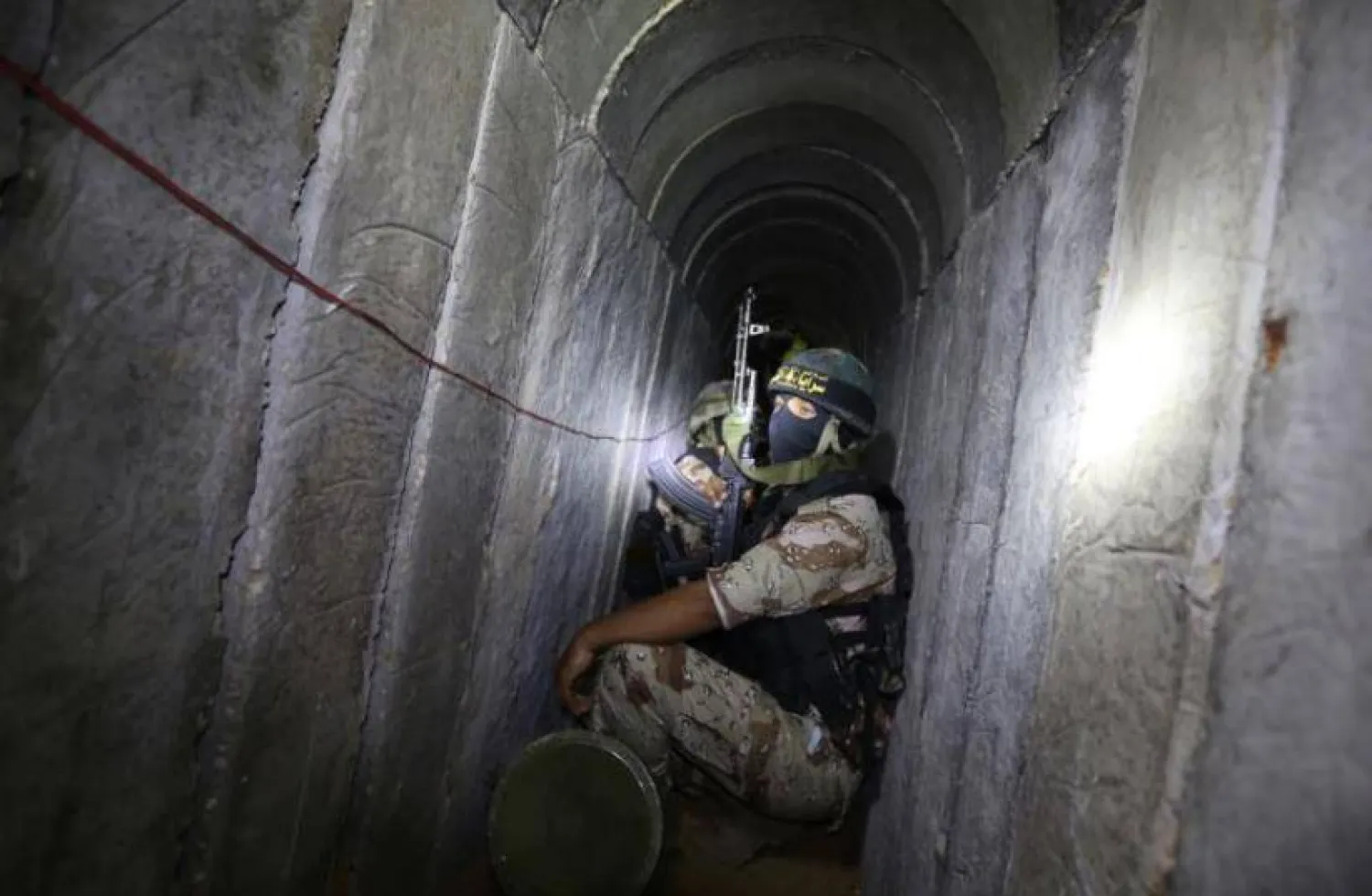
A Palestinian fighter from the Islamic Jihad's armed wing, the Al-Quds Brigades, is seen in a tunnel in the south of the Gaza Strip (AFP)
TT

Israeli Army’s Plan to Flood Hamas Tunnels Fails

A Palestinian fighter from the Islamic Jihad's armed wing, the Al-Quds Brigades, is seen in a tunnel in the south of the Gaza Strip (AFP)

The Israeli media on Saturday renewed talk about the Atlantis system, a significant engineering and technological breakthrough that was supposed to take out the Hamas tunnels and to kill senior Hamas officials, by pumping in seawater at high intensity.

The system was supposed to be the game changer, a new, relatively quick and lethal solution to one of the more complex fronts in the Gaza Strip.

But Israel started by adopting an old and unsuitable plan, continued by ignoring professional advice and the possible danger to the abductees – and ended quietly a few months later, anyone saying whether it achieved anything at all.

Haaretz surveys profiled the Atlantis project – a predictable military failure which no one stopped until it was too late.

“But about half a year after this system was revealed to the public, it turns out that Atlantis is lost; it's no longer in use, and nobody in the army can say what benefit, if any, was gained from this expensive project,” the newspaper wrote.

A Haaretz investigation – based on discussions with a series of different sources, who are closely involved in the development and operation of the system, as well as documents and minutes from closed discussions, in which senior officers and professionals participated– reveals a large number of screw-ups in the way it was handled by the army, and provides a profile of a failure foretold.

For example, it turns out that the system started to operate even before the necessary opinions requested by the army were given; that behind the accelerated activity there was a great deal of pressure imposed from above by the head of Southern Command, Maj. Gen. Yaron Finkelman; and that it was activated while possibly endangering Israelis who were alive when abducted to the Strip.
“The system was activated in at least one central Hamas tunnel that was clearly used by the organization during various stages of the war,” said a defense source who was deeply involved in project Atlantis. “And it's very likely that there were hostages there who served as a human shield.”

The question of how it happened that a project described by the Israeli Army as a “tie breaker” turned into a steadily growing failure has a complex answer.

One of the main causes is the backdrop, Haaretz said. During the first days of the war, says a defense source, “The achievements on the ground against Hamas officials were insignificant. Most of the Hamas forces, mainly the military arm, entered the tunnels and that created pressure on the senior Israeli Army command.”

That's why, says another source who spoke to Haaretz, Finkelman demanded solutions; ways of striking at Hamas activists in the tunnels. “There was frustration because during those stages the forces didn't really think that we'd start to enter all the tunnels,” recalls the source.

“They also began to realize the dimensions of the tunnels that Military Intelligence didn't know about.”

At that time, the Israeli Army was still learning about the tunnels they encountered in the Strip and their scope hundreds of kilometers.

“The army,” he adds, “found itself on the ground realizing that Hamas was below the ground and it had no solution for removing them from there.”

It was actually the renewal of a contingency plan that was proposed in the ground forces years before Finkelman assumed his position.

At the time the purpose was to deal with a different type of tunnel. Its chances of success in dealing with the tunnels that the army found in the Strip beginning on October 7 were low.

But according to defense sources who spoke to Haaretz, Finkelman gave a green light to taking the old plan and adapting it to the new situation.
After the plan received the necessary permits, the Army turned to the Israel Water Authority for assistance.

The authority hastened to mobilize for the mission and formed two groups of civilian experts in several fields. One group was placed in charge of pumping the water into the tunnels, the second was asked to study the subject of water loss through the walls of a tunnel. Both groups got started.
But the Israeli Army didn't wait for the conclusions, and already at this point they embarked on the next stage.

The Southern Command's 162nd division was chosen as the contractor of the operation, and infrastructure work was assigned to the fighters of the Shayetet 13 naval commandos, which for several weeks became a pipeline unit.

The main goal: joining pipes and deploying them in the combat area.

“For a month and a half the Israeli army neutralized an entire division,” says one of the commanders who took part in the project. “It assigned combat soldiers to plumbing jobs and guarding pipes, throughout the Strip, when it had no idea whether the project had any operational feasibility.”

He said, “The Army had no way of knowing whether the system was working, what had happened in the tunnels, what the situation was of the terrorists inside and whether there were hostages who were harmed as a result of the water. To this moment it isn't clear what damage was caused in the tunnels, if any. They simply don't know anything.”

According to a document issued by the experts on the subject, about three weeks after Atlantis began to operate, “The activation wasn't carried out according to the recommendations of the professionals. The pumping wasn't done according to the combat theory that was developed, no findings were gathered and they didn't take the measurements that were described.”

The experts were angry throughout the period. “There was a disconnect between the sources in the field and the accompanying unit on the one hand and the experts who planned the method of operation on the other,” they said.

And in fact, at that time, say professionals, the military lacked the requisite information and data about the tunnels, certainly not how to flood them in a way that would harm those inside or cause them to flee to the surface.

In the course of the project, the Water Authority investigators had a chance to be exposed to the study prepared by a Hamas activist who served in the tunnel system in the past 10 years. Along with his statement that the tunnels became the main system prepared by the organization for a military confrontation with Israel, he described how they were constructed and the logic behind them.



UN Probe: RSF Actions in Sudan's el-Fasher Point to Genocide

Forces affiliated with the Rapid Support Forces in the city of el-Fasher, Darfur region (AFP)
TT

UN Probe: RSF Actions in Sudan's el-Fasher Point to Genocide

Forces affiliated with the Rapid Support Forces in the city of el-Fasher, Darfur region (AFP)

Mass killings of non-Arab communities when the Rapid Support Forces captured the Sudanese city of el-Fasher bears hallmarks that point to genocide, an independent UN probe said in a new report on Thursday.

At the end of October last year, the RSF took over the city - which had been the last remaining stronghold of the Sudanese Armed Forces (SAF) in the Darfur region in the west of the country - with thousands of people killed and raped during three days of horror, the UN Independent International Fact-Finding Mission for Sudan said.

It followed an 18-month siege where the RSF imposed conditions of life calculated to bring about the physical destruction of non-Arab communities, in particular the Zaghawa and the Fur, ‌the report stated.

The ‌UN mission said it found evidence that the RSF carried out a pattern ‌of ⁠coordinated and repeated ⁠targeting of individuals based on ethnicity, gender and perceived political affiliation, including mass killings, rape and torture, as well as inflicting conditions of life calculated to bring about the group’s physical destruction - core elements of the crime of genocide under international law.

The final draft of the report was shared with the Government of Sudan but no response was received, while the RSF did not respond to the UN mission's request to meet with its leadership, the report stated. The RSF and SAF did not immediately respond to requests from Reuters for comment.

In the past, the RSF has ⁠denied such abuses - saying the accounts have been manufactured by its enemies and ‌making counter-accusations against them.

"The scale, coordination, and public endorsement of the operation ‌by senior RSF leadership demonstrate that the crimes committed in and around el-Fasher were not random excesses of war" said Mohamad ‌Chande Othman, Chair of the Fact-Finding Mission on Sudan.

"They formed part of a planned and organized operation ‌that bears the defining characteristics of genocide," he added.

Before its takeover el-Fasher's population mainly consisted of the Zaghawa, a non-Arab community, while displacement camps around the area were comprised of the Fur community, as well as Berti, Masalit and Tama, the report said.

"Survivors describe explicit threats to 'clean' the city," the report stated. Alongside attacking displacement camps, communal kitchens and medical centers ‌with drones and heavy weapons, the RSF also carried out killings, looting, beatings and sexual violence in el-Fasher, the report stated.

The RSF's "exterminatory rhetoric" and other violations indicated ⁠its intent to destroy ⁠the Zaghawa and Fur communities in whole or in part, the report said.

"Witnesses heard the Rapid Support Forces saying, 'Is there anyone Zaghawa among you? If we find Zaghawa, we will kill them all'," the report said.

Survivors recounted point-blank executions of civilians, as well as bodies of men, women and children filling roads, the report stated.

Women and girls aged 7 to 70 years old from non-Arab communities, particularly the Zaghawa were raped and subject to other acts of sexual violence, including whipping and forced nudity, the report stated.

British Foreign Secretary Yvette Cooper said the international response to the report and the situation in Sudan had to be emphatic and urged for a ceasefire.

"The findings of this UN report are truly horrific - atrocities including systematic starvation, torture, killings, rape and deliberate ethnic targeting used on the most horrendous scale during the Rapid Support Forces siege of el-Fasher," she said in a statement.

The UN mission was mandated by members of the Human Rights Council, following backing from countries that included Britain, to urgently investigate violations and abuses under international law in and around el-Fasher.


Sudanese Political, Civil Groups Propose Ramadan Truce

The war in Sudan, ongoing since mid-April 2023, has caused extensive destruction across the country (AFP)
TT

Sudanese Political, Civil Groups Propose Ramadan Truce

The war in Sudan, ongoing since mid-April 2023, has caused extensive destruction across the country (AFP)

A broad coalition of Sudanese political and civil forces has made an urgent appeal to the leadership of the Sudanese Armed Forces and the Rapid Support Forces (RSF), calling for a “comprehensive humanitarian truce” during the holy month of Ramadan.

The initiative calls for a temporary cessation of hostilities, guarantees for the protection of civilians, and unhindered humanitarian aid delivery, amid increasingly dire humanitarian conditions as Sudanese citizens observe their fourth consecutive Ramadan under gunfire and shelling.

More than ten Sudanese political parties made the appeal, some of which are part of the Civil Democratic Alliance of the Forces of the Revolution (“Sumoud”), led by former Prime Minister Abdalla Hamdok.

Prominent signatories include the National Umma Party, the Federal Gathering, and the Sudanese Congress Party.

The document was also endorsed by parties outside the “Sumoud” alliance, most notably the Arab Baath Socialist Party and the Democratic Unionist Party, alongside various civil and trade union groups.

The appeal urges both warring parties — the army and the RSF — to announce a humanitarian truce beginning on the first day of Ramadan. The proposal includes a ceasefire, the safeguarding of civilian facilities, the opening of safe corridors for relief organizations, the immediate release of civilian detainees, and the initiation of prisoner exchange arrangements under international supervision to ensure compliance with humanitarian law.

It also calls for clear monitoring and implementation mechanisms to prevent either side from exploiting the truce for military gains.

The signatories stressed that the initiative comes in response to the worsening humanitarian crisis, particularly among vulnerable groups such as women, children, and the elderly, and to the mounting threats to the lives of millions, which they say require urgent intervention.

This marks the second initiative put forward by political and civil forces to halt the war since its outbreak in 2023. The first resulted in the signing of what became known as the “Addis Ababa Declaration” between the Civil Democratic Forces Alliance (Taqaddum) and the RSF. The declaration was addressed to the army leadership, which neither rejected nor signed it.

Since the fall of the cities of El-Fasher and Babanusa, as well as the town of Heglig in West Kordofan State, clashes between the army and the RSF intensified in South and North Kordofan before subsiding in recent weeks and shifting into more “technical” warfare.

This phase has seen the increased use of combat drones, jamming devices, guided artillery, and aerial munitions, leading to a rise in civilian casualties and injuries.


Anger in Iraq Over Use of ‘Greatest Arab Poet’ in Ramadan Ad

The late Iraqi poet Muhammad Mahdi al-Jawahiri serves tea to Prime Minister Mohammed Shia al-Sudani, as portrayed in a Ramadan advertisement
TT

Anger in Iraq Over Use of ‘Greatest Arab Poet’ in Ramadan Ad

The late Iraqi poet Muhammad Mahdi al-Jawahiri serves tea to Prime Minister Mohammed Shia al-Sudani, as portrayed in a Ramadan advertisement

Baghdad - A promotional video produced by a local platform and sponsored by several companies has sparked widespread criticism in Iraq over content described as “irresponsible,” according to the Iraqi Writers and Authors Union, for allegedly insulting the “Greatest Arab Poet,” Muhammad Mahdi al-Jawahiri (1899–1997), as well as former royal-era prime minister Nuri al-Said (1888–1958).

Although the production company branded the advertisement “Unified Iraq,” it depicted al-Jawahiri in an AI-generated image serving tea to Prime Minister Mohammed Shia al-Sudani inside his office. In a similar scene, Nuri al-Said was shown serving tea to former parliament speaker Mohammed al-Halbousi, triggering a wave of public outrage.

Alongside the controversy over the AI-generated portrayals of al-Jawahiri and al-Said, another debate erupted after the video showed US Chargé d’Affaires Joshua Harris, British Ambassador Irfan Siddiq, French Ambassador Patrick Durel, and German Ambassador Daniel Krebber at a banquet, appearing to be hosted by Farhad Alaaldin, the Iraqi prime minister’s adviser for foreign affairs.

The advertisement also briefly featured the late Iraqi president, Jalal Talabani, holding an umbrella while walking through the streets of Erbil, the capital of the Kurdistan Region, raising further questions about its purpose.

While the video included a song about “a unified Iraq as a homeland of peace,” critics said its central narrative — built around a homeless young beggar — was confusing and poorly defined. Sources close to the production team told Asharq Al-Awsat that the creators had “their own artistic methods” of expressing the idea.

Government Distances Itself

Amid the mounting backlash, the prime minister’s office expressed rejection of “the virtual video in which al-Jawahiri appeared in a manner inconsistent with the prime minister’s respect and appreciation for his literary and national stature.”

Al-Sudani instructed the Communications and Media Commission to launch an urgent investigation into the entities that produced, promoted, or published the advertisement, citing its alleged offense to cultural icons and state institutions, as well as what he described as the irresponsible and unprofessional use of artificial intelligence technologies.

He also signaled the possibility of legal action against the party responsible for producing what he called “the offensive video against Iraq and its national symbols.”

In contrast, the production company asserted that the PM’s office had prior knowledge of the project, and that the same applied to al-Halbousi. However, sources denied being aware of the inclusion of al-Jawahiri and Nuri al-Said in the work.

The sources also suggested that a government official may have been involved in facilitating the production in cooperation with Al-Bayan University, whose building and offices appeared in the advertisement.

“Deliberate Insult”

The Iraqi Writers and Authors Union condemned what it called an “insult to the immortal al-Jawahiri” after the video showed him serving tea to the prime minister.

In a statement, the union said the act reflected “a deliberate offense to a poet distinguished by his immense cultural and moral value, and his well-known national and humanitarian positions.”

It urged relevant authorities to take a firm and deterrent stance against “irresponsible acts aimed at distorting facts and undermining Iraq’s national symbols.”

The union added that al-Jawahiri remained a national symbol “we proudly present to the world and refuse to see insulted by any party.”

The union was founded in al-Jawahiri’s home in 1959 and he became Iraq’s first journalists’ syndicate head the same year.

Claims of Prior Approvals

Facing intense criticism, the advertisement’s author and head of the production company said all participating political figures had approved the details of the project and filming inside their offices.

She stated that the scenes featuring al-Sudani and al-Halbousi were real, with only the figures of al-Jawahiri and Nuri al-Said later added using artificial intelligence.

In a statement on Instagram, al-Jumaili said the project took two months to complete and was reviewed by several international parties before being shown in Iraq, adding that “no step was taken without official approvals.” She did not specify the nature of those entities or whether the political figures were aware of the AI portrayals alongside them.

She argued that the backlash was politically driven and overlooked the advertisement’s positive messages, later explaining that the tea-serving scenes symbolized a “national identity” passed from past intellectual and political leaders to a new generation of leaders.