


More than 40,000 Palestinians Have Been Killed in Gaza, Territory’s Health Ministry Says

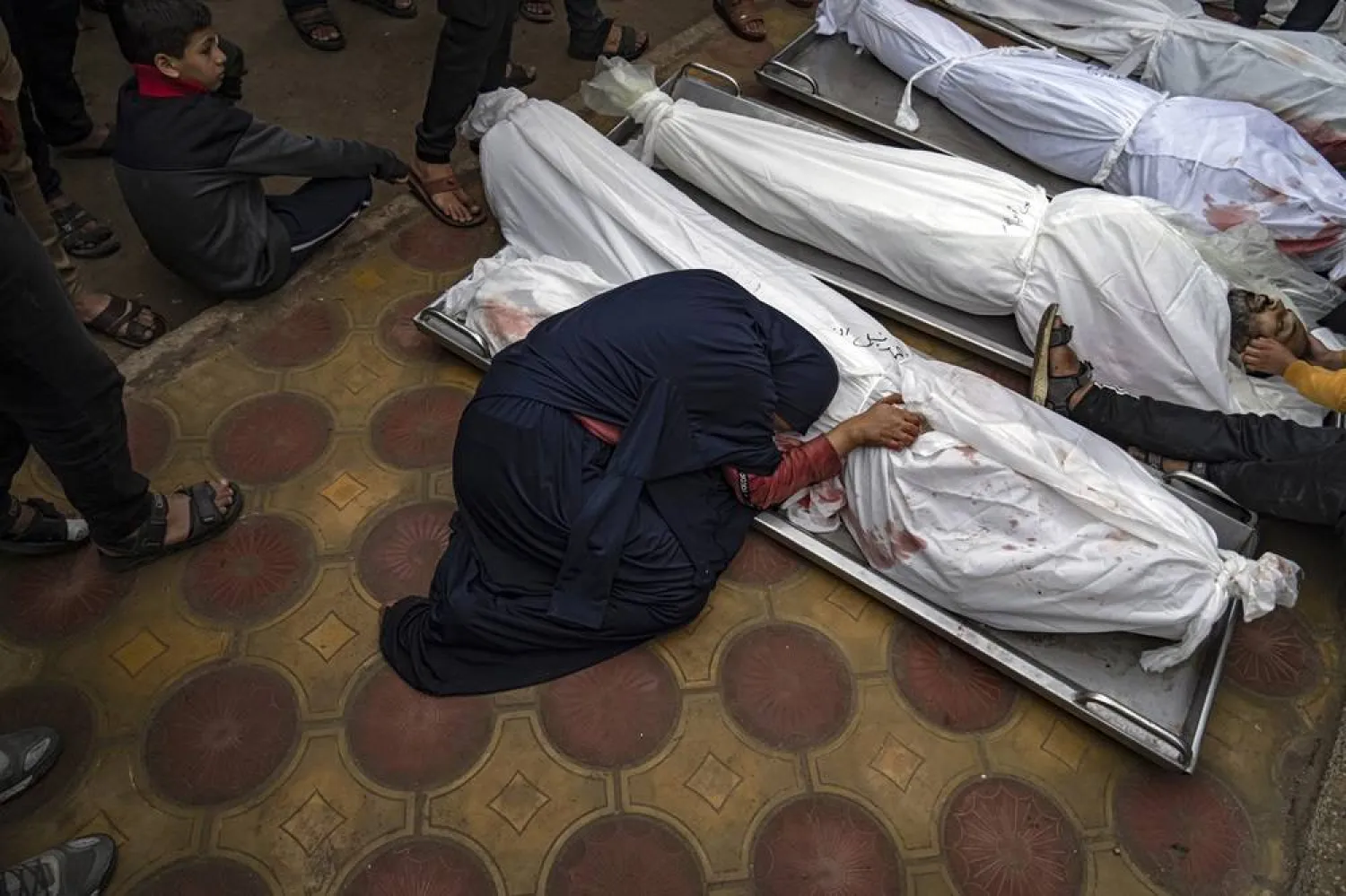
A woman mourns the covered bodies of her child and her husband killed in an Israeli army bombardment of the Gaza Strip, in the hospital in Khan Younis, Tuesday Dec. 5, 2023. (AP)
TT

More than 40,000 Palestinians Have Been Killed in Gaza, Territory’s Health Ministry Says

A woman mourns the covered bodies of her child and her husband killed in an Israeli army bombardment of the Gaza Strip, in the hospital in Khan Younis, Tuesday Dec. 5, 2023. (AP)

More than 40,000 Palestinians have been killed in the Israel-Hamas war in Gaza, the territory’s Health Ministry said Thursday.

Israel’s offensive has also wounded 92,401 people and displaced over 85% of the population from their homes, the ministry in Hamas-run Gaza said. It does not distinguish between civilians and militants in its toll.

The announcement came during yet another push from international mediators to broker a ceasefire in the war, now in its 11th month.

The conflict began Oct. 7 after Hamas-led fighters attacked southern Israel, killing some 1,200 people — most of them civilians — and dragging roughly 250 hostages to Gaza.

Israel says 111 of the captives have not been released, including the bodies of 39. The hostages include 15 women and two children under the age of 5.

In Gaza, health officials have struggled to fully identify the dead as bodies stream into overwhelmed hospitals and morgues where they say the count is compiled amid the chaos of war and displacement.

In its most recent detailed report on the dead, issued Thursday, the ministry said 40,005 people have been killed. Health officials and civil defense workers say the true toll is likely thousands higher, since many bodies remain buried under the rubble of buildings destroyed in airstrikes.

Israel’s air and ground offensive in Gaza has been one of the most devastating military campaigns in recent history.

The bombardment and shelling have killed entire Palestinian families. With cemeteries often unreachable, families fleeing Israeli airstrikes bury their dead wherever possible — in backyards, along roadsides and under the staircases of their homes.

Israel says it aims to eliminate Hamas. It blames Hamas for civilian deaths because fighters operate in civilian areas and have built extensive tunnel networks underneath them. Israeli forces have regularly targeted mosques, schools, hospitals and cemeteries where it claims fighters or tunnels are located, often causing civilian casualties.

The fighting has also killed 329 Israeli soldiers. The Israeli military claims around 15,000 Hamas fighters are among those killed in Gaza but has not provided evidence.

Nearly 85% of Gaza’s 2.3 million people have been driven from their homes, fleeing multiple times across the territory to escape ground offensives. During the war, thousands within Israel and in southern Lebanon have also been displaced.

The assault has created a massive humanitarian crisis in Gaza. The entire territory is at high risk of famine and over 495,000 people — more than a fifth of the population — are expected to experience the most severe level of hunger in the next months, according to the latest report by the leading authority on measuring hunger.

Sanitation systems have been destroyed, leaving pools of sewage and towers of garbage in tent camps packed with displaced families.

The offensive likely either damaged or destroyed 59% of all structures in Gaza by July 3, including 70% of buildings in north Gaza, according to an analysis of satellite data by Corey Scher and Jamon Van Den Hoek, experts in mapping damage during war.

The conflict has sparked fears of a wider regional war, with Lebanon’s Hezbollah and the Israeli military trading fire almost daily over their countries’ border.

More than 500 people have been killed on the Lebanese side, including some 350 Hezbollah members and 50 fighters from other armed groups, with the rest civilians. In Israel, 22 soldiers and 24 civilians have been killed.



Eight Killed in Israeli Strike on Lebanon’s Tyre

Smoke rises following an Israeli airstrike in the southern city of Tyre on June 9, 2026. (AFP)
TT

Eight Killed in Israeli Strike on Lebanon’s Tyre

Smoke rises following an Israeli airstrike in the southern city of Tyre on June 9, 2026. (AFP)

Israel struck the historic port city of Tyre in southern Lebanon on Tuesday, killing at least eight people, in an escalation that adds strain to efforts to broker a peace deal to end the wider Middle East war.

On Monday, Israel and Iran halted direct attacks on each other after an appeal by US President Donald Trump, but Tehran warned it would resume hostilities if Israel continued to attack its ally Hezbollah in Lebanon.

The raids were the deadliest on Tyre since fighting erupted in Lebanon in early March, when Hezbollah launched rockets at Israel in support of Tehran after Israel and the United States began their war against Iran.

Israel had issued an evacuation order for the city earlier on Tuesday.

Residents fled and civil defense teams transported elderly residents into temporary shelters, state media reported.

The eight victims were killed in a ‌single strike on ‌the city's eastern edge, Lebanon's health ministry said.

A video verified by Reuters showed debris strewn ‌across ⁠a road at the ⁠site of the attack.

Israel's refusal to end its campaign in Lebanon, as Iran demands, has hindered Trump's efforts to extend a tenuous ceasefire in the wider US-Israeli war with Iran into a durable settlement.

US and Israeli officials said Trump and Israeli Prime Minister Benjamin Netanyahu had spoken on Monday.

In an interview with Axios, Trump said he had warned the Israeli leader not to return to war with Iran: "I said, 'Bibi, you better be careful, or you will be on your own very soon.'"

Tehran has long said any peace deal with the US depends in part on an end to fighting in Lebanon, which Israel invaded in March in pursuit of Hezbollah fighters who had fired across the border.

In northern Israel on Tuesday, Israeli troops operating in the Ramim Ridge area close to Lebanon's border killed one person in an incident in which they returned fire, the military said.

Israel has never halted its Lebanon campaign, which has killed thousands of people, saying the conflict should be treated separately from any US-Iranian ceasefire. Hezbollah has also continued its attacks.


First War Crimes Complaint Against Sudan’s RSF Filed in Kenya

 Lawyers Antonio Mulvay, left, and Willis Otieno, center, who are part of the legal team filing a law suit against Sudan's Rapid Support Forces (RSF) on behalf of Sudanese torture victims, speak to the media in Nairobi, Tuesday June 9, 2026. (AP)
Lawyers Antonio Mulvay, left, and Willis Otieno, center, who are part of the legal team filing a law suit against Sudan's Rapid Support Forces (RSF) on behalf of Sudanese torture victims, speak to the media in Nairobi, Tuesday June 9, 2026. (AP)
TT

First War Crimes Complaint Against Sudan’s RSF Filed in Kenya

 Lawyers Antonio Mulvay, left, and Willis Otieno, center, who are part of the legal team filing a law suit against Sudan's Rapid Support Forces (RSF) on behalf of Sudanese torture victims, speak to the media in Nairobi, Tuesday June 9, 2026. (AP)
Lawyers Antonio Mulvay, left, and Willis Otieno, center, who are part of the legal team filing a law suit against Sudan's Rapid Support Forces (RSF) on behalf of Sudanese torture victims, speak to the media in Nairobi, Tuesday June 9, 2026. (AP)

Victims of alleged atrocities linked to the war in Sudan on Tuesday asked prosecutors in Kenya to investigate allegations of torture and sexual violence by members of a notorious paramilitary group.

It is the first attempt to prosecute members of the Rapid Support Forces, or RSF, the paramilitary group fighting against the Sudanese military for over three years, outside Sudan.

The group, which has been accused by rights organizations of committing atrocities amounting to war crimes and crimes against humanity, has ties with Kenya’s government, while Kenyan President William Ruto has previously hosted RSF leader Gen. Mohamed Hamdan Dagalo for talks that he said were aimed at advancing peace efforts in Sudan, a move that sparked diplomatic tensions.

The complaint filed by the Switzerland-based global legal organization Legal Action Worldwide details torture and sexual violence committed by RSF members at various locations in and around Khartoum between April 2023 and March 2025 when the Sudanese capital was controlled by the paramilitaries.

The 12 victims are urging Kenya’s Director of Public Prosecutions to approve charges against 10 members of the RSF, some of whom are believed to be residing in Kenya.

The Associated Press has contacted the RSF for a comment.

According to this latest complaint, the victims were held in inhumane conditions, with little or no food, limited access to water, and inadequate sanitation facilities. They allege that they were beaten, burned, suffocated, subjected to electric shocks, and sexually abused, including through rape. Some were reportedly forced to transport dead bodies from detention facilities.

Legal Action Worldwide founder Antonia Mulvey said Kenya should consider prosecuting the alleged crimes under the country’s International Crimes Act of 2008.

“For Kenya, despite the sensitivity of the matter, it is an opportunity to lead in the fight against impunity. Authorities can now demonstrate the strength of the country’s investigative, prosecutorial, and judicial institutions in addressing the most serious international crimes, regardless of where they are committed,” she said.

The RSF has been at war with the Sudanese military since April 2023, when tensions between the two sides erupted into open conflict in Khartoum and other parts of the country.

The group emerged from the notorious Janjaweed militias, which were accused of widespread atrocities in the early 2000s against communities identifying as East or Central African in Sudan’s western Darfur region.

The RSF has been accused by human rights organizations and the United Nations of committing atrocities during the conflict that may amount to war crimes and crimes against humanity, particularly in Darfur, where the group maintains a strong presence.

Mulvey argued that the victims are unlikely to obtain justice in Sudan because the country’s justice system is currently “inaccessible, unavailable, and ineffective.”

She said the International Criminal Court’s jurisdiction is limited to Darfur and does not extend to crimes committed in or around Khartoum.

Willis Otieno, a lawyer in Kenya who filed the complaint locally, said there was information suggesting that some of the persons of interest have links to Kenya and that the country possesses the legal framework necessary to investigate and prosecute such crimes.

Otieno described Kenya’s Office of the Director of Public Prosecutions as competent, adding: “We have faith that the office will act. For now, let’s treat them with that goodwill.”

The RSF has in the past been accused of mass killing, gang rape, and ethnicity-motivated crimes, most recently in October during an assault on the Darfur city of el-Fashir, in which over 6,000 people were killed in three days. UN-commissioned experts have described the offensive as bearing the “hallmarks of genocide.”

In one of its last decisions, the Biden administration accused the group of genocide and imposed sanctions of its commanders, including Dagalo.

The war killed at least 59,000 people over the course of three years, according to the Armed Conflict Location & Event Data Project, a US-based war tracking group which said the toll was almost certainly undercut given the difficulties in reporting.

The conflict has created the world’s largest humanitarian crisis, with about 34 million people — almost two out of every three Sudanese — need assistance, according to the UN.


Rival Palestinian Factions Discuss Gaza Disarmament

A Palestinian woman stands amid debris at the site of an Israeli airstrike in Khan Younis, southern Gaza Strip, on June 7, 2026. (AFP)
TT

Rival Palestinian Factions Discuss Gaza Disarmament

A Palestinian woman stands amid debris at the site of an Israeli airstrike in Khan Younis, southern Gaza Strip, on June 7, 2026. (AFP)

Members of Palestinian factions including Hamas agreed in principle for Gaza's armed groups to hand over parts of their arsenals to a yet-to-be-created, ad hoc Palestinian entity during talks in Cairo, Palestinian sources told AFP on Tuesday.

Such a proposal has almost no chance of being accepted by Israel, which demands a complete demilitarization of the Gaza Strip, starting with Palestinian movement Hamas.

Several of those who attended the Cairo talks that began on Saturday expressed hope the proposal would break a months-long deadlock on negotiations over Gaza's future.

The talks are being attended by most major factions, including Hamas and its ally Islamic Jihad, but not the Fatah party that dominates the Palestinian Authority.

On Tuesday, the factions discussed the details of the weapons handover to a new entity with representation from various Palestinian political currents, according to a source close to negotiations.

They rejected the idea of a full disarmament, as demanded by Israel, several sources who asked for anonymity said.

"Egypt and the mediators are working to formulate a new, acceptable formula that takes into account the factions' agreement," one of the participants told AFP.

Another Palestinian taking part in the talks told AFP that Egyptian and Qatari mediators welcomed this approach.

"Hamas is linking the weapons question to a full Israeli withdrawal from Gaza and to Gaza's reconstruction," one Palestinian political official said.

Senior Hamas official Taher al-Nunu told AFP that recent days had brought "significant progress", adding that the factions aimed to implement US President Donald Trump's peace plan for Gaza.

Israeli strikes have continued at an almost daily pace despite the ceasefire announced in October 2025 after two years of war, under Trump's phased peace plan.

Hamas and Israel blame each other for the current impasse, each accusing the other almost daily of violating the ceasefire.

Hamas accuses Israel of failing to honor its commitments, particularly on allowing humanitarian aid into Gaza, while Israel insists on the complete disarmament of the movement before any further implementation of the plan.

Hamas has repeatedly stated that it is not opposed to handing over some of its arsenal, but only as part of a Palestinian political process.

Former Hamas chief Khaled Meshaal also suggested a weapons "freeze" or "storage", which Israel rejected.