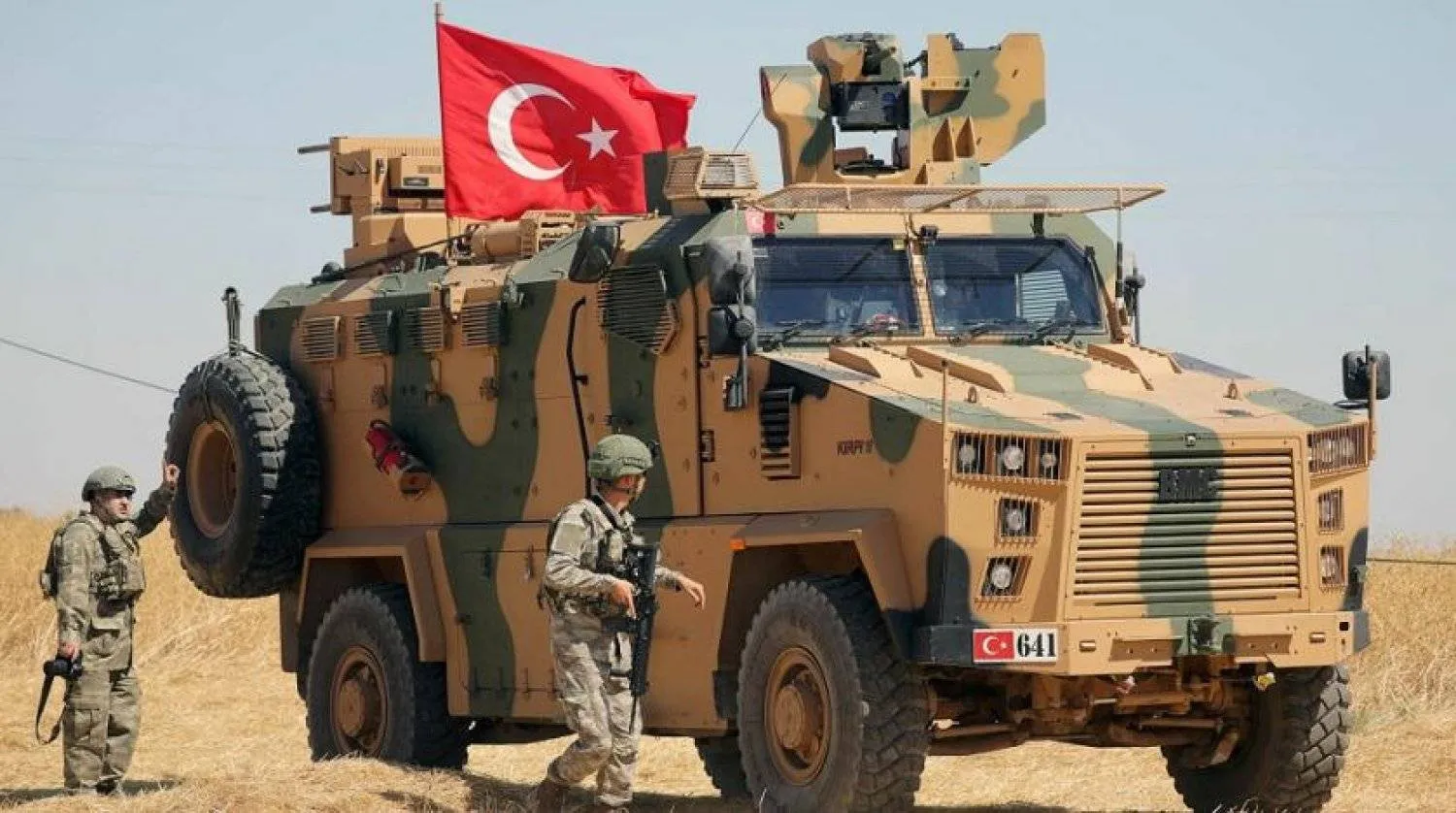
Türkiye, Russia Resume Joint Patrols in Northeast Syria, Turkish Ministry Says

A Turkish soldier walks next to a Turkish military vehicle during a joint US-Türkiye patrol near Tel Abyad, Syria. (Reuters file)
TT

Türkiye, Russia Resume Joint Patrols in Northeast Syria, Turkish Ministry Says

A Turkish soldier walks next to a Turkish military vehicle during a joint US-Türkiye patrol near Tel Abyad, Syria. (Reuters file)

Turkish and Russian troops in armored vehicles have resumed joint ground patrols in northeast Syria after operations were halted last year for security reasons, Türkiye’s defense ministry said on Friday.

The joint ground patrol was relaunched on Thursday into the east of the "Operation Peace Spring" zone in northeast Syria, involving four vehicles and 24 personnel, the statement said.

The ministry did not elaborate on the security issues that halted joint patrol operations in October last year. A total of 344 joint patrols had been conducted in the area since 2019, the ministry said.

In 2019, Türkiye and its Syrian opposition allies began military operations in northeast Syria, dubbed "Operation Peace Spring", aiming to drive back Kurdish-led Syrian Democratic Forces (SDF).

That year, Ankara and Moscow agreed to conduct joint patrols in the region under a deal struck by President Recep Tayyip Erdogan and Russian counterpart Vladimir Putin.

Joint ground patrols will continue in the near future to establish stability in northeast Syria, ensure security of Türkiye’s borders and demonstrate Turkish-Russian cooperation in the fight against terrorism, the defense ministry said.


Syrian Authorities Hold Onto Campaign to Root Out Illegal Enrichment

The head of Syria's committee for combating illicit enrichment, Basel Al-Suwaidan (Asharq Al-Awsat)
TT

Syrian Authorities Hold Onto Campaign to Root Out Illegal Enrichment

The head of Syria's committee for combating illicit enrichment, Basel Al-Suwaidan (Asharq Al-Awsat)

The head of Syria's committee for combating illicit enrichment, Basel Al-Suwaidan, has revealed that settlements reached with prominent businessmen accused of ties with former president Bashar Al-Assad had returned to the state treasury as assets belonging to the Syrian people.

In remarks to Asharq Al-Awsat, Al-Suwaidan said that the committee had received hundreds of voluntary disclosure requests, leading to many settlements, while others were rejected for not meeting the criteria.

"How does the committee define the limits of illicit gains?" Asharq Al-Awsat asked him. He explained that illicit enrichment is "a legal concept inherently tied to individuals, defined as any unjustified increase in financial wealth that is disproportionate to the owner's known legitimate resources, and for which they are unable to provide a legal and convincing explanation of its source."

This includes companies, real estate and stocks.

Al-Suwaidan said that despite the committee's work being linked to individuals, it adopts objective criteria for selecting cases. He stressed that accountability is based on financial evidence, not on position or status.

Syrian President Ahmed Al-Sharaa issued Presidential Decree No. 13 on May 4, 2025, concerning the formation of the committee to protect public funds, combat illicit gains in all its forms, and recover illegal funds.

On December 28, 2025, the committee launched the voluntary disclosure program for a period of six months, along with its official website, which includes services for reporting, voluntary disclosure, inquiries, and communication with the committee.

Al-Suwaidan clarified that the program represents one of the main tools adopted by the committee within its internal operating system, and it is an integral part of legal work, not an exceptional measure.

The program is defined as "a mechanism that allows individuals whose funds are linked to suspicions of illicit gains to voluntarily disclose them, subjecting them to comprehensive financial and legal scrutiny, leading to an organized settlement through which funds or assets to be recovered for the state are determined."

He noted that the adoption of this mechanism was based on UN recommendations.

According to Al-Suwaidan, past experiences have shown that relying exclusively on traditional judicial paths can be time-consuming, leading to asset freezes or loss, whereas voluntary disclosure allows for faster and more efficient recovery.

Syrian authorities reached in mid-April a settlement with Wassim Qattan and his brothers, as well as Naim Al-Jarrah, as part of the voluntary disclosure requests submitted to the committee.

A settlement has also been reached with businessman Samer Al-Foz. Another settlement involved businessman Tarif Al-Akhras, in line with adopted official procedures.

However, Mohammad Hamsho, who was a prominent businessman accused of ties to Assad's rule and of profiting from the country's war, was the first to reach a formal settlement with the Syrian authorities.

Al-Suwaidan stressed, however, that the voluntary disclosure program does not exonerate suspects. It rather works in parallel with the judicial path.

He explained to Asharq Al-Awsat that the primary goal is to reduce the time taken by litigation procedures and alleviate the burden on the Syrian judiciary.

Al-Suwaidan revealed that the number of cases undergoing examination is estimated in the thousands.


US Urges Meeting Between Lebanese President, Israeli PM

An explosion of what appears to be white phosphorus fired by the Israeli army on the Lebanese side of the Israel-Lebanon border as seen from the Israeli side of the border, April 30, 2026. (Reuters)
TT

US Urges Meeting Between Lebanese President, Israeli PM

An explosion of what appears to be white phosphorus fired by the Israeli army on the Lebanese side of the Israel-Lebanon border as seen from the Israeli side of the border, April 30, 2026. (Reuters)

The US embassy in Lebanon on Thursday urged a meeting between Lebanese and Israeli leaders as the health ministry said Israeli strikes on the country's south killed at least 17 people despite an ongoing ceasefire.

Israeli and Lebanese representatives this month have met twice in Washington -- the first such meetings in decades -- after Iran-backed Hezbollah group drew Lebanon into the Middle East war on March 2, sparking heavy Israeli strikes and a ground invasion.

After the first talks, US President Donald Trump announced a 10-day ceasefire in Lebanon that began on April 17, and a three-week extension after the second round.

Trump has said he hopes to host Lebanese President Joseph Aoun and Israeli Prime Minister Benjamin Netanyahu "over the next couple of weeks" as the two countries prepare for direct negotiations.

The planned negotiations have caused a rift in Lebanon, with Hezbollah rejecting direct negotiations as well as Beirut's previous commitment to disarm it.

"Lebanon stands at a crossroads. Its people have a historic opportunity to reclaim their country and shape their future as a truly sovereign, independent nation," the embassy said, adding that "the time for hesitation is over".

A direct meeting between Aoun and Netanyahu, "facilitated by President Trump, would give Lebanon the chance to secure concrete guarantees on full sovereignty, territorial integrity, secure borders, humanitarian and reconstruction support, and the complete restoration of Lebanese state authority over every inch of its territory -- guaranteed by the United States," the statement added.

- 'Violations' -

On Wednesday, Aoun said Israel "must first fully implement the ceasefire in order to move on to negotiations... Israeli attacks cannot continue as they are."

"We are now waiting for the United States to set a date to begin direct negotiations" with Israel, he said.

Israel has kept up deadly strikes on Lebanon despite the truce, and its soldiers are operating inside a "Yellow Line" running some 10 kilometers (six miles) deep inside Lebanon along the border.

Lebanon's health ministry said Israeli strikes in the south killed 17 people on Thursday, including five women and two children, while the army said another strike killed one of its soldiers.

Israel's army also said one of its soldiers had been killed in south Lebanon.

Aoun on Thursday slammed "continuing Israeli violations" in the country's south.

Speaking to a delegation from the International Federation of Red Cross and Red Crescent Societies, he said these were occurring "despite the ceasefire, as do demolitions of homes and places of worship, while the number of killed and wounded rises".

"Pressure must be exerted on Israel to ensure it respects international laws and conventions and ceases targeting civilians, paramedics, civil defense, and humanitarian health and relief organizations," Aoun said, on a day when three civil defense personnel killed by Israel were buried.

- 'Will not surrender' -

The NNA reported multiple Israeli airstrikes on southern Lebanon on Thursday, while an Israeli army spokesperson called for the evacuation of more than 20 southern villages.

Hezbollah claimed 10 attacks on Israeli army targets in south Lebanon, including tanks and soldiers.

In Beirut, dozens of southern Lebanon residents and local officials gathered to protest Israel's ongoing destruction of their villages.

Protester Hanaa Ibrahim, 48, told AFP that "we will not surrender and will not normalize" relations with Israel.

The text of the ceasefire, published by the US State Department, grants Israel the right to act against "planned, imminent or ongoing attacks".

Hezbollah rejects that language, saying it was never presented to Lebanon's cabinet, in which members of the group are represented.

On Wednesday, Aoun had said the wording "is the same text that was adopted in November 2024" as part of the ceasefire agreement ending the last war, adding that "all parties" at the time had agreed to the text.

Parliament speaker Nabih Berri, a Hezbollah ally, called Aoun's remarks "inaccurate, to say the least, and this also applies to the November 2024 agreement".


Evacuation Warnings Expand South Lebanon ‘Red Zone’, Strikes Raise Toll

Residents from southern Lebanon hold signs bearing the names of their occupied towns and those at risk of Israeli destruction during a sit-in in Martyrs’ Square in central Beirut (AFP)
TT

Evacuation Warnings Expand South Lebanon ‘Red Zone’, Strikes Raise Toll

Residents from southern Lebanon hold signs bearing the names of their occupied towns and those at risk of Israeli destruction during a sit-in in Martyrs’ Square in central Beirut (AFP)

Israel has expanded the scope of the “red zone” in southern Lebanon to areas about 22 kilometers from the border in Tyre and Nabatieh, issuing successive evacuation warnings covering more than 20 towns.

The warnings triggered a new wave of displacement toward the city of Sidon, before Israel followed them with a series of intensive strikes that raised the human toll and widened the scale of destruction, while imposing a new field reality beyond the limits of the “yellow line.”

Successive warnings and geographic expansion

The Israeli army on Thursday issued a series of urgent warnings ordering residents of southern towns to evacuate immediately. The warnings came in two stages and included villages in Tyre and Nabatieh, reflecting a clear expansion of the area of operations.

The first warning included the towns of al-Samaaiyeh, al-Hinniyeh, al-Qlayleh, Wadi Jilo, al-Kaniseh, Kafra, Majdal Zoun and Siddiqin, before these areas were directly hit after the warning.

In a second warning, the Israeli army expanded the alerts to include Jebchit, Habboush, Harouf, Kfar Jouz, Nabatieh al-Fawqa, Abba, Adchit al-Shqif, Arab Salim, Toul, Houmine al-Fawqa, in Nabatieh district, as well as al-Majadel, Arzoun, Dounine, al-Hamiri and Maaroub, in Tyre district.

Israeli army spokesperson Avichay Adraee called on residents to move at least 1,000 meters away.

Southern Lebanese sources told Asharq Al-Awsat that an expanded “red zone” had emerged alongside the “yellow line,” stretching to the outskirts of Nabatieh across an area more than 35 kilometers wide and extending about 25 kilometers into Lebanese territory.

The zone includes dozens of villages now exposed to shelling or evacuation warnings, triggering large waves of displacement.

The road from the south toward Sidon and Beirut witnessed a new wave of displacement, especially from Nabatieh and its surroundings, after Adraee’s latest threat.

Strikes accompany warnings

The warnings were accompanied by direct strikes, with raids targeting several of the towns included in them. A drone also struck a motorcycle in the town of al-Shahabiyeh, killing two people and wounding one, while warplanes raided the Al Hamza neighborhood between Nabatieh al-Fawqa and Kfar Rumman.

Israeli forces carried out a dawn explosion in the town of Khiam, as raids continued on several areas, including Toulin and al-Jmayjmeh. Shelling also hit Safad al-Batikh, Zebqine, Jabal al-Batm, Qabrikha and Khirbet Selm.

In Bint Jbeil, explosions hit homes and infrastructure in the Khallet al-Mashta area, while a raid destroyed a heritage house in Nabatieh al-Fawqa that was more than 100 years old. A strike on Batouliyeh also destroyed the water station, halting water pumping to residents.

High human toll

Figures showed that 42 people were killed in 24 hours, raising the number of casualties since March 2 to 2,576 dead and 7,962 wounded.

In a detailed toll, the Health Emergency Operations Center said nine people were killed, including two children and five women, and 23 were wounded, including eight children and seven women.

Seven people were also killed in a raid that targeted the town of Zebdine, as strikes continued on villages in Nabatieh.

Civil defense teams resumed search operations in the town of Jouaya for missing people after retrieving five bodies, while a house in al-Hinniyeh collapsed on its residents amid difficulties for rescue teams trying to reach the site.

Israeli warplanes also broke the sound barrier over the Bekaa region, causing a loud boom in the afternoon.

Drone escalation on both sides

Hezbollah, meanwhile, said it targeted four Merkava tanks in Bint Jbeil and Qantara with attack drones, saying they scored direct hits. It also said it targeted artillery south of the town of Yarine.

The group said it downed an Israeli Hermes 450 drone with a surface-to-air missile over Nabatieh airspace, which the Israeli army acknowledged.

The Israeli army said 12 soldiers were wounded after a military vehicle was targeted by an attack drone in Shomera. It said it had carried out operations against Hezbollah members and dismantled rocket-launching sites.

No real ceasefire

On the ground, Israeli army Chief of Staff Eyal Zamir said during a tour near Taybeh that Israeli forces would remain positioned at the “yellow line” and would not withdraw before ensuring the security of northern settlements.

He stressed that “there is no ceasefire on the fighting front.”

Israel’s public broadcaster reported a discussion between US President Donald Trump and Israeli Prime Minister Benjamin Netanyahu, in which Trump called for more caution in operations inside Lebanon, warning that targeting buildings harms Israel’s image internationally.

It pointed to efforts to prevent the collapse of the ceasefire over the next two weeks, while Israel requested a time frame for negotiations until mid-May, considering that Hezbollah is the problem, and ending Iran’s influence could open the door to Lebanon’s stability.