Türkiye, Russia Resume Joint Patrols in Northern Syria as Ankara Seeks to Mend Ties with Assad

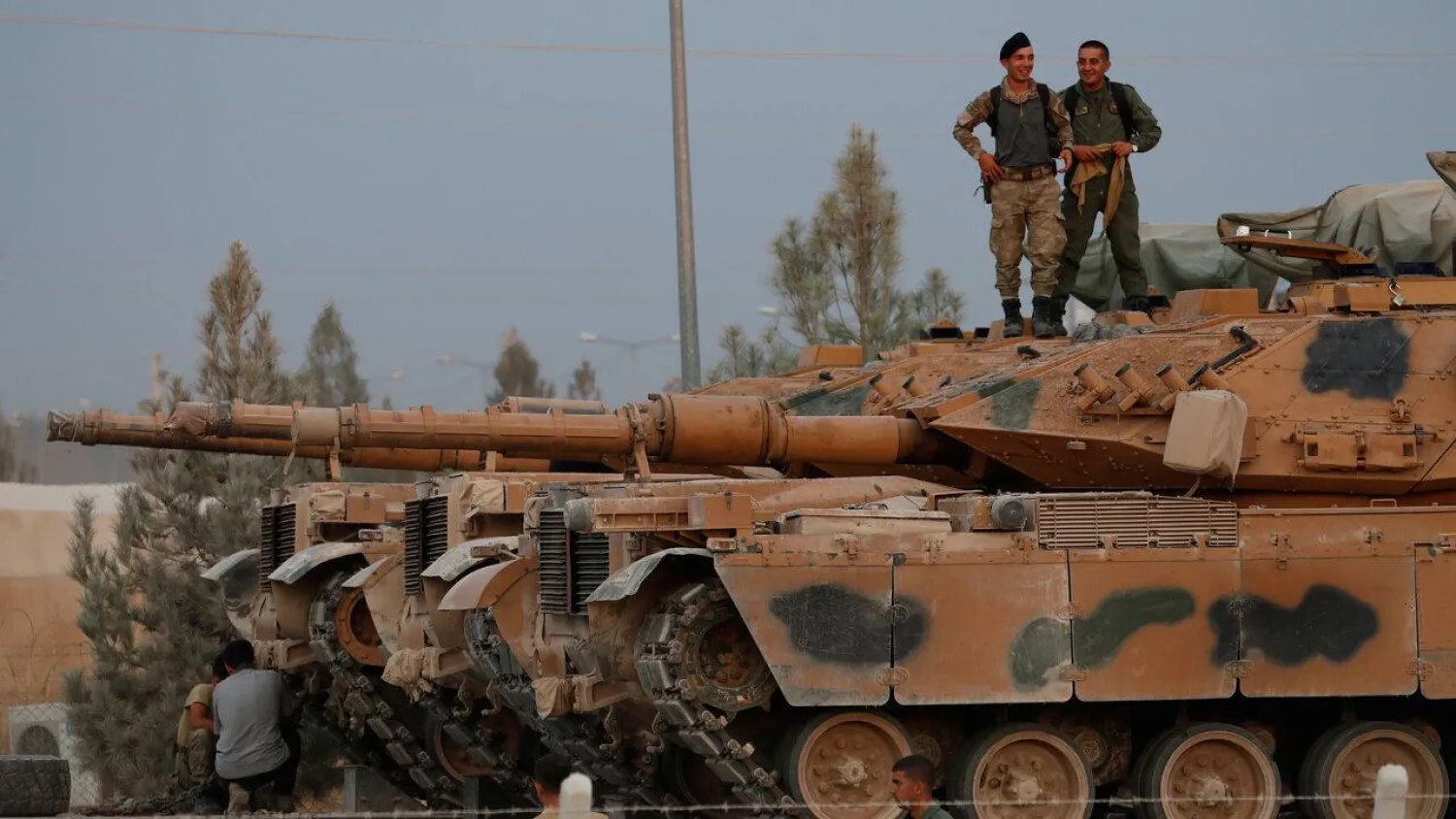
Turkish soldiers stand on top of a tank in the border town of Akcakale in Sanliurfa province, Türkiye, Oct. 11, 2019. (Reuters)
TT

Türkiye, Russia Resume Joint Patrols in Northern Syria as Ankara Seeks to Mend Ties with Assad

Turkish soldiers stand on top of a tank in the border town of Akcakale in Sanliurfa province, Türkiye, Oct. 11, 2019. (Reuters)

Türkiye and Russia have resumed joint military patrols in northern Syria after nearly a year's break, the Turkish Defense Ministry announced Saturday.

Combined patrols began in the Operation Peace Spring area, the statement said, referring to a 30-kilometer (19-mile) -deep strip of land on the Syrian side of the Türkiye-Syria border between Tal Abyad and Ras al-Ayn. The territory was captured from Kurdish fighters by Turkish and allied Syrian forces in 2019.

The renewed Turkish-Russian patrols come as Ankara is trying to repair its relations with Syrian President Bashar Assad, whose regime draws support from Moscow.

Assad has said he will only meet Turkish President Recep Tayyip Erdogan to discuss the withdrawal of Turkish troops from Syria and an end to Ankara’s support for Syrian fighters that Damascus considers terrorists.

Turkish and Russian soldiers first began joint operations in the area in November 2019, conducting 344 patrols until October last year, when they were suspended, the ministry said.

Some 24 Turkish personnel in four vehicles took part in the first resumed patrol on Thursday at the eastern end of the Operation Peace Spring area.

“It is planned to continue the United Land Patrol ... to ensure the security of our country’s borders and the civilian population in the region (and) to establish stability in northern Syria,” the ministry said in its statement.

The operation would also identify “checkpoints, headquarters and military structures” of Kurdish fighters from the People’s Protection Units (YPG).

Türkiye considers the YPG a terrorist organization due to its links to the PKK, which has fought a 40-year insurgency against Ankara, leading to tens of thousands of deaths.

The United States, however, partnered with the YPG in 2014 to fight the ISIS group in Syria and continues to support the Kurdish fighters under the umbrella of the Syrian Democratic Forces. The relationship has led to tensions between NATO allies Türkiye and the US.


Sudanese Paramilitary Forces Kill at Least 28 People in an Attack in Darfur

FILE PHOTO: Displaced people ride a an animal-drawn cart, following Rapid Support Forces (RSF) attacks on Zamzam displacement camp, in the town of Tawila, North Darfur, Sudan April 15, 2025. REUTERS/Stringer/File Photo
TT

Sudanese Paramilitary Forces Kill at Least 28 People in an Attack in Darfur

FILE PHOTO: Displaced people ride a an animal-drawn cart, following Rapid Support Forces (RSF) attacks on Zamzam displacement camp, in the town of Tawila, North Darfur, Sudan April 15, 2025. REUTERS/Stringer/File Photo

An attack by the Sudanese paramilitary forces on a stronghold of a Darfur tribal leader left at least 28 people dead, a doctors group said on Tuesday.

The paramilitary Rapid Support Forces on Monday rampaged through the town of Misteriha in North Darfur province, according to the Sudan Doctors Network, which tracks the country’s ongoing war.

The town is a stronghold of tribal leader Musa Hilal who also hails from the Rizeigat tribe as the majority of the members of the paramilitary RSF.

At least 39 people, including 10 women, were wounded in the attack, the medical group said.

Sudan’s war erupted in 2023 after tensions between the Sudanese army and the rival RSF escalated into fighting that began in Khartoum and spread nationwide, killing thousands, triggering mass displacement, disease outbreaks, and severe food insecurity. Aid workers were frequently targeted.


Hamas Calls for Sanctions Against Israel Over New West Bank Moves 

A drone view shows Kedar Sheep farm, an Israeli outpost in the Israeli-occupied West Bank, January 20, 2026. (Reuters)
TT

Hamas Calls for Sanctions Against Israel Over New West Bank Moves 

A drone view shows Kedar Sheep farm, an Israeli outpost in the Israeli-occupied West Bank, January 20, 2026. (Reuters)

Hamas on Tuesday called for sanctions against Israel, welcoming a joint condemnation by nearly 20 countries of new Israeli measures aimed at tightening control over the occupied West Bank.

Israel has approved a series of initiatives this month backed by far-right ministers, including launching a process to register land in the West Bank as "state property" and allowing Israelis to purchase land there directly.

Late on Monday, 18 countries including Saudi Arabia, Egypt, and European powers France and Spain, slammed Israel over the recent moves.

They "are part of a clear trajectory that aims to change the reality on the ground and to advance unacceptable de facto annexation", the countries said.

"Such actions are a deliberate and direct attack on the viability of the Palestinian state and the implementation of the two-state solution."

Hamas hailed the condemnation as "a step in the right direction in confronting the occupation's expansionist plans, which flagrantly violate international law and relevant UN resolutions".

The group in a statement urged the countries involved "to impose deterrent sanctions and exert pressure on the fascist occupation government to halt its policies aimed at entrenching annexation, colonial settlement and forced displacement".

It said the Israeli measures were part of ongoing "aggression" against Palestinians in the West Bank and Gaza.

In addition to roughly three million Palestinians, more than 500,000 Israelis live in settlements and outposts in the West Bank, which are considered illegal under international law.

Israel's current government has accelerated settlement expansion, approving a record 54 settlements in 2025, according to activists.

The West Bank, which Israel has occupied since 1967, is envisioned as the core of a future Palestinian state, but many on Israel's religious right view it as part of Israel's historic homeland.


Israel Seeking Direct Military Coordination with Lebanon 

Lebanese soldiers and UNIFIL forces on patrol in Naqoura southern Lebanon. (Reuters file)
TT

Israel Seeking Direct Military Coordination with Lebanon 

Lebanese soldiers and UNIFIL forces on patrol in Naqoura southern Lebanon. (Reuters file)

Israel is seeking to alter the post-ceasefire coordination mechanism along the Lebanese border by establishing direct contact with the Lebanese army, bypassing the United Nations peacekeeping force deployed in the south, said Israeli media.

The proposal has reignited debate in Beirut over the future of UN Security Council Resolution 1701 and the role of international oversight in southern Lebanon, with Lebanese officials insisting that any modification must remain strictly within the United Nations framework.

Reports attributed to Israel’s security establishment say the United Nations Interim Force in Lebanon (UNIFIL) has recently adopted what Israeli officials describe as a “confrontational stance” toward the Israeli military.

Israeli media quoted officials as telling American counterparts that direct coordination between the Israeli military and the Lebanese army would be preferable to the current arrangement, which operates through UNIFIL. Some officials reportedly argued that the peacekeeping force now causes “more harm than benefit.”

The Israeli Public Broadcasting Corporation said Israel’s security establishment believes UNIFIL has grown increasingly “hostile” in recent weeks.

The force’s mandate in southern Lebanon is due to expire at the end of this year.

Lebanese officials have responded by underscoring that the country’s position remains anchored in international legality and UN authority.

Fadi Alame, head of the Foreign Affairs and Immigrants Committee in Lebanon’s parliament, said Israeli media discussions “do not bind Lebanon,” stressing that “Lebanon’s sole reference remains the international resolutions issued by the United Nations.”

Speaking to Asharq Al-Awsat, Alame reiterated Lebanon’s commitment to Resolution 1701 and expressed support for UNIFIL.

He said the force monitors implementation of the resolution and safeguards Lebanon’s rights and sovereignty within the UN framework.

“As long as there is a UN resolution in force, any amendment or termination must occur through the United Nations itself,” he stated. “International law requires an international monitoring body as long as the resolution remains in effect.”

Addressing speculation about replacing UNIFIL or shifting to direct coordination with the Lebanese army, Alame said Beirut’s official stance remains unchanged.

“Lebanon is committed to Resolution 1701 under a clear government decision,” he underlined. “For us, Resolution 1701 and other UN resolutions remain the foundation.”

He added that Lebanon is awaiting a report from the UN secretary-general in June that is expected to outline potential options. These could range from maintaining the current international force to introducing a European-led presence or increasing the number of international observers.

Any proposal, he stressed, would remain subject to UN approval.

Meanwhile, a Lebanese ministerial source told Asharq Al-Awsat that Israel’s proposal for direct coordination without UNIFIL “raises questions,” noting that the peacekeeping force is already embedded in the existing tripartite coordination mechanism.

Communication with Israel is conducted through UNIFIL under an established framework, the source explained, adding that Lebanon insists on maintaining an international sponsor and monitoring body as long as Resolution 1701 has not been fully implemented.

European proposals remain under discussion, including the possibility of a European-led force under French supervision or a mission focused on training and equipping the Lebanese army to assume expanded responsibilities. However, these ideas have yet to crystallize and remain tied to future political and security developments.

The debate follows a UN Security Council decision in August 2025 to extend UNIFIL’s mandate until December 31, 2026, with a coordinated drawdown planned to begin the following year.

UNIFIL has been deployed in southern Lebanon since 1978. It serves as a monitoring and buffer force, overseeing implementation of Resolution 1701 and supporting the Lebanese army’s deployment south of the Litani River.