

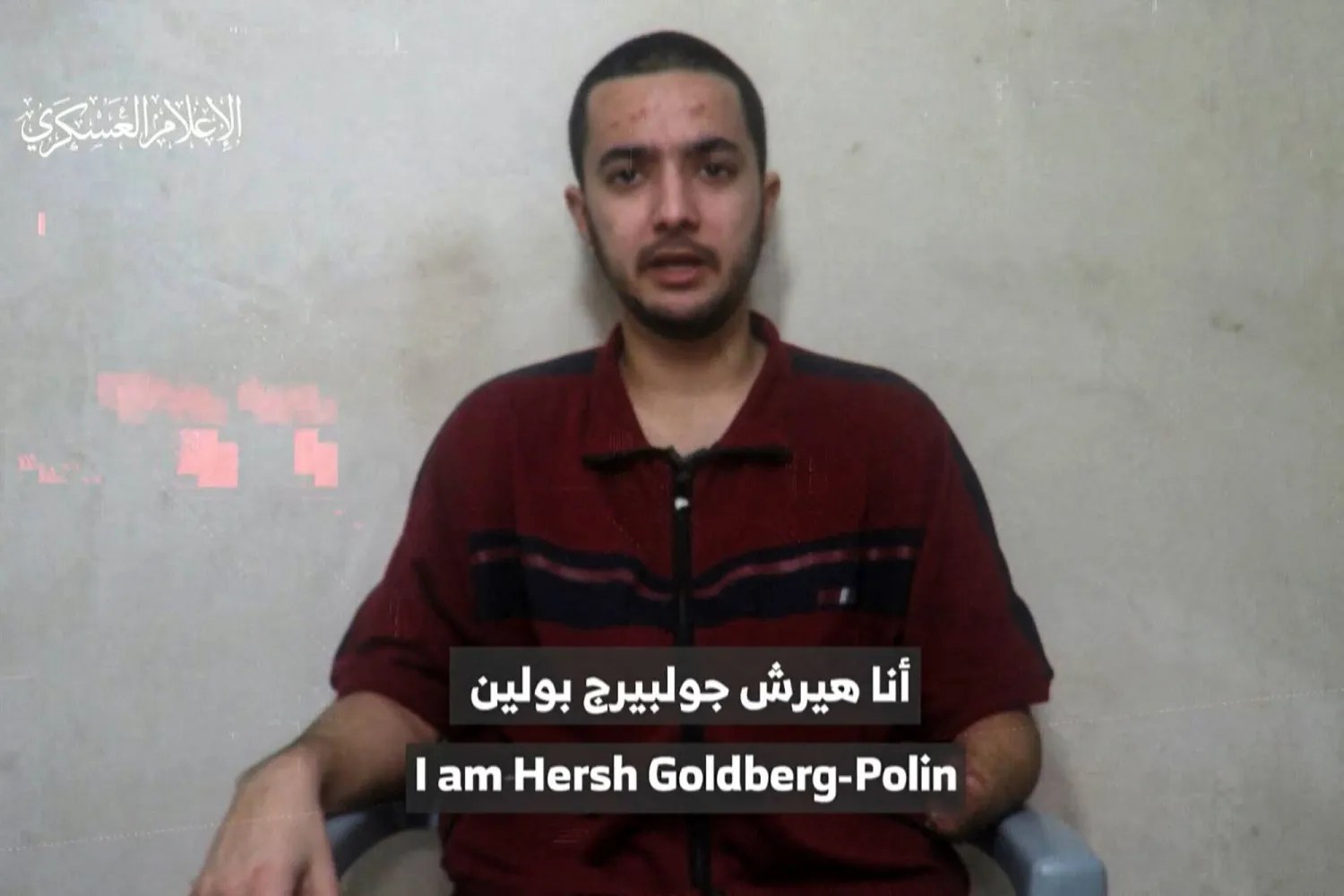

Israel Recovers the Bodies of 6 Hostages in Gaza, Including Israeli-American Hersh Goldberg-Polin

(FILES) An image grab from a video released by the media office of the Palestinian group Hamas on April 24, 2024, shows an Israeli-American man who identified himself as Hersh Goldberg-Polin, 23, one of the hostages abducted from the Nova music festival in southern Israel during the Hamas attack on October 7, 2023, speaking to a camera. (Photo by Hamas Media Office / various sources / AFP)
TT

Israel Recovers the Bodies of 6 Hostages in Gaza, Including Israeli-American Hersh Goldberg-Polin

(FILES) An image grab from a video released by the media office of the Palestinian group Hamas on April 24, 2024, shows an Israeli-American man who identified himself as Hersh Goldberg-Polin, 23, one of the hostages abducted from the Nova music festival in southern Israel during the Hamas attack on October 7, 2023, speaking to a camera. (Photo by Hamas Media Office / various sources / AFP)

Israel on Sunday said it had recovered the bodies of six hostages in Gaza, including a young Israeli-American man who became one of the most well-known captives held by Hamas as his parents met with world leaders and pressed for his release.

The military said all six had been killed shortly before the arrival of Israeli forces. Their recovery sparked calls for mass protests against Prime Minister Benjamin Netanyahu, whom many Israelis blame for failing to bring them back alive in a deal with Hamas to end the 10-month-old war. Negotiations over such a deal have dragged on for months.

Netanyahu said Israel would hold Hamas accountable for killing the hostages in "cold blood," and blamed the group for the stalled negotiations, saying "whoever murders hostages doesn’t want a deal."

Fighters seized Hersh Goldberg-Polin, 23, and four of the other hostages at a music festival in southern Israel during Hamas' Oct. 7 attack, which triggered the war.

The native of Berkeley, California, lost part of his left arm to a grenade in the attack. In April, a Hamas-issued video showed him alive but with his left hand missing, sparking new protests in Israel urging the government to do more to secure the hostages' release.

The army identified the other dead hostages as Ori Danino, 25; Eden Yerushalmi, 24; Almog Sarusi, 27; and Alexander Lobanov, 33; who were also taken from the music festival. The sixth, Carmel Gat, 40, was abducted from the nearby farming community of Be'eri.

It said the bodies were recovered from a tunnel in the southern Gaza city of Rafah, around a kilometer (half a mile) from where another hostage, Qaid Farhan Alkadi, 52, was rescued alive last week.

Lt. Col. Nadav Shoshani, a military spokesperson, said the army believed there were hostages in the area but had no specific intelligence. He said Israeli forces found the bodies several dozen meters (yards) underground as "ongoing combat" was underway, but that there was no firefight in the tunnel itself.

He said there was no doubt that Hamas had killed them.

Hamas has offered to release the hostages in return for an end to the war, the withdrawal of Israeli forces and the release of a large number of Palestinian prisoners, including high-profile militants.

Izzat al-Rishq, a senior Hamas official, said the hostages would still be alive if Israel had accepted a US- backed ceasefire proposal that Hamas said it had agreed to back in July.

Families of hostages call for a "complete halt of the country" Netanyahu has vowed to continue the war until Hamas is destroyed and says military pressure is needed to bring home the hostages.

Israel's Channel 12 reported that he got into a shouting match at a security Cabinet meeting late Thursday with his defense minister, Yoav Gallant, who accused him of prioritizing control of a strategic corridor along the Gaza-Egypt border — a major sticking point in the talks — over the lives of the hostages.  

The Cabinet reportedly voted in favor of remaining in the corridor over the objections of Gallant, who said it would prevent a hostage deal.

An Israeli official confirmed the report and said three of the hostages — Goldberg-Polin, Yerushalmi and Gat — had been slated to be released in the first phase of a ceasefire proposal discussed back in July. The official was not authorized to brief media about the negotiations and spoke on condition of anonymity.

"In the name of the state of Israel, I hold their families close to my heart and ask forgiveness," Gallant said Sunday after the remains were recovered. He later called for the Cabinet to reverse its decision.

A forum of hostage families called for a massive protest on Sunday, demanding a "complete halt of the country" to push for the implementation of a ceasefire and hostage release.

"A deal for the return of the hostages has been on the table for over two months. Were it not for the delays, sabotage, and excuses those whose deaths we learned about this morning would likely still be alive," it said in a statement.

US President Joe Biden, who has met with Goldberg-Polin's parents, said he was "devastated and outraged."

"It is as tragic as it is reprehensible," he said. "Make no mistake, Hamas leaders will pay for these crimes. And we will keep working around the clock for a deal to secure the release of the remaining hostages."

Vice President Kamala Harris said her prayers were with the Goldberg-Polin family and condemned Hamas.

A high-profile campaign Goldberg-Polin’s parents, US-born immigrants to Israel, became perhaps the most high-profile relatives of hostages on the international stage. They met with Biden, Pope Francis and others and addressed the United Nations, urging the release of all hostages.

On Aug. 21, his parents addressed a hushed hall at the Democratic National Convention — after sustained applause and chants of "bring him home."

"This is a political convention. But needing our only son — and all of the cherished hostages — home is not a political issue. It is a humanitarian issue," said his father, Jon Polin. His mother, Rachel, who bowed her head during the ovation and touched her chest, said "Hersh, if you can hear us, we love you, stay strong, survive."

She and her husband sought to keep their son and the others held from being reduced to numbers, describing Hersh as a music and soccer lover and traveler with plans to attend university since his military service had ended.

Some 250 hostages were taken on Oct. 7. Israel now believes that 101 remain in captivity, including 35 who are believed to be dead. More than 100 were freed during a weeklong ceasefire in November in exchange for the release of Palestinians imprisoned by Israel. Eight have been rescued by Israeli forces.

Two previous Israeli operations to free hostages killed scores of Palestinians. Hamas says several hostages have been killed in Israeli airstrikes and failed rescue attempts. Israeli troops mistakenly killed three Israelis who escaped captivity in December.

Hamas-led fighters killed some 1,200 people, mostly civilians, when they stormed into southern Israel on Oct. 7, attacking army bases and several farming communities.

Israel's retaliatory offensive in Gaza has killed over 40,000 Palestinians, according to local health officials, who do not say how many were fighters. It has displaced the vast majority of Gaza's 2.3 million people, often multiple times, and plunged the besieged territory into a humanitarian catastrophe.

In a separate development Sunday, Palestinian militants killed three Israeli police officers when they opened fire on their vehicle in the West Bank, according to Israeli officials. Israel has been carrying out large-scale military raids across the occupied territory in recent days.



Airstrikes on Iraq’s PMF Site Kill 14 Including Anbar Commander

 A billboard displays an image depicting a US Air Force airplane in flames, the name of the Iraqi deputy PMF leader Abu Mahdi al-Muhandis who was killed in a US strike in 2020, and words that read in Arabic, "They will no longer have safety. By God, we will not spare them", in Baghdad, Iraq, Monday, March 23, 2026. (AP)
A billboard displays an image depicting a US Air Force airplane in flames, the name of the Iraqi deputy PMF leader Abu Mahdi al-Muhandis who was killed in a US strike in 2020, and words that read in Arabic, "They will no longer have safety. By God, we will not spare them", in Baghdad, Iraq, Monday, March 23, 2026. (AP)
TT

Airstrikes on Iraq’s PMF Site Kill 14 Including Anbar Commander

 A billboard displays an image depicting a US Air Force airplane in flames, the name of the Iraqi deputy PMF leader Abu Mahdi al-Muhandis who was killed in a US strike in 2020, and words that read in Arabic, "They will no longer have safety. By God, we will not spare them", in Baghdad, Iraq, Monday, March 23, 2026. (AP)
A billboard displays an image depicting a US Air Force airplane in flames, the name of the Iraqi deputy PMF leader Abu Mahdi al-Muhandis who was killed in a US strike in 2020, and words that read in Arabic, "They will no longer have safety. By God, we will not spare them", in Baghdad, Iraq, Monday, March 23, 2026. (AP)

Airstrikes targeting a site belonging to Iraq's Shiite Popular Mobilization Forces in the western province of Anbar killed at least 14 fighters, including the PMF's Anbar operations commander, and wounded 30 others overnight, security and health sources told Reuters early on Tuesday.

The PMF confirmed in a statement the death of its Anbar commander, Saad al-Baiji, ‌and several ‌of his companions. It accused the ‌United ⁠States of carrying ⁠out the attack, saying a US airstrike targeted a command headquarters while personnel were on duty.

The strikes targeted the PMF headquarters during a security meeting attended by senior commanders, the sources added.

The PMF is an umbrella group of ‌mostly Shiite paramilitary ‌factions that was formally integrated into Iraq's state security forces ‌and includes several groups aligned with Iran.

Separately, ‌at least six Kurdish Peshmerga fighters were killed and 22 wounded in an overnight rocket attack on their base north of Erbil in Iraqi Kurdistan, security ‌and Peshmerga sources said, adding that it was not immediately clear who carried ⁠out ⁠the attack.

Tehran-backed armed groups have launched attacks on US bases in Iraq since the outbreak of the US-Israeli war on Iran in February, raising fears of a wider regional escalation.

The conflict has spilled beyond Iran's borders, with Tehran launching strikes on Israel and Gulf Arab states hosting US military installations, while Israel has carried out attacks in Lebanon following cross-border fire by Iran-aligned Hezbollah.


Hezbollah Escalates its Rhetoric, Threatens Lebanese Govt

23 March 2026, Lebanon, Chaat: A Hezbollah flag is seen fixed to the debris after an Israeli airstrike that targeted a residential home in Chaat. (dpa)
TT

Hezbollah Escalates its Rhetoric, Threatens Lebanese Govt

23 March 2026, Lebanon, Chaat: A Hezbollah flag is seen fixed to the debris after an Israeli airstrike that targeted a residential home in Chaat. (dpa)

Leading Hezbollah officials decided to escalate their rhetoric against the Lebanese government, threatening to take new political approaches after the war, even as its fighters battle Israeli troops on the ground.

The Iran-backed party has decided to effectively open a new battle in Lebanon, this time against the government and the political authority.

Mahmoud Qamati, deputy head of Hezbollah's political council, said last week: “A confrontation with the political authority is inevitable after the war.”

“Hezbollah is capable of turning the country and government upside down. The party’s patience has limits, and the traitors will pay for their betrayal,” he declared.

The government has slammed Hezbollah for dragging Lebanon to a new war with Israel and banned the group’s military operations. It has also expressed readiness for Lebanon to engage with negotiations with Israel to end the war.

Hezbollah political council member Wafiq Safa echoed Qamati’s remarks, saying the party will force the government to retract its decision to ban its military operations, “regardless of the way it will do so.”

At the moment, the party will not topple the government in the streets, but it has a “new agenda” that it will implement after the war, including street action, he said.

Hezbollah opponents dismissed the threats, saying the party was resorting to such rhetoric to rally its supporters after witnessing their displacement from the war, as well as the destruction of their homes and the mounting death toll.

Change MP Mark Daou told Asharq Al-Awsat: “Hezbollah is in the heart of the battle. It will try to escalate its positions to rally its supporters given their humanitarian plight and the party’s own failure in offering the displaced any real assistance.”

The Hezbollah leadership instructed its officials to “stir debates that are fodder for the media that would portray the party as coming under attack and so as the garner the public’s support,” he explained.

“Hezbollah is suffering from successive setbacks. The decisions taken by the government since 2024 until now are mounting against it,” he remarked.

“The party’s weapons are no longer legal and its allies have distanced themselves from it,” he added. It has also lost its ally, the Syrian regime, and its main backer Iran is under attack by the US and Israel.

“Hezbollah therefore has to protect itself by resorting to stoking sectarian tensions inside Lebanon,” Daou noted.

As for the post-war phase, that is up to the state to manage, such as reconstruction, protecting the people and addressing the affairs of the displaced, said the MP.

“The state will decide what will happen after the war. The Lebanese army also has a major responsibility to secure the situation in Lebanon and stop Hezbollah’s military operations so that the state can have control over decisions of war and peace,” he remarked.

Jad Al-Akhaoui, a Shiite opponent to Hezbollah and head of the Lebanese Democratic Coalition, said the party’s escalating rhetoric against the government “reflects changes in its political and military environment.”

“The blows it has suffered on various levels forced it to stoke tensions to compensate for its relative losses on the ground,” he told Asharq Al-Awsat.

He noted that there have been rising calls within the Shiite community, which is the party’s main support base, demanding that the state impose monopoly over arms and that Hezbollah be held responsible for dragging Lebanon to war.

Hezbollah has reacted to these calls by adopting a sharper rhetoric in an attempt to intimidate its internal opponents and prevent a new political movement that works against it from emerging, he explained.

On Safa’s statements, Al-Akhaoui said Hezbollah is sensing that there will be official or international efforts to curb the party’s activities after the war.

“So, it is acting preemptively by drawing red lines as if to say that any decision about his weapons will be confronted, perhaps through means that go beyond traditional politics,” he remarked.

Al-Akhaoui ruled out that Hezbollah would succeed in having full control over post-war Lebanon as it did before the conflict. “It will still hold major sway and have the ability to obstruct or impose conditions, but not have total control,” he added.


Syrian Army Says Base Targeted by Missiles from Iraq

A soldier from the US-led coalition stands guard during a joint US- Kurdish-led Syrian Democratic Forces (SDF) patrol in the countryside of Qamishli in northeastern Syria February 8, 2024. (Reuters)
TT

Syrian Army Says Base Targeted by Missiles from Iraq

A soldier from the US-led coalition stands guard during a joint US- Kurdish-led Syrian Democratic Forces (SDF) patrol in the countryside of Qamishli in northeastern Syria February 8, 2024. (Reuters)

Syria's army said on Monday that one of its bases in the northeast was targeted by a missile attack from neighboring Iraq, while an Iraqi official said a local armed group was behind the attack.

"One of our military bases near the town of al-Yarubiyah in the Hasakeh province was targeted by a missile attack," the army said in a statement.

The Iraqi official, requesting anonymity, told AFP that "an Iraqi faction fired seven Arash-4 rockets, an improved version of the Grad rocket, towards a base in the Hasakeh region".

He added that a rocket launcher platform had been found abandoned in the northern Rabia area, near the Syrian border.

This month, the Syrian army took over the Rmeilan base in Hasakeh after the withdrawal of a US-led international coalition against the ISIS group from it.

"We have been in contact and coordination with the Iraqi side regarding the incident, and they have confirmed that the Iraqi army has begun a search operation to locate the perpetrators," the Syrian military added.

Syrian Kurdish military official Sipan Hamo, who was recently appointed as Syria's Assistant Minister of Defense for the eastern region, said they "condemn the attack targeting" Rmeilan.

"We hold the Iraqi authorities fully and directly responsible for this act, due to their failure to control their territory and prevent its use to launch attacks that threaten our security and territorial integrity," he added stating that the incident resulted in "material damage, but no casualties".

Iraq has been unwillingly drawn into the conflict started on February 28 when the US and Israel launched a massive wave of strikes on Iran.

Pro-Tehran armed groups have claimed responsibility for near-daily attacks on US interests in Iraq and across the region, while strikes have also targeted these groups.