UNRWA Chief Says Many Palestinians Camps in Lebanon Empty after Israeli Strikes

Commissioner-General of UNRWA Philippe Lazzarini attends an interview with Reuters, in Beirut, Lebanon, October 11, 2024. REUTERS/Amr Abdallah Dalsh/File Photo
TT

UNRWA Chief Says Many Palestinians Camps in Lebanon Empty after Israeli Strikes

Commissioner-General of UNRWA Philippe Lazzarini attends an interview with Reuters, in Beirut, Lebanon, October 11, 2024. REUTERS/Amr Abdallah Dalsh/File Photo

Most Palestinian refugees living in camps in southern Lebanon or near Beirut have fled following escalating Israeli strikes, the head of the United Nations agency on Palestine refugees said on Friday, drawing parallels with mass displacement in Gaza.

UNRWA chief Philippe Lazzarini told Reuters that the agency continued to provide services to the most vulnerable left behind - and that repeatedly fleeing was sadly "part of the history" of Palestinians.

"Now, that's part, unfortunately, of the plight, but if you compare with what happened also in Gaza recently, you might have heard me describing how people are constantly being moved like pinballs. And one of the fears is that we replicate a situation similar to the one we have seen until now in Gaza," he said.

Israel has ramped up strikes across southern Lebanon and on Beirut's once-densely populated southern suburbs over the last three weeks, issuing evacuation warnings for more than 100 towns in southern Lebanon and neighbourhoods near the capital.

They include evacuation warnings and strikes on the Burj al-Barajneh Palestinian refugee camp in Beirut's southern suburbs and Rashidiyeh Palestinian refugee camp near the southern coastal city of Tyre.

Many of the Palestinians who arrived in Lebanon after Israel's creation in 1948, and their descendants, were living in 12 refugee camps around the country, which hosted about 174,000 Palestinian refugees.

Around 1.2 million people have been displaced in Lebanon and more than 2,100 people killed in the last year, most of them since Sept. 23, according to Lebanese authorities.

Israeli leaders have accused UNRWA staff of collaborating with Hamas in Gaza, leading many donors to suspend funding.

The UN launched an investigation into Israel's accusations and dismissed nine staff, while the records of others were still being reviewed.

In July, the Israeli parliament gave preliminary approval to a bill that would declare UNRWA a "terrorist organization."

Asked about the move, Lazzarini said the agency "has never, ever been as much under assault and attack."

"A year ago, it was primarily a financial existential threat, but today it's a combination of a political and financial threat. 2025 will be, again, a difficult year," he said.

He said he would have more clarity early next year on whether the US would resume funding.

The agency was nominated to win this year's Nobel Peace Prize but just an hour before Reuters interviewed Lazzarini, the prize went to Japanese organization Nihon Hidankyo, a grassroots movement of atomic bomb survivors from Hiroshima and Nagasaki and also known as Hibakusha.

"It would certainly have been also a great message for the Palestinian refugees community. But I do believe that if we look at the impact worldwide beyond the region, the choice of eradicating the nuclear weapon is certainly a good one," Lazzarini said.


Israeli Defense Minister Says Lebanon's Hezbollah Chief is Now 'Target for Elimination'

Supporters watch a televised speech by Hezbollah chief Naim Qassem during a rally to show their solidarity with Iran, in the southern suburb of Beirut on January 26, 2026. (Photo by Anwar AMRO / AFP)
TT

Israeli Defense Minister Says Lebanon's Hezbollah Chief is Now 'Target for Elimination'

Supporters watch a televised speech by Hezbollah chief Naim Qassem during a rally to show their solidarity with Iran, in the southern suburb of Beirut on January 26, 2026. (Photo by Anwar AMRO / AFP)

Israeli Defense Minister Israel Katz said ‌on ‌Monday that ‌Hezbollah ⁠chief Naim Qassem ⁠was now a "target for ⁠elimination", after ‌the ‌Iran-aligned militant group ‌fired ‌at Israel in ‌retaliation for the killing ⁠of ⁠Iran's Supreme Leader Ali Khamenei.

On Sunday, Qassem said in a statement: “We will undertake our duty of confronting the aggression," adding that his movement would not leave "the field of honor and resistance".

Israeli strikes on Lebanon killed at least 31 people on Monday, authorities said, following rocket fire from Tehran-backed militant group Hezbollah after the killing of Khamenei.

Israel's military vowed to intensify its attacks on the country and make Hezbollah pay a "heavy price" after launching several strikes on Beirut's southern suburbs and south Lebanon, areas where Hezbollah holds sway.

Lebanese authorities, who have been trying to spare the country from any repercussions of the US-Israeli attack on Iran, said Hezbollah's rocket fire gave Israel "excuses" to ramp up its attacks.

Lebanese President Joseph Aoun said attacks from the country's territory risked drawing the country into regional conflict.

Lebanese Prime Minister Nawaf Salam, whose government has pushed for Hezbollah's disarmament, called Monday's rocket fire "irresponsible".

He vowed to "stop the perpetrators and protect the Lebanese people".


Israel Army Chief Says Lebanon Fighting Could Take 'Many' Days

TOPSHOT - A man walks past a building damaged after an Israeli airstrike in Beirut's southern suburb neighborhood of Haret Hreik on March 2, 2026. (Photo by Ibrahim AMRO / AFP)
TT

Israel Army Chief Says Lebanon Fighting Could Take 'Many' Days

TOPSHOT - A man walks past a building damaged after an Israeli airstrike in Beirut's southern suburb neighborhood of Haret Hreik on March 2, 2026. (Photo by Ibrahim AMRO / AFP)

Israel's military chief Eyal Zamir said fighting against Lebanese militant group Hezbollah, which began early Monday, could take "many" more days.

"We have launched an offensive campaign against Hezbollah," Zamir said in a video shared by the military on Monday, hours after rocket fire claimed by Hezbollah prompted a wave of Israeli strikes on Lebanon. "We must be prepared for several days of fighting, many."

Israel carried out the airstrikes in Lebanon after Hezbollah launched missiles and drones towards Israel to avenge the killing of Iran's Supreme Leader Ali Khamenei.

More than a dozen explosions rocked Beirut, in the most intensive strikes on the southern suburbs since a war between Israel and Hezbollah in 2024.

People fled on foot and by car, clogging the roads, after the series of strikes began around 2:40 a.m. (0040 GMT).

The Israeli military said it had begun striking Hezbollah targets across Lebanon, including ⁠senior Hezbollah members ⁠in Beirut’s southern suburbs.


Iran War Spreads Across Region

Smoke rises after Israeli strikes in Beirut's southern suburbs, Lebanon, March 2, 2026. REUTERS/Mohamed Azakir
TT

Iran War Spreads Across Region

Smoke rises after Israeli strikes in Beirut's southern suburbs, Lebanon, March 2, 2026. REUTERS/Mohamed Azakir

Israel bombarded Lebanon on Monday, expanding conflict across the region after the massive Israel-US attack on Iran.

Israeli forces pounded targets across Lebanon, including Beirut’s southern suburbs, after Hezbollah fired rockets towards Israel in retaliation for the killing of Iran's supreme leader Ali Khamenei.

US President Donald Trump and Israeli Prime Minister Benjamin Netanyahu have urged Iranians to overthrow the government in Iran.

In a video address, Trump urged Iranian security forces "to lay down your arms and receive full immunity or face certain death."

"It will be certain death," he repeated. "It won't be pretty."

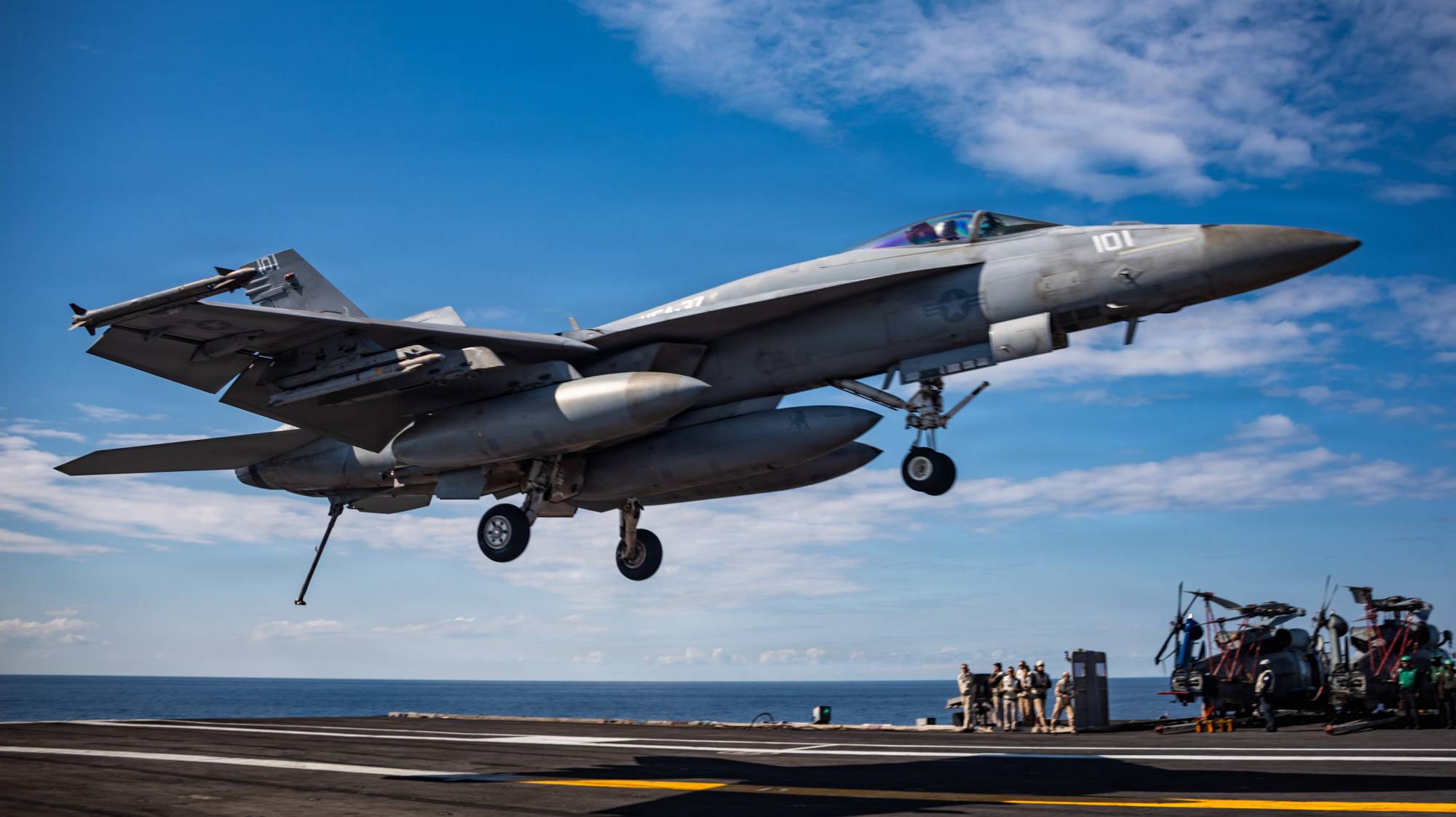
In this image provided by US Central Command, an F/A-18E Super Hornet aircraft, attached to Strike Fighter Squadron 37, lands on the flight deck of the world's largest aircraft carrier, USS Gerald R. Ford (CVN 78), while operating in support of Operation Epic Fury, on March 1, 2026. (US Navy via AP)

As the American and Israeli airstrikes kept hitting the country, top Iranian security official Ali Larijani said on X: “We will not negotiate with the United States.”

Iran's first retaliatory strikes on Saturday hit all the Gulf states apart from mediator Oman.

On Sunday, Oman's commercial port of Duqm was hit by two drones, injuring a foreign worker, the Oman News Agency said.

Three ships were also attacked in the Strait of Hormuz on Sunday after Iran had previously declared the strategic waterway was closed, sending global oil prices spiking.

The Revolutionary Guards claimed to strike the aircraft carrier USS Abraham Lincoln, but the Pentagon said the "missiles launched didn't even come close."

Trump said that US military strikes had sunk nine Iranian naval vessels and partially destroyed its navy headquarters.

Iran's retaliatory strikes in the Gulf have killed at least four people and wounded dozens of others.

More than 200 people have been killed since the start of the strikes that killed Khamenei and other senior leaders, Iranian leaders have said.