Iraq's Kurdish Region Goes to the Polls With a Flagging Economy and Political Infighting Top of Mind

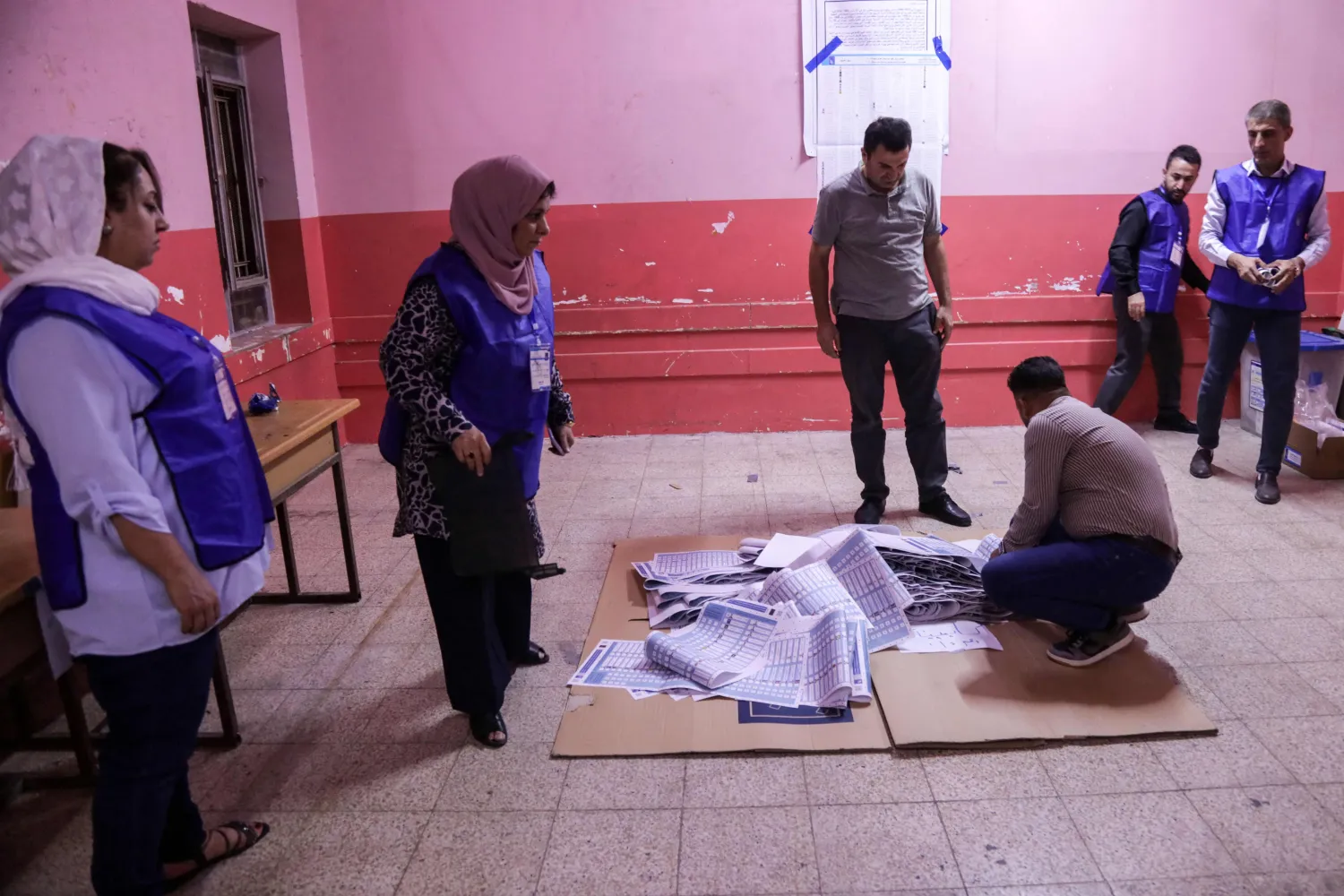
Employees of Iraq's Independent High Electoral Commission (IHEC) count votes at the end of the parliamentary election, at a polling station in Irbil, the capital of Iraq's autonomous northern Kurdish region, on October 20, 2024. (Photo by Safin HAMID / AFP)
TT

Iraq's Kurdish Region Goes to the Polls With a Flagging Economy and Political Infighting Top of Mind

Employees of Iraq's Independent High Electoral Commission (IHEC) count votes at the end of the parliamentary election, at a polling station in Irbil, the capital of Iraq's autonomous northern Kurdish region, on October 20, 2024. (Photo by Safin HAMID / AFP)

Residents of Iraq’s semi-autonomous northern Kurdish region went to the polls in long-awaited parliamentary elections Sunday under the shadow of ongoing rivalries, economic instability and unresolved disputes with Baghdad.
The primary competitors are the two dominant Kurdish parties: the Kurdistan Democratic Party and the Patriotic Union of Kurdistan. The two have historically controlled different parts of the region, with the KDP overseeing the regional capital, Irbil, and Dohuk and the PUK governing Sulaymaniyah.
This division has frequently led to political deadlock. The parliamentary elections, originally set for 2022, were postponed several times amid disputes over the election law and procedures.
Ministry of Interior personnel and peshmerga forces — the regional military — voted in special elections Friday, with the general public voting Sunday.
In Friday’s special election, the KDP secured a significant lead, capturing 60% of the votes, while the PUK got around 30%. The New Generation Movement, an opposition party that has seen a gradual rise in support, garnered 5.3% of the total, up from 3% in the 2018 special election. In that special election, the KDP garnered 40% of the vote and the PUK 28.5%.
While New Generation’s appeal continues to grow, particularly among younger voters frustrated with the traditional political system, it still faces significant challenges in competing with the well-established dominance of the KDP and PUK.
Results of Sunday's vote were expected to be announced Monday.
At some polling centers, there were delays due to malfunctions in fingerprint scanners used for biometric verification of voters’ identities. In some cases, it was unclear if voters whose fingerprints could not be scanned would be able to vote at all.
At a center in Irbil's Ankawa district, resident Raman Ramzi said his wife and mother hadn't been able to vote due to fingerprint and ID recognition issues caused by the biometric machines. A number of other would-be voters left the station without casting a vote due to the same issue.
At another polling station in Irbil, coordinator Sirwan Gardi said that three to four percent of prospective voters' fingerprints were not being recognized by the devices, particularly older people and women.
Rizgar Maghdid, whose fingerprint was not recognized, said he felt sad because he could not vote. Voting “is an essential right of humans,” he said. “I would like to vote for the person who would serve us and our country.”
Regional government Prime Minister Masrour Barzani, a KDP official, called on voters to “reward service and truthfulness and punish the parties that are playing with the rights and destiny of the people of Kurdistan," using the region's local name.
The region’s economic struggles are voters’ primary concern. Despite its oil wealth, the Kurdish region faces significant economic issues, including delayed payment of salaries to civil servants, fluctuating oil prices, and budget cuts from Baghdad. The public is deeply dissatisfied with the economy and lack of opportunities, and many blame political leaders for mismanagement.
“People want to have electricity and get paid their salary on time, and to have more jobs. This is all they want," said Ghazi Najib, who went to the polls in Irbil.
Corruption is also among the central issues in the election. For years, the regional government has faced allegations of nepotism and lack of transparency. Many voters, particularly among the younger generation, are calling for reforms to address these concerns.
Many voters, however, have lost hope for reforms and are also skeptical of opposition parties’ ability to make changes, given the longstanding hold the two major parties have over the political landscape.
Political cooperation with the central government is another key electoral issue. Relations between Irbil and Baghdad have remained tense since a 2017 referendum over independence for the Kurdish region, particularly over issues of oil revenue sharing and budget allocations.
Iraqi Prime Minister Mohammed al-Sudani in a recent visit to Irbil said, “We are committed to ensuring the rights of the Kurdish people, but this must be done within Iraq’s constitution.”
In certain areas, the current elections are significantly influenced by security concerns since the ISIS group sleeper cells are still active in areas that are disputed between the regional and central governments.
“We hope that Kurdistan will be more developed, and to see more safety and reconstruction in Kurdistan,” said Jamila Mohammed Amin, a voter in Irbil. “All political parties and entities should work together and achieve these goals and protect it against enemies.”



Four Killed in Israeli Strikes on Southern Lebanon

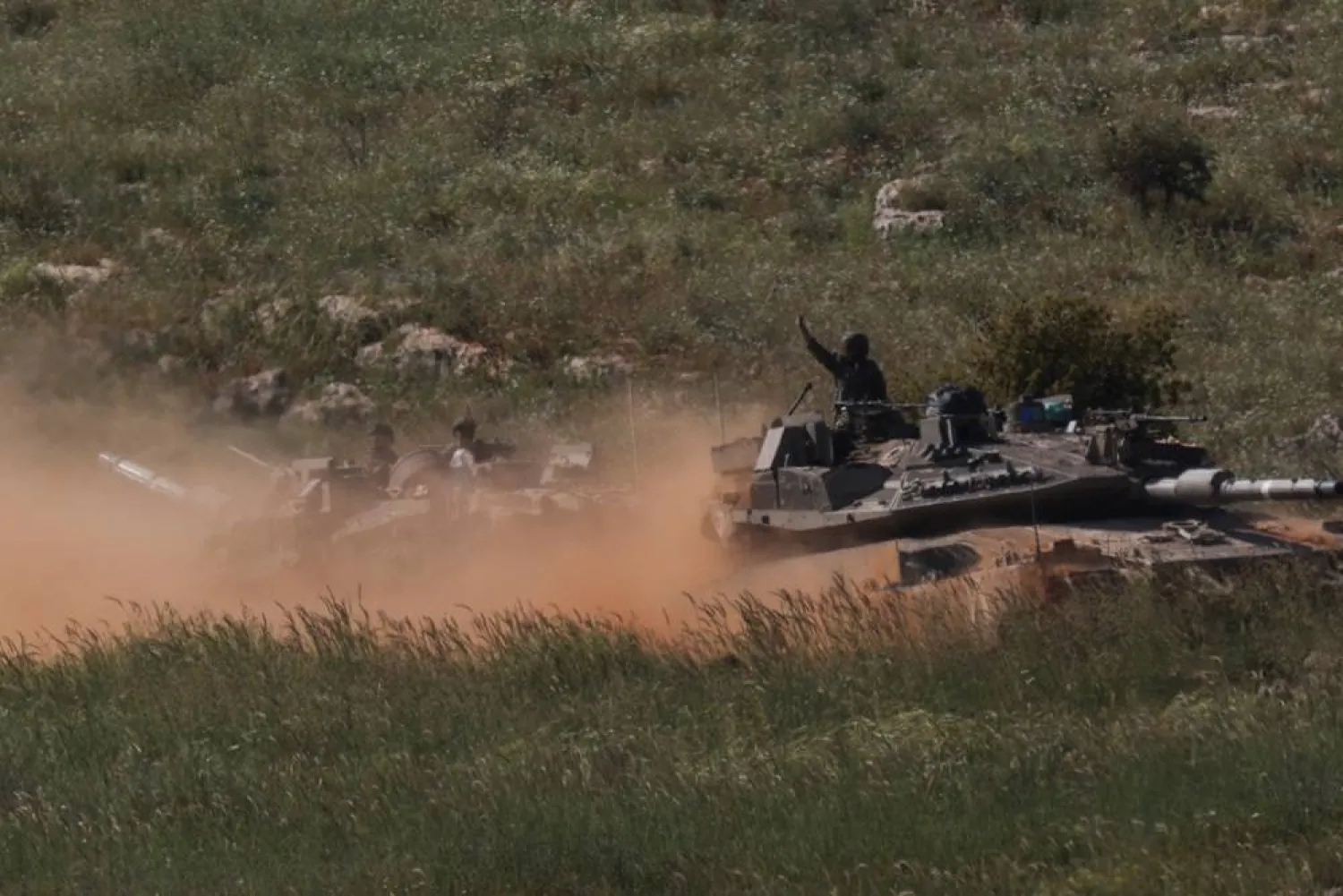
Israeli tanks drive in Lebanon, as seen from the Israeli side of the Israel-Lebanon border, in northern Israel, April 25, 2026. (Reuters)
TT

Four Killed in Israeli Strikes on Southern Lebanon

Israeli tanks drive in Lebanon, as seen from the Israeli side of the Israel-Lebanon border, in northern Israel, April 25, 2026. (Reuters)

Four people were killed on Saturday in Israeli strikes on southern Lebanon, Lebanon's state news agency reported, while the Israeli military said Hezbollah had fired rockets at Israel, the latest challenges to a tenuous, recently extended ceasefire.

The ceasefire agreed between Israel and Lebanon has led to a significant reduction in hostilities, ‌but Israel ‌and Iran-backed Hezbollah ‌have ⁠continued to clash ⁠in southern Lebanon, where Israel has kept soldiers in the self-declared buffer zone.

The Israeli military said on Saturday that it had struck loaded rocket launchers belonging to Hezbollah in three locations in southern Lebanon overnight ⁠and targeted several Hezbollah fighters in ‌separate strikes.

It was ‌unclear whether the deaths reported by the ‌state news agency were linked to those ‌Israeli strikes.

The Israeli military restated its warning for Lebanese residents not to approach the Litani River area in southern Lebanon while it battles ‌Hezbollah.

It said it had intercepted a "suspicious aerial target" within the area its ⁠forces ⁠are presently occupying, and that two rockets were fired by Hezbollah into northern Israel, one of which was intercepted. There were no reports of casualties.

A Hezbollah lawmaker said on Friday that a US-mediated ceasefire in the war with Israel was meaningless, a day after it was extended for three weeks. The truce had been due to expire on Sunday.


Syria to Begin Trying Assad-Era Figures on Sunday, Says Justice Official

Residents gather in a street after Friday prayers to celebrate the arrest of Amjad Yousef, a key suspect in the 2013 Tadamon massacre, in Tadamon, Syria, April 24, 2026. (Reuters)
TT

Syria to Begin Trying Assad-Era Figures on Sunday, Says Justice Official

Residents gather in a street after Friday prayers to celebrate the arrest of Amjad Yousef, a key suspect in the 2013 Tadamon massacre, in Tadamon, Syria, April 24, 2026. (Reuters)

Trials of prominent figures from the rule of ousted Syrian leader Bashar al-Assad are set to begin this weekend, a justice ministry official told AFP on Saturday, starting with a former security official.

"The first trial sessions for symbolic former Syrian regime figures will begin on Sunday" with Atif Najib, who was arrested in January of last year, the official told AFP on condition of anonymity.

Najib is the former head of political security in south Syria's Daraa province, the cradle of the country's 2011 uprising, and is accused of orchestrating a crackdown there. He is also a cousin of the ousted leader.

The ministry official said trials would follow for Wassim al-Assad -- another of the former president's cousins -- and Amjad Youssef, the main suspect in a 2013 massacre who was arrested this week, as well as "pilots who took part in bombing Syrian cities and towns".

Syria's civil war began with a brutal crackdown on pro-democracy protests and spiraled into a 13-year conflict that killed more than half a million people.

Assad's forces pounded opposition-held areas, including with airstrikes and crude barrel bomb attacks, while tens of thousands of people disappeared, some into the country's brutal prison system.

Since seizing power in December 2024, Syria's new authorities have repeatedly announced the arrests of former officials, vowing to provide justice and accountability for Assad-era atrocities.

Assad fled to Russia with only a handful of confidants, abandoning senior officials and security officers, some of whom reportedly went abroad or took refuge in the coastal heartland of Assad's Alawite minority.

Syrian Justice Minister Mazhar al-Wais said Friday on X that the Damascus criminal court was ready "for the moment that victims have long waited for: the start of public trials", calling them "part of the transitional justice process".

Rights groups, activists and the international community have repeatedly emphasized the importance of transitional justice in the war-ravaged country.

The protest movement against Assad began in Daraa on March 15, 2011, after 15 students were arrested for allegedly writing anti-government slogans on the city's walls.

Residents said the students were tortured, leading to a protest to demand their release that ended in bloodshed.

Najib, blamed for the crackdown, was dismissed soon after. He was on a US Treasury sanctions list alongside other Syrian officials.

Wassim al-Assad was arrested last June. The US Treasury sanctioned him in 2023, saying he had led a paramilitary unit and was "a key figure in the regional drug trafficking network".


Low Turnout as Palestinians Vote in First Elections Since Gaza War

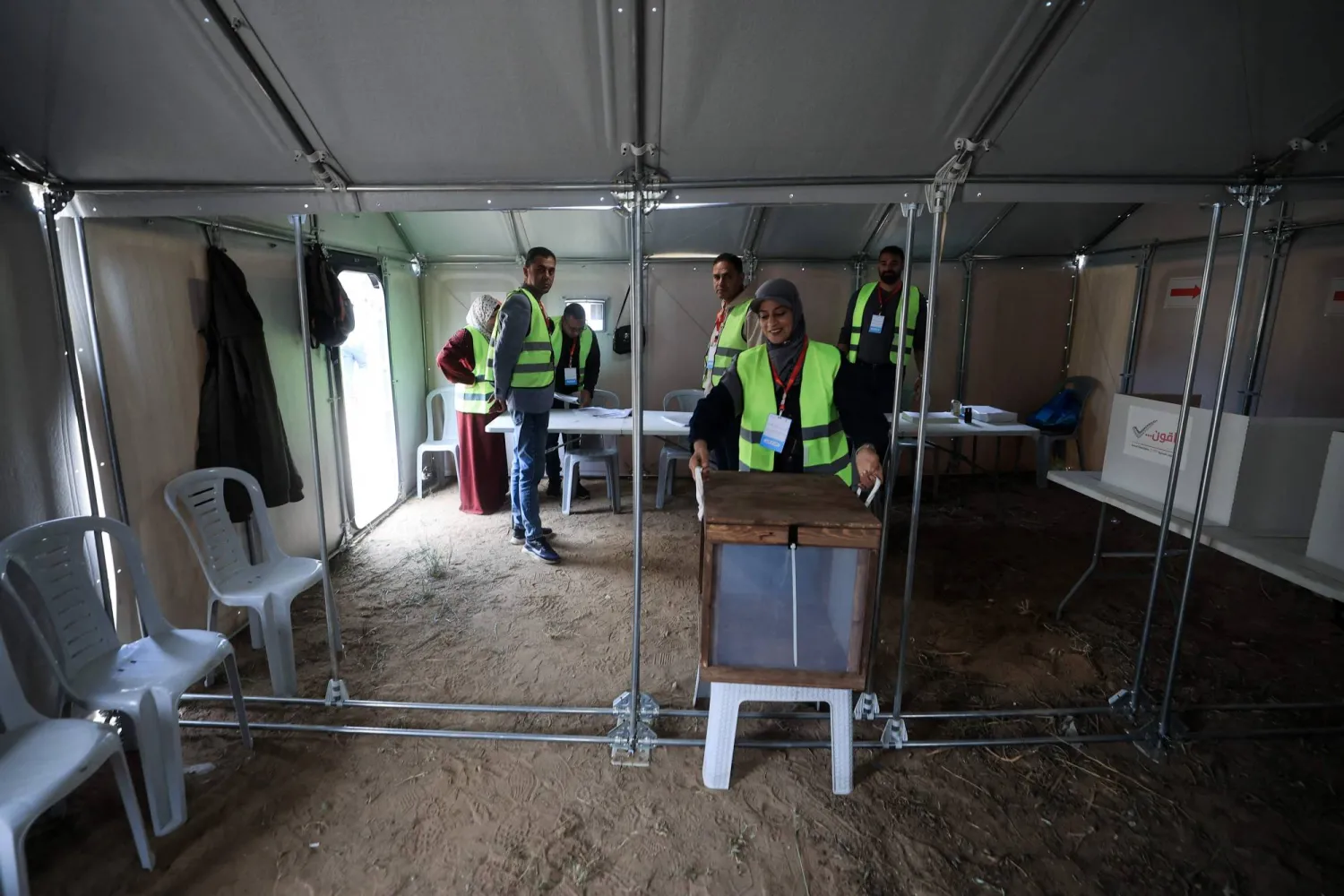
Palestinian electoral officials set up a polling station in a tent for municipal elections in Deir al-Balah, Gaza Strip, on April 25, 2026. (AFP)
TT

Low Turnout as Palestinians Vote in First Elections Since Gaza War

Palestinian electoral officials set up a polling station in a tent for municipal elections in Deir al-Balah, Gaza Strip, on April 25, 2026. (AFP)

Palestinians in the West Bank and central Gaza voted on Saturday in municipal elections, the first since the Gaza war erupted, marked by low turnout and a narrow slate of contenders. 

Nearly 1.5 million people were registered to vote in the Israeli-occupied West Bank, as well as 70,000 people in Gaza's Deir al-Balah area, according to the Ramallah-based Central Elections Commission (CEC). 

"We are very pleased to exercise democracy in spite of the many challenges we face, both locally and internationally," Palestinian president Mahmud Abbas told journalists after voting in Al-Bireh, Wafa news agency said. 

Early Saturday, a steady trickle of voters headed to polling stations in the West Bank, as foreign diplomats observed the process. 

By 5 pm (1400 GMT), turnout in the West Bank reached 40.62 percent, the CEC said. 

But participation in Deir al-Balah was significantly lower, at just 21.2 percent, by the time polls closed there at 6 pm. 

In the previous municipal elections in March 2022, turnout was 53.7 percent in West Bank cities. 

Voting in the West Bank ended at 7 pm, with a notable late surge of women voters in Jericho, an AFP journalist said. 

"We will elect someone who can improve the local community ... things like water and repairing the streets," said Manar Salman, an English teacher in the city. 

"We don't receive much support from outside, and the occupation affects us in many ways... it limits what the municipality can do." 

Some questioned the election's timing. 

"We didn't want elections at this time -- not with war in Gaza and settler attacks ongoing in the West Bank," said Ziad Hassan, a businessman from Dura Al-Qaraa village. 

"The decision was imposed on us, and so we are compelled to elect an administrative body for the village council." 

Israeli settler attacks have surged in recent months, and become a major concern. 

"The main thing is security from settlers. That's why we need new faces, young people willing to fight for our rights," said Abed Jabaieh, 68, former mayor of Ramun village. 

Most electoral lists were aligned with Abbas's secular-nationalist Fatah movement or composed of independents. 

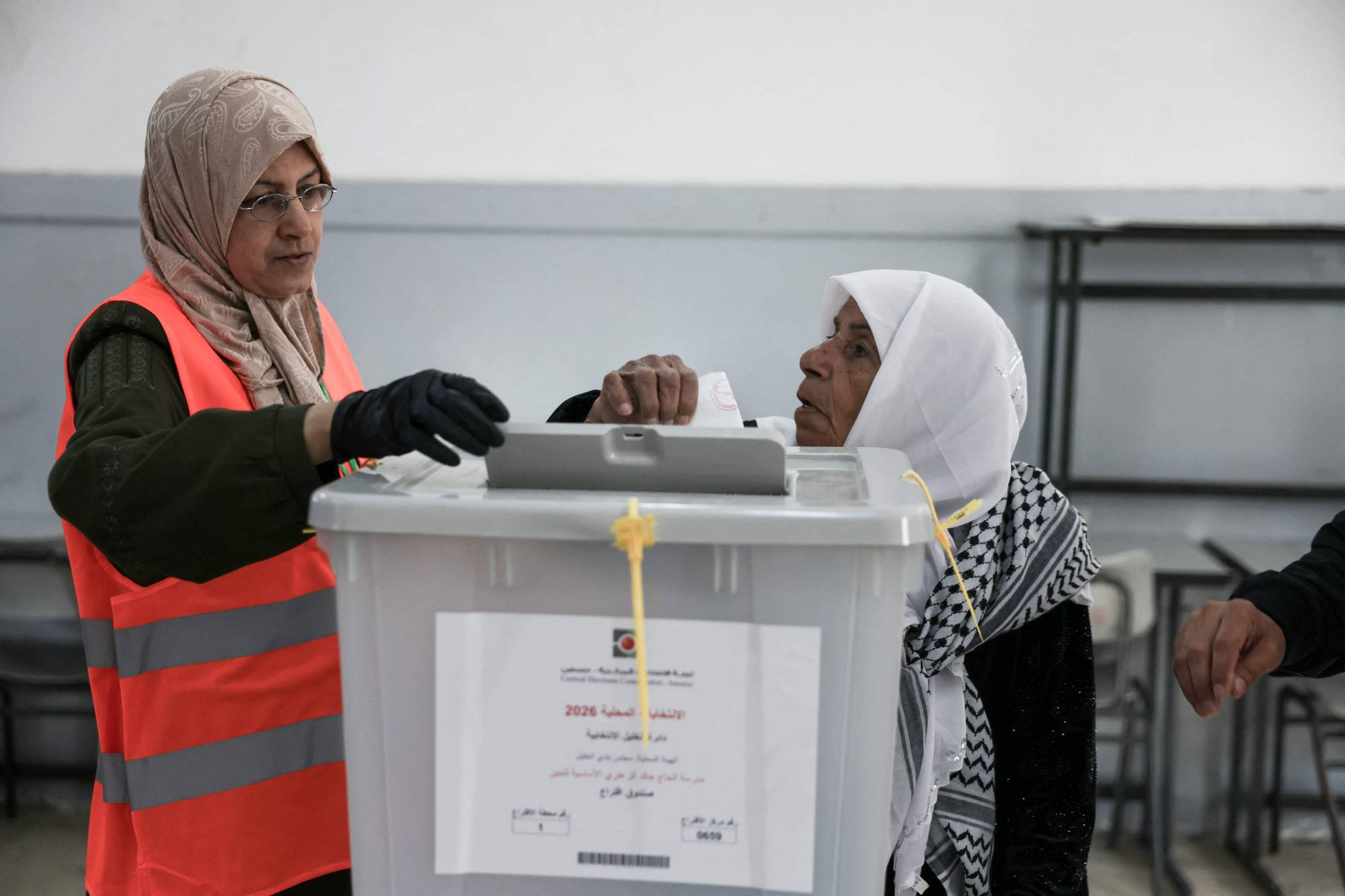
A Palestinian woman casts her ballot in a polling station during municipal elections in the Israeli-occupied West Bank city of Hebron on April 25, 2026. (AFP)

- EU hails vote - 

Hamas, Fatah's bitter rival and the ruling power in Gaza, was absent from the race. 

In many municipalities, Fatah-backed lists faced off against independents supported by smaller factions such as the Marxist-Leninist Popular Front for the Liberation of Palestine. 

Municipal councils oversee water, sanitation, and local infrastructure but do not enact legislation. 

Still, with presidential or legislative elections frozen since 2006, councils have become one of the last remaining democratic mechanisms under the Palestinian Authority. 

The PA faces widespread criticism over corruption, stagnation and declining legitimacy. 

Western and regional donors have increasingly tied financial and diplomatic support for the PA to reform, particularly in local governance. 

The European Union called the vote an "important step towards broader democratization and strengthened local governance ... in line with the ongoing reforms process". 

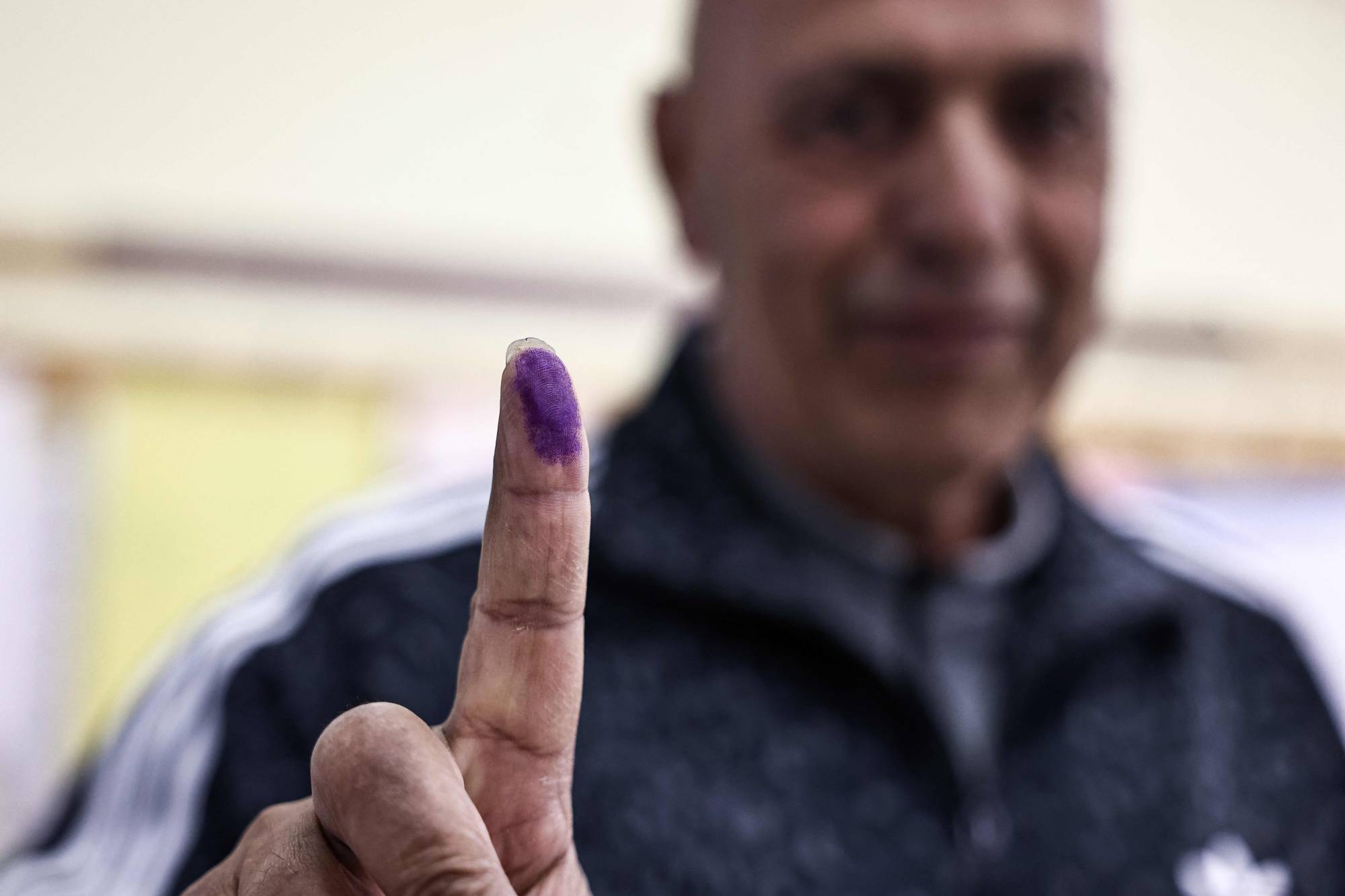
A Palestinian man shows his marked finger after casting his ballot at a polling station during municipal elections in the Israeli-occupied West Bank city of Al-Bireh on April 25, 2026. (AFP)

- 'Strong determination' - 

The polls closed earlier in Deir al-Balah to allow for counting in daylight because of the lack of electricity in the war-devastated strip, the CEC told AFP. 

Two years of war have left swathes of Gaza destroyed and more than 72,000 people dead, according to the territory's health ministry, whose figures are considered reliable by the UN. 

Public infrastructure, sanitation and health services in Gaza are all struggling to function. 

Under Hamas control since 2007, Gaza experienced its first vote since the 2006 legislative elections that the movement won. 

The PA is holding elections only in Deir al-Balah to test its "success or failure, since there are no post-war opinion polls", said Jamal al-Fadi, a political scientist at Cairo's Al-Azhar University. 

It was chosen as one of the few areas where the population has not been massively displaced. 

After voting there, Mohammed al-Hasayna, 24, said although the elections were largely symbolic, they served as a sign of people's "will to live". 

"We are an educated people with strong determination, and we deserve to have our own state," he told AFP. 

"We want the world to help us overcome the catastrophe of war. Enough wars -- it is time to work towards rebuilding Gaza."