


Still Wrecked from Past Israeli Raids, Hospitals in Northern Gaza Come Under Attack Again

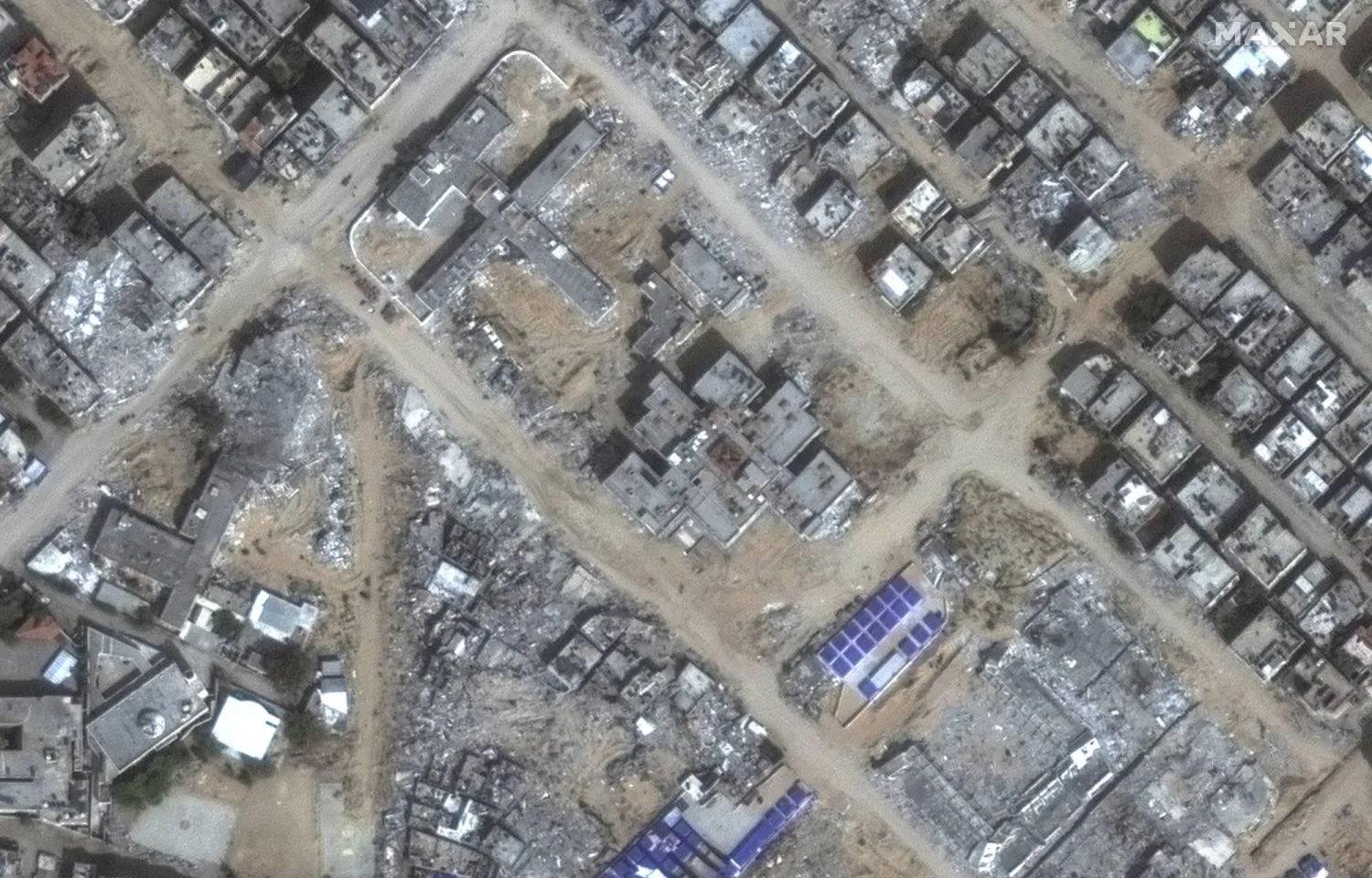
This satellite image released by Maxar Technologies shows damage to al-Nasr Children's Hospital in Gaza City, bottom left, sustained during an Israeli raid in late 2023. (Satellite image ©2024 Maxar Technologies via AP)
TT

Still Wrecked from Past Israeli Raids, Hospitals in Northern Gaza Come Under Attack Again

This satellite image released by Maxar Technologies shows damage to al-Nasr Children's Hospital in Gaza City, bottom left, sustained during an Israeli raid in late 2023. (Satellite image ©2024 Maxar Technologies via AP)

They were built to be places of healing. But once again, three hospitals in northern Gaza are encircled by Israeli troops and under fire.
Bombardment is pounding around them as Israel wages a new offensive against Hamas fighters that it says have regrouped nearby. As staff scramble to treat waves of wounded, they remain haunted by a war that has seen hospitals targeted with an intensity and overtness rarely seen in modern warfare.
All three were besieged and raided by Israeli troops some 10 months ago. The Kamal Adwan, al-Awda and Indonesian hospitals still have not recovered from the damage, yet are the only hospitals even partially operational in the area.
Medical facilities often come under fire in wars, but combatants usually depict such incidents as accidental or exceptional, since hospitals enjoy special protection under international law. In its yearlong campaign in Gaza, Israel has stood out by carrying out an open campaign on hospitals, besieging and raiding at least 10 of them across the Gaza Strip, some several times, as well as hitting multiple others in strikes.
It has said this is a military necessity in its aim to destroy Hamas after the militants’ Oct. 7, 2023 attacks. It claims Hamas uses hospitals as “command and control bases” to plan attacks, to shelter fighters and to hide hostages. It argues that nullifies the protections for hospitals.
“If we intend to take down the military infrastructure in the north, we have to take down the philosophy of (using) the hospitals,” Israeli military spokesman Rear Adm. Daniel Hagari said of Hamas during an interview with The Associated Press in January after the first round of hospital raids.
Most prominently, Israel twice raided Gaza City’s Shifa Hospital, the biggest medical facility in the strip, producing a video animation depicting it as a major Hamas base, though the evidence it presented remains disputed.
But the focus on Shifa has overshadowed raids on other facilities. The AP spent months gathering accounts of the raids on al-Awda, Indonesian and Kamal Adwan Hospitals, interviewing more than three dozen patients, witnesses and medical and humanitarian workers as well as Israeli officials.
It found that Israel has presented little or even no evidence of a significant Hamas presence in those cases. The AP presented a dossier listing the incidents reported by those it interviewed to the Israeli military spokesman’s office. The office said it could not comment on specific events.

The Israeli military has never made any claims of a Hamas presence at al-Awda. When asked what intelligence led troops to besiege and raid the hospital last year, the military spokesman’s office did not reply.
In recent weeks, the hospital has been paralyzed once again, with Israeli troops fighting in nearby Jabalia refugee camp and no food, water or medical supplies entering areas of northern Gaza. Its director Mohammed Salha said last month that the facility was surrounded by troops and was unable to evacuate six critical patients. Staff were down to eating one meal a day, usually just a flat bread or a bit of rice, he said.
As war-wounded poured in, exhausted surgeons were struggling to treat them. No vascular surgeons or neurosurgeons remain north of Gaza City, so the doctors often resort to amputating shrapnel-shattered limbs to save lives.
“We are reliving the nightmares of November and December of last year, but worse,” Salha said. “We have fewer supplies, fewer doctors and less hope that anything will be done to stop this.”
The military, which did not respond to a specific request for comment on al-Awda hospital, says it takes all possible precautions to prevent civilian casualties.
Last year, fighting was raging around al-Awda when, on Nov. 21, a shell exploded in the facility's operating room. Dr. Mahmoud Abu Nujaila, two other doctors and a patient’s uncle died almost instantly, according to international charity Doctors Without Borders, which said it had informed the Israeli military of its coordinates.
Dr. Mohammed Obeid, Abu Nujaila’s colleague, recalled dodging shellfire inside the hospital complex. Israeli sniper fire killed a nurse and two janitors and wounded a surgeon, hospital officials said.
By Dec. 5, al-Awda was surrounded. For 18 days, coming or going became “a death sentence,” Obeid said.
Survivors and hospital administrators recounted at least four occasions when Israeli drones or snipers killed or badly wounded Palestinians trying to enter. Two women about to give birth were shot and bled to death in the street, staff said. Salha, the administrator, watched gunfire kill his cousin, Souma, and her 6-year-old son as she brought the boy for treatment of wounds.
Shaza al-Shuraim said labor pains left her no choice but to walk an hour to al-Awda to give birth. She, her mother-in-law and 16-year-old brother-in-law raised flags made of white blouses. “Civilians!” her mother-in-law, Khatam Sharir, kept shouting. Just outside the gate, a burst of gunfire answered, killing Sharir.
On Dec. 23, troops stormed the hospital, ordering men ages 15 to 65 to strip and undergo interrogation in the yard. Mazen Khalidi, whose infected right leg had been amputated, said nurses pleaded with soldiers to let him rest rather than join the blindfolded and handcuffed men outside. They refused, and he hobbled downstairs, his stump bleeding.
“The humiliation scared me more than death,” Khalidi said.
The hospital’s director, Ahmed Muhanna, was seized by Israeli troops; his whereabouts remain unknown. One of Gaza’s leading doctors, orthopedist Adnan al-Bursh, was also detained during the raid and died in Israeli custody in May.
In the wreckage from the November shelling, staff found a message that Abu Nujaila had written on a whiteboard in the previous weeks.
“Whoever stays until the end will tell the story,” it read in English. “We did what we could. Remember us.”

Several blocks away, on Oct. 18, artillery hit the upper floors of Indonesian Hospital, staff said. People fled for their lives. They'd already been surrounded by Israeli troops, leaving doctors and patients inside without enough food, water and supplies.
“The bombing around us has increased. They’ve paralyzed us," said Edi Wahyudi, an Indonesian volunteer.
Two patients died because of a power outage and lack of supplies, said Muhannad Hadi, the UN humanitarian coordinator for Palestinian territories.
Tamer al-Kurd, a nurse at the hospital, said around 44 patients and only two doctors remain. He said he was so dehydrated he was starting to hallucinate. “People come to me to save them. ... I can’t do that by myself, with two doctors,” he said in a voice message, his voice weak. “I’m tired.”
On Saturday, the Israeli military said it had facilitated the evacuation of 29 patients from Indonesian and al-Awda hospitals.
The Indonesian is Northern Gaza’s largest hospital. Today its top floors are charred, its walls pockmarked by shrapnel, its gates strewn with piled-up rubble — all the legacy of Israel's siege in the autumn of 2023.
Before the assault, the Israeli army claimed an underground command-and-control center lay beneath the hospital. It released blurry satellite images of what it said was a tunnel entrance in the yard and a rocket launchpad nearby, outside the hospital compound.
The Indonesia-based group that funds the hospital denied any Hamas presence. “If there’s a tunnel, we would know. We know this building because we built it brick by brick, layer by layer. It’s ridiculous,” Arief Rachman, a hospital manager from the Indonesia-based Medical Emergency Rescue Committee, told the AP last month.
After besieging and raiding the hospital, the military did not mention or show evidence of the underground facility or tunnels it had earlier claimed. When asked if any tunnels were found, the military spokesman's office did not reply.
It released images of two vehicles found in the compound — a pickup truck with military vests and a bloodstained car belonging to an abducted Israeli, suggesting he had been brought to the hospital on Oct. 7. Hamas has said it brought wounded hostages to hospitals for treatment.
During the siege, Israeli shelling crept closer and closer until, on Nov. 20, it hit the Indonesian’s second floor, killing 12 people and wounding dozens, according to staff. Israel said troops responded to “enemy fire” from the hospital but denied using shells.
Gunfire over the next days hit walls and whizzed through intensive care. Explosions sparked fires outside the hospital courtyard where some 1,000 displaced Palestinians sheltered, according to staff. The Israeli military denied targeting the hospital, although it acknowledged nearby bombardment may have damaged it.
For three weeks, wounded poured in — up to 500 a day to a facility with capacity for 200. Supplies hadn’t entered in weeks. Bloodstained linens piled up. Doctors, some working 24-hour shifts, ate a few dates a day. The discovery of moldy flour on Nov. 23 was almost thrilling.

Without medicines or ventilators, there was little doctors could do. Wounds became infected. Doctors said they performed dozens of amputations on infected limbs. Medics estimated a fifth of incoming patients died. At least 60 corpses lay in the courtyard. Others were buried beneath a nearby playground.
“To see patients dying before your eyes because you don’t have the ability to help them, you have to ask yourself: ‘Where is humanity?’” asked Dergham Abu Ibrahim, a volunteer.
Kamal Adwan: ‘This makes no sense’ Kamal Adwan Hospital, once a linchpin of northern Gaza’s health system, was burning on Thursday of last week.
Israeli shells crashed into the third floor, igniting a fire that destroyed medical supplies, according to the World Health Organization, which had delivered the equipment just days before. The artillery hit water tanks and damaged the dialysis unit, badly burning four medics who tried to extinguish the blaze, said the hospital’s director, Hossam Abu Safiya.
In videos pleading for help over the past weeks, Abu Safiya had fought to maintain his composure as Israeli forces surrounded the hospital. But last weekend, there were tears in his eyes.
“Everything we have built, they have burned,” he said, his voice cracking. “They burned our hearts. They killed my son.”
On Oct. 25, Israeli troops stormed the hospital after what an Israeli military official described as an intense fight with militants nearby. During the battle, Israeli fire targeted the hospital’s oxygen tanks because they “can be booby traps,” the official said.
Israeli forces withdrew after three days, during which Palestinian health officials said nearly all of Kamal Adwan's medical workers were detained, an Israeli drone killed at least one doctor and two children in intensive care died when generators stopped working.
Days later, a drone struck Abu Safiya’s son in nearby Jabalia. The 21-year-old had been wounded by Israeli snipers during the first military raid on Kamal Adwan last December. Now he is buried in the yard of the hospital, where just Abu Safiya and one other doctor remain to treat the dozens of wounded pouring in each day from new strikes in Jabalia.
The Israeli military said troops detained 100 people, some who were “posing as medical staff.” Soldiers stripped the men to check for weapons, the military said, before those deemed militants were sent to detention camps. The military claimed that the hospital was "fully operational, with all departments continuing to treat patients.” It released footage of several guns and an RPG launcher with several rounds it said it found inside the hospital.

Kamal Adwan staff say more than 30 medical personnel remain detained, including the head of nursing, who is employed by MedGlobal, an American organization that sends medical teams to disaster regions, and Dr. Mohammed Obeid, the surgeon employed by Doctors without Borders who previously worked at al-Awda Hospital and had moved to Kamal Adwan.
The turmoil echoed Israel’s nine-day siege of Kamal Adwan last December. On Dec. 12, soldiers entered and allowed police dogs to attack staff, patients and others, multiple witnesses said. Ahmed Atbail, a 36-year-old who had sought refuge at the hospital, said he saw a dog bite off one man’s finger.
Witnesses said the troops ordered boys and men, ranging from their mid-teens to 60, to line up outside crouched in the cold, blindfolded and nearly naked for hours of interrogation. “Every time someone lifted their heads, they were beaten,” said Mohammed al-Masri, a lawyer who was detained.
The military later published footage of men exiting the hospital. Al-Masri identified himself in the footage. He said soldiers staged the images, ordering men to lay down rifles belonging to the hospital guards as if they were militants surrendering. Israel said all photos released are authentic and that it apprehended dozens of suspected militants.
As they released some of the men after interrogation, soldiers fired on them as they tried to reenter the hospital, wounding five, three detainees said. Ahmed Abu Hajjaj recalled hearing bursts of gunfire as he made his way back in the dark. “I thought, this makes no sense — who would they be shooting at?”
Witnesses also said a bulldozer lumbered into the hospital compound, plowing into buildings. Abu Safiya, Abu Hajjaj and al-Masri described being held by soldiers inside the hospital as they heard people screaming outside.
After the soldiers withdrew, the men saw the bulldozer had crushed tents that previously sheltered some 2,500 people. Most of the displaced had evacuated, but Abu Safiya said he found bodies of four people crushed, with splints from recent treatment in the hospital still on their limbs.
Asked about the incident, the Israeli military spokesman’s office said: “Lies were spread on social media” about troops’ activities at the hospital. It said bodies were discovered that had been buried previously, unrelated to the military’s activities.
Later, the military said Hamas used the hospital as a command center but produced no evidence. It said soldiers uncovered weapons, but it showed footage only of a single pistol.
The hospital’s director, Dr. Ahmed al-Kahlout, remains in Israeli custody. The military released footage of him under interrogation saying he was a Hamas agent and that militants were based in the hospital. His colleagues said he spoke under duress.
The fallout Hagari, the military spokesperson, said hospitals “provide a life of their own ... to the (Hamas) war system.” He said hospitals were linked to tunnels allowing fighters movement. “And when you take it, they have no way to move. Not from the south to the north.”
Despite often suggesting hospitals are linked to Hamas' underground networks, the military has shown only one tunnel shaft from all the hospitals it raided — one leading to Shifa's grounds.

In a report last month, a UN investigation commission determined that “Israel has implemented a concerted policy to destroy the health-care system of Gaza.” It described Israeli actions at hospitals as “collective punishment against the Palestinians in Gaza.”
Some patients now fear hospitals, refusing to go to them or leaving before treatment is complete. “They are places of death,” Ahmed al-Qamar, a 35-year-old economist in Jabalia refugee camp, said of his fear of taking his children to the hospital. “You can feel it.”
Zaher Sahloul, the president of MedGlobal who has also worked in Gaza during the war, said the sense of safety that should surround hospitals has been destroyed.



Yemen PM Announces Comprehensive Reform Plan with Saudi Support

Zindani government holds first meeting after ministers return to Aden (Saba News Agency)
TT

Yemen PM Announces Comprehensive Reform Plan with Saudi Support

Zindani government holds first meeting after ministers return to Aden (Saba News Agency)

Yemen’s new government convened its first cabinet meeting on Thursday in the temporary capital Aden, with Prime Minister Shayea al-Zindani presiding after ministers completed their return to the country to resume duties, in what officials cast as the start of a hands-on push to stabilize security, revive services and shore up a battered economy with broad Saudi backing.

The meeting coincided with remarks by Presidential Leadership Council member Abdulrahman al-Mahrami, who warned against unrest in Aden, in an apparent reference to attempts led by elements of the dissolved Southern Transitional Council. “We will not allow any attempts to destabilize public order or drag our city into chaos or futile conflicts,” he said.

At the cabinet’s first meeting following its return to Aden, Zindani stressed that “there is no room for any government member to remain outside the country,” affirming that the government would be present on the ground, living among the population and addressing their daily needs, in a move aimed at restoring public trust and strengthening direct government performance.

The Yemeni prime minister, who also retains the foreign affairs portfolio, said his government would enter a new phase of field-based work from Aden, emphasizing that the next stage would rely on direct engagement with citizens, enhancing the effectiveness of state institutions and achieving tangible improvements in services and economic and security stability.

He said improvements in some basic services in recent weeks were not temporary, but the result of disciplined measures and practical reforms, alongside significant Saudi support, which he said had once again proven to be a pillar of the Yemeni state and a key partner in achieving peace and ensuring stability. He added that Saudi moves in support of the Yemeni people were consistent with international law.

Zindani said the government was working to ensure the sustainability of service delivery so that citizens feel a real and lasting difference, not a fleeting improvement, noting that the coming phase would include serious steps to combat corruption, enhance transparency and enforce the law as key pillars for building effective state institutions.

Reforms on all fronts

On the economic front, Zindani announced that the government would present a realistic 2026 budget for the first time in years, giving top priority to the regular payment of public-sector salaries as a legal and moral obligation.

Measures would also be taken to curb inflation and contain the erosion of citizens’ purchasing power, thereby easing living burdens.

On the security and military fronts, he said the government was committed to removing all military camps from Aden and other cities and to unifying military and security decision-making under the state’s authority, to strengthen stability and prevent multiple centers of influence.

He stressed the importance of respecting rights and equality for all citizens, and of not allowing calls that promote chaos or threaten public order.

Regarding the southern issue, the prime minister expressed confidence that south-south dialogue would open a genuine window to address it, calling on southerners to abandon the rhetoric of treason and avoid fueling strife and grudges, and to entrench a culture of tolerance and move beyond past conflicts.

He said southerners are the ones concerned with determining their present and future through dialogue, away from the imposition of individual or factional will, stressing there was no room to politicize or diminish the southern issue, which he described as a national cause concerning all Yemenis.

On the peace track, Zindani said the state retained all options to restore its institutions if the Houthis remained intransigent, while affirming that the internationally recognized government continues to extend its hand for peace and to end the Houthi coup, alongside efforts to launch a broad process of reconstruction, development and modernization.

Gradual work

Upon his arrival at Aden International Airport, Zindani said the government’s return to the country represents a practical commitment to shoulder national responsibilities and directly address accumulated challenges facing citizens, particularly amid difficult economic conditions and the repercussions of the ongoing war.

In his first interview after being sworn in as prime minister, Zindani said his government would soon relocate to Aden, noting that being inside the country was not a symbolic step but a prerequisite for effective decision-making and restoring the regular functioning of state institutions.

Speaking to Asharq Al-Awsat, he said the current phase “does not tolerate broad rhetoric,” but requires gradual work to rebuild trust and restore institutional rhythm, stressing that improving living conditions, services, and economic recovery are urgent priorities.

He justified retaining the foreign affairs portfolio as necessary to complete organizational and diplomatic reforms he had previously begun.

Zindani said his cabinet was formed based on professional criteria, away from quota-based arrangements, with a focus on competence, specialization and national balance.

Economically, he adopted what he described as a realistic tone, avoiding quick promises, and said recovery requires restructuring financial administration, controlling resources, enhancing transparency and activating oversight.

He said unifying political and military decision-making would enable state institutions to enforce the law, make accountability possible and give the government a more cohesive negotiating position in any upcoming peace process with the Houthis.

No tolerance for unrest

In support of Zindani’s government, Presidential Leadership Council member Abdulrahman al-Mahrami said security and stability in Aden would remain a non-negotiable priority.

He stressed that no attempts would be allowed to undermine public order or drag Aden into chaos and futile conflicts.

In a statement on his official X account, he reaffirmed that Aden’s security and stability will remain a priority and the government will accept no compromise or negligence.

"We will not allow any attempts to destabilize public order or drag our city into chaos or futile conflicts, without detracting from the political path of the south and its cause," he said.

He added: “We look forward to a South-South dialogue sponsored by Riyadh. It is a historic opportunity that we value and hold on to, and we thank the Kingdom’s leadership for it. We also affirm our full support for the government headed by Dr. Shayea al-Zindani, urging all its members to provide services and improve living conditions in a way that citizens can feel.”

Al-Mahrami pledged to follow up on performance “with care, transparency and responsibility,” calling on “everyone to unite, reject rumors, strengthen the spirit of national responsibility and stand together to protect the capital and safeguard state institutions.”

He added: “We trust that all understand the importance of preserving security and stability as the foundation for government and institutional work and the provision of services, away from political direction or exploitation by any party to harm people’s lives and increase their suffering, without detracting from our just cause.”


Rafah Crossing Traffic Lags Two Weeks after Reopening

Humanitarian and relief aid crosses Rafah Crossing (Egyptian Red Crescent)
TT

Rafah Crossing Traffic Lags Two Weeks after Reopening

Humanitarian and relief aid crosses Rafah Crossing (Egyptian Red Crescent)

Despite nearly two weeks since the reopening of the Rafah crossing in both directions, the number of people and humanitarian aid entering the Gaza Strip falls short of what was agreed under the “Gaza ceasefire agreement,” according to an official from the Egyptian Red Crescent in North Sinai.

The daily movement of individuals to and from Gaza does not exceed 50 people, Khaled Zayed, head of the Egyptian Red Crescent in North Sinai, told Asharq Al-Awsat. He said this figure represents only one-third of what was agreed upon in the ceasefire deal.

He added that truck traffic stands at about 100 per day, despite Gaza’s population requiring the entry of around 600 trucks daily.

On Feb. 2, Israel reopened the Rafah crossing on the Palestinian side for individual travel, allowing Palestinians to leave and return to the enclave. Indicators show that most of those departing Gaza are patients and wounded individuals, who are being received at Egyptian hospitals.

This comes as Egyptian Foreign Minister Badr Abdelatty stressed the need to “ensure the unhindered delivery of humanitarian aid and not obstruct movement through the Rafah crossing.”

In his remarks during a ministerial Security Council session on developments in the Middle East on Wednesday, he underscored the importance of “halting all measures aimed at displacing residents or altering the demographic character of the occupied Palestinian territories.”

Israel took control of the Rafah border crossing in May 2024, about nine months after the outbreak of the war in Gaza. The reopening of the crossing was part of the first phase of the ceasefire agreement that entered into force last October, though the deal remains fragile.

The Egyptian Red Crescent announced the departure of the 14th group of wounded, sick, and injured Palestinians arriving and leaving through the crossing.

In a statement on Thursday, it said humanitarian efforts to receive and see off Palestinians include a comprehensive package of relief services, psychological support for children, distribution of suhoor and iftar meals, and heavy clothing, in addition to providing “return bags” for those heading back to Gaza.

At the same time, the Red Crescent dispatched the 142nd “Zad Al-Ezza” convoy, which includes 197,000 food parcels and more than 235 tons of flour as part of the “Iftar for One Million Fasters” campaign in Gaza.

The convoy also carries more than 390 tons of medicines, relief, and personal care supplies, as well as about 760 tons of fuel, according to the organization’s statement.

Zayed said the daily number of individuals crossing through Rafah over the past two weeks does not compare with what was stipulated in the ceasefire agreement.

With the reopening of the Rafah crossing on the Palestinian side, Israel’s Arabic-language public broadcaster Makan reported that 150 people were expected to leave Gaza, including 50 patients, while 50 people would be allowed to enter the enclave.

Despite what he described as Israeli obstacles, Zayed said allowing the movement of individuals and the wounded represents “an unsatisfactory breakthrough in the humanitarian situation in Gaza,” stressing the need to fulfill the ceasefire’s obligations and advance early recovery efforts inside the territory.

The total number of Palestinians who have left through the Rafah crossing since it reopened on both sides does not exceed 1,000, according to Salah Abdel Ati, head of the International Commission to Support Palestinian Rights.

He said around 20,000 wounded and sick Palestinians require urgent evacuation, and that Israeli restrictions are hindering access to medical care, adding that the humanitarian situation requires continued pressure by mediators on Israel.

Abdelatty told Asharq Al-Awsat he was counting on the outcome of the first meeting of the Board of Peace to adopt easing measures, including lifting Israeli restrictions and establishing guarantees for the ceasefire in the Palestinian territories, as well as securing the funding needed for Gaza’s early recovery, in line with US President Donald Trump’s peace plan for the enclave.

According to a statement by the Egyptian Red Crescent, Egypt continues relief efforts at all logistical hubs to facilitate the entry of humanitarian aid, which has exceeded 800,000 tons, with the participation of more than 65,000 volunteers from the Egyptian Red Crescent.


US Slaps Sanctions on Sudan’s RSF Commanders over El-Fasher Killings

FILE - A Sudanese child, who fled el-Fasher city with family after Sudan's RSF attacked the western Darfur region, receives treatment at a camp in Tawila, Sudan, Nov. 2, 2025. (AP Photo/Mohammed Abaker, File)
TT

US Slaps Sanctions on Sudan’s RSF Commanders over El-Fasher Killings

FILE - A Sudanese child, who fled el-Fasher city with family after Sudan's RSF attacked the western Darfur region, receives treatment at a camp in Tawila, Sudan, Nov. 2, 2025. (AP Photo/Mohammed Abaker, File)

The United States announced sanctions on Thursday on three Sudanese Rapid Support Forces (RSF) commanders over their roles in the "horrific campaign" of the siege and capture of El-Fasher.

The US Treasury said the RSF carried out "ethnic killings, torture, starvation, and sexual violence" in the operation.

Earlier Thursday, the UN's independent fact-finding mission on Sudan said the siege and seizure of the city in Darfur bore "the hallmarks of genocide."

Its investigation concluded that the seizure last October had inflicted "three days of absolute horror," and called for those responsible to be brought to justice.

"The United States calls on the Rapid Support Forces to commit to a humanitarian ceasefire immediately," US Treasury Secretary Scott Bessent said in a statement.

"We will not tolerate this ongoing campaign of terror and senseless killing in Sudan."

The Treasury noted that the three sanctioned individuals were part of the RSF's 18-month siege of and eventual capture of El-Fasher.

They are RSF Brigadier General Elfateh Abdullah Idris Adam, Major General Gedo Hamdan Ahmed Mohamed and field commander Tijani Ibrahim Moussa Mohamed.

Bessent warned that Sudan's civil war risks further destabilizing the region, "creating conditions for terrorist groups to grow and threaten the safety and interests of the United States."

The UN probe into the takeover of El-Fasher -- after the 18-month siege -- concluded that thousands of people, particularly from the Zaghawa ethnic group, "were killed, raped or disappeared."