Lebanon’s Prime Minister Asks Iran to Help Secure a Ceasefire in Israel-Hezbollah War

A handout photo released by the Lebanese government press office shows senior adviser to Iran supreme leader Ali Larijani (L) meeting with Lebanon caretaker prime minister Najib Mikati (R), in Beirut, on November 15, 2024. (Photo by Lebanese government press office / AFP)
TT

Lebanon’s Prime Minister Asks Iran to Help Secure a Ceasefire in Israel-Hezbollah War

A handout photo released by the Lebanese government press office shows senior adviser to Iran supreme leader Ali Larijani (L) meeting with Lebanon caretaker prime minister Najib Mikati (R), in Beirut, on November 15, 2024. (Photo by Lebanese government press office / AFP)

Lebanon’s caretaker prime minister on Friday asked Iran to help secure a ceasefire in the war between Israel and Hezbollah and appeared to urge it to convince the armed group to agree to a deal that could require it to pull back from the Israel-Lebanon border.

The prime minister made the comments in talks with Ali Larijani, a top adviser to Iran’s supreme leader, Ali Khamenei. Larijani’s visit to Lebanon comes as the United States continued pushing both sides to agree to a deal to end 13 months of exchanges of fire between Israel and Hezbollah.

Iran is a main backer of Hezbollah and for decades has been funding and arming the Lebanese group. Hezbollah began firing rockets into northern Israel the day after Hamas’ surprise attack into Israel on Oct. 7, 2023 ignited the war in Gaza – prompting exchanges between the two sides ever since.

Since late September, Israel dramatically escalated its bombardment of Lebanon, vowing to cripple Hezbollah and end its barrages in Israel. More than 3,300 people have been killed in Lebanon by Israeli fire – 80% of them in the past month -- Lebanon’s Health Ministry says.

According to Lebanese media, US Ambassador Lisa Johnson handed over a draft of a proposed ceasefire deal to Lebanese Parliament Speaker Nabih Berri, who has been leading the talks representing Hezbollah, his close ally.

A Lebanese official confirmed that Beirut has received a copy of a draft proposal based on UN Security Council resolution 1701, which ended the last Israel-Hezbollah war, in the summer of 2006.

That resolution, among other things, said that only the Lebanese army and UN peacekeepers should operate in southern Lebanon, meaning Hezbollah would have to end its presence there. That provision was never implemented. Lebanon accuses Israel of also violating the resolution by maintaining hold of a small, disputed border area and conducting frequent military overflights over Lebanon.

The Lebanese official did not give details other than to say Israel was insisting that some guarantees be included. The official spoke on condition of anonymity, because they weren’t authorized to speak to the media about the ongoing talks.

The US Embassy refused to either confirm or deny the reports.

In talks with Larijani, caretaker Lebanese Prime Minister Najib Mikati urged Iran to help implement resolution 1701. He said the Lebanese government wants the war to end and the resolution to be implemented “in all its details,” according to a statement on the talks issued by his office.

Mikati, who in recent weeks has become more critical of Iran’s role in Lebanon, also said the government wants Iran to help Lebanon’s national unity and not take any stance backing one party against another.

Iran’s backing for Hezbollah has helped the group, which is the most powerful faction among Lebanon’s Shiite Muslims, dominate the country’s politics the last decade.

After meeting Mikati and Berri, Larijani said his visit’s main aim was “to loudly say that we will stand by Lebanon’s government and people.”

Asked if he was trying to thwart US ceasefire mediation, Larijani said: “We are not trying to blow up any effort, but we want to solve the problem and we will stand by Lebanon, whatever the circumstances.”

Larijani held similar talks a day earlier in Syria with President Bashar al-Assad. Syria’s state news agency said that Assad and Larijani discussed the “ongoing aggression on Palestine and Lebanon and the necessity of stopping it.”

While Larijani was in Beirut, Israeli forces carried out a new strike on the southeastern edge of the city.

Images taken by an Associated Press photographer showed a rocket about to strike an 11-story residential building in Beirut’s Tayyouneh neighborhood – then a blast of flame erupts from the side of the building. Much of a lower level of the building was smashed to rubble.

There were no immediate reports of casualties. The Israeli military had issued a warning before the attack, saying it was a facility that belonged to Hezbollah.

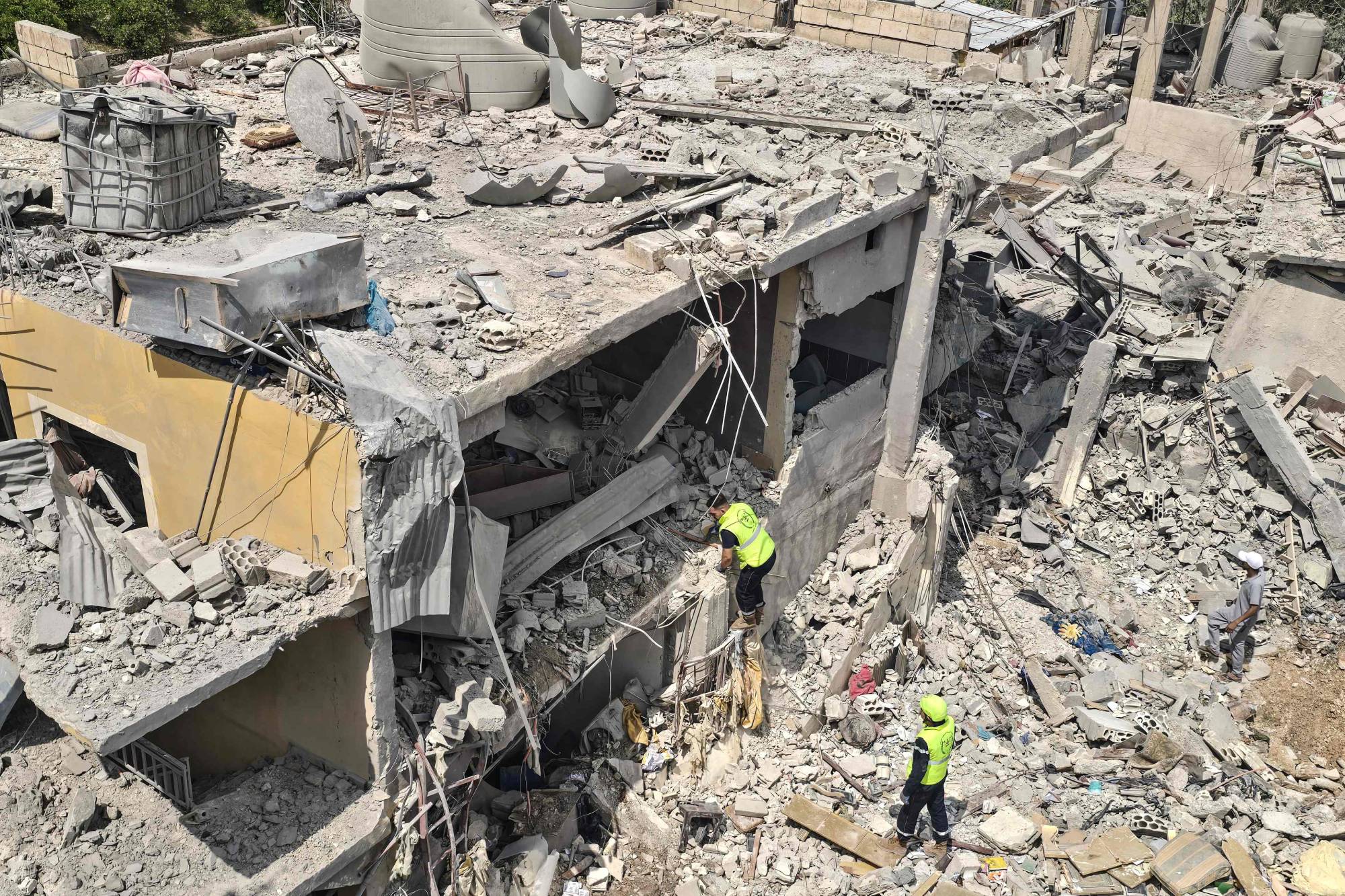
Near the eastern Lebanese city of Baalbek, rescue teams continued searching through the rubble Friday at the site of an Israeli strike the night before that hit a civil defense center in the town of Douris.

So far, the bodies of 13 employees and volunteers with the Lebanese Civil Defense had a been recovered, the agency said, as well as some other remains that will require DNA testing.

Israel expanded its operations in Lebanon even as it continues its campaign in the Gaza Strip, vowing to destroy Hamas, which is also backed by Iran.

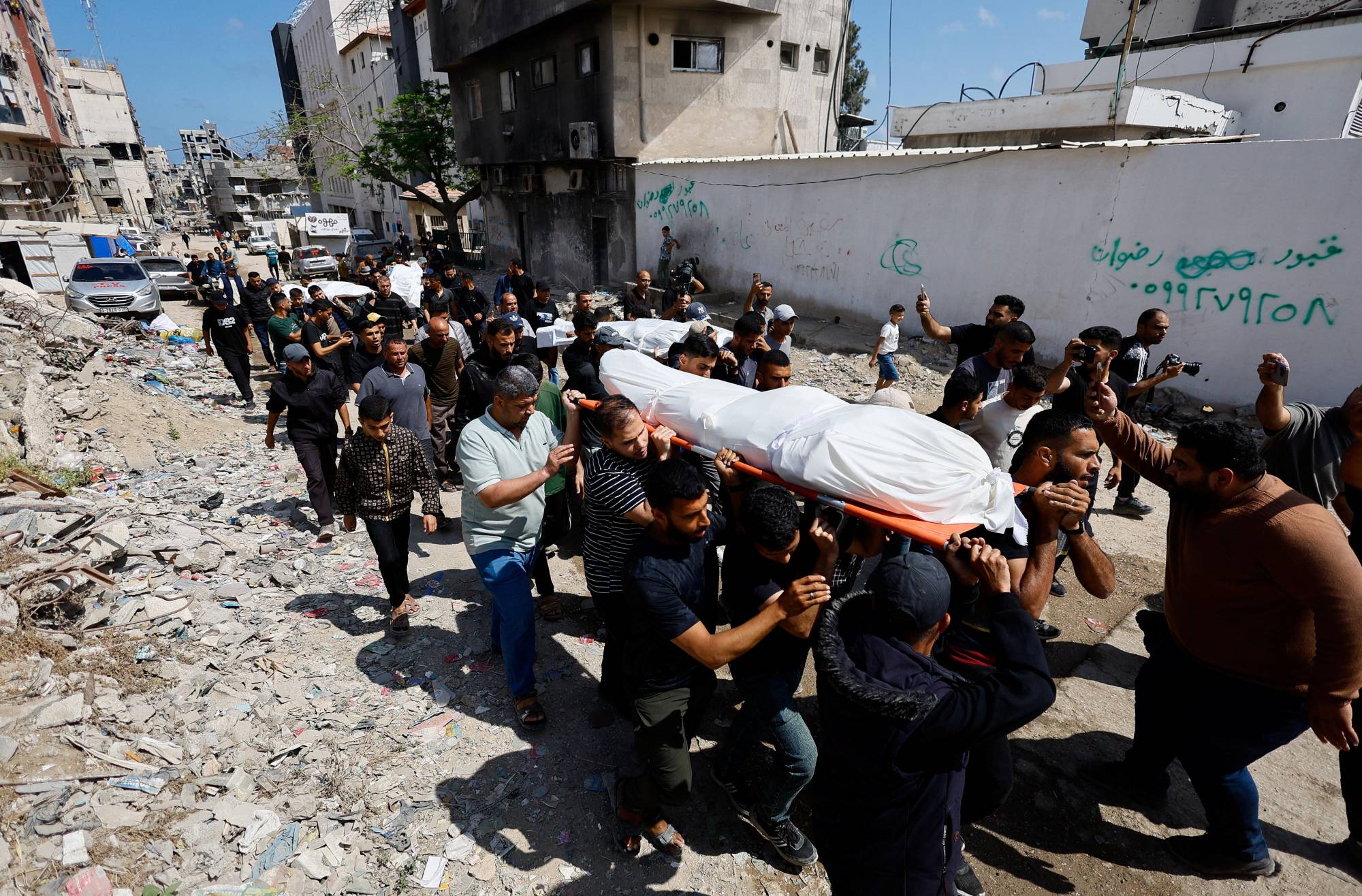
Funerals were held Friday for 11 Palestinians killed Thursday in a series of Israeli airstrikes in and around the central Gaza Strip city of Deir al-Balah. Two children were among the dead, seen with the other dead by an AP reporter.

On Thursday, the UN Security Council’s 10 elected members circulated a draft resolution demanding “an immediate, unconditional and permanent ceasefire” in Gaza. The US, Israel’s closest ally, holds the key to whether the UN. Security Council adopts the resolution. The four other permanent members — Russia, China, Britain and France — are expected to support it or abstain.

The Israel-Hamas war began after Palestinian fighters stormed into Israel on Oct. 7, 2023, killing about 1,200 people — mostly civilians — and abducting 250 others.

Israel’s bombardment and ground offensives since then have killed more than 43,000 people in Gaza, Palestinian health officials say. The officials don’t distinguish between civilians and combatants but say more than half of those killed have been women and children.

MSF Will Keep Operating in Gaza 'as Long as We Can'

(FILES) A Palestinian man walks on his crutches to the Doctors Without Borders or Medecins Sans Frontieres (MSF) clinic, in the al-Rimal neighborhood of Gaza City on new year's Eve, December 31, 2025. (Photo by Omar AL-QATTAA / AFP)
TT

MSF Will Keep Operating in Gaza 'as Long as We Can'

(FILES) A Palestinian man walks on his crutches to the Doctors Without Borders or Medecins Sans Frontieres (MSF) clinic, in the al-Rimal neighborhood of Gaza City on new year's Eve, December 31, 2025. (Photo by Omar AL-QATTAA / AFP)

The head of Doctors Without Borders in the Palestinian territories told AFP the charity would continue working in Gaza for as long as possible, following an Israeli decision to end its activities there.

In early February, Israel announced it was terminating all the activities in Gaza by the medical charity, known by its French acronym MSF, after it failed to provide a list of its Palestinian staff.

MSF has slammed the move, which takes effect on March 1, as a "pretext" to obstruct aid.

"For the time being, we are still working in Gaza, and we plan to keep running our operations as long as we can," Filipe Ribeiro told AFP in Amman, but said operations were already facing challenges.

"Since the beginning of January, we are not anymore in the capacity to get international staff inside Gaza. The Israeli authorities actually denied any entry to Gaza, but also to the West Bank," he said.

Ribeiro added that MSF's ability to bring medical supplies into Gaza had also been impacted.

"They're not allowed for now, but we have some stocks in our pharmacies that will allow us to keep running operations for the time being," he said.

"We do have teams in Gaza that are still working, both national and international, and we have stocks."

In December, Israel announced it would prevent 37 aid organizations, including MSF, from working in Gaza from March 1 for failing to submit detailed information about their Palestinian employees, drawing widespread condemnation from NGOs and the United Nations.

It had alleged that two MSF employees had links with Palestinian militant groups Hamas and Islamic Jihad, which the medical charity has repeatedly and vehemently denied.

MSF says it did not provide the names of its Palestinian staff because Israeli authorities offered no assurances regarding their safety.

Ribeiro warned of the massive impact the termination of MSF's operations would have for healthcare in war-shattered Gaza.

"MSF is one of the biggest actors when it comes to the health provision in Gaza and the West Bank, and if we are obliged to leave, then we will create a huge void in Gaza," he said.

The charity says it currently provides at least 20 percent of hospital beds in the territory and operates around 20 health centers.

In 2025 alone, it carried out more than 800,000 medical consultations, treated more than 100,000 trauma cases and assisted more than 10,000 infant deliveries.


Egyptian-Turkish Military Talks Focus on Strengthening Partnership

The Commander of the Egyptian Air Force during his meeting with the Turkish Air Force chief in Cairo on Wednesday (Egyptian military spokesperson)
TT

Egyptian-Turkish Military Talks Focus on Strengthening Partnership

The Commander of the Egyptian Air Force during his meeting with the Turkish Air Force chief in Cairo on Wednesday (Egyptian military spokesperson)

Senior Egyptian and Turkish air force commanders met in Cairo on Wednesday for talks focused on strengthening military partnership and expanding bilateral cooperation, in the latest sign of warming defense ties between the two countries.

The meeting brought together the Commander of the Egyptian Air Force, Lt. Gen. Amr Saqr, and his Turkish counterpart, Gen. Ziya Cemal Kadioglu, to review a range of issues of mutual interest amid growing cooperation between the two air forces.

Egypt’s military spokesperson said the talks reflect the Armed Forces’ commitment to deepening military collaboration with friendly and partner nations.

Earlier this month, Egypt and Türkiye signed a military cooperation agreement during talks in Cairo between Egyptian President Abdel Fattah el-Sisi and his Turkish counterpart, President Recep Tayyip Erdogan.

Sisi highlighted similar viewpoints on regional and international issues, while Erdogan noted that enhanced cooperation and forthcoming joint steps would help support regional peace.

Cairo and Ankara also signed an agreement last August on the joint production of vertical take-off and landing (VTOL) drones. Production of unmanned ground vehicles has also begun under a partnership between the Turkish firm HAVELSAN and Egypt’s Kader Factory.

During the talks, Saqr underscored the importance of coordinating efforts to advance shared interests and expressed hope for closer ties that would benefit both air forces.

Kadioglu, for his part, stressed the depth of bilateral partnership and the strong foundations of cooperation between the two countries’ air forces.

According to the military spokesperson, Kadioglu also toured several Egyptian Air Force units to review the latest training and armament systems introduced in recent years.

Military cooperation between Egypt and Türkiye has gained momentum since 2023, following the restoration of full diplomatic relations and reciprocal presidential visits that reflected positively on the defense sector.

In September last year, the joint naval exercise “Sea of Friendship 2025” was held in Turkish territorial waters, aimed at enhancing joint capabilities and exchanging expertise against a range of threats.


UN Says Israeli Actions Raising 'Ethnic Cleansing' Fears in West Bank, Gaza

A member of the Salhab family weeps as he sits on the on the rubble of apartment building after it was demolished by Israeli bulldozers near the Israeli settlement of Hagai, south of the occupied West Bank city of Hebron, on February 18, 2026. (Photo by HAZEM BADER / AFP)
TT

UN Says Israeli Actions Raising 'Ethnic Cleansing' Fears in West Bank, Gaza

A member of the Salhab family weeps as he sits on the on the rubble of apartment building after it was demolished by Israeli bulldozers near the Israeli settlement of Hagai, south of the occupied West Bank city of Hebron, on February 18, 2026. (Photo by HAZEM BADER / AFP)

Israel's increased attacks and forcible transfers of Palestinians "raise concerns over ethnic cleansing" in the Gaza Strip and the West Bank, the United Nations said Thursday.

The UN human rights office said the cumulative impact of Israel's military conduct during the war in Gaza, plus its blockade of the territory, had inflicted living conditions "increasingly incompatible with Palestinians' continued existence as a group in Gaza".

"Intensified attacks, the methodical destruction of entire neighborhoods and the denial of humanitarian assistance appeared to aim at a permanent demographic shift in Gaza", the office said in a report.

"This, together with forcible transfers, which appear to aim at a permanent displacement, raise concerns over ethnic cleansing in Gaza and the West Bank."

The report looked at November 1, 2024 to October 31, 2025.

In the occupied West Bank and annexed East Jerusalem, the report said the "systematic use of unlawful force" by Israeli security forces, "widespread" arbitrary detention and the "extensive unlawful demolition" of Palestinian homes was being carried out to "systematically discriminate, oppress, control and dominate the Palestinian people".

"These violations were "altering the character, status and demographic composition of the occupied West Bank, raising serious concerns of ethnic cleansing", it said.

- 'Inhumane choice' -

In Gaza, the report condemned the continued killing and maiming of "unprecedented numbers of civilians", the spread of famine, and destruction of the "remaining civilian infrastructure".

During the 12 months covered in the report, at least 463 Palestinians, including 157 children, starved to death in Gaza, it said.

"Palestinians faced the inhumane choice of either starving to death or risking being killed while trying to get food," said the report.

"The situation of famine and malnutrition was the direct result of actions taken by the Israeli government," with the deaths and suffering from hunger "foreseeable and repeatedly foretold".

Across the reporting period, Hamas and other Palestinian armed groups continued to hold Israeli and foreign hostages seized on October 7, 2023 -- dead or alive -- as "bargaining tools".

The rights office said the hostages' treatment amounted to war crimes.

"Israeli forces, Hamas, and other Palestinian armed groups committed serious violations of international humanitarian law in Gaza, gross violations and abuses of international human rights law, and atrocity crimes," the report concluded.

- Impunity 'kills' -

Last week, UN rights chief Volker Turk warned that the world was witnessing "rapid steps to change permanently the demography of the occupied Palestinian territory".

On Tuesday, Israel's far-right Finance Minister Bezalel Smotrich vowed to encourage "emigration" from the Palestinian territories.

And on Wednesday, UN Under-Secretary-General Rosemary DiCarlo warned the Security Council that steps by Israel to tighten control of areas of the West Bank administered by the Palestinian Authority amount to "gradual de facto annexation".

Thursday's rights office report concluded that considered together, Israeli practices "indicated a concerted and accelerating effort to consolidate annexation of large parts of the Occupied Palestinian Territory and to deny Palestinians' right to self-determination".

The report said there was a pervasive climate of impunity for serious violations of international law by the Israeli authorities in the Palestinian territories.

"Impunity is not abstract -- it kills. Accountability is indispensable. It is the prerequisite for a just and durable peace in Palestine and Israel," Turk said in a statement.