


Israeli Army Reaches Outskirts of Litani River in Southern Lebanon

An Israeli tank loaded onto a truck being transported to the border with southern Lebanon in the Upper Galilee (EPA)
TT

Israeli Army Reaches Outskirts of Litani River in Southern Lebanon

An Israeli tank loaded onto a truck being transported to the border with southern Lebanon in the Upper Galilee (EPA)

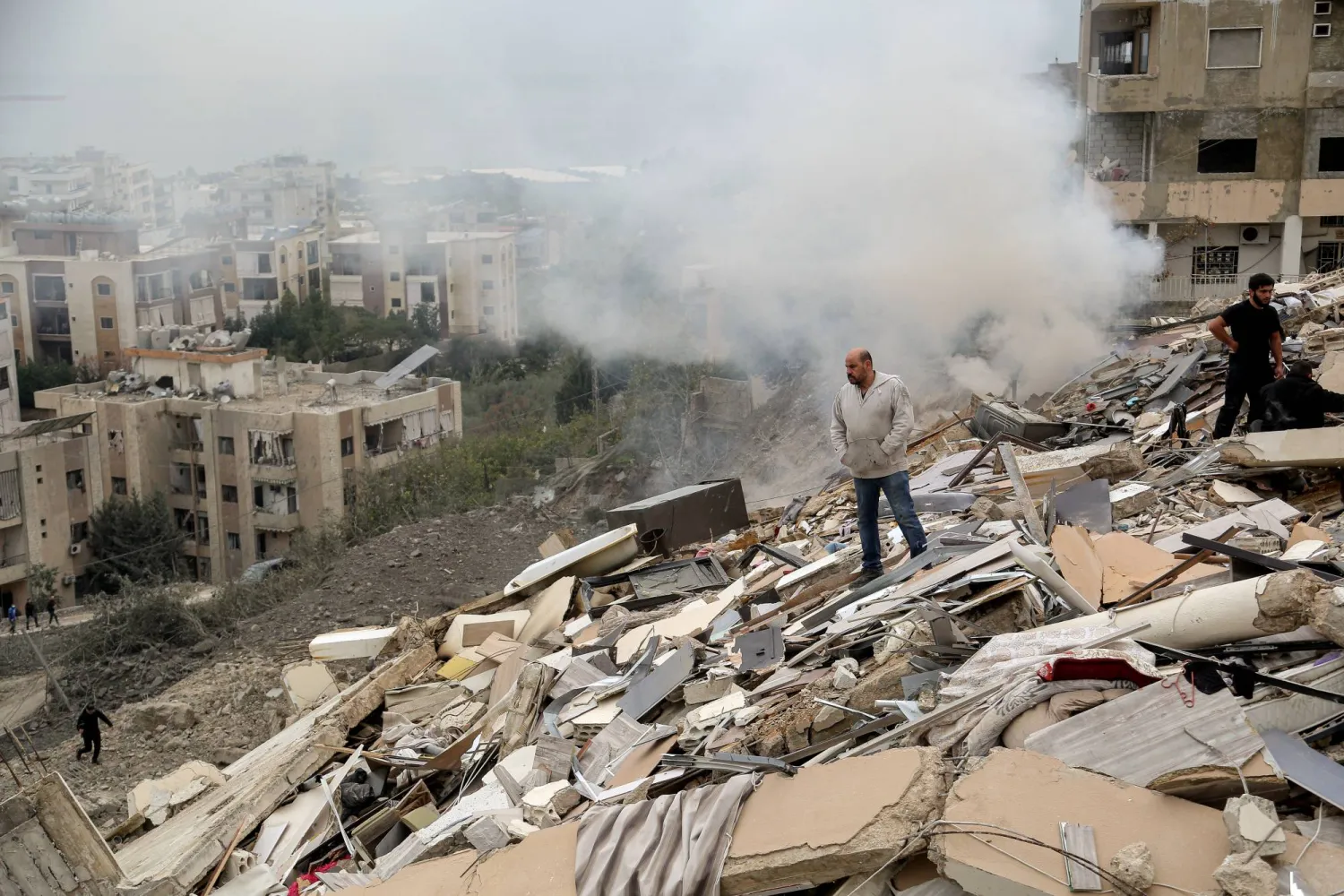
Israeli forces have launched their largest ground incursion into southern Lebanon since the conflict began, reaching the outskirts of the Litani River near Deirmimas.

They entered the town’s edges in an effort to separate Nabatieh from Marjayoun and prepare for an attack on the town of Taybeh from the west and north.

This move also aimed to neutralize Taybeh hill, which overlooks the Khiam plain, where Israel plans to extend its operations and capture the city of Khiam.

Lebanese media reported that Israel set up a checkpoint at the Deirmimas junction, cutting off Marjayoun from Nabatieh.

They also blocked the western entrance to Deirmimas near a fuel station using earth mounds, with Israeli military vehicles stationed there. Reports also said Israeli forces prevented UNIFIL and the Lebanese army from passing toward Marjayoun.

Lebanese sources following the battle in the south reported that Israeli forces advanced five kilometers west from the town of Kfar Kila, moving through olive groves. This advance took advantage of the absence of Hezbollah fighters in Christian areas like Qlayaa, Bir al-Muluk, and Deirmimas.

The sources told Asharq Al-Awsat that this allowed Israeli forces to reach the outskirts of the Litani River for the first time since 2006, cutting off Nabatieh from Marjayoun. Israeli artillery had previously targeted this route several times, and drones had carried out strikes there.

Israel supported its ground advance with heavy artillery fire. Lebanese security sources said Israeli artillery targeted hills overlooking Deirmimas throughout Thursday night into Friday, hitting locations like Beaufort Castle, Arnoun, Yihmour, Wadi Zawtar, and Deir Siryan.

This fire typically provides cover for infantry advances. The sources also confirmed that Israeli ground movements were backed by airstrikes and drones for added security.

They speculated the advance followed a route from Kfar Kila through Tall al-Nahas and Bir al-Muluk toward Deirmimas, which is almost empty of residents and has no Hezbollah presence.

Hezbollah fired rockets at Israeli forces in the area, with three statements confirming the targeting of Israeli positions and vehicles near Deirmimas.

Media reports mentioned multiple rocket strikes on Israeli targets in Khiam and near Tall al-Nahas, as well as a guided missile attack on Israeli movements near oil groves close to the Marqos station at Deirmimas’ edge.

A photo shared by Lebanese media showed an Israeli tank behind an exposed hill east of Qlayaa, protected from the west and north. To the south, Israeli forces entered the town of Deirmimas, which overlooks the position.

Military expert Mustafa Asaad said the image, showing a bulldozer behind a tank at the Qlayaa-Marjayoun-Deirmimas junction, suggests that infantry units secured the area—either on foot or in fast vehicles—before entering Deirmimas.

The town’s mayor confirmed to local media that Israeli forces made a “small incursion” into Deirmimas, advancing through olive groves from Kfar Kila.

Hezbollah has stated it does not have military positions in Christian or Druze areas in southern Lebanon, as these communities oppose its presence. Sources close to Hezbollah say this is due to political reasons and security concerns.



Arab Parliament Affirms Support for Stability in Yemen, Unity Efforts in Sudan

Arab Parliament Affirms Support for Stability in Yemen, Unity Efforts in Sudan
TT

Arab Parliament Affirms Support for Stability in Yemen, Unity Efforts in Sudan

Arab Parliament Affirms Support for Stability in Yemen, Unity Efforts in Sudan

The Arab Parliament reiterated its strong and unwavering support for the security and stability of Yemen. It emphasized that prioritizing dialogue, understanding, and wisdom is essential to serve the best interests of the Yemeni people.

In a statement issued on Friday, the parliament highlighted the importance of making every effort to de-escalate the situation, address the crisis, and achieve a sustainable political solution that respects Yemen's sovereignty and the will of the Yemeni people, the Saudi Press Agency said.

The parliament expressed its full commitment to supporting all initiatives that enhance security, stability, and development in Yemen, as well as to fulfilling the legitimate aspirations of the Yemeni people for progress, stability, and prosperity.

The Arab Parliament also reiterated its strong and unwavering support for all initiatives aimed at resolving the Sudanese crisis and ensuring the security, stability, and unity of Sudan.

In a statement, the Arab Parliament congratulated the Sudanese people on the anniversary of Independence Day. It expressed hope that the next Independence Day will be celebrated with the crisis fully resolved, fulfilling the aspirations of the Sudanese people for security, stability and development.


Lebanon PM Pledges State Authority, Vows to End Israeli Attacks

An Israeli officer displays weapons seized by the army in Gaza, Lebanon and Syria during a media tour (AFP). 
TT

Lebanon PM Pledges State Authority, Vows to End Israeli Attacks

An Israeli officer displays weapons seized by the army in Gaza, Lebanon and Syria during a media tour (AFP). 

Lebanon’s Prime Minister Nawaf Salam has pledged to press ahead with reforms, extend the authority of the state, and work to end Israeli attacks and remove the occupation, even as Israel signals preparations for a “measured” military action against Hezbollah.

In a New Year message posted on X, Salam wished Lebanese a year marked by hope, continued state recovery, and restored public trust.

“We promise to continue together the path of reform and the extension of state authority,” he wrote. He added a renewed pledge “to keep working to end Israeli attacks, remove the occupation, and secure the return of our detainees,” saluting the Lebanese army and security forces deployed nationwide to safeguard public safety.

Lebanon has maintained diplomatic contacts with the sponsors of the ceasefire with Israel, which took effect in November 2024 and ended 66 days of fighting between Hezbollah and the Israeli army.

Beirut says diplomacy and steps by the Lebanese army have prevented a renewed war. Israel, however, still occupies five border points inside Lebanese territory, holds around 20 detainees, including civilians, and continues to violate the agreement through intermittent strikes and targeted killings inside Lebanon.

In parallel, Israeli media report heightened security readiness for possible action against Hezbollah, citing Israeli assessments that recent Lebanese measures fall short of ceasefire terms.

The daily Maariv said security chiefs are preparing to brief Prime Minister Benjamin Netanyahu on readiness levels, pointing to what Israel describes as Lebanon’s failure to dismantle Hezbollah’s military infrastructure south and north of the Litani River.

According to the report, Lebanon may soon declare the end of army operations to disarm Hezbollah south of the Litani without extending them northward, an outcome Israel deems a breach. Israeli assessments suggest this could prompt unilateral action if Lebanon is seen as unable or unwilling to comply.

Israel accuses Hezbollah of rebuilding capabilities, including precision missiles, and says recent airstrikes targeted training sites linked to the Radwan Forces. Israeli officials argue Hezbollah is currently in a weakened operational state, enabling “calibrated” options aimed at pressuring the group while preserving the ceasefire framework.


Türkiye Plans First Overseas Deepwater Drilling in Somalia Next Month

Türkiye Minister of Energy and Natural Resources Alparslan Bayraktar speaks during the conference 'Energy Security in the World and Türkiye: Risks and Solutions in Critical Minerals' at the Sabanci University Istanbul International Center for Energy and Climate (IICEC), in Istanbul, Türkiye, December 26, 2025. REUTERS/Umit Bektas
TT

Türkiye Plans First Overseas Deepwater Drilling in Somalia Next Month

Türkiye Minister of Energy and Natural Resources Alparslan Bayraktar speaks during the conference 'Energy Security in the World and Türkiye: Risks and Solutions in Critical Minerals' at the Sabanci University Istanbul International Center for Energy and Climate (IICEC), in Istanbul, Türkiye, December 26, 2025. REUTERS/Umit Bektas

Türkiye will send a drilling vessel to Somalia in February to carry out the country's first deepwater exploration project abroad, ‌Energy Minister ‌Alparslan Bayraktar ‌said.

He ‌said the operation with the Cagri Bey vessel will focus on offshore areas ⁠in Somali waters but did not ‍provide ‍details on targeted ‍reserves or investment size.

In 2024, Türkiye signed an energy exploration deal with Somalia. It has been ⁠seeking to diversify its energy sources and reduce reliance on imports, investing in exploration at home and overseas.