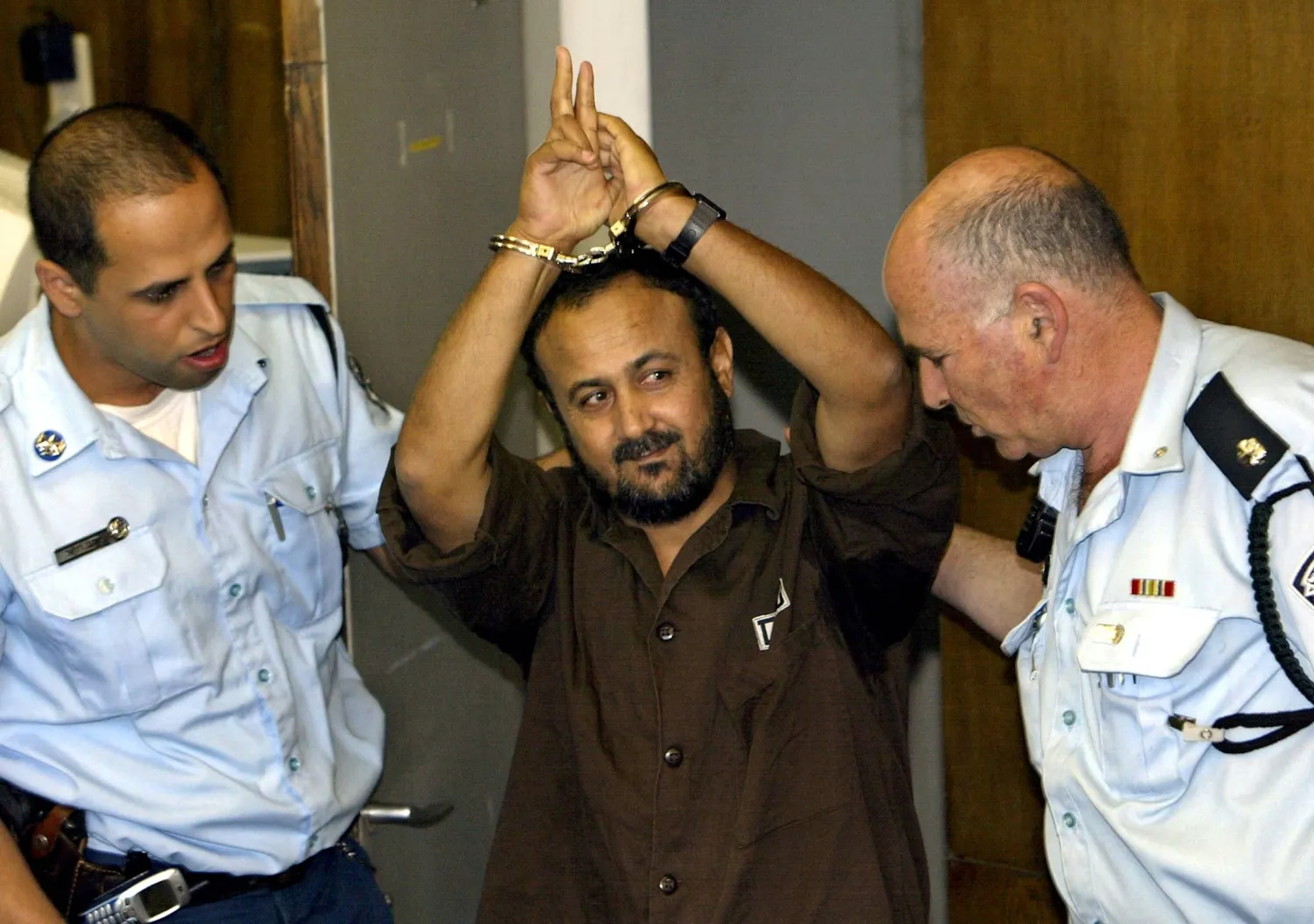
Twenty-four years after the arrest of Palestinian leader Marwan Barghouti, now 67, and after long stretches in solitary confinement, he remains a central figure in Palestinian politics.
His influence has outpaced that of other officials in decision-making roles, and he has topped Fatah elections in previous years, as the movement prepares for its eighth conference next month, a key test of what has changed over time.
Palestinians, the presidency, Fatah, and Barghouti’s family marked the 24th anniversary of his arrest late last week. President Mahmoud Abbas pledged to continue efforts to secure his release.
Fatah said Barghouti, known as Abu al-Qassam, had become a living symbol for Palestinians through his sacrifices, struggle, courage, and patience.
The anniversary came as a lawyer who visited Barghouti on April 12 said he had been assaulted three times in recent weeks, on March 24 and 25 and April 8, leaving him bleeding in several parts of his body without proper medical treatment.
Israeli lawyer Ben Marmarelli said Barghouti was severely beaten and left bleeding for more than two hours on one occasion. Israel’s prison service said it was “not aware” of such incidents.
Barghouti is believed to have been held in solitary confinement for two and a half years. Last year, Israel’s National Security Minister Itamar Ben-Gvir posted a video showing him confronting Barghouti in his cell, speaking in a condescending and threatening tone in what appeared to be an attempt to break him. The move backfired, drawing renewed attention to Barghouti to the point that US President Donald Trump said he was considering whether to release him.
Trump said last October he might ask Israel to release Barghouti, adding he had discussed the option with aides at the White House.
Trump’s intervention has further elevated Barghouti’s standing, with many viewing him as a potential “savior”.
Presidential contender
Informed Palestinian sources told Asharq Al-Awsat that Barghouti will almost certainly run in the next presidential election. “He will most likely be Fatah’s candidate, but even if that does not happen, he will run because he is Marwan,” the sources said.
Elections canceled at the last minute five years ago pointed to his chances. Barghouti formed a list with former Central Committee member Nasser al-Qudwa to challenge Fatah’s official slate.
The list was headed by al-Qudwa and lawyer Fadwa Barghouti, Barghouti’s wife, and included prominent figures from the movement. Barghouti’s name was not listed as he planned to run for president.
His stance underscored a rift dating back to 2005, when he briefly ran against Abbas before withdrawing, a divide that appears unresolved despite expectations of a reconciliation.
There is little sign his position has shifted, even as the broader landscape has. Since the Oct. 7, 2023, war, Israel has increased pressure on the Palestinian Authority, reshaped conditions in the West Bank, and imposed harsher measures on prisoners, including Barghouti. Israel has also rejected Trump’s remarks about his possible release.
Meanwhile, Abbas has moved to reshape the Palestinian Authority and Fatah, appointing senior Central Committee member Hussein al-Sheikh as vice president, launching reconciliation efforts, and allowing the return of previously dismissed members, including al-Qudwa, who has rejoined the Central Committee.
Abbas met Barghouti’s wife late last year and said he would continue working to secure his release.
The meeting sent a clear signal aimed at dispelling doubts over Barghouti, who enjoys strong support within Fatah. His backers present him as a unifying figure capable of bringing Palestinians together and as a potential successor to Abbas, an idea that has not previously gained traction within decision-making circles in Ramallah.
One shift since the war is that Hamas is expected to back him more strongly in any election. The group sought his release in prisoner exchange talks with Israel, placing him among five top-priority detainees, but Israel firmly refused.
Arafat loyalist
Barghouti, arrested in 2002, is serving five life sentences plus 40 years after being convicted of leading the al-Aqsa Martyrs Brigades, Fatah’s armed wing, which carried out attacks that killed Israelis during the second Palestinian uprising that began in 2000.
Before his arrest, he was close to Palestinian leader Yasser Arafat and is widely regarded within Fatah as an Arafat loyalist. This strengthens his standing among the movement’s base, though it may count against him with Israel and opponents of Arafat.
Abbas’s reconciliation push ahead of the eighth conference, scheduled for May 14, comes at a sensitive moment as he works to reorganize the Palestinian Authority and ensure a smooth leadership transition.
The conference will elect a new Central Committee, the movement’s top decision-making body, which will shape both Fatah and the broader Palestinian political landscape.
Selecting a new committee, alongside a new Palestinian National Council, will signal the scale of change and reveal the influence of key figures.
At Fatah’s seventh conference, Barghouti secured the highest number of votes, 930 out of about 1,100, underscoring his strong backing within the movement.
The upcoming conference will show whether he has maintained that standing or lost ground amid sweeping changes within the Palestinian Authority, Fatah, and Palestinian society.
His supporters had hoped he would be named vice president in recent years, but both roles went to others, with the leadership arguing the move was impractical given his imprisonment.
A source close to Barghouti said, “All Palestinians, not just Fatah members, see him as the one who can unite them, as do many countries in the region and beyond. Israel does not want that for well-known reasons.”
“His standing has not diminished over time; it has grown stronger. His presence will remain dominant. He will gain his freedom and unite the Palestinians,” he added.