


Lebanon’s Foreign Minister to Asharq Al-Awsat: Aid and Reconstruction Tied to State Control over Arms

Lebanon’s Foreign Minister Youssef Rajji (Asharq Al-Awsat)
TT

Lebanon’s Foreign Minister to Asharq Al-Awsat: Aid and Reconstruction Tied to State Control over Arms

Lebanon’s Foreign Minister Youssef Rajji (Asharq Al-Awsat)

Lebanon’s Foreign Minister, Youssef Rajji, said that the Lebanese government has been explicitly informed that there would be no international aid or reconstruction support unless all weapons, both north and south of the Litani River, are brought under the exclusive control of the Lebanese state.

Rajji stated that this message was clearly communicated by US envoy Morgan Ortagus during her recent visit to Beirut, where she met with a number of Lebanese officials.

“We were told clearly that international reconstruction and aid are conditional upon state control over all weapons and full sovereignty over Lebanese territory—not only south of the Litani, but across the entire country,” Rajji said, in an interview with Asharq Al-Awsat.

According to the minister, Ortagus conveyed that the US sees a current “window of opportunity” for Lebanon. The American administration is reportedly willing to support the country’s efforts to liberate its occupied territories, rebuild its economy, and resume development. However, this support is tied to key demands—particularly economic reforms and exclusive state control over arms.

“These are not just American demands, but ones echoed by the international community, Arab and Gulf countries, and even many Lebanese,” Rajji remarked.

He clarified that Ortagus did not present a specific timeline for disarmament but urged that it happen “as soon as possible.” While she acknowledged that some progress had been made, she emphasized that more significant and faster steps are required.

On how Lebanon plans to achieve the objective of exclusive arms control, Rajji said: “There is a general principle that the state does not negotiate its internal sovereignty. Therefore, the government must take a clear stance and define a mechanism to ensure that weapons are solely in the hands of the Lebanese state.”

Negotiation Committees with Israel

Regarding proposed negotiations with Israel, Rajji said both the Americans and Israelis have been pushing for the establishment of three committees to discuss five occupied points, prisoner issues, and disputed border zones.

“We made it clear that we are not open to discussions on the first two. Lebanon is not occupying Israeli land nor holding any Israeli prisoners. Israel must withdraw unconditionally from the occupied areas and release the prisoners without negotiation,” he stated. “What we are open to is technical negotiations around border demarcation, which is a complex and specialized issue.”

He noted that while there was a previous idea to form civilian committees for these issues, the matter was not reviewed during Ortagus’ latest visit.

Diplomatic Challenges and National Sovereignty

Rajji emphasized that Lebanon’s diplomatic efforts to regain its occupied lands are ongoing.

“We are asking the international community to pressure Israel to withdraw from Lebanese territory. That would eliminate any justification for Hezbollah to retain its weapons and bolster the Lebanese state’s authority,” he told Asharq Al-Awsat.

However, he acknowledged Lebanon’s limitations. “We have no military or economic power. All we can rely on is diplomacy and the goodwill of our allies,” he emphasized.

On Palestinian Arms

Rajji expressed surprise at the argument that Hezbollah’s disarmament should follow the removal of Palestinian weapons from within and outside the refugee camps.

“What do the two have to do with each other?” he asked. “Palestinian weapons must certainly be handed over—but Hezbollah’s arms were not meant to counter Palestinian factions. We must focus on ensuring that the Lebanese Army is the sole legitimate armed force that protects all Lebanese.”

Economic Reforms

Commenting on the economic crisis, Rajji praised the performance of Prime Minister Nawaf Salam’s government: “They are doing excellent work under very difficult conditions. But this crisis is deep and can’t be solved in just a few weeks. The international community understands that but insists the time to act is now.”

Visit to Syria

Rajji is scheduled to join Salam next week on an official visit to Syria to resolve several pending issues. He expressed optimism about the Syrian leadership’s current stance, saying: “For the first time since our independence, a Syrian regime has clearly stated it respects Lebanon’s sovereignty and will not interfere in our internal affairs.”

The visit will also address the Syrian refugee crisis, which Rajji described as Lebanon’s top national priority.

“Lebanon can no longer bear the demographic, social, and economic strain. We are urging the international community to redirect aid to refugees inside Syria, not in Lebanon, and to support reconstruction efforts in Syria to encourage their return,” he underlined.

The minister added that discussions will include the eastern border issue and the fate of missing Lebanese in Syria. “We want to know what happened—how they were killed, where they are buried—so their families can find closure.”

Lebanese-Gulf Relations

On Lebanon’s relationship with Gulf countries, particularly Saudi Arabia, Rajji acknowledged past failures. However, he pointed to signs of improvement, especially following President Joseph Aoun’s and Prime Minister Salam’s recent visits to Saudi Arabia.

He stated: “The official Lebanese position did not align with Lebanon’s longstanding tradition of excellent relations with the Gulf states. Today, however, these ties have begun to return to their historically strong footing — the clearest evidence of this being the highly significant visit made by President General Joseph Aoun to the Kingdom, at the invitation of Crown Prince Mohammed bin Salman.”



Lebanon Says Two Killed in Israeli Strike on Palestinian Refugee Camp

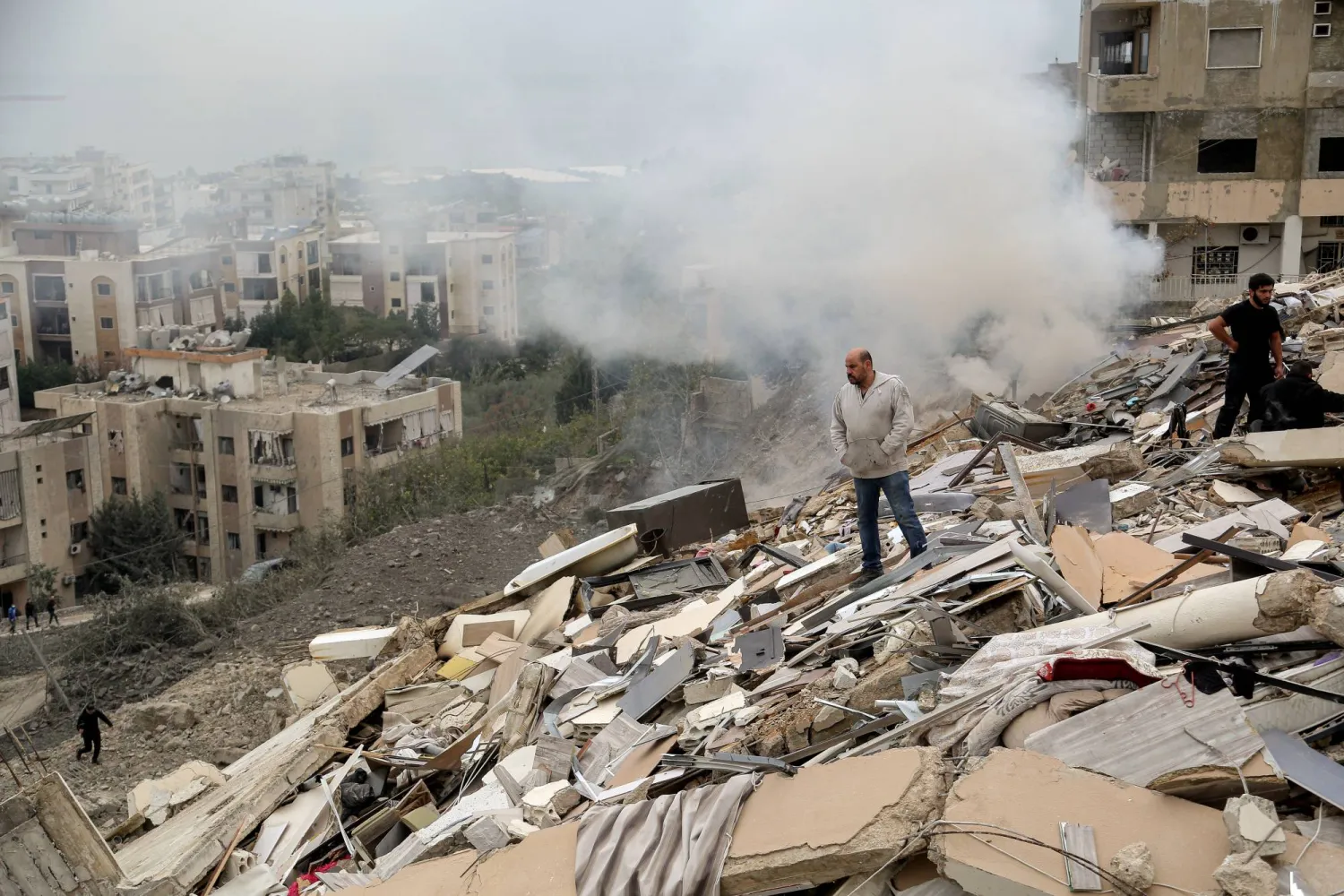
22 January 2026, Lebanon, Qnarit: People inspect the damage of a building that was destroyed by an Israeli air raid on the southern Lebanese village of Qnarit. (dpa)
TT

Lebanon Says Two Killed in Israeli Strike on Palestinian Refugee Camp

22 January 2026, Lebanon, Qnarit: People inspect the damage of a building that was destroyed by an Israeli air raid on the southern Lebanese village of Qnarit. (dpa)

Lebanon said an Israeli strike on the country's largest Palestinian refugee camp killed two people on Friday, with Israel's army saying it had targeted the Palestinian group Hamas. 

The official National News Agency said "an Israeli drone" targeted a neighborhood of the Ain al-Hilweh camp, which is located on the outskirts of the southern city of Sidon. 

Lebanon's health ministry said two people were killed in the raid. The NNA had earlier reported one dead and an unspecified number of wounded. 

An AFP correspondent saw smoke rising from a building in the densely populated camp as ambulances headed to the scene. 

The Israeli army said in a statement that its forces "struck a Hamas command center from which terrorists operated", calling activity there "a violation of the ceasefire understandings between Israel and Lebanon" and a threat to Israel. 

The Israeli military "is operating against the entrenchment" of the Palestinian group in Lebanon and will "continue to act decisively against Hamas terrorists wherever they operate", it added. 

Israel has kept up regular strikes on Lebanon despite a November 2024 ceasefire that sought to halt more than a year of hostilities with Hezbollah. 

Israel has also struck targets belonging to Hezbollah's Palestinian ally Hamas, including in a raid on Ain al-Hilweh last November that killed 13 people. 

The UN rights office had said 11 children were killed in that strike, which Israel said targeted a Hamas training compound, though the group denied it had military installations in Palestinian camps in Lebanon. 

In October 2023, Hezbollah began launching rockets at Israel in support of Hamas at the outset of the Gaza war, triggering hostilities that culminated in two months of all-out war between Israel and the Iran-backed Lebanese group. 

On Sunday, Lebanon said an Israeli strike near the Syrian border in the country's east killed four people, as Israel said it targeted operatives from Palestinian group Islamic Jihad. 


UN Says It Risks Halting Somalia Aid Due to Funding Cuts 

A Somali trader marks watermelons for sale at an open-air grocery market as Muslims start the fasting month of Ramadan, the holiest month in the Islamic calendar, within Bakara market in Mogadishu, Somalia, February 18, 2026. (Reuters)
TT

UN Says It Risks Halting Somalia Aid Due to Funding Cuts 

A Somali trader marks watermelons for sale at an open-air grocery market as Muslims start the fasting month of Ramadan, the holiest month in the Islamic calendar, within Bakara market in Mogadishu, Somalia, February 18, 2026. (Reuters)

The UN's World Food Program (WFP) warned Friday it would have to stop humanitarian assistance in Somalia by April if it did not receive new funding.

The Rome-based agency said it had already been forced to reduce the number of people receiving emergency food assistance from 2.2 million in early 2025 to just over 600,000 today.

"Without immediate funding, WFP will be forced to halt humanitarian assistance by April," it said in a statement.

In early January, the United States suspended aid to Somalia over reports of theft and government interference, following the destruction of a US-funded WFP warehouse in the capital Mogadishu's port.

The US announced a resumption of WFP food distribution on January 29.

However, all UN agencies have warned of serious funding shortfalls since Washington began slashing aid across the world following President Donald Trump's return to the White House last year.

"The situation is deteriorating at an alarming rate," said Ross Smith, WFP Director of Emergency Preparedness and Response, in Friday's statement.

"Families have lost everything, and many are already being pushed to the brink. Without immediate emergency food support, conditions will worsen quickly.

"We are at the cusp of a decisive moment; without urgent action, we may be unable to reach the most vulnerable in time, most of them women and children."

Some 4.4 million people in Somalia are facing crisis-levels of food insecurity, according to the WFP, the largest humanitarian agency in the country.

The Horn of Africa country has been plagued by conflict and also suffered two consecutive failed rainy seasons.


Hamas Says Path for Gaza Must Begin with End to ‘Aggression’ 

Makeshift tents of displaced Palestinian families among the ruins of their homes at sunset during the holy month of Ramadan in Jabaliya northern Gaza Strip on, 19 February 2026. (EPA)
TT

Hamas Says Path for Gaza Must Begin with End to ‘Aggression’ 

Makeshift tents of displaced Palestinian families among the ruins of their homes at sunset during the holy month of Ramadan in Jabaliya northern Gaza Strip on, 19 February 2026. (EPA)

Discussions on Gaza's future must begin with a total halt to Israeli "aggression", the Palestinian movement Hamas said after US President Donald Trump's Board of Peace met for the first time.

"Any political process or any arrangement under discussion concerning the Gaza Strip and the future of our Palestinian people must start with the total halt of aggression, the lifting of the blockade, and the guarantee of our people's legitimate national rights, first and foremost their right to freedom and self-determination," Hamas said in a statement Thursday.

Trump's board met for its inaugural session in Washington on Thursday, with a number of countries pledging money and personnel to rebuild the Palestinian territory, more than four months into a fragile ceasefire between Israel and Hamas.

Israeli Prime Minister Benjamin Netanyahu has insisted however that Hamas must disarm before any reconstruction begins.

"We agreed with our ally the US that there will be no reconstruction of Gaza before the demilitarization of Gaza," Netanyahu said.

The Israeli leader did not attend the Washington meeting but was represented by his foreign minister Gideon Saar.

Trump said several countries had pledged more than seven billion dollars to rebuild the territory.

Muslim-majority Indonesia will take a deputy commander role in a nascent International Stabilization Force, the unit's American chief Major General Jasper Jeffers said.

Trump, whose plan for Gaza was endorsed by the UN Security Council in November, also said five countries had committed to providing troops, including Morocco, Kazakhstan, Kosovo and Albania.