


Jordan Shifts Strategy Against Muslim Brotherhood Following Plot to ‘Stir Chaos’

Jordanian government spokesman Mohammad Momani announces details of terrorist cell arrests in Amman on Tuesday. (Petra)
TT

Jordan Shifts Strategy Against Muslim Brotherhood Following Plot to ‘Stir Chaos’

Jordanian government spokesman Mohammad Momani announces details of terrorist cell arrests in Amman on Tuesday. (Petra)

Jordanian authorities said they thwarted plans aimed at stirring chaos and causing material damage in the kingdom, in a move that analysts say may signal a strategic shift in how the state deals with the outlawed Muslim Brotherhood group.

The General Intelligence Department (GID) announced on Tuesday it had foiled “schemes targeting national security and aimed at sowing disorder and sabotage inside the country.”

According to the GID, 16 individuals were arrested in connection with the alleged plots, which officials say had been under close surveillance since 2021.

Sources familiar with the matter told Asharq Al-Awsat the developments could mark a turning point in Amman’s approach to the banned group, long considered a sensitive political issue in the kingdom.

Jordan is preparing for a strategic shift in how it deals with the Muslim Brotherhood, a senior political source, who requested anonymity, told Asharq Al-Awsat.

The source said the group had been operating without official recognition, but recent indictments and alleged foreign ties suggest that Amman is poised to adopt a tougher approach.

“If the movement has so far been active despite questions over its legal status, the charges laid out and the extent of its external links point to a coming change in how the kingdom deals with the Islamist movement,” the source said.

It added that the group’s activities would be subject to legal scrutiny and prosecution once court rulings are issued against those accused of belonging to its cells.

The source also revealed that the discovery of powerful explosives stored in residential homes points to the possible existence of armed militias posing a threat to Jordan's internal and external security.

Other Jordanian sources revealed that short-range rockets uncovered during a recent security operation were part of a broader effort to form ideologically driven, armed militias aimed at destabilizing the country from within.

Speaking to Asharq Al-Awsat, the sources estimated the missiles—believed to have a range of no more than five kilometers—were intended for sabotage and terrorist operations on Jordanian soil.

The activities were described as part of a recruitment strategy embedded in religious rhetoric aimed at mobilizing followers.

The sources stressed the importance of a legal and political separation between the Muslim Brotherhood and its political arm, the Islamic Action Front, which currently holds 31 seats in parliament.

“Ensuring the rule of law applies equally to all actors is now a priority,” one source said, noting that the circumstances surrounding the case reveal the danger of providing fertile ground for cross-border agendas and the spread of extremist ideology through armed factions.

Authorities reiterated Jordan’s official position advocating moderation and rejecting extremism. “Jordan must not become a source of instability threatening its neighbors,” one official said, highlighting the country’s commitment to peace.

While popular sentiment in Jordan continues to view Israel as an adversary, the official stance remains aligned with the 1994 peace treaty, which was ratified by parliament and remains in force.

Amman has also warned against Israel’s efforts to portray itself as a security target—a label officials fear could be used to justify expanded military operations in the occupied Palestinian West Bank.

Jordan views such moves, including potential displacement policies in Gaza or the West Bank, as a direct threat to its national interests.

Jordanian authorities have said that while four terrorist cells identified by security forces have been active since May 2021, there is no operational connection to the Hamas-led attacks during the Al-Aqsa Flood Operation against Israel in October 2023.

However, intelligence sources revealed that key figures within the Muslim Brotherhood received directives from foreign entities, though these were not named.

According to the sources, the suspects maintained communications with external groups, receiving funds from regional countries. They were also trained in southern Lebanon, suggesting ties to Hezbollah and Hamas operatives in the area.

Further investigations revealed potential Iranian financial support, with some evidence linking Tehran to efforts aimed at escalating tensions along the eastern front against Israel. These activities, the sources suggest, could be part of broader regional strategic moves.



Tunisia President Sacks Energy Minister Ahead of Renewable Energy Projects Vote

Tunisian ‌President Kais Saied. (AFP)
TT

Tunisia President Sacks Energy Minister Ahead of Renewable Energy Projects Vote

Tunisian ‌President Kais Saied. (AFP)

Tunisia’s ‌President Kais Saied dismissed Energy Minister Fatma Thabet on Tuesday, amid growing controversy over renewable energy projects set to be voted on in parliament.

Saied said he had appointed Housing and Infrastructure Minister Salah Eddine ‌Zouari to ‌temporarily oversee the ministry. ‌No ⁠detailed explanation was ⁠provided for the decision.

The move comes as Saied's government seeks to pass draft laws on renewable energy, which ⁠will be put to ‌a ‌vote in parliament later on Tuesday.

The ‌projects have a planned ‌capacity of 600 megawatts, with 500 million euros ($585 million) as total investment.

The projects are ‌part of Tunisia’s efforts to expand clean energy ⁠production. ⁠Some lawmakers and political parties oppose the projects, describing them as a form of "energy colonization."

They have criticized the exclusion of the state electricity company (STEG) from the contracts, which they say were awarded exclusively to foreign firms.


Israeli Strikes on Gaza Kill Five, Including 9-Year-Old Boy, Medics Say

 Mourners react during the funeral of Palestinian child Adel Al-Najjar, who was killed today in an Israeli strike, according to medics, at Nasser Hospital in Khan Younis, in the southern Gaza Strip, April 28, 2026. (Reuters)
Mourners react during the funeral of Palestinian child Adel Al-Najjar, who was killed today in an Israeli strike, according to medics, at Nasser Hospital in Khan Younis, in the southern Gaza Strip, April 28, 2026. (Reuters)
TT

Israeli Strikes on Gaza Kill Five, Including 9-Year-Old Boy, Medics Say

 Mourners react during the funeral of Palestinian child Adel Al-Najjar, who was killed today in an Israeli strike, according to medics, at Nasser Hospital in Khan Younis, in the southern Gaza Strip, April 28, 2026. (Reuters)
Mourners react during the funeral of Palestinian child Adel Al-Najjar, who was killed today in an Israeli strike, according to medics, at Nasser Hospital in Khan Younis, in the southern Gaza Strip, April 28, 2026. (Reuters)

Israeli strikes killed five Palestinians, including a 9-year-old boy, in the Gaza Strip on Tuesday, health officials said.

Medics said an Israeli drone killed the child, Adel Al-Najjar, in eastern Khan Younis in the south of the enclave, while an Israeli airstrike targeted a vehicle in Gaza City, killing four people.

The Israeli military did not ‌immediately comment on ‌either incident.

At Nasser Hospital’s morgue, relatives arrived ‌to ⁠bid farewell to Najjar's ⁠small, white-shrouded body.

Women cried next to the body, which lay on a medical stretcher on the floor, and men held a special prayer before carrying him to the cemetery for burial.

The boy was collecting cardboard that the family uses for cooking, relatives said. There has been no electricity in ⁠Gaza since the war began in October 2023, ‌and Palestinians have complained of Israeli ‌restrictions on the entry of cooking gas.

"We don't have gas. ‌We collect cardboard to bake, they want to eat; they ‌want to drink," said one of the boy's relatives, Sabreen Al-Najjar.

Violence in Gaza has persisted despite an October 2025 ceasefire, with Israel conducting almost daily attacks on Palestinians.

At least 800 Palestinians have been ‌killed since the ceasefire took effect, according to local medics, while Israel says gunmen attacks have ⁠killed four ⁠of its soldiers over the same period.

“Isn’t it shameful what is happening to us? Isn’t it shameful that we bury our children every day, right in front of us? Isn’t it shameful? I swear to God, our hearts are breaking for these children,” another relative, Suhaib Al-Najjar, said at the morgue.

Israel and Hamas have blamed each other for ceasefire violations.

More than 72,500 Palestinians have been killed since the Gaza war began in October 2023, according to Gaza health authorities.

Hamas’ October 7, 2023, attacks on Israel killed 1,200 people, according to Israeli tallies.


Israel Says Has ‘No Territorial Ambitions’ in Lebanon, Despite Evacuations

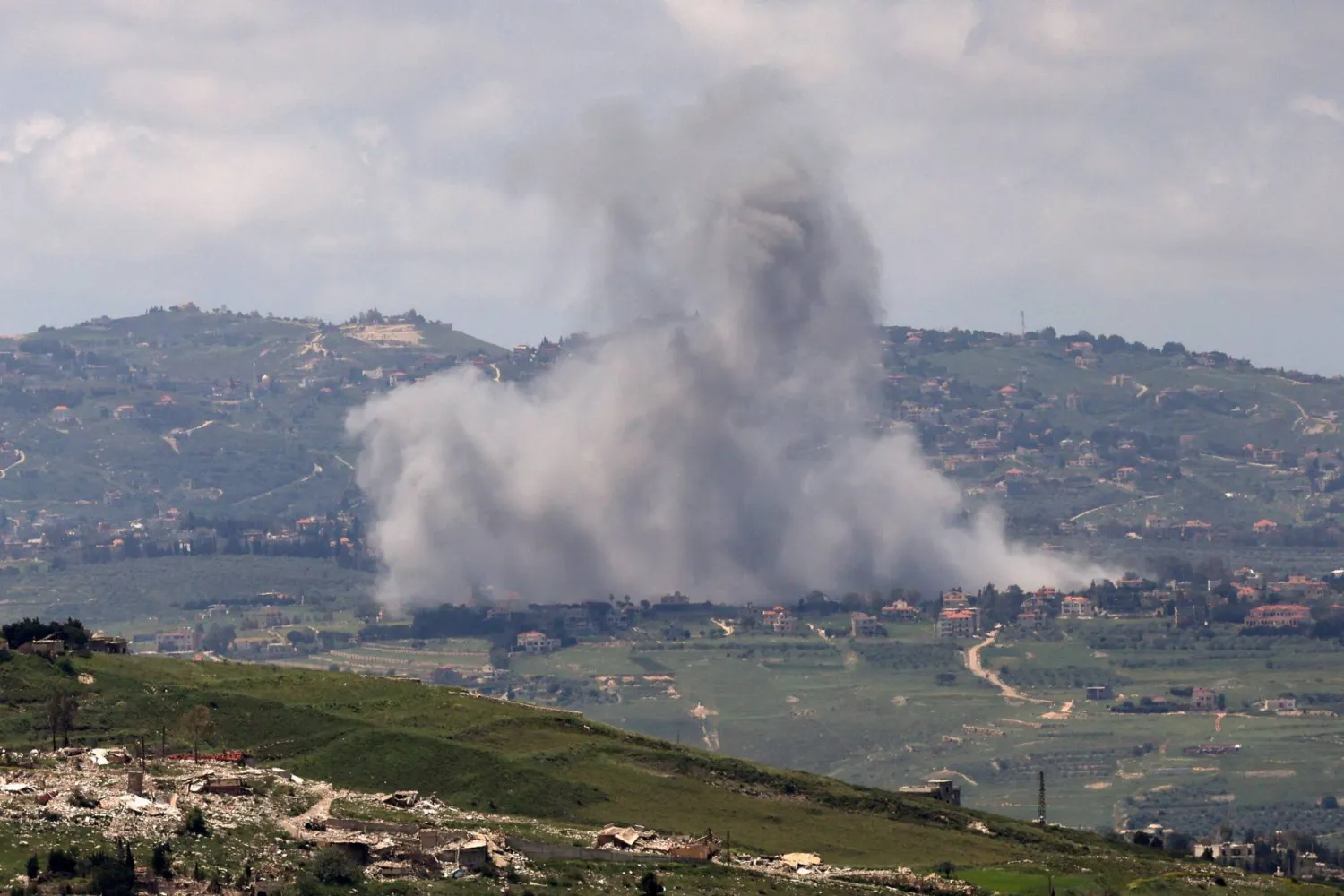
 Smoke rises following an explosion in southern Lebanon, near the Israel-Lebanon border, as seen from northern Israel, April 28, 2026. (Reuters)
Smoke rises following an explosion in southern Lebanon, near the Israel-Lebanon border, as seen from northern Israel, April 28, 2026. (Reuters)
TT

Israel Says Has ‘No Territorial Ambitions’ in Lebanon, Despite Evacuations

 Smoke rises following an explosion in southern Lebanon, near the Israel-Lebanon border, as seen from northern Israel, April 28, 2026. (Reuters)
Smoke rises following an explosion in southern Lebanon, near the Israel-Lebanon border, as seen from northern Israel, April 28, 2026. (Reuters)

Israel on Tuesday said it was not seeking to take territory in Lebanon, as its military issued a wave of new evacuation warnings for towns and villages in the battle-scarred south. 

"Israel has no territorial ambitions in Lebanon. Our presence... serves one purpose: protecting our citizens," Foreign Minister Gideon Saar told a news conference. 

"No country would be willing to live in such a way with a gun pointed to its head," he said as the military pressed its operations in Lebanon against Iran-backed Hezbollah. 

Shortly after a ceasefire with Hezbollah came into effect on April 17, Israel declared a so-called "Yellow Line" -- a strip of Lebanese territory around 10 kilometers (six miles) deep along the border within which Israeli troops are operating. 

"In a reality where Hezbollah and other terror organizations -- including Palestinian terror groups -- are dismantled, Israel will have no need to maintain its presence in these areas," he added. 

Despite the ceasefire, Israel and Hezbollah have both engaged in fighting, trading blame over violations of the fragile truce. 

Tuesday's evacuation warning was aimed at residents in more than a dozen villages and towns, urging them to immediately head northwards. 

"Out of concern for your safety, you are required to evacuate your homes immediately and move... towards the Sidon District," the military's Arabic-language spokesman Avichay Adraee wrote on X. 

Shortly afterwards, Lebanon's state media reported that Israel carried out airstrikes across the south, hitting targets including the named areas. 

It also said at least one Israeli demolition operation was taking place in the south. 

All the areas listed for evacuation appear to be outside or on the border of the "Yellow Line". 

In two incidents earlier on Tuesday, the military said it intercepted "a suspicious aerial target" in an area where troops were operating. 

It also said a soldier had been severely injured and another lightly hurt a day earlier "as a result of an explosive drone impact", branding it a new ceasefire violation by Hezbollah. 

Israeli Prime Minister Benjamin Netanyahu said Monday that Hezbollah's rockets and drones remained a key threat requiring ongoing military action. 

Hezbollah drew Lebanon into the Middle East war on March 2 by firing rockets towards Israel to avenge the killing of Iranian supreme leader Ali Khamenei.