


Two-State Solution Conference Prepares Roadmap with International Backing

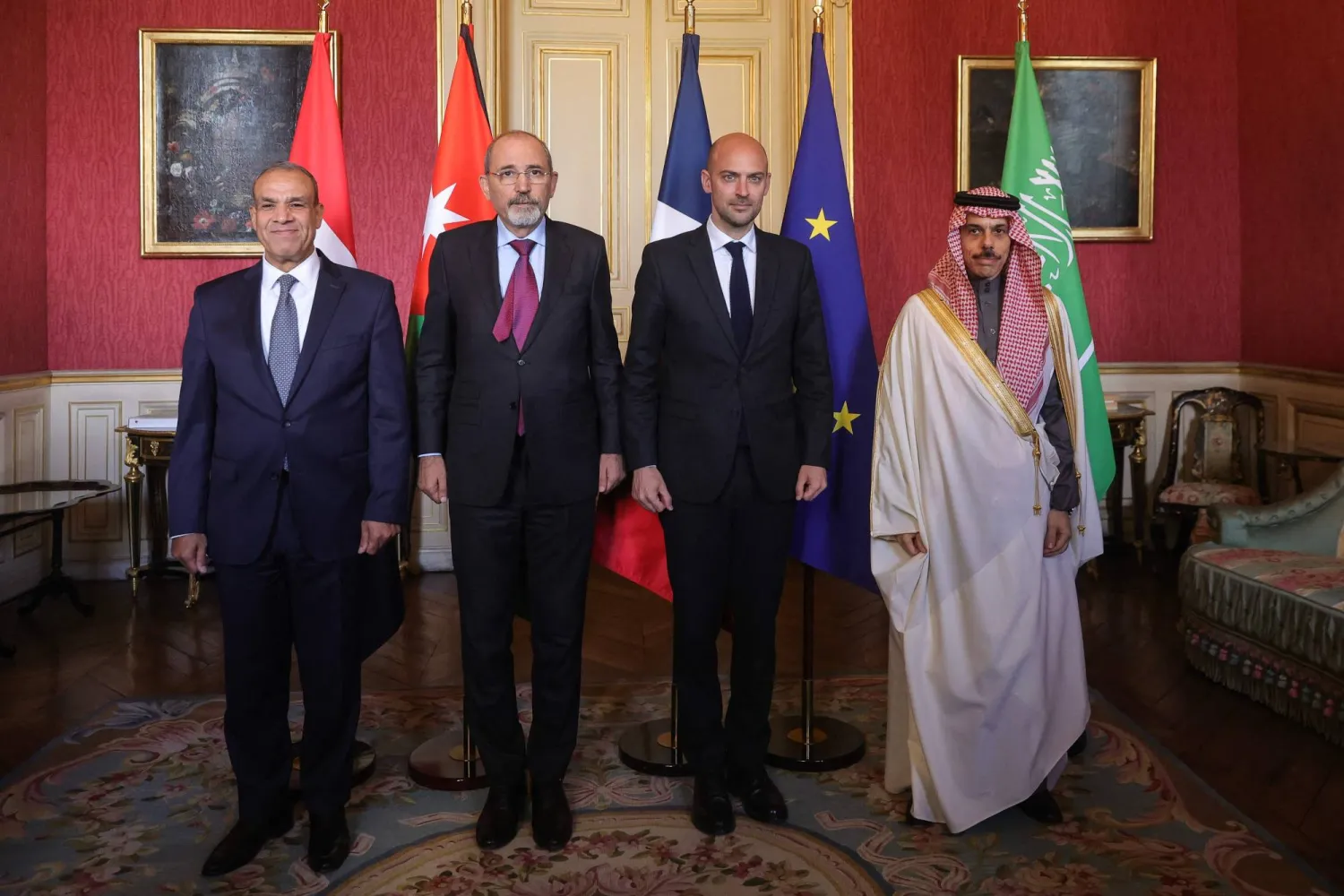
Foreign ministers of France, Saudi Arabia, Egypt, and Jordan preparing for the New York conference on the two-state solution to the Israeli-Palestinian conflict (AFP)
TT

Two-State Solution Conference Prepares Roadmap with International Backing

Foreign ministers of France, Saudi Arabia, Egypt, and Jordan preparing for the New York conference on the two-state solution to the Israeli-Palestinian conflict (AFP)

Preparations are underway for the “Two-State Solution Conference,” scheduled from June 17 to 20 and co-hosted by Saudi Arabia and France at the United Nations headquarters in New York.

The conference aims to produce a final document serving as a “roadmap” for establishing a Palestinian state. This roadmap will draw on the work of eight expert groups tasked with offering practical proposals on various dimensions of the Israeli-Palestinian conflict, including statehood, security, economics, humanitarian concerns, and sustaining any future peace agreement.

Key group chairs include Jordan and Spain on statehood, Italy and Indonesia on security, Norway and Japan on economic foundations, while the EU and the Arab League are overseeing proposals on the durability of peace. The structure reflects a broad international effort to tackle every major aspect of the conflict.

According to French diplomatic sources, the conference is driven by the urgency of reviving the two-state solution, now under severe threat due to the war in Gaza, the acceleration of Israeli settlement expansion, and the stated intentions of some Israeli leaders to reoccupy Gaza and displace its population.

France argues that the idea of indefinitely freezing or postponing the conflict is no longer viable. With military solutions failing, only a political resolution centered on mutual recognition and the creation of a Palestinian state offers a sustainable path forward.

French President Emmanuel Macron recently reaffirmed in Indonesia that the political route is the only path to lasting peace. He announced the conference as a platform to renew international momentum for recognizing both Palestine and Israel and affirming their right to coexist in peace and security.

The event operates on a principle of mutual recognition. It invites Western nations that have not yet recognized Palestine to do so, while also encouraging Arab and Islamic countries that have yet to recognize Israel to take steps toward normalization.

This approach recalls the 2002 Arab Peace Initiative, which proposed normalized relations with Israel in exchange for withdrawal from occupied territories and Palestinian statehood within 1967 borders.

The sources said that while full normalization is seen as unlikely in the short term, France views it as a process, not a one-time event. Recognition of Palestine is not presented as conditional on normalization with Israel but may come alongside statements of intent from Arab nations signaling readiness for future steps.

The sources added that the French government stresses that the conference is a starting point rather than a definitive solution. The goal is to reintroduce momentum for peace and back it with concrete proposals. Paris also emphasizes the need for Palestinian Authority reform and the disarmament of Hamas, aiming to ensure a credible Palestinian leadership.

Although Israel has threatened to annex parts of the West Bank in response to the growing recognition of Palestine, France remains firm in its belief that diplomatic recognition is a reward for peace-seeking actors, not for extremists, the diplomatic sources underlined.



Türkiye Begins Black Box Analysis of Jet Crash That Killed Libyan Military Chief and 7 Others

Libyan national flags fly at half-mast in Tripoli on December 24, 2025, after the head of Libya's armed forces and his four aides died in a plane crash in Türkiye. (AFP)
TT

Türkiye Begins Black Box Analysis of Jet Crash That Killed Libyan Military Chief and 7 Others

Libyan national flags fly at half-mast in Tripoli on December 24, 2025, after the head of Libya's armed forces and his four aides died in a plane crash in Türkiye. (AFP)

The technical analysis of the recovered black boxes from a jet crash that killed eight people, including western Libya’s military chief, began as the investigation proceeded in cooperation with Libyan authorities, the Turkish Ministry of Defense said Thursday.

The private jet with Gen. Muhammad Ali Ahmad al-Haddad, four other military officials and three crew members crashed on Tuesday after taking off from Türkiye’s capital, Ankara, killing everyone on board. Libyan officials said the cause of the crash was a technical malfunction on the plane.

The high-level Libyan delegation was on its way back to Tripoli after holding defense talks in Ankara aimed at boosting military cooperation between the two countries.

The wreckage was scattered across an area covering 3 square kilometers (more than a square mile), complicating recovery efforts, according to the Turkish Interior Minister Ali Yerlikaya.

A 22-person delegation, including five family members, arrived from Libya early on Wednesday to assist in the investigation.


Lebanese President: We are Determined to Hold Parliamentary Elections on Time

President Joseph Aoun between Prime Minister Nawaf Salam and Speaker Nabih Berri (Lebanese Presidency file photo)
TT

Lebanese President: We are Determined to Hold Parliamentary Elections on Time

President Joseph Aoun between Prime Minister Nawaf Salam and Speaker Nabih Berri (Lebanese Presidency file photo)

Lebanese President Joseph Aoun reiterated on Thursday that the country’s parliamentary elections are a constitutional obligation that must be carried out on time.

Lebanon’s state-run National News Agency quoted Aoun as saying that he, alongside Prime Minister Nawaf Salam and Parliament Speaker Nabih Berri, is determined to hold the elections on schedule.

Aoun also emphasized that diplomatic efforts have continued unabated to keep the specter of war at bay, noting that "things are heading in a positive direction".

The agency also cited Berri reaffirming that the elections will take place as planned, with "no delays, no extensions".

The Lebanese parliamentary elections are scheduled for May next year.


Israel Calls Countries Condemning New West Bank Settlements ‘Morally Wrong’

Newly constructed buildings are pictured in the Israeli settlement of Givat Zeev near the Palestinian city of Ramallah in the occupied West Bank on October 24, 2025. (AFP)
TT

Israel Calls Countries Condemning New West Bank Settlements ‘Morally Wrong’

Newly constructed buildings are pictured in the Israeli settlement of Givat Zeev near the Palestinian city of Ramallah in the occupied West Bank on October 24, 2025. (AFP)

Israel reacted furiously on Thursday to a condemnation by 14 countries including France and Britain of its approval of new settlements in the occupied West Bank, calling the criticism discriminatory against Jews.

"Foreign governments will not restrict the right of Jews to live in the Land of Israel, and any such call is morally wrong and discriminatory against Jews," Foreign Minister Gideon Saar said.

"The cabinet decision to establish 11 new settlements and to formalize eight additional settlements is intended, among other things, to help address the security threats Israel is facing."

On Sunday, Israel's far-right Finance Minister Bezalel Smotrich announced that authorities had greenlit the settlements, saying the move was aimed at preventing the establishment of a Palestinian state.

Fourteen countries, including Britain, France, Germany, Spain and Canada, then issued a statement urging Israel to reverse its decision, "as well as the expansion of settlements".

Such unilateral actions, they said, "violate international law", and risk undermining a fragile ceasefire in Gaza in force since October 10.

They also reaffirmed their "unwavering commitment to a comprehensive, just and lasting peace based on the two-state solution... where two democratic states, Israel and Palestine, live side-by-side in peace and security".

Israel has occupied the West Bank following the 1967 Arab-Israeli war.

Excluding east Jerusalem, which was occupied and annexed by Israel in 1967, more than 500,000 Israelis live in the West Bank, along with about three million Palestinian residents.

Earlier this month, the United Nations said the expansion of Israeli settlements in the West Bank, all of which are illegal under international law, had reached its highest level since at least 2017.