

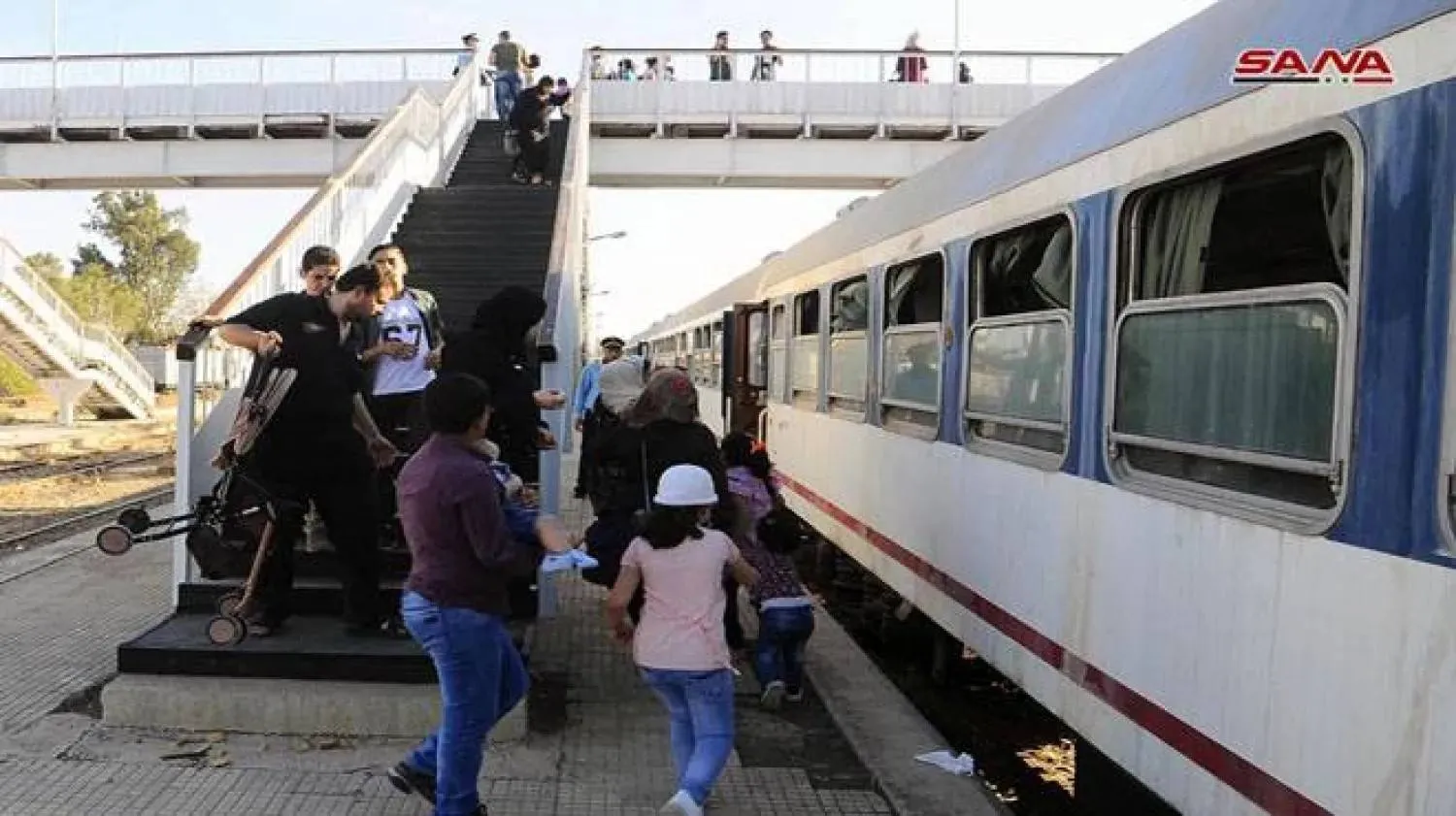

Syria, Jordan Seek to Restart Historic Hejaz Railway Line

Al-Qadam Train Station in Damascus – SANA
TT

Syria, Jordan Seek to Restart Historic Hejaz Railway Line

Al-Qadam Train Station in Damascus – SANA

Cooperation between Syria and Jordan in the fields of economy, trade, and transport has taken a significant leap forward since the fall of Bashar al-Assad’s regime late last year, with the latest development marked by an agreement to hold a meeting aimed at reviving the historic Hejaz railway line.

The joint Syrian-Jordanian technical committee on land transport concluded a two-day meeting in Amman on Wednesday, focusing on boosting bilateral relations, particularly in land transport, a vital sector supporting trade and people’s movement, Syria’s state news agency SANA reported.

A key topic was linking Damascus and Amman by rail. Both sides agreed to hold a soon-to-be-scheduled technical meeting with relevant authorities to explore the feasibility of reopening the Hejaz railway line, initially for freight transport.

The committee also agreed to reduce and unify transit fees to 2 percent in both countries, down from Jordan’s previous 5 percent charge. The Jordanian delegation underscored the importance of facilitating the passage of transit trucks across both territories and pledged to remove any technical or procedural obstacles to enhance trade flow and regional economic integration.

This renewed cooperation follows years of suspension due to the former Syrian regime’s policies.

Meanwhile, Syria’s General Authority for Land and Sea Borders announced on Wednesday it had reached an agreement with Jordanian authorities to cancel the $115 diesel tax previously imposed on Syrian trucks entering Jordanian territory, making the measure reciprocal.

In April, Zahi Khalil, Director-General of the Jordanian Hejaz Railway Foundation, announced plans to launch tourist train trips from Jordan to Syria, passing through historic stations along the border. The proposed route would start at Amman’s Hejaz station, pass through Zarqa and Mafraq, cross into Syria via the Jaber border, and terminate at Damascus’ Al-Qadam station, the last stop on the Hejaz line.

Khalil noted that Syrian counterparts would handle maintenance within Syria, while technical and security challenges, especially line interruptions inside Syria, are still being addressed.

The Hejaz railway, built during the reign of Ottoman Sultan Abdul Hamid II, is a 1,050- mm-wide gauge rail connecting Damascus to Madinah. Constructed between 1900 and 1908 to serve Muslim pilgrims and consolidate Ottoman control, it was operational until World War I, with construction costs initially estimated at 3.5 million Ottoman lira, supplemented by donations from within the empire and other Islamic countries.

The line’s route follows the traditional pilgrimage path from Syria’s Hauran region through Daraa into Jordan, continuing to Madinah, shortening pilgrimage travel time from 40 days by camel to just five days by rail.

The surge in Syria-Jordan cooperation in economic, trade, and transport sectors reflects a broader effort to reshape bilateral relations on economic grounds, aiming for sustained long-term collaboration after Assad’s fall.

In late May, Damascus and Amman inaugurated the “Higher Coordination Council” following a visit by Jordanian Foreign Minister Ayman Safadi to Syria, where he met with his Syrian counterpart, Asaad al-Shabaan. This came after Jordan’s Ministry of Industry, Trade, and Supply announced on February 27 the resumption of operations at the Syria-Jordan joint free zone.

In early June, Amman’s chambers of commerce president Khalil al-Haj al-Tawfiq reported a sharp rise in trade exchange with Syria, driven by economic openness and reconstruction efforts, describing trade figures as unprecedented.

Between mid-December 2024 and late May 2025, 55,566 trucks entered Jordan through the Jaber border crossing, including 30,154 Jordanian, 5,768 Syrian, and 19,644 foreign trucks. Outbound trucks totaled 59,788, comprising 21,574 exports and 36,805 transit trucks from other centers, with 1,409 empty trucks.

These developments follow a long period of border tension under the previous Syrian regime, when border areas became hubs for smuggling drugs, weapons, and militants. Such activities have declined since the regime’s downfall.

Abed Fadliya, an economics professor at Damascus University, told Asharq Al-Awsat newspaper that Syrian-Jordanian economic and trade ties have noticeably improved over recent months thanks to joint government efforts.

“Geographically, Jordan is one of Syria’s most important neighbors due to its openness and its role as a gateway for Syrian goods and people to most Arab countries, especially the Gulf states with which Syria maintains close cooperation across several sectors, particularly trade and investment,” Fadliya said.

He added that Jordan is among the key Arab countries that have distinguished relations with Syria, alongside Saudi Arabia, the UAE, and Qatar, emphasizing the need for sustained government efforts to cement these ties on a stable political foundation framed by bilateral agreements.



Türkiye’s Erdogan Says Discusses Syria, Gaza with Trump in 'Very Good' Call

US President Donald Trump, left, greets Turkish President Recep Tayyip Erdogan during a summit on Gaza in Sharm el-Sheikh on October 13, 2025. (AFP)
TT

Türkiye’s Erdogan Says Discusses Syria, Gaza with Trump in 'Very Good' Call

US President Donald Trump, left, greets Turkish President Recep Tayyip Erdogan during a summit on Gaza in Sharm el-Sheikh on October 13, 2025. (AFP)

Turkish President Recep Tayyip Erdogan discussed developments in Syria and Gaza in a call with US President Donald Trump, his office said on Wednesday, as Syria's ​Türkiye-backed government announced a ceasefire with US-allied Kurdish forces after days of clashes.

Syria's government this week seized swathes of territory in the northeast and gave the Kurdish-led Syrian Democratic Forces four days to agree on integrating into the central state.

The SDF's main ally, the United States, said in a statement that the partnership with the group had changed nature after Syria's ‌new government ‌emerged and urged the group to ‌accept.

"During ⁠the ​call, President ‌Erdogan stated that Türkiye was closely following developments in Syria, that Syria's unity, harmony and territorial integrity were important for Türkiye," the Turkish presidency said in a statement.

It added that Erdogan and Trump also discussed the battle with ISIS and "the situation of the ISIS prisoners in the Syrian prisons".

Türkiye deems the SDF a ⁠terrorist organization linked with the outlawed Kurdistan Workers Party (PKK), which has carried out a ‌four-decade insurgency against the Turkish state.

Ankara ‍has been engaged in a ‍peace process with the PKK, under which it says the ‍militant group - and its extensions - must disband and disarm.

Ankara, the main foreign backer of Syria's new government, has praised Damascus' advances against the SDF and repeatedly demanded that the group disband, disarm, and integrate into ​the Syrian state apparatus.

"Our President said that a Syria that is developing with all of its elements, is ⁠rid of terror and in peace will contribute to the region's stability," Erdogan's office said.

The two presidents also discussed developments in Gaza, it said, adding Erdogan told Trump that Türkiye would continue to work in coordination with its NATO ally the United States to achieve peace there.

Erdogan thanked Trump for inviting him to join the Board of Peace, it added.

Trump said earlier on Tuesday that he had a "very good call" with Erdogan, without elaborating, after having told reporters during a briefing prior to the meeting that the ‌discussions were going to be "very important".


Syria Gives Kurds Four Days to Accept Integration as US Signals End of Support

 A member of the Syrian army stands guard on the road towards Al-Hasakah, following the withdrawal of the Syrian Democratic Forces, Syria, January 20, 2026. (Reuters)
A member of the Syrian army stands guard on the road towards Al-Hasakah, following the withdrawal of the Syrian Democratic Forces, Syria, January 20, 2026. (Reuters)
TT

Syria Gives Kurds Four Days to Accept Integration as US Signals End of Support

 A member of the Syrian army stands guard on the road towards Al-Hasakah, following the withdrawal of the Syrian Democratic Forces, Syria, January 20, 2026. (Reuters)
A member of the Syrian army stands guard on the road towards Al-Hasakah, following the withdrawal of the Syrian Democratic Forces, Syria, January 20, 2026. (Reuters)

Syria's government set a four-day deadline on Tuesday for Kurdish-led forces to agree on integrating their last enclave into the central state as their former main ally, the United States, urged them to do so.

US envoy Tom Barrack in a social media post described integration as the "greatest opportunity" ‌the Kurds ‌now have in Syria.

He added that ‌the ⁠original purpose ‌of the Syrian Democratic Forces as a counterweight to ISIS militants had largely expired, and that the US had no long-term interest in retaining its presence in Syria, signaling the apparent end of Washington's backing.

The SDF, which has lost swathes of territory during government advances in ⁠recent days, said it accepted a ceasefire agreement with the Damascus government ‌and that it would not engage ‍in any military action ‍unless attacked.

A Syrian government statement said it had ‍reached an understanding with the SDF, long backed by the United States in the battle against ISIS, for it to devise an integration plan for Hasakah province or risk state forces entering two SDF-controlled cities.

The government announced a four-day ceasefire and said it had asked ⁠the SDF to submit the name of a candidate to take the role of assistant to the defense minister in Damascus as part of the integration.

The swift reversal for the SDF along one of Syria's main faultlines marks the biggest shift in territorial control in Syria since Sharaa toppled President Bashar al-Assad in 2024 and raises questions over the security of facilities holding ISIS detainees.


Israel Orders Gaza Families to Move in First Forced Evacuation Since Ceasefire

A Palestinian girl walks past the rubble of houses destroyed in Israeli strikes during the war, in Khan Younis, southern Gaza Strip, January 17, 2026. (Reuters)
TT

Israel Orders Gaza Families to Move in First Forced Evacuation Since Ceasefire

A Palestinian girl walks past the rubble of houses destroyed in Israeli strikes during the war, in Khan Younis, southern Gaza Strip, January 17, 2026. (Reuters)

Israeli forces have ordered dozens of Palestinian families in the southern Gaza Strip to leave their homes in the first forced evacuation since October's ceasefire, as residents and Hamas said on Tuesday the military was ​expanding the area under its control.

Residents of Bani Suhaila, east of Khan Younis, said the leaflets were dropped on Monday on families living in tent encampments in the Al-Reqeb neighborhood.

“Urgent message. The area is under Israeli army control. You must evacuate immediately,” said the leaflets, written in Arabic, Hebrew, and English, which the army dropped over the Al-Reqeb neighborhood in the town of Bani Suhaila.

In the two-year war before the US brokered ceasefire was signed in October, Israel dropped leaflets over areas that were subsequently raided or bombarded, forcing some families to move several times.

Residents and a source from the Hamas group said this was the first time they had been ‌dropped since then. ‌The Israeli military did not immediately respond to a request for comment.

SIDES FAR ‌APART ⁠ON ​NEXT PHASES

The ‌ceasefire has not progressed beyond its first phase, under which major fighting has stopped, Israel withdrew from less than half of Gaza, and Hamas released hostages in return for Palestinian detainees and prisoners.

Virtually the entire population of more than 2 million people are confined to around a third of Gaza's territory, mostly in makeshift tents and damaged buildings, where life has resumed under control of an administration led by Hamas.

Israel and Hamas have accused each other of major breaches of the ceasefire and remain far apart on the more difficult steps planned for the next phase.

Mahmoud, a resident from the ⁠Bani Suhaila area, who asked not to give his family name, said the evacuation orders impacted at least 70 families, living in tents and homes, ‌some of which were partially damaged, in the area.

"We have fled ‍the area and relocated westward. It is maybe the ‍fourth or fifth time the occupation expanded the yellow line since last month," he told Reuters by phone ‍from Khan Younis, referring to the line behind which Israel has withdrawn.

"Each time they move it around 120 to 150 meters (yards) inside the Palestinian-controlled territory, swallowing more land," the father-of-three said.

HAMAS CITES STATE OF HUMANITARIAN DISRUPTION

Ismail Al-Thawabta, director of the Hamas-run Gaza government media office, said the Israeli military had expanded the area under its control in eastern Khan Younis five times since ​the ceasefire, forcing the displacement of at least 9,000 people.

“On Monday, 19 January 2026, the Israeli occupation forces dropped warning leaflets demanding the forced evacuation of the Bani Suhaila area in eastern ⁠Khan Younis Governorate, in a measure that falls within a policy of intimidation and pressure on civilians,” Thawabta told Reuters.

He said the new evacuation orders affected approximately 3,000 people.

“The move created a state of humanitarian disruption, increased pressure on the already limited shelter areas, and further deepened the internal displacement crisis in the governorate,” Thawabta added.

Israel's military has previously said it has opened fire after identifying what it called "terrorists" crossing the yellow line and approaching its troops, posing an immediate threat to them.

It has continued to conduct air strikes and targeted operations across Gaza. The Israeli military has said it views "with utmost severity" any attempts by militant groups in Gaza to attack Israel.

Under future phases of the ceasefire that have yet to be hammered out, US President Donald Trump's plan envisages Hamas disarming, Israel pulling out further, and an internationally backed administration rebuilding Gaza.

More than 460 Palestinians and three Israeli soldiers have been reported killed since the ceasefire took ‌effect.

Israel launched its operations in Gaza in the wake of an attack by Hamas-led fighters in October 2023 which killed 1,200 people, according to Israeli tallies. Israel's assault has killed 71,000 people, according to health authorities in the enclave.