


Israel Will Send Ceasefire Negotiating Team to Qatar a Day Before Trump and Netanyahu Meet

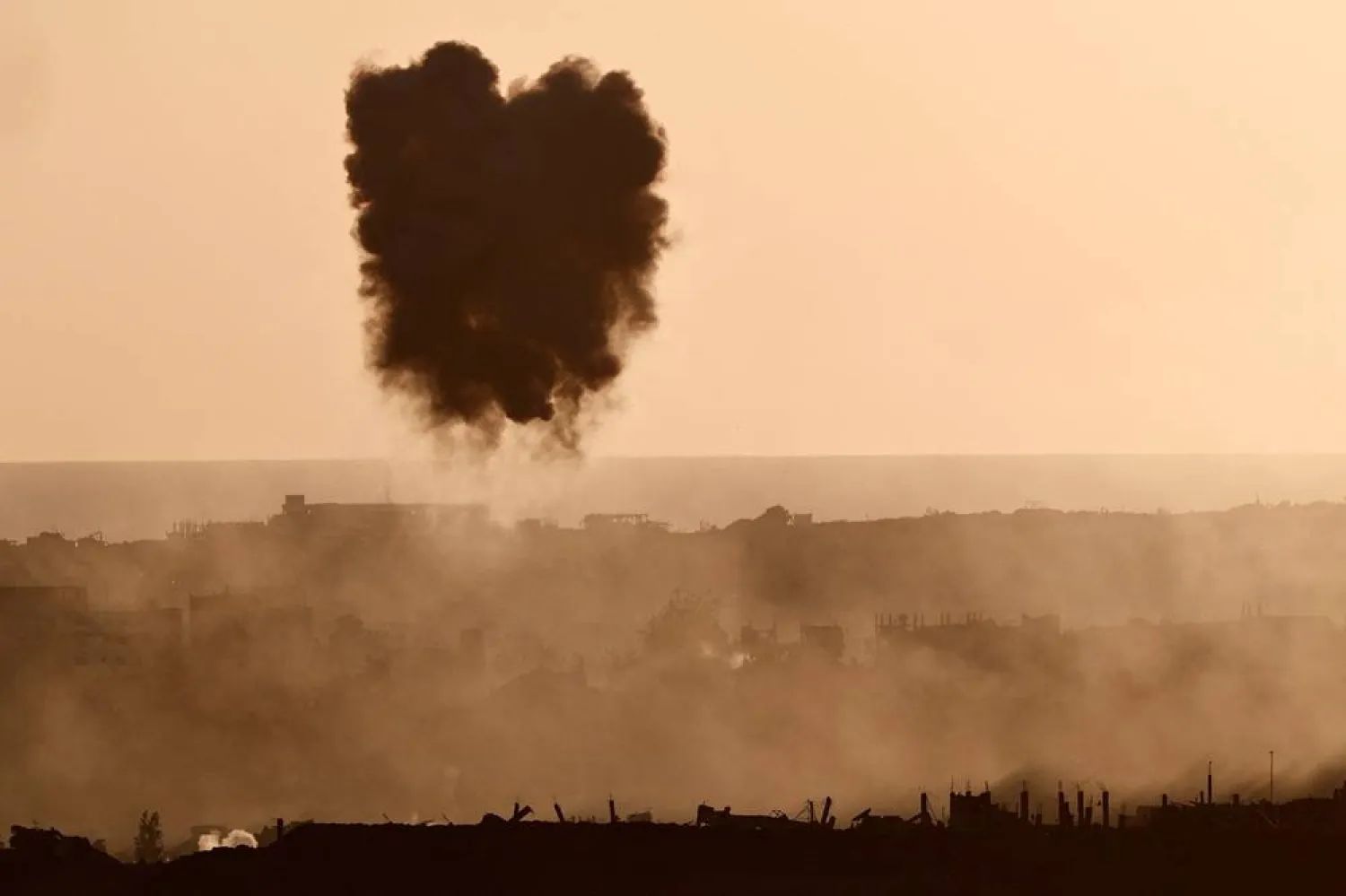
 Smoke rises in Gaza following a military strike, as seen from the Israeli side of the border, July 5, 2025. (Reuters)
Smoke rises in Gaza following a military strike, as seen from the Israeli side of the border, July 5, 2025. (Reuters)
TT

Israel Will Send Ceasefire Negotiating Team to Qatar a Day Before Trump and Netanyahu Meet

 Smoke rises in Gaza following a military strike, as seen from the Israeli side of the border, July 5, 2025. (Reuters)
Smoke rises in Gaza following a military strike, as seen from the Israeli side of the border, July 5, 2025. (Reuters)

US-led ceasefire efforts in Gaza appeared to gain momentum Saturday after nearly 21 months of war, as Prime Minister Benjamin Netanyahu ’s office said Israel on Sunday will send a negotiating team to talks in Qatar.

The statement also asserted that Hamas was seeking “unacceptable” changes to the proposal. US President Donald Trump has pushed for an agreement and will host Netanyahu at the White House on Monday to discuss a deal.

Inside Gaza, Israeli airstrikes killed 14 Palestinians and another 10 were killed while seeking food aid, hospital officials in the embattled enclave told The Associated Press. And two American aid workers with the Israel-backed Gaza Humanitarian Foundation were injured in an attack at a food distribution site, which the organization blamed on Hamas, without providing evidence.

Weary Palestinians expressed cautious hope after Hamas gave a “positive” response late Friday to the latest US proposal for a 60-day truce but said further talks were needed on implementation.

“We are tired. Enough starvation, enough closure of crossing points. We want to sleep in calm where we don’t hear warplanes or drones or shelling,” said Jamalat Wadi, one of Gaza's hundreds of thousands of displaced people, speaking in Deir al-Balah. She squinted in the sun during a summer heatwave of over 30 degrees Celsius (86 degrees Fahrenheit).

Hamas has sought guarantees that the initial truce would lead to a total end to the war and withdrawal of Israeli troops from Gaza. Previous negotiations have stalled over Hamas demands of guarantees that further negotiations would lead to the war’s end, while Netanyahu has insisted Israel would resume fighting to ensure the militant group's destruction.

“Send a delegation with a full mandate to bring a comprehensive agreement to end the war and bring everyone back. No one must be left behind,” Einav Zangauker, mother of hostage Matan Zangauker, told the weekly rally by relatives and supporters in Tel Aviv.

A Palestinian doctor and his three children killed Israeli airstrikes struck tents in the crowded Muwasi area on Gaza’s Mediterranean coast, killing seven people including a Palestinian doctor and his three children, according to Nasser Hospital in the southern city of Khan Younis.

Four others were killed in the town of Bani Suheila in southern Gaza. Three people were killed in three strikes in Khan Younis. Israel's army did not immediately comment.

Separately, eight Palestinians were killed near a GHF aid distribution site in the southern city of Rafah, the hospital said. One Palestinian was killed near another GHF point in Rafah. It was not clear how far the Palestinians were from the sites.

GHF denied the killings happened near their sites. The organization has said no one has been shot at its sites, which are guarded by private contractors and can be accessed only by passing Israeli military positions hundreds of meters (yards) away.

The army had no immediate comment but has said it fires warning shots as a crowd-control measure and only aims at people when its troops are threatened.

Another Palestinian was killed waiting in crowds for aid trucks in eastern Khan Younis, officials at Nasser Hospital said. The United Nations and other international organizations have been bringing in their own supplies of aid since the war began. The incident did not appear to be connected to GHF operations.

Much of Gaza's population of over 2 million now relies on international aid after the war has largely devastated agriculture and other food sources and left many people near famine. Crowds of Palestinians often wait for trucks and unload or loot their contents before they reach their destinations. The trucks must pass through areas under Israeli military control. Israel's military did not immediately comment.

American aid workers injured The GHF said the two American aid workers were injured on Saturday morning when assailants threw grenades at a distribution site in Khan Younis. The foundation said the injuries were not life-threatening. Israel's military said it evacuated the workers for medical treatment.

The GHF — a US- and Israeli-backed initiative meant to bypass the UN — distributes aid from four sites that are surrounded by Israeli troops. Three sites are in Gaza's far south.

The UN and other humanitarian groups have rejected the GHF system, saying it allows Israel to use food as a weapon, violates humanitarian principles and is not effective. Israel says Hamas has siphoned off aid delivered by the UN, a claim the UN denies. Hamas has urged Palestinians not to cooperate with the GHF.

GHF, registered in Delaware, began distributing food in May to Palestinians, who say Israeli troops open fire almost every day toward crowds on roads heading to the distribution points.

Several hundred people have been killed and hundreds more wounded, according to Gaza’s Health Ministry and witnesses. The UN human rights office says it has recorded 613 Palestinians killed within a month in Gaza while trying to obtain aid, most of them while trying to reach GHF sites.

The war began when Hamas attacked Israel on Oct. 7, 2023, killing some 1,200 people and taking 251 others hostage.

Israel responded with an offensive that has killed over 57,000 Palestinians, more than half of them women and children. according to Gaza's Health Ministry, which is led by medical professionals employed by the Hamas government. It does not differentiate between civilians and combatants, but the UN and other international organizations see its figures as the most reliable statistics on war casualties.



Israeli Defense Minister: We Will Never Withdraw our Forces from Gaza

Israeli Defense Minister Israel Katz. (dpa)
TT

Israeli Defense Minister: We Will Never Withdraw our Forces from Gaza

Israeli Defense Minister Israel Katz. (dpa)

Israeli Defense Minister Israel Katz said on Tuesday that Israel “will never withdraw from the Gaza Strip,” announcing that new settlement outposts will be established in the northern part of the enclave “when the appropriate time comes.”

Israeli media reported that Katz made the remarks during a ceremony held in Beit El, stating: “We will do this in the right way and at the right time. There will be those who protest, but we are ministers.”


A Shaky Start for Lebanon’s Financial Gap Bill

Depositors hold protest banners against the draft deposit recovery law during popular demonstrations on the road to the Presidential Palace (Asharq Al-Awsat). 
TT

A Shaky Start for Lebanon’s Financial Gap Bill

Depositors hold protest banners against the draft deposit recovery law during popular demonstrations on the road to the Presidential Palace (Asharq Al-Awsat). 

A widening wave of objections in Lebanon to the draft “financial gap” bill has exposed the hurdles facing its passage in parliament.

Prepared by a ministerial and legal committee chaired by Prime Minister Nawaf Salam, the bill has drawn resistance from influential political and sectoral actors, bolstering the opposition voiced by depositors’ associations and the banking lobby.

Conflicting ministerial positions ahead of Monday’s special cabinet session to review the final draft underscore the sharp disputes likely to intensify once the bill is formally sent to parliament, a senior financial official told Asharq Al-Awsat.

With parliamentary elections due next spring, candidates are wary of confronting voters or powerful interest groups.

According to the government’s forthcoming brief, the bill marks the end of years of disorder and the start of a clear path to restore rights, protect social stability, and rebuild confidence in the financial system after six years of paralysis, silent erosion of deposits, and crisis mismanagement.

It is framed not as a narrow technical fix, but as a strategic shift, from denying losses and letting them fall haphazardly, to acknowledging and organizing them within an enforceable legal framework.

The government argues the plan would protect about 85% of depositors by enabling access to a guaranteed portion of savings, up to $100,000 over four years, while preserving the nominal value of all deposits via central bank–guaranteed bonds maturing in 10, 15, and 20 years.

Banks, however, have openly declared their “fundamental reservations and strong objection” to the bill on financial regularization and deposit treatment.

Professional associations and unions have joined depositors’ groups in opposing proposals they say would load the bulk of losses onto depositors, either through direct haircuts or by stretching repayment over one to two decades.

The Beirut Order of Engineers added its voice, warning that the near-final draft manages collapse rather than delivers reform, distributing losses unfairly at the expense of depositors and productive sectors, and failing to explicitly protect union funds.

Legal objections have also surfaced over provisions with retroactive effect, taxes, levies, and accounting adjustments applied to transfers made after the crisis erupted in autumn 2019, as well as to past deposit returns.

Banks say such measures constitute an unjustified infringement of rights and lack sound legal and financial grounding or precedent.

The financial official noted that these retroactive elements could be challenged before the State Council, as they contradict the principle that laws apply only after promulgation. Most transactions, he added, were conducted under then-valid laws and central bank approvals.

By contrast, previous governments compelled the central bank to spend more than $11 billion on poorly controlled subsidies, much of which was smuggled abroad, notably to Syrian markets.

Banks insist that any credible solution must begin with a precise, transparent assessment of the financial gap at the Central Bank, based on audited, unified accounts and realistic financial modeling.

They argue that the plan effectively wipes out banks’ capital and - under loss-sharing rules set by Law 23/2025 - ultimately hits depositors, while the state avoids settling its debts to the central bank or covering its balance-sheet shortfall.


Gazans Fear Renewed Displacement after Israeli Strikes

This overview shows a destroyed mosque and other buildings in Khan Younis in the southern Gaza Strip on October 7, 2024 on the first anniversary of the ongoing war in the Palestinian territory between Israel and Hamas. (AFP)
TT

Gazans Fear Renewed Displacement after Israeli Strikes

This overview shows a destroyed mosque and other buildings in Khan Younis in the southern Gaza Strip on October 7, 2024 on the first anniversary of the ongoing war in the Palestinian territory between Israel and Hamas. (AFP)

When her children, trembling with fear, ask where the family can go to escape Israel's continued bombardment in southern Gaza's Khan Yunis area, Umm Ahmed has no answer.

In her small, devastated village near Khan Yunis city, recent Israeli drone and artillery strikes shattered the tenuous sense of peace delivered by a ceasefire that has largely held since October 10, AFP said.

Residents say the strikes have targeted neighborhoods east of the so-called Yellow Line -- a demarcation established under the truce between Israel and Hamas.

The Israeli military says its troops are deployed in the area in accordance with the ceasefire framework, accusing Hamas militants of "crossing the Yellow Line and carrying out terrorist activities".

More than two years after Hamas's October 7 attack on Israel sparked a devastating war, tens of thousands of Gazans still live in tents or damaged homes in these areas, where the Israeli army maintains control and operates checkpoints.

Now, many fear being forced from their homes, compelled to move west of the Yellow Line.

"We don't sleep at night because of fear. The bombardments in the east are relentless," said Umm Ahmed, 40.

"My children tremble at every explosion and ask me, 'Where can we go?' And I have no answer."

Her home in Bani Suheila has been completely destroyed, yet the family has stayed, pitching a tent beside the ruins.

"Staying close to our destroyed home is easier than facing the unknown," Umm Ahmed said.

Crossing the Yellow Line to Al-Mawasi, west of Khan Yunis, is not an option for them.

There, makeshift camps stretch as far as the eye can see, housing tens of thousands of Palestinians who fled the fighting.

"There is no place left for anyone there, and not enough food or water," Umm Ahmed said, as Gaza remains trapped in a catastrophic humanitarian crisis.

- 'We will not leave' -

The Israeli military blames continued threats from the Hamas group for its actions in the area.

The Israeli military said in a statement to AFP that the army’s “current operations in Gaza, and their deployment in the Yellow Line area in particular, are carried out to address direct threats from terrorist organizations in Gaza.”

The war in Gaza began with Hamas's attack on Israel on October 7, 2023 that resulted in the deaths of 1,221 people, mostly civilians, according to an AFP tally based on official Israeli figures.

Since the war began, more than 70,000 people have been killed in Gaza, according to the Hamas-run territory's health ministry.

The vast majority of Gaza's more than two million residents were displaced during the war, many multiple times.

A fragile ceasefire has been in place since October 10, though both sides regularly accuse each other of violations.

Under the truce, Israeli forces withdrew to positions east of the Yellow Line.

Earlier this month, Israeli army chief Lieutenant General Eyal Zamir described the Yellow Line as the "new border line" with Israel.

"The Yellow Line is a new border line -- serving as a forward defensive line for our communities and a line of operational activity," he said to reserve soldiers in Gaza.

For Palestinian officials, the line is seen as a tool for permanent displacement.

"The objective is to frighten residents, expel them from their areas, and force them west," said Alaa al-Batta, mayor of Khan Yunis, denouncing the bombardments as "violations of the ceasefire agreement".

Mahmud Baraka, 45, from Khuzaa, east of Khan Yunis, described constant artillery fire and home demolitions in the area.

"It feels like we are still living in a war zone," he said.

"Explosions happen as if they are right next to us. The objective of the occupation is clear: to intimidate us and drive us out, so the region is emptied."

For now, residents feel trapped between bombardment and displacement, uncertain how long they can endure.

Despite the danger, Abdel Hamid, 70, refuses to leave his home located north of Khan Yunis, where he lives with his five children.

"We will not leave... this is our land," he said.

"Moving would not be a solution, but yet another tragedy."