

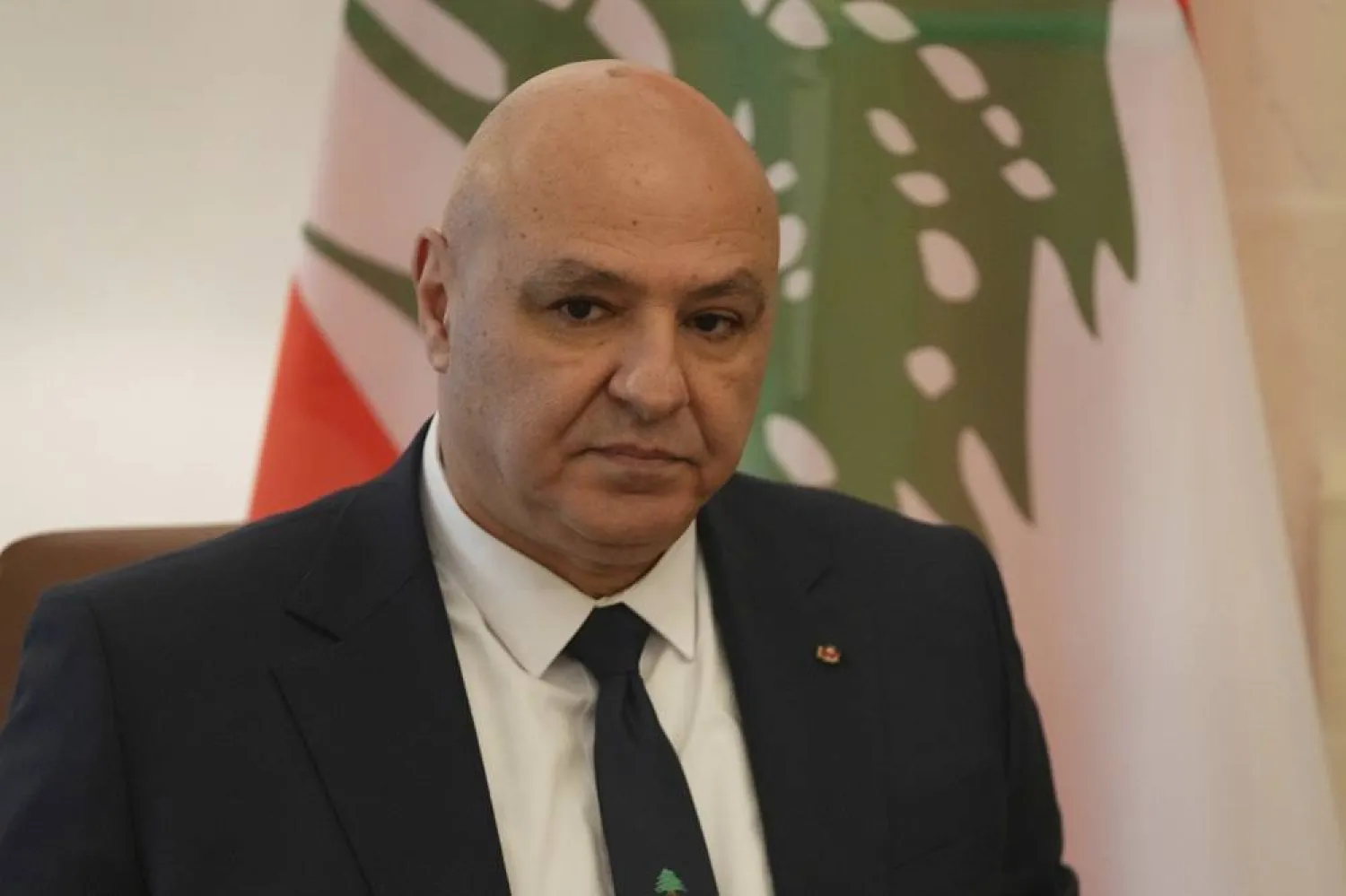

Lebanon’s President Reveals the Country’s Stance on Relations with Israel

 Lebanese President Joseph Aoun looks on during a meeting with Cyprus' President Nikos Christodoulides at the Presidential Palace in the capital Nicosia, Cyprus, Wednesday, July 9, 2025. (AP)
Lebanese President Joseph Aoun looks on during a meeting with Cyprus' President Nikos Christodoulides at the Presidential Palace in the capital Nicosia, Cyprus, Wednesday, July 9, 2025. (AP)
TT

Lebanon’s President Reveals the Country’s Stance on Relations with Israel

 Lebanese President Joseph Aoun looks on during a meeting with Cyprus' President Nikos Christodoulides at the Presidential Palace in the capital Nicosia, Cyprus, Wednesday, July 9, 2025. (AP)
Lebanese President Joseph Aoun looks on during a meeting with Cyprus' President Nikos Christodoulides at the Presidential Palace in the capital Nicosia, Cyprus, Wednesday, July 9, 2025. (AP)

Lebanon has no plans to have normal relations with Israel at the present time, and Beirut’s main aim is to reach a “state of no war” with its southern neighbor, the country’s president said Friday.

President Joseph Aoun’s comments came as the Trump administration is trying to expand the Abraham Accords signed in 2020 in which Israel signed historic pacts with United Arab Emirates and Bahrain.

In May, Syrian President Ahmed al-Sharaa said during a visit to France that his country is holding indirect talks with Israel to prevent military activities along their border from going out of control. Talks about peace between Israel and Syria have increased following the ouster of President Bashar al-Assad from power in December.

Aoun added in comments released by his office that only the Lebanese state will have weapons in the future, and the decision on whether Lebanon would go to war or not would be for the Lebanese government.

Aoun’s comments were an apparent reference to the armed Hezbollah group that fought a 14-month war with Israel, during which it suffered major blows including the killing of some of its top political and military commanders.

Hezbollah says it has ended its armed presence near the border with Israel, but is refusing to disarm in the rest of Lebanon before Israel withdraws from five overlooking border points and ends its almost daily airstrikes on Lebanon.

Earlier this week, US envoy Tom Barrack met with Lebanese leaders in Beirut, saying he was satisfied with the Lebanese government’s response to a proposal to disarm Hezbollah.

Hezbollah’s weapons have been one of the principal sticking points since Israel withdrew from southern Lebanon in 2000. Since then, Hezbollah fought two wars with Israel, one in 2006, and the other starting a day after the Hamas-led attack on southern Israel on Oct. 7, 2023, which triggered the war in Gaza.

The Hezbollah-Israel war, which ended with a US-brokered ceasefire in November, left more than 4,000 people dead in Lebanon and caused destruction estimated at $11 billion. In Israel, 127 people, including 80 soldiers, were killed during the war.

“Peace is the state of no war and this is what is important for us in Lebanon at the present time,” Aoun was quoted as telling visitors on Friday. He added that “the matter of normalization (with Israel) is not included in Lebanon’s current foreign policy.”

Lebanon and Israel have been at a state of war since 1948.


Israeli Strikes in South Lebanon Kill Two

Smoke rises from the site of an Israeli airstrike that targeted the village of Sohmor, in southern Lebanon on January 15, 2026. (Photo by Rabih DAHER / AFP)
TT

Israeli Strikes in South Lebanon Kill Two

Smoke rises from the site of an Israeli airstrike that targeted the village of Sohmor, in southern Lebanon on January 15, 2026. (Photo by Rabih DAHER / AFP)

An Israeli strike on south Lebanon killed one person on Friday, the health ministry in Beirut said a day after raids that Israel said had targeted Hezbollah.

Israel has kept up regular strikes in Lebanon despite a November 2024 ceasefire that sought to end more than a year of hostilities with Hezbollah, usually saying it is targeting members of the group or its infrastructure.

In a statement, the health ministry said an "Israeli enemy strike" on a vehicle in Mansuri in south Lebanon killed one person.

According to AFP, it also said that a strike on Mayfadun in south Lebanon the previous night killed one person.

Israel said Thursday's attack killed a Hezbollah member it alleged "took part in attempts to reestablish Hezbollah's infrastructure in the Zawtar al-Sharqiyah area.”

The attacks come a week after Lebanon's military said it had completed disarming Hezbollah south of the Litani River, the first phase of a nationwide plan, although Israel has called those efforts insufficient.

On Thursday, Israel carried out several strikes against eastern Lebanon's Bekaa region, north of the Litani, after issuing warnings to evacuate.

United Nations peacekeepers, deployed in the south to separate Lebanon from Israel, said on Friday that an Israeli drone "dropped a grenade" on its troops.

On Monday, the peacekeeping force said an Israeli tank fired near its troops, and warned that such incidents were becoming "disturbingly common".


Syria's Leader Sharaa in Berlin on Tuesday, Says German Presidency

Syria's President Ahmed al-Sharaa.
TT

Syria's Leader Sharaa in Berlin on Tuesday, Says German Presidency

Syria's President Ahmed al-Sharaa.

Syria's President Ahmed al-Sharaa will be visiting Berlin next Tuesday and meet his German counterpart Frank-Walter Steinmeier, the German presidency said.

The office of Chancellor Friedrich Merz has yet to announce whether they would also hold talks during the visit, which comes at a time when the German government is seeking to step up repatriations of Syrians to their homeland.


US Envoy Opens File on Funds Smuggled from Iraq

Iraqis burn pictures of US President Donald Trump and Israeli Prime Minister Benjamin Netanyahu outside the Iranian consulate in Basra, January 13, 2026 (Reuters). 
TT

US Envoy Opens File on Funds Smuggled from Iraq

Iraqis burn pictures of US President Donald Trump and Israeli Prime Minister Benjamin Netanyahu outside the Iranian consulate in Basra, January 13, 2026 (Reuters). 

Iraqi politicians and observers warn of the potential fallout from a comprehensive review of suspicious financial transactions in Iraq as promised by US envoy Mark Savaya.

Meanwhile, a surprise decision by Iraqi Prime Minister Mohammed Shia al-Sudani, the leading vote-getter in the elections, to relinquish his right to form a government in favor of runner-up Nouri al-Maliki continues to cast a shadow over the leadership of the Coordination Framework, the umbrella alliance of Shiite political forces.

Savaya, who was praised on Wednesday by US President Donald Trump for having done “a great job in Iraq,” announced on Thursday the launch of a comprehensive review of suspicious payments and financial transactions in Iraq.

The review will be conducted in cooperation with the US Treasury Department and the Office of Foreign Assets Control, alongside discussions on potential sanctions targeting networks that undermine financial integrity and finance terrorist activities.

Savaya has not yet made an official visit to Baghdad since assuming his role as presidential envoy to Iraq, although he previously visited the country in a personal capacity. He is of Christian Iraqi origin, and his family left Iraq in the 1990s.

In a statement, Savaya said he was meeting with the US Treasury Department and OFAC to discuss key challenges and reform opportunities in Iraq’s state-owned and private banks, with a particular focus on strengthening financial governance, compliance, and institutional accountability.

According to the statement, both sides agreed to conduct a comprehensive review of records related to suspicious payments and financial transactions involving Iraqi institutions, companies, and individuals linked to smuggling operations, money laundering, and fraudulent contracts and financial projects that fund and enable terrorist activities.

Discussions also included next steps regarding potential sanctions against entities and networks that undermine financial integrity and state authority.

Savaya said relations between Iraq and the United States have never been stronger than they are today under Trump’s leadership.

Iraqi politician and former electricity minister Luay al-Khatteeb told Asharq Al-Awsat that Savaya’s message aligns with statements made by the US chargé d’affaires during his shuttle meetings with political bloc leaders regarding Washington’s official stance should a parliamentary majority vote in favor of undesirable figures.

Al-Khatteeb said the Coordination Framework must act with intelligence, seriousness, and realism by selecting credible figures who exceed US administration expectations and command international respect.

He warned that Iraq’s political scene is deeply unsettled and that the economy is in its worst condition, heading toward collapse if Shiite leaders continue clinging to failed policies and appointing ineffective and internationally unacceptable figures.

“The choices of the Coordination Framework,” he said, “will be the official response and message to the international community - and especially to the US administration - either yielding rewards or exacting a heavy price.”
