
Tribal Leader Says Evacuations from Syria’s Sweida are ‘Temporary’

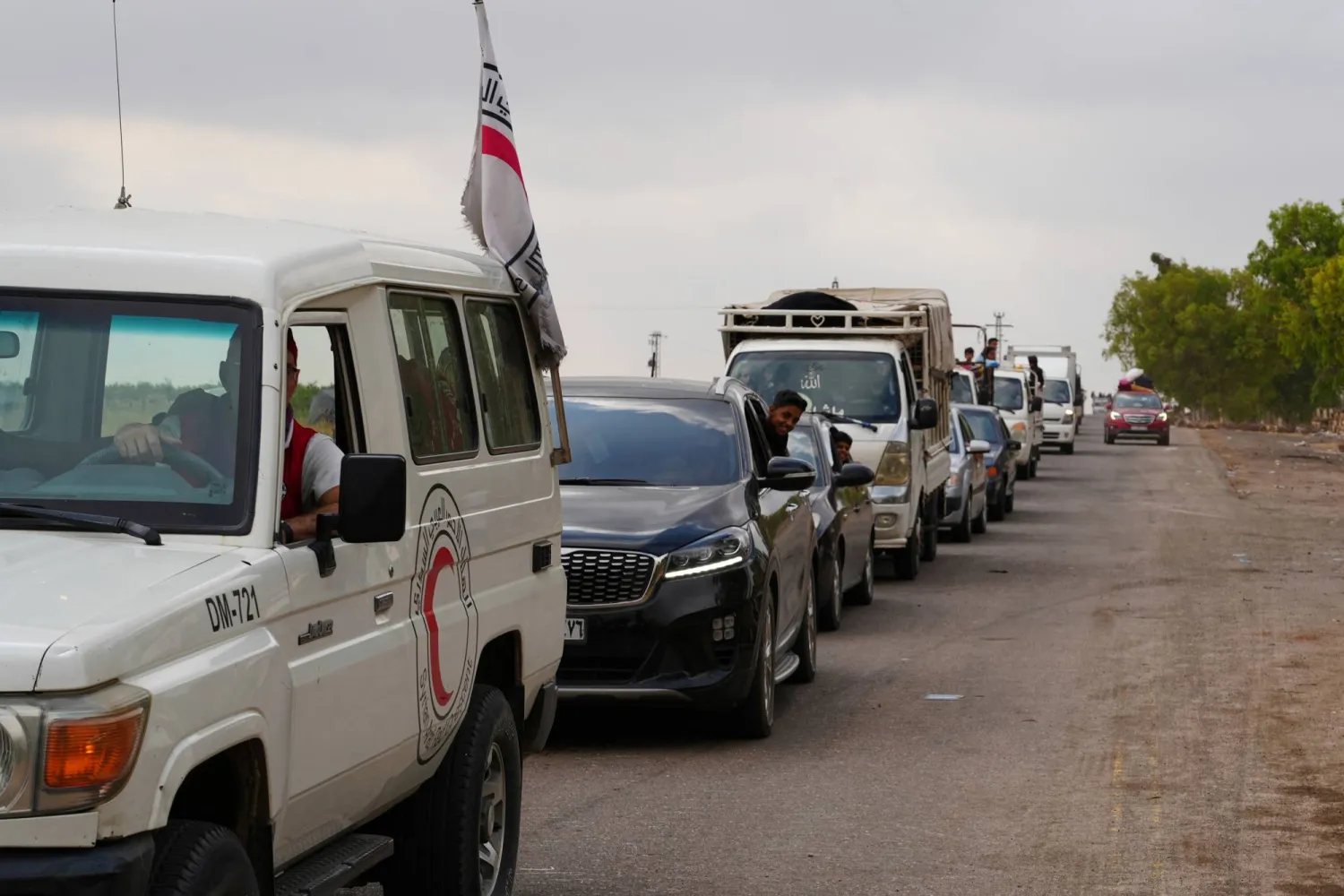
Syrian Bedouin families ride in a convoy led by Red Crescent vehicles in Busra al-Harir, heading to Daraa after being evacuated from Sweida following more than a week of violent clashes, Monday, July 21, 2025. (AP Photo/Malek Khattab)
TT

Tribal Leader Says Evacuations from Syria’s Sweida are ‘Temporary’

Syrian Bedouin families ride in a convoy led by Red Crescent vehicles in Busra al-Harir, heading to Daraa after being evacuated from Sweida following more than a week of violent clashes, Monday, July 21, 2025. (AP Photo/Malek Khattab)

Hundreds of Bedouin civilians were bussed out of Syria’s mainly Druze city of Sweida on Monday under a US-backed ceasefire aimed at halting days of fighting between Bedouin tribesmen and Druze militants that witnesses said has killed scores of people.

The head of Syria’s Supreme Council of Tribes and Clans said on Monday that hundreds of the Arab families who began leaving the southern city of Sweida were undertaking a “temporary displacement” to allow the army to secure the area, rejecting accusations of a wholesale forced exodus.

Sheikh Mudar Hamad al‑Asaad told Asharq al‑Awsat daily that homes belonging to Arab Bedouin families in several Sweida neighborhoods had been burned, looted and wrecked during recent unrest.

“The streets are blocked and the houses are uninhabitable,” he said. “The departure is only until the army and internal security forces can restore order across the city and its outlying villages.”

State news agency SANA said earlier that the Interior Ministry had brokered an agreement allowing “all civilians who wish to leave Sweida because of the current conditions” to do so until their safe return can be guaranteed. Buses began moving families from Sweida at dawn on Monday.

Asaad dismissed social‑media claims that the transfers amounted to sectarian “ethnic cleansing” of Arabs from the Druze‑majority province.

“Electronic trolls are stirring up sedition,” he said. “The aim is to prolong the dispute between the government, the militias of Sheikh Hikmat al‑Hijri and the Arab tribes, and to push the region towards instability.”

He accused “remnants of the Assad regime, PKK elements, arms and narcotics traffickers – and Hijri himself – of exploiting the chaos” to carve out a Druze‑run enclave.

Asaad said most of the evacuees were women and children from farming and trading families who had fled other parts of Syria during the civil war.

The tribal leader denied the withdrawal was a capitulation. He said the clans had agreed to leave only after a presidential statement urged them to quit the flashpoint areas.

“Without that order, the tribes would be in complete control of Sweida today,” he said, adding that Druze elders and local political figures had also asked them to help stop Hijri’s “destructive project”.

Arabs have lived in Sweida “since before Islam” and make up roughly 30 percent of the province’s population, alongside Syriac Christians (just over 10 percent) and Druze who settled in the 11th century, Asaad said.

He estimated that more than 150,000 young tribesmen had mobilized during the recent flare‑up. According to Asaad, the tribes back the Syrian army’s deployment in Sweida and want all weapons – whether held by Druze, tribes or others – placed under state control.

“The clans seek to spread peace among the Syrian people, settle disputes and bury sectarian strife,” he said.

“We stand with all components of Syrian society and have no ambition to replace the state, only to defend the gains of the Syrian revolution and support national stability.”



Israel Says US Gaza Executive Board Composition Against its Policy

FILE - A displacement camp sheltering Palestinians on a beach amid stormy weather is seen in Gaza City, Jan. 13, 2026. (AP Photo/Jehad Alshrafi, File)
TT

Israel Says US Gaza Executive Board Composition Against its Policy

FILE - A displacement camp sheltering Palestinians on a beach amid stormy weather is seen in Gaza City, Jan. 13, 2026. (AP Photo/Jehad Alshrafi, File)

Prime Minister Benjamin Netanyahu's office said on Saturday that this week's Trump administration announcement on the composition of a Gaza executive board was not coordinated with Israel and ran counter to government policy.

It said Foreign Minister Gideon Saar would raise the issue with US Secretary of State Marco Rubio.

The ⁠statement did not specify what part of the board's composition contradicted Israeli policy. An Israeli government spokesperson declined to comment.

The board, unveiled by the White House on Friday, includes Turkish Foreign Minister Hakan Fidan. Israel ⁠has repeatedly opposed any Turkish role in Gaza.

Other members of the executive board include Sigrid Kaag, the UN special coordinator for the Middle East peace process; an Israeli-Cypriot billionaire; and a minister from the United Arab Emirates.

Washington this week also announced the start of the second phase of President ⁠Donald Trump's plan, announced in September, to end the war in Gaza. This includes creating a transitional technocratic Palestinian administration in the enclave.

The first members of the so-called Board of Peace - to be chaired by Trump and tasked with supervising Gaza's temporary governance - were also named. Members include Rubio, billionaire developer Steve Witkoff and Trump's son-in-law Jared Kushner.


Sisi Says he Values Trump Offer to Mediate Egypt-Ethiopia Dispute on GERD

FILE PHOTO: US President Donald Trump points as he attends a meeting with oil industry executives, at the White House in Washington, D.C., US, January 9, 2026. REUTERS/Evelyn Hockstein/File Photo
TT

Sisi Says he Values Trump Offer to Mediate Egypt-Ethiopia Dispute on GERD

FILE PHOTO: US President Donald Trump points as he attends a meeting with oil industry executives, at the White House in Washington, D.C., US, January 9, 2026. REUTERS/Evelyn Hockstein/File Photo

Egyptian President Abdel Fattah al-Sisi said he valued an offer by US President Donald Trump to mediate ⁠a dispute over Nile River waters between Egypt and Ethiopia.

In a post on ⁠X, Sisi said on Saturday that he addressed Trump's letter by affirming Egypt's position and concerns about the country's water ⁠security in regards to Ethiopia's Grand Ethiopian Renaissance Dam (GERD).

"I am ready to restart US mediation between Egypt and Ethiopia to responsibly resolve the question of 'The Nile Water Sharing' once and for all," Trump wrote to Sisi in the letter that was also posted on Trump’s Truth Social account.

Addis Ababa's September 9 inauguration of GERD has been a source of anger ⁠in Cairo, which is downstream on the Nile.

Ethiopia sees the $5 billion dam on a tributary of the Nile as central to its economic ambitions.

Egypt says the dam violates international treaties and could cause both droughts ⁠and flooding.

Sudan, another ​downstream country, has expressed concern about the regulation and safety of ⁠its own water supplies and dams.

Sudan's army leader Abdel Fattah al-Burhan also welcomed Trump's mediation offer on Saturday.


Kurds Say Sharaa's Decree Falls Short, Syrian Government Forces Enter Deir Hafer

Syrian army convoys enter the Deir Hafer area in the eastern Aleppo countryside, Syria, after the Kurdish-led Syrian Democratic Forces (SDF) announced the handover of the area west of the Euphrates to the Syrian government, 17 January 2026. EPA/AHMAD FALLAHA
TT

Kurds Say Sharaa's Decree Falls Short, Syrian Government Forces Enter Deir Hafer

Syrian army convoys enter the Deir Hafer area in the eastern Aleppo countryside, Syria, after the Kurdish-led Syrian Democratic Forces (SDF) announced the handover of the area west of the Euphrates to the Syrian government, 17 January 2026. EPA/AHMAD FALLAHA

Syria's Kurds on Saturday said a presidential decree recognizing the minority's rights and making Kurdish an official language fell short of their expectations as Syrian government forces entered the outskirts of a northern town.

In a statement, the Kurdish administration in Syria's north and northeast said the decree issued by President Ahmed al-Sharaa on Friday was "a first step, however it does not satisfy the aspirations and hopes of the Syrian people".

It added that "rights are not protected by temporary decrees, but... through permanent constitutions that express the will of the people and all components" of society.

Al-Sharaa’s decree affirmed that Syrian citizens of Kurdish origin are an integral and original part of the Syrian people, and that their cultural and linguistic identity is an inseparable component of Syria’s inclusive national identity.

The decree commits the state to protecting cultural and linguistic diversity and guarantees Kurdish citizens the right to preserve their heritage, arts, and mother tongue within the framework of national sovereignty.

It recognizes Kurdish as a national language and allows it to be taught in public and private schools in areas where Kurds make up a significant proportion of the population.

It also grants Syrian nationality to all residents of Kurdish origin living on Syrian territory, including those previously unregistered, while ensuring full equality in rights and duties.

The decree further designates Nowruz, celebrated annually on March 21, as an official public holiday.

Syrian government forces entered the outskirts of the northern town of Deir Hafer Saturday morning after the command of Kurdish-led fighters said it would evacuate the area in an apparent move to avoid conflict.

This came after deadly clashes erupted earlier this month between government troops and the US-backed and Kurdish-led Syrian Democratic Forces in the city of Aleppo, Syria’s largest.

It ended with the evacuation of Kurdish fighters from three neighborhoods taken over by government forces.

An Associated Press reporter saw on Saturday government tanks, armored personnel carriers and other vehicles, including pickup trucks with heavy machine-guns mounted on top of them, rolling toward the town of Deir Hafer from nearby Hamima after bulldozers removed barriers. There was no SDF presence on the edge of the town.

Meanwhile, the Syrian military said Saturday morning its forces were in full control of Deir Hafer, captured the Jarrah airbase east of the town, and were working on removing all mines and explosives. It added that troops would also move toward the nearby town of Maskana.

On Friday night, after government forces started pounding SDF positions in Deir Hafer, the Kurdish-led fighters’ top commander Mazloum Abdi posted on X that his group would withdraw from contested areas in northern Syria. Abdi said SDF fighters would relocate east of the Euphrates River starting 7 a.m. (0400 gmt) Saturday.

The easing of tension came after US military officials visited Deir Hafer on Friday and held talks with SDF officials in the area.

The United States has good relations with both sides and has urged calm.